green fire

Hiking on the Bolinas Ridge Trail at the Geography of Hope. Copyright Robin L. Chandler
Hiking on the Bolinas Ridge Trail at the Geography of Hope. Copyright 2013 Robin L. Chandler

In his essay Thinking Like a Mountain, Aldo Leopold recorded the moment his ecological thinking evolved. “We reached the old wolf in time to watch a fierce green fire dying in her eyes.  I realized then, and I have known ever since, that there was something new to me in those eyes – something known only to her and to the mountain.  I was young then and full of trigger-itch; I thought that because wolves meant fewer deer, that no wolves would mean hunter’s paradise.  But after seeing the green fire die, I sensed that neither the wolf nor the mountain agreed with me.”

Leopold spent a lifetime as a forester, a professor and an environmentalist developing his ideas and perspectives on the ethics of nature and wildlife preservation. Ultimately, his philosophy, evolving over years of observation and contemplation became known as his Land Ethic, which is at the core of his most beloved book A Sand County Almanac.  Aldo Leopold joins Henry David Thoreau and John Muir as one of our three great American wilderness visionaries and writers.

This weekend March 15 – 17, 2013, Point Reyes Books (near Tomales Bay) is hosting its 4th Geography of Hope Conference entitled Igniting the Green Fire: Finding the Hope in Aldo Leopold’s Land Ethic. Typically held in March, these intellectual and spiritual gatherings are a gift to celebrate the coming of spring and rebirth encouraging us to think deeply about our relationships with the earth and our fellow living beings. At the conference’s center is the film Green Fire: Aldo Leopold and a Land Ethic for Our Time, a wonderful film directed by Steve Dunsky, edited by Ann Dunsky, written by Stephen Most and narrated by Curt Meine.  It was announced at the conference that the film would be shown on PBS stations nationwide in April 2013.

Surrounding the film is a series of panel discussions with writers, thinkers and doers engaged the building of communities, the importance of stewardship and discussing our responsibilities to the land and to each other. One of the most compelling conversations has been with Michael Howard, Director of Eden Place Nature Center (part of the Fuller Park Community Development Corporation).  Inspired by Leopold’s belief in the importance of community and the land, Michael Howard has built a park and a farm for the African-American community on Chicago’s South Side.  “Eden” is in a place that was the former site of meat packing industry slaughterhouses, also polluted with lead poisoning which has impacted the ability of children to learn for generations.  Howard deeply moved me with his work to try to persuade a people about the benefit of having a relationship with the land; a people whose daily concerns are about having money to pay bills and feed their children and who have spent years running away from a specter of linking the land to sharecropping and slavery.  Michael Howard’s experience evoked for many conferee’s Paul Hawken’s Blessed Unrest about the emergence of non-profit and community organizations engaged in the environmental and social justice movement.

There is so much wisdom flowing from this conference, I will need days, weeks, perhaps a lifetime to really grasp and understand it all, and to see my thinking evolve as Aldo Leopold has demonstrated.  But what rings clear and true is this: we need to understand that change is something that happens gradually, and it comes by engaging in deep listening, exchange with and respect for both humans and the land. We must learn to “think like a mountain.”

Washington Square

Washington Square by night. Copyright Robin L. Chandler.
Washington Square by night. Copyright 2013 Robin L. Chandler.

After a memorable dinner at Lupa on Thompson Street, we walked quickly through the brisk night eager for the warmth of a bus leaving the village.  Fittingly, we find ourselves precisely on President’s Day at this place facing the monument shimmering in the darkness.  The Washington Square Arch was built to celebrate the 100th anniversary of our first President’s inauguration. And here we are, at the square on George Washington’s Birthday looking uptown from the base of Fifth Avenue, where patriotic colors of red, white and blue playfully adorn the Empire State Building in celebration of this day. Its cold and late, but I reach for my watercolors and brushes.  The night skyline is framed so perfectly by the arch, I just can’t let this moment go by without trying to paint it.  I’m not the first to succumb to this impulse and frankly I’m in great company. Watercolourist and blogger Poul Webb wrote inspiringly about some of these painters who captured the noble arch round-the-clock in all seasons.

Designed by architect Sanford White, in the early 20th century, the Washington Square Arch was situated in a wealthy enclave bordering working-class neighborhoods.  The monument captivated members of New York’s Ashcan School, painting in the early 1900’s, including William Glackens, George Luks, Everett Shinn, and John Sloan.  Robert Henri, the group’s teacher encouraged his students to paint the dynamic of the street: its beauty and its brutal reality. One of the Ashcan group, George Bellows, is the subject of an exhibition, recently at the Met and soon to travel to London, providing the first comprehensive survey of Bellow’s work in almost fifty years.  Bellow’s created some of the most moving depictions of the urban landscape when America was an emerging industrial giant.  He captured the harshness of this rapidly changing society but also a timeless beauty that continues to captivate me in paintings such as The Lone Tenement and Blue Morning.  Charles Baudelaire described this ability to extract the “eternal from the transitory” as searching for modernity.

Constellation Cetus and a shooting star

Farallon Islands from Point Reyes on a winter day.  Copyright Robin L. Chandler.
Farallon Islands from Point Reyes on a winter day. Copyright 2012 Robin L. Chandler.

It’s late afternoon on the last day of December 2012 and the annual Pacific migration of the gray whales from the Arctic to Baja is underway. On a spectacular day the air is clear and crisp, the sea is still – little movement on the waves, a cold rainy front moves south towards Southern California just skirting the Bay Area. Miles-at-sea, there is a flash of lightening. From the cliffs at Point Reyes National Seashore we look south towards the Farallon Islands. Wave gazes out at the infinite horizon and happily finds a small pod of whales. One fluke breaks the plane, and a bushy kind of heart shaped blow emerges nearby. “A whale spout is like catching a glimpse of a shooting star,” she says.

Antoine de Saint-Exupery’s 1943 novel The Little Prince comes to mind:

“All men have the stars,” he answered, “but they are not the same things for different people. For some, who are travellers, the stars are guides. For others they are no more than little lights in the sky. For others, who are scholars, they are problems. For my businessman they were wealth. But all the stars are silent. You–you alone–will have the stars as no one else has them–”

Footnote: this afternoon Public Radio International interviewed the iconic American folksinger Pete Seeger about the beloved Chilean poet and musican Victor Jara who wrote and sang songs about love, peace and social justice. Jara was brutally murdered during the 1973 Chilean military coup that ousted President Salvador Allende and finally last week a Chilean judge issued an international arrest warrant for his killers and their accomplices.  Pete sang the words “Victor Jara lived like a shooting star, a shooting star.”

Prosperity is right around the corner

Grain elevators, Thorndale, Texas. Copyright Robin L. Chandler
Grain elevators, Thorndale, Texas. Copyright 2012 Robin L. Chandler

“What do you want to do,” he asked. “Thorndale…I want to visit the Texas town where you were born and grew up.” We drive through Milam County listening to my Father’s stories as he points out his life landmarks. Travelling the farm-to-market roads in cotton country, we pass through mostly ghost towns like Bartlett, a once thriving farming community and sometime Hollywood location shoot, and San Gabriel, originally a Spanish mission.  Under gray winter skies, the soil, where corn and cotton were recently harvested, still look rich and black. Farmers still grow these crops here, but you get the feeling, people don’t do much of their living here anymore. Living might be a few miles to the south where the economy has shifted to the technology industries surrounding Austin.

It’s Christmas Eve and Thorndale is quiet. Thorndale is about ten miles east of Taylor where my grandparents and my mother are buried and about forty miles from Temple where I was born. A few trucks are parked in front of the main street café where we get a last cup of black coffee before they close down for the holiday. A main state highway cuts through town paralleling the railroad tracks.  Pick-up trucks roar by and now and again the sound of a Santa Fe diesel train engine horn moans lonesomely in the distance. We walk around town visiting the Victorian era farmhouse where my Father was born and grew up during the Great Depression. Living mostly in busy urban centers, it’s hard to believe that many of these ramshackle wood frame houses – that a strong wind might scatter – are still lived in.

Looking north from Temple, Texas at an oncoming cold front.  Copyright Robin L. Chandler.
Looking north from Temple, Texas at an oncoming cold front. Copyright 2012 Robin L. Chandler.

When my Father was a boy, more than one thousand people lived in Thorndale. Ironically, the 2010 US Census counts the town’s population at over one thousand. As we walk, my father points out the now boarded-up movie theater where he watched Tom Mix movies, and the abandoned car dealership. Some businesses from his childhood remain, including Mr. Butts’s dry goods store where you can still buy a good pair of work boots. I feel like a human Historypin, my imagination does the work of the computer overlaying linked-data historic photographs of a busy farm town on the now sadly deserted streets. Down the street, stands a small brick building framed with Doric columns, still housing the Prosperity Bank; I laugh to myself, recalling a scene from the 1936 film My Man Godfrey.

Set in a “Hooverville” along New York’s East River, Godfrey Park (the actor William Powell) and Mike (the actor Pat Flaherty) exchange a few words. “Mike, I wouldn’t worry.  Prosperity’s right around the corner.” “Yeah. It’s been there a long time.  I just wish I knew which corner.” Prosperity’s right around the corner was a phrase employed by Republican Party members advising the country after the Wall Street Crash to be patient and trust the free market’s ability to right itself.  Will patience serve us today as our Congress and President tango close to the fiscal cliff? As we stand in front of the bank, my Dad recounts a sight that remains stamped on his brain.  As a young man in the early 1930s, he witnessed grown men leaving the bank with tears streaming down their faces when the bank foreclosed on their farms.  He recalls they didn’t know how they were going to feed their families and hoping the federal government would continue to provide the five-pound sack of flour for free.  Woody Guthrie’s song about the bank robber Pretty Boy Floyd comes to mind.  The Smithsonian Folkway released a wonderful collection of his songs this year celebrating the centennial of his birth.

“Well, you say that I’m an outlaw, You say that I’m a thief. Here’s a Christmas dinner, for the families on relief.”

“Yes, as through this world I’ve wandered, I’ve seen lots of funny men; Some will rob you with a six-gun, and some with a fountain pen.”

“And as through your life you travel, yes, as through your life you roam. You won’t never see an outlaw, drive a family from their home.”

more or less

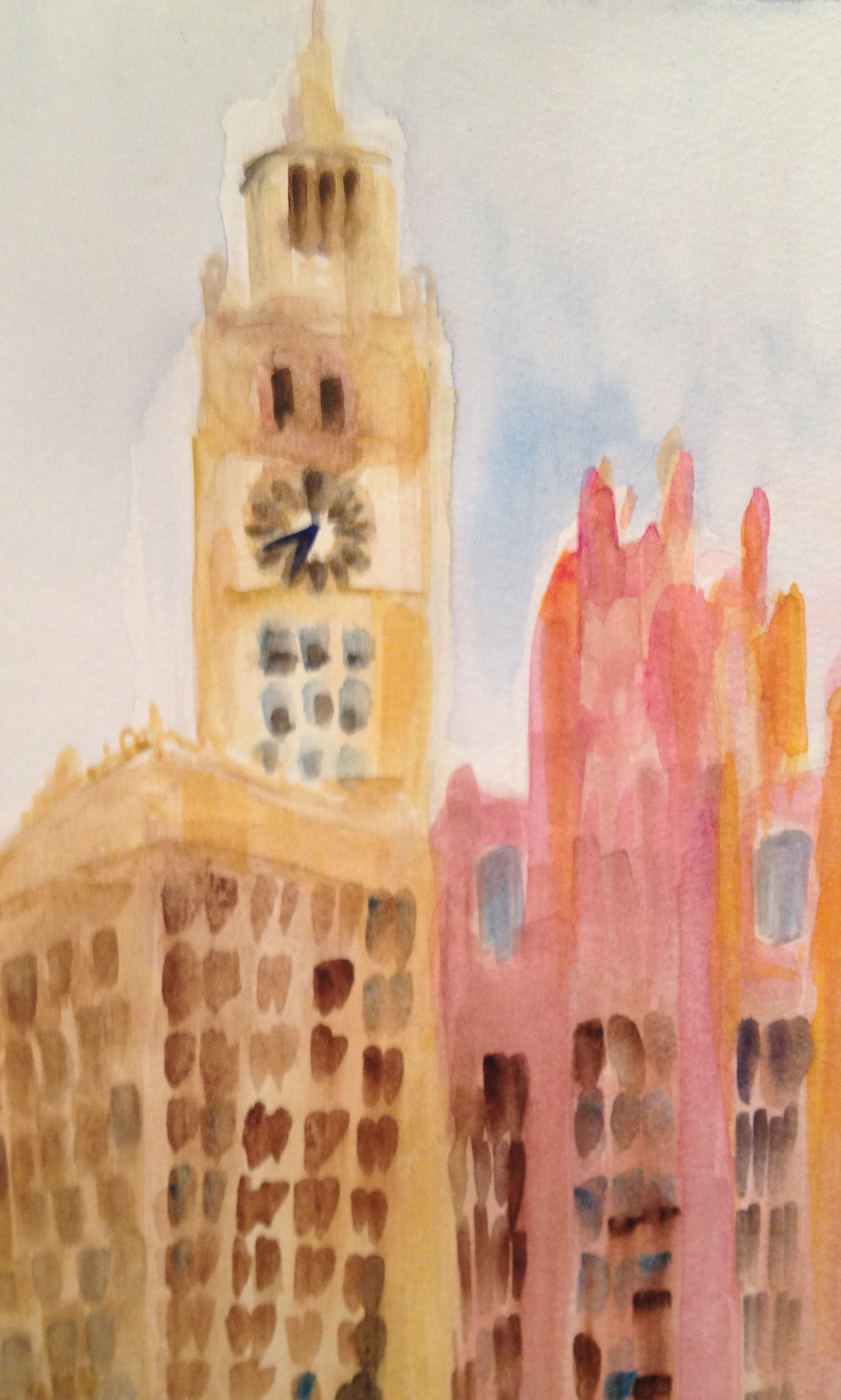
Chicago’s Wrigley Building and Tribune Tower. Copyright 2012 Robin L. Chandler.

From a distance, the sprawling city of Chicago soars from the flatlands like the emerald city of Oz.  So accustomed to California’s topography  — rugged coastlines, deserts and mountains honed by earthquake and tide, wind and rain — I am enchanted by the Midwest with it’s boundless horizon punctuated solely by skyscrapers; bold sentences spoken by vertical and horizontal voices. My profession brought me earlier this month to Chicago, home of the Society of American Archivists (SAA), serving on the program committee, shaping our summer 2013 annual meeting. Early Sunday morning I walk Chicago’s streets awestruck by the artistry of the built environment. Sunrise flirts momentarily on the glazed terra cotta, accessorizing these temples of industry in pink and orange. Laura Tatum’s spirit accompanies me as I walk amongst these towering icons of American architecture on my way to the meeting. Chicago, a living building museum, graced by artifacts in a range of styles, created by Daniel Burnham, Louis Sullivan, Frank Lloyd Wright and Mies Van Der Rohe.

A prairie city, Chicago is home for corporations monetizing the labor of farmers and ranchers and now profiting from the labor of programmers and analysts. Migrants of all nationalities, races, and creeds – from all compass points – came to Chicago to work in factories and services spinning straw into gold (turning raw into retail). Barrack Obama, our first African-American President and native-son of Hawaii, elected last week for a second-term, like so many others was drawn to Chicago and makes his home here – this land of Lincoln. The 1871 Chicago Fire wiped the slate clean and a new city rose on the shores of Lake Michigan giving birth to the skyscraper, a building type made possible primarily by the manufacture of inexpensive steel able to frame and support multi-storied structures. Chicago architect Louis Sullivan considered by many the “father of skyscrapers” coined the phrase “form follows function.” These skyscrapers were and remain today the home offices for many corporations.

My hotel room, situated above the Chicago River provided wonderful views of North Michigan Avenue’s Wrigley Building and Tribune Tower. Built in 1921 in the neoclassical style, the Wrigley Building, an early skyscraper sheathed in white terra cotta, glows when lit at night. Personally, it provides a visual and stylistic reminder of the buildings populating Burnham’s White City also-known-as the Chicago World’s Fair. Across the avenue, is the Tribune Tower, a product of the 1922 international design competition held by the Chicago Tribune newspaper. While this gothic-revival design won, the competition inspired many modernist architects to envision skyscrapers in the emerging international style.  One of these young architects, Mies van de Rohe, soon to become a “master” at the Bauhaus and its last Director, submitted a visionary design for a Tribune Tower with transparent plate glass walls on a steel frame. Known for his clarity and simplicity, Mies, is perhaps most famous for his Barcelona Pavilion and Villa Tugendhat. Given the outcome of the Tribune Tower competition, it is somewhat ironic that Mies would become the Director of Chicago’s Illinois Institute of Technology bringing his “less is more” design aesthetic to what is now known as the Second Chicago School of architecture.

blessed are they that mourn

Chief Skedans Totem. Copyright 2012 Robin L. Chandler.

Brahms’ Requiem is a prayer for the living, and it begins “blessed are they that mourn, for they shall have comfort.” I’ve been listening to it for days, seeking comfort, because a dear friend passed away on Saturday night. Last week, I found myself standing in Stanley Park, Vancouver, awestricken before a totem carved by Haida artist Bill Reid. Recreating a pole carved in 1870 in the village of Skidegate, Queen Charlotte Islands, the totem honors the passing of the Raven Chief Skedans; images of the Moon, Mountain Goat, Grizzly Bear and the Whale grace its visage. The Chief’s daughter erected the pole as a memorial honoring her father’s passing. I was in Victoria when Laura Tatum passed away. In the tradition of the memorial totem, I offer these watercolors today in remembrance of Laura. My friend Laura brought an extraordinary sparkle and passion to all aspects of her life. Laura had a smile that could light up the darkest of rooms. She was a superb archivist who specialized in architectural records and broke new ground engaging architects in arrangement and description of their archival collections.

Mount Rainier, Seattle, Sunrise. Copyright 2012 Robin L. Chandler

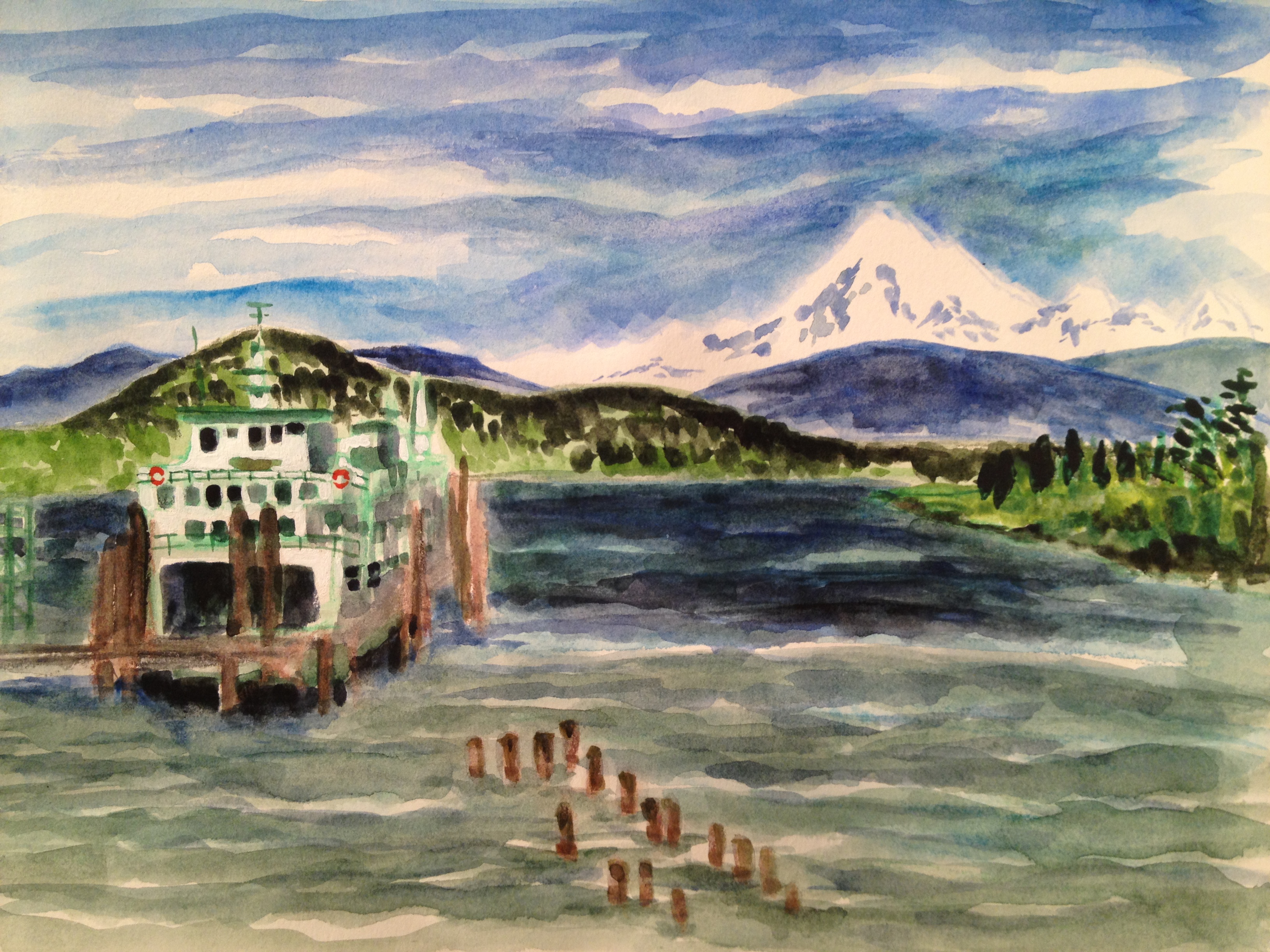
Work has brought me to the Pacific Northwest & British Columbia several times in the last year: Portland, Seattle, Vancouver, and Victoria. I have attempted to capture the region’s beauty in my watercolors.

View of the Olympic Range from Victoria. Copyright 2012 Robin L. Chandler.

In my mind’s eye, I see Laura, a native Oregonian, flying magically and Marc Chagall-like in the heavens over the rooftops and green space of the Pacific Northwest and British Columbia. Her journey takes her northward from Oregon along the Cascade Range to Mount Rainier, westward to the Olympic Range, and northward again across the Strait of Juan de Fuca towards Vancouver and Victoria, her spirit living and loving, ever inspiring us to live life to the fullest. With this magic, I shall have comfort.

working through history

Heidelberg view of the marketplatz and the Church of the Holy Spirit. Copyright 2012 Robin L. Chandler.

Situated on the northern side of the river Neckar, the Philosophenweg or Philospher’s Walk, provides beautiful views of the picturesque city of Heidelberg, Germany.  After a good hike from the train station, I found myself gazing down upon the ruins of the schloss, the old bridge, the medieval marketplatz and the imposing late Gothic Church of the Holy Spirit. My friend Astrid had encouraged me to visit Heidelberg, and soaking up the southern exposure tucked amongst the vineyards and vegetable gardens dotting the hillside and the industrious bees, I was glad I took her advice.  Below me the sounds of a bustling city travelled across the river and up the hillside. Sited on a major tributary to the Rhine Heidelberg has become a tourist destination – whose history spans the Romans, the Reformation and the third Reich – it is also the site of a major University making significant contributions in scientific research. Being September, the faculty and students  – like migratory birds  – were winging their way back to begin anew the cyclical learning experience. In such a place, history is everywhere – you sense the very vineyards surrounding you have roots in the pax Romana. Reaching for my watercolors, I began sketching, attempting to  capture the moment before returning to the bahnhof and Frankfurt.

Although painting requires focus, it also provides a quiet time for reflection and anticipation. Thirty years have passed since my first trip to Germany.  In 1982, my youth, love of history, and study of Existentialism brought me to Cold-War Berlin, Hitler’s Munich, and the Nazi concentration camp at Dachau seeking answers to difficult questions. Germans have a phrase  – Vergangenheitsbewaltigung or Aufarbeitung der Geschichte which means the working through of history. Returning in 2012, this trip is a continuation of a conversation started. History is a heavy responsibility.  It can be crippling or it can be a reservoir of evidence preserved by archivists supporting scholars, who sift through the past seeking patterns, providing perspectives, guiding us in the present. Ahead still lay my journey from Bingen to Bauhaus (tempted to sing out the lyrics to the tune of Emmylou’s Boulder to Birmingham, I delayed the impulse). On this journey we would visit Bingen on the Rhine near Niederwalddenkmal the monument commemorating Bismark’s 1871 Prussian victory and the beginning of the German Empire, the former ghettos and cemeteries of Jewish Frankfurt, Zollverein the coal-mining complex of the Ruhr Valley, the gardens of Sanssouci, the Einstein Tower an Expressionist masterpiece by Erich Mendelsohn, the 1936 Olympic Stadium site of Jesse Owen’s triumph, Bertohlt Brecht’s Archives & Museum in former East Berlin, and Walter Groupius’ Bauhaus in Dessau.

For the trip, I brought with me Stephen Ozment’s  A Mighty Fortress: A New History of the German People.  Ozment puts forward what he calls the Tacitus challenge: can a more than 2,000 year old civilization be defined by its last 150 years? Paraphrasing German Historian Thomas Nipperdey, Ozment writes it is one thing to know the end of a story and to be moved by it to learn the whole story, and quite another to tell that story from its known outcome. Because of this visit, my personal tapestry of European history is more complete. Over the years, I have made many journeys to France, Great Britain, and Italy and solo excursions to Austria, Czech Republic, Hungary, Norway and Slovakia. Because of this visit, the weak threads connecting Germany with her neighbors are strengthened to more fully support my understanding of the warp and weft of European history. Working through history is good advice  —  grapple with the past – but engage fully and openly in dialogue with the present.

a meditation of light upon the land

Meditation on Lovell Beach House & Lovell Health House. Copyright 2012 Robin L. Chander

This spring and summer we’ve made three trips to Southern California. Crossing “the Grapevine” through the Tehachapi Mountains I am filled with glorious anticipation of the descent into the Los Angeles Basin. Why such excitement?  Perhaps it’s my fascination with the contradictory juxtapositions of the place and it’s history, and the palpable tensions. But then again maybe some of the appeal comes from aesthetics; something as simple as the light.  Carey McWilliams, in Southern California: An Island of the Land, wrote “a desert light brings out the sharpness of points angles and forms…..but let the light turn soft with ocean mist, and miraculous changes occur…..but this is not desert light nor is it tropical for it has neutral tones. It is Southern California light and it has no counterpoint in the world.” There is a quality of light in Los Angeles and Southern California that is born from the relationship of desert, sea and the impact of humans (and the pollution we make) on the environment.

Years ago I read a February/March 1988 New Yorker article “L.A. Glows: Why Southern California doesn’t look like any place else.” Lawren Weschler tried to capture this sense of light with anecdotes from scientists, writers, and architects. Caltech Professor Glen Cass gazing north towards the San Gabriel Mountains identified a bright, white atmospheric haze.  Cass said “on some days there can be billions of particles in the line of site between me and the mountain – each of them with the mirrorlike potential to bounce white sunlight directly back into my eye.” The poet Paul Vangelisti said “for one thing, I think the light of L.A. is the whitest light I’ve every seen,” and the Pritzker Prize winning architect Coy Howard said …..it’s not exactly a dramatic light…..if anything its meditative…..when you get the kind of veiled light we get here more regularly you become aware of a sort of multiplicity – not illumination so much as luminosity.  Southern California glows…..and the opacity melts away into translucency, and even transparency.”

On these southern voyages, we’ve made it a point to have encounters with the work of artists and architects working in and inspired by the Los Angeles basin, such as Richard Diebenkorn, who I blogged about in April.  Most recently we’ve seen the pale, soft and transparent light of Southern California play against buildings designed by Rudolph Schindler and Richard Neutra in Los Angeles, Orange County and San Diego.  Friends, colleagues and rivals they both came to Los Angeles after WW I from Vienna, Austria where they had individually studied with Adolf Loos and Josef Hoffman.  Making their ways separately to California, Schindler worked for Frank Lloyd Wright and Neutra for Eric Mendelsohn in Berlin.  Collectively, they practiced the concepts of modernism or the International Style in Southern California when these were still revolutionary ideas. Schindler and Neutra both designed homes for Philip and Leah Lovell; Schindler designed the Lovell Beach House in Newport, California and Neutra designed the Lovell Health House in the Hollywood/Los Feliz neighborhood of Los Angeles. Both buildings are inspiring examples of innovation in materials (concrete and steel) and the architect’s use of space, form and the importance of light to the structure creating a sense of transparency between the interior and the exterior so characteristic of what would become the post-WWII California lifestyle.  Each building is a monumental work of art, but miraculously each structure lay easily and understatedly upon the landscape. In the case of Schindler, the eye of the viewer is lifted skyward into the light by concrete frames lifting the house above streetlevel; whereas with Neutra, the house is nestled within the canyon contours firmly anchored but appearing to gently to float cloudlike hugging the landscape.  Each home – considered historic structures in the story of California’s architectural past – remains a meditation of light upon the land.

put down a color the paper will like

Earth, trees, sea and sky: Santa Cruz oil sketch. Copyright 2012 Robin L. Chandler

Like John Marin, I am a watercolorist who has begun to paint in oils.  In the the 1920s, Marin’s watercolors, as Winsow Homer’s before him, had again shown that watercolor need not be considered a second rate medium.  Seeking to explore new directions for his work, in the 1930s, Marin chose to experiment in oils. The experiment succeeded resulting in a dialogue across the two mediums spanning the rest of his life.   Marin’s choice of subject also draws me to his paintings.  Throughout his career, Marin was captivated by architecture but deeply inspired by what he described as the essential forces of nature: earth, trees, sea and sky.  Although sometimes associated with movements such as Abstract Expressionism or Surrealism because of his symbolic lines and evocative forms, Marin never considered himself a theoretician.  In the retrospective catalog of his work John Marin, 1870 – 1953: a centennial exhibit organized by the Los Angeles County Museum of Art, Larry Curry, curator writes “he had no patience with any kind of art that had its origin within the mind without reference to the outside world.  As a rule when Marin attempted to explain his work, he spoke of subject matter and his subjective reaction to it.”   Marin wrote “you cannot create a work of art unless the things you behold respond to something in you.”  Drawn passionately to landscape, my most successful paintings are born from a connection to place.  The paintings flow readily from this connection.  When I paint, Aldo Leopold’s words also resonate with me. In Sand County Almanac, Leopold writes,  “we abuse land, because we regard it as a commodity belonging to us; when we see land as a community to which we belong, we may begin to use it with love and respect.” Torn between a love of the road and a desire for roots, I am inspired to paint place when I sense the  intersections between land and people attempting to live honorably with it. John Marin, excerpted from the book John Marin by John Marin, strikes a similar note  when he describes how to paint a landscape. “First you make your bow to the Landscape – then you wait and if and when the Landscape bows to you then and not until then Can you paint the Landscape.”

in every grain of sand there is a story

Otters at Elkhorn Slough. Copyright 2012 Robin L. Chandler

The thirty-eight miles from Santa Cruz to Monterey can be a very busy road to navigate.  Route One is a major corridor with trucks carrying produce from the fields, and cars transporting farm workers, fishermen, tourists, recreation seekers of every stripe, and people like me who live and work at least part of their lives in this region.  Hurtling through space, my eye catches glimpses of life’s daily epic poem acted-out by the inhabitants – people, plants and animals – of this region.

Our Elkhorn Slough epic begins near Moss Landing, now a man-made harbor, but once an estuary, part of the Pajaro-Salinas river system that historically shared a common entrance to the Pacific Ocean.  Launching kayaks recently on a cold gray Sunday morning, we were treated to a new chapter in this epic story.  An important component of the Pacific Flyway for migratory birds, the harbor and slough are populated with many species. This day we spotted Bandt’s, Double-crested, and Pelagic Cormorants; Brown and White Pelicans; Common Loons; Clark’s, Western and Horned Grebes; Forester’s Terns,  and shorebirds including Curlews, Dowitchers and Godwits.  Elkhorn is also home to many marine mammals.  Hauled out on the beaches and mud banks, harbor seals and pups nap after a busy night seeking nourishment in the waters of the Pacific.  Sea Lions rest comfortably piled-up on man-made docks. At low-tide, we spot Sea Anenome’s anchored to pilings and there secure amongst the now visible Eel Grass and occasional wayward kelp strand, we find mother Otters and their pups.  The epic story of one such Otter pup is told in the movie Otter 501, a visual poem to stewardship.  Paradoxically, Elkhorn Slough  –  a safety net to many animals and plants –  is situated amongst a complex and encroaching human ecosystem including a  vibrant agricultural economy, a regional power plant, an active fisherman’s harbor, recreational area for birders, hikers and kayakers, and a major north-south highway transporting people and goods.   It is through tireless stewardship that these animals and plants survive in this amazing place.

To the uninitiated speeding by in their cars, Elkhorn Slough is just a flash of light reflecting off water, punctuated mostly by the two power-plant towers dominating the skyline.  But for the animals and plants it is a sanctuary part of the Monterey Bay National Marine Sanctuary (MBNMS).  In 1992, MBNMS became a Federally protected marine area offshore California’s Central Coast. Stretching from Marin County to Cambria near Hearst’s Castle San Simeon, the sanctuary encompasses some 276 miles of shoreline and over 6,000 square miles of ocean.  MBNMS is the home to one of the most diverse ecosystems in the world with more than 33 species of marine mammals, 94 species of birds and 345 species of fish.  MBNMS partners with organizations and institutions such as the Elkhorn Slough Foundation, the Monterey Bay Aquarium and research universities including the University of California and Stanford to preserve, perform research, and educate citizens about co-existing as members of this ecosystem on the central coast.

Elkhorn Slough is a fragile marine ecosystem.  Most of us quickly drive by the Slough, preoccupied with getting to our next destination. Most of us don’t grasp the Slough’s role as a sanctuary in an epic poem, and fewer grasp that we are actors in the story and that have responsibilities to co-exist with the animals and plants as members of this ecosystem.  We can actively choose to act as stewards; we can choose to oversee and protect places like Elkhorn Slough, places worth caring for and preserving because they provide sanctuary to living creatures  that enrich our lives and ensure our survival both spiritually and physically. Anyone can be a steward; it can be as simple as recycling plastic bottles and composting vegetable waste or casting a vote to raise tax revenue to keep California State Parks open and education affordable for students at the University of California.  Stewardship is becoming a member of the Elkhorn Slough Foundation to help create conservation easements or becoming a volunteer naturalist with the MBNMS or taking a child to the Monterey Bay Aquarium to teach them about the wonders of the ocean.

Stewardship is a story that must be shared with others, repeatedly.  Saddened, I fear that for every story told, there are thousands of people who will never hear the story, therefore never be educated to learn about and understand their role as stewards.  With education, we build empowerment, foster discussion, enable understanding, and  realize just actions through compromise.  These are noble aspirations, and evidence abounds that it is always an uphill battle.   However, as the church of baseball teaches and Yogi Berra preaches, “it ain’t over till its over.”   At the bottom of the ninth with two outs and down by five runs, the Sisyphus at the plate knows heaven is found in the uphill struggle (described in the The Great Wave blog entry).   And so we must continue the hard work to learn and to teach each other about our responsibilities as stewards of ecosystems, no matter how great the odds.  As Rachel Carson wrote in her 1958 article Our Ever Changing Shore republished the book Lost Woods: The Discovered Writing of Rachel Carson, “in every out thrust headland, in every curving beach, in every grain of sand there is the story of the earth.”