Don de Tejas Magos

Behind the wheel, I’d been putting miles between us and our cameos in that timeless bittersweet holiday love story; the laughter and tears of parents and children. We’d had the joy of loving those in need and receiving their blessings in return. Needed warmth in the oft-desolate wasteland of the heart. Suddenly, I am shaken from my journey in the land of existential (“dust storms may exist”; “zero visibility possible”*). Deep in the heart of Texas,** the temperature gauge spiked. Oh, shit! Was our good luck running thin? Ahead the two-lane road came to a rise. We pulled off the road feeling small and alone amidst the vast sparse plains and endless blue sky. Prickly pair cactus for miles around and a little Armadillo road kill on the side. Nearby, a hawk perched hungrily watching a meadowlark dart across the road. Mockingbirds and ravens settled on the mesquite trees as if taking their seats for the show. Feeling a little like the wilderness comic, I bowed to the audience and lifted the hood dreading the voice of doom. Somewhere in the midst of that fine German engineering the car sizzled. I knew then we wouldn’t be sleeping that night in New Mexico. Under my breath I hummed the Grateful Dead lyrics “Casey Jones you better watch your speed…trouble ahead, trouble behind.”

The miles of country behind  – cotton fields, pecan trees, goats, and the occasional steer – had been punctuated with cell towers. We might feel a bit lost out here in the desert, but we could be found; GPS and handhelds with bars serving as a strong substitute for a bright guiding star. Seconds later Google maps located the nearest VW dealer some 150 miles northwest. Plan B began to take shape. Later that night in an Abilene Best Western, that had room for us, we mused about our best-laid plans and what a roll of the dice can bring. Our luck never really ran thin. It was quite the opposite. Bearing gifts they came to us one following the other. John, our Abilene VW service manager, although miles away inspired confidence as we collaborated via cell phone to diagnose the problem and how to resolve it; Mrs. Wise, a local rancher, stopped and offered comfort making sure we had water and a way forward; and Sergeant-Major, twenty-year career soldier and medic, gave us command over the problem all the while laughing and sharing stories of his life in the army as he towed us west towards the stable, excuse me, garage managed by Donna (where they affectionately called her Ma). We will never forget the Texas magi and their gifts.

* Actual road signs in New Mexico, Land of Enchantment

** In 1923, Brady, Texas was officially designated as the “heart of Texas.”

pilgrims and desolate angels

On the road in Texas. Copyright 2010 Robin L. Chandler

On Christmas Eve morning we began our journey heading southeast past the fields of plowed-under cornhusks and bales of cotton standing ready at the gin.  At the small towns of Little River, Bartlett and Granger I slow the car. Out the corner of my eye, I see the bustling cotton towns of the 1920s.  Now I quickly glance at a few farmers and ranchers, their wives and children, topping off the tank and buying a quart of milk at the convenience store before settling-in for the coming day of celebration, rest, and reflection.  Desolate and empty towns transformed by the shift from local to global economy.  From the north and west comes a great cold front.  From the vantage point of a small rise the change of weather is visible for a great distance in the hill country.  Still hours away, the dark gray storm clouds will bring a hard driving rain that floods the road and challenges visibility.  In Taylor, we pilgrims stop to rest and replenish our minds and bodies with conversation and good Texas barbeque with pinto beans, slaw, pickles and onions.  The years of rich smoky air browning the walls will stick to our clothes leaving a sweet reminder of time past. Refreshed we continue our pilgrimage on state route 79 to the cemetery to pay our respects to my grandfather, grandmother and mother.  In 1946 the year he passed, my Grandfather Eph asked my father to bury him with a view of the road heading east to Thorndale, the town where he raised his children and supervised the cotton gin.  We stand on the hillock, the cold wind blowing rain in our faces, and pay our respects to our loved ones.  All around a world of grey: sky and two-lane highway.  I think of Desolate Angel –  Dennis McNalley’s biography of Jack Kerouac –  and the words “the great walking saint would be a pilgrim who would traverse until his death America’s streets and roads as penance for its sins, loving all its creatures – inhabitants, asking the cars as they hurtled by ‘whither goest thou?’ “

floating world: arancia hearts

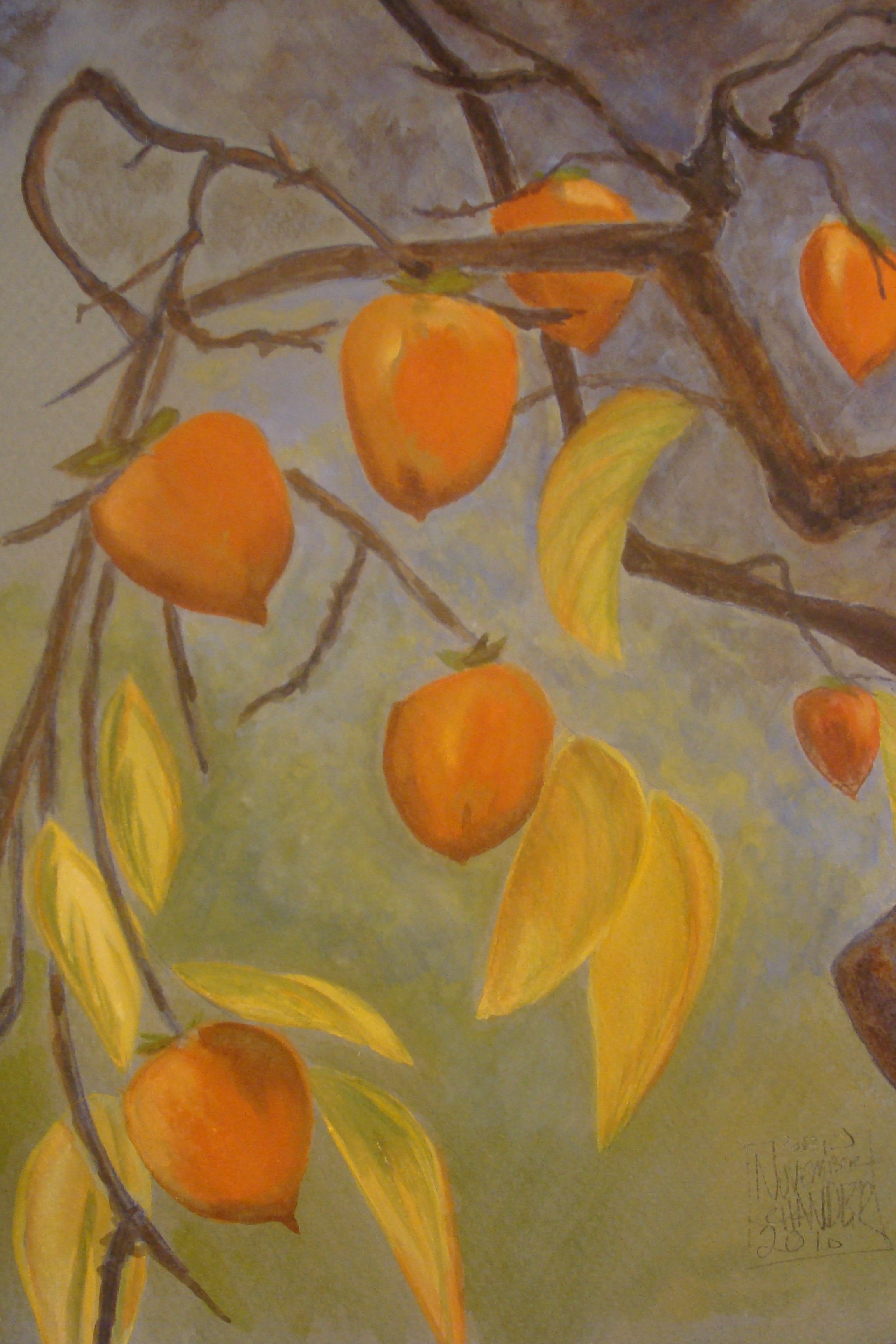
With the coming of the cross-quarter,  winter begins.  Leaves in artful decay proclaim the changing season.  Gone are summer’s limbs heavy with ripened apricot and plum.   From the corner of my eye, the persimmon, branches nearly bare, adorned with amarillo bangles and arancia hearts. Floating. Breathtaking in the fading light.  I paint; a deep sense of connection between myself and everything. For the moment, I fade away, lost in the act.  Later, steady cold rains: the kind we welcome to keep the drought years at bay.   Mugs of hot matcha take the edge from chilled hands.   In the oven, persimmon cookies bake, the golden taste of connection. (San Francisco) California dreamin’ on such a winter’s day.

Persimmon Tree. Copyright 2010 Robin L. Chandler

Legends tell us the heart-shaped Hachiya fondly called kaki was introduced to Japan from China in the 8th century by a wandering Buddhist. The monk traveled Japan subsisting on persimmons spreading seeds “Johnny Appleseed-like” throughout the land.  Masaoka Shiki a 19th century Japanese author helped revive waka and haiku poetry and introduced the concept of nature sketching or shashei honored the fruit’s place in Japanese culture with this poem composed while stopped at Nara on his journey to Tokyo:

I bite a persimmon

the bell tolls

Horyu-ji Temple

In her book Nine Gates: Entering the Mind of Poetry, Jane Hirshfield writes that “every good poem begins in language awake to its own connections….it begins…in the body and mind of concentration….true concentration appears paradoxically at the moment willed effort drops away….the self disappears ….we seem to fall utterly into the object of our attention, or else vanish into attentiveness itself.”  Echoing Jane Hirshfield, Phil Lesh lovingly described his life with the Grateful Dead in  Searching for the Sound . “We were in the music and the music was playing us. To loose oneself completely in a spontaneous flow of music is one of the great human joys: one is creating, but being created. In fact, one no longer exists. At the same time, there’s a give-and-take a handing off of ideas that mimics the process of thought itself….Bobby and I left holes for each other’s notes, creating an interlocking constantly changing rhythm.”

a tale of two cities

Basilica of Notre-Dame de Fourvière in Lyon, France. Copyright 2010 Robin L. Chandler

This summer we visited Lyon, France and Matera, Italy, two European cities, which share some common traits: both are UNESCO World Heritage Sites with roots in ancient Rome, situated on hillsides above rivers and crowned by majestic cathedrals. However, upon walking their streets one feels dramatic differences, metaphorically speaking, it is the difference between living and dying. Lyon is a vibrant metropolitan center, the second largest city in France located in the Rhone-Alpes region and situated on a continuum between Paris and Marseille at the confluence of the Rhone and Saone rivers. Matera, located in Basilicata in Southern Italy, is a city whose breathing is shallow, so near death the priest has given the last rites, the children have long ago moved away, and all that remains is the cemetery sextant to care for the gravesite. Yet, Matera mysteriously lingers in the imagination. Would I return to Lyon and Matera? Yes, but for different purposes: Lyon to seek my living, and Matera, to seek the meaning of my life.

Italo Calvino’s Invisible Cities speaks to the imaginative potentials of cities and provides a framework to consider Lyon and Matera. One of Calvino’s sections Trading Cities features Esmeralda, a city reminiscent of Lyon. “Esmeralda’s residents are spared the boredom of following the same streets every day…the network of routes is not arranged on one level, but follows instead an up-and-down course of steps, landings, cambered bridges, hanging streets…combining the segments of the various routes, elevated or on ground level, each inhabitant can enjoy every day the pleasure of a new itinerary to reach the same places.” On our visit, we walked the historic narrow walkways named traboules passing through buildings linking streets on either side in the in Vieux Lyon and the slopes of the Croix-Rouss. Thought to be built in the 4th century, the passageways allowed craftsman to move quickly from their workshops and homes on the hill to the silk merchants on the river. The Basilica of Notre-Dame de Fourviere, built in the late 19th century crowns the hillside on the site of the Roman forum of Trajan. Today, Lyon is a major centre for banking and industries such as chemical, pharmaceutical, biotech and computer software.

Matera Cathedral. Copyright 2010 Robin L. Chandler

In his section Cities and the Dead, Calvino conjures Matera with the imaginary city of Argia. “What makes Argia different from other cities is that it has earth instead of air. The streets are completely filled with dirt…..over the roofs of houses hang layers of rocky terrain like skies with clouds…..from up here nothing of Argia can be seen; some say, ‘its down below there,’ and we can only believe them. The place is deserted. At night, putting your ear to the ground, you can sometimes hear a door slam.” Matera, an agricultural settlement, believed founded by the Romans in the 3rd century, was built upon a hillside of soft tufa, which permitted the inhabitants to build underground chambers and dwellings as well as cisterns drawing upon the water table from which the “la Gravina” river flowed in the ravine below town. For many centuries the city thrived and many magnificent churches and monasteries were built including the 13th century Matera Cathedral.  However, over population and agriculture expansion coupled with the mismanagement of water supplies reached a crisis point in the late 19th and early 20th centuries and the city began a steady decline. Matera became the symbol of peasant misery in southern Italy as described by the author Carlo Levi in his 1945 novel Christ Stopped at Eboli.

landscape of memory

On Sunday April 4, 2010 a 7.2  earthquake rocked Baja California and the desert lands near San Diego, Anza Borego and the Salton Sea.  For nearly a minute tectonic forces were oblivious to international boundaries and struggling peoples trying to make ends meet on either side of the border.

Anza-Borego Desert East of San Diego. Copyright 2009 Robin L. Chandler

Such a jolt shakes personal and collective memories  to the surface…quakes I have known myself such as October 17, 1989 Loma Prieta or quakes I have mythologized such as April 18,  1906  San Francisco.  On October 17, 1989 after leaving the Montgomery Street BART station, I walked the six miles home.  Gone were the thoughts of seeing the opening game of the World Series Giants versus the Athletics  as I hiked past the milling crowds of displaced persons, broken glass, fallen bricks, and scent of natural gas. I heard snatches of news from people sitting on their front porches with battery powered transistor radios reporting fires in the Marina District, the collapsed Cypress Structure in the East Bay, and the severe damage to the Bay Bridge.  I trudged onward uncertain as to what I would find at home in Noe Valley.   Sometime later, I reached the Mission District and walked up the Dolores Street hill where with enough elevation, I was able to get my first view of the city.  I turned slowly, dreading what I might see, but the city was intact — yes there were fires and yes I knew some person’s lives would be changed irrevocably, but at that moment it was not the chaos and extensive devastation I feared.  Suddenly I realized where I was standing  at 20th and Dolores the site of the Golden Hydrant.

Taking a quote from About.com “On the morning of April 18, 1906 on the slopes of Noe Valley overlooking the Mission district, Dolores Park was packed with displaced citizens watching the fire advance from downtown. This hydrant across the intersection of Dolores and 20th streets was found to have water, but the exhausted horses could not pull the fire engines up the hill. The people mobilized to do the job, then spread out under the firefighters’ direction and, with crude tools and hand labor, stopped the flames”  and saved the Mission District  from the advancing fire. This hydrant is painted gold in a special ceremony every April 18th at 5:40AM.

That sense of a shared history and a collective memory with San Franciscan’s past and their strength to rebuild after tragedy gave me courage to keep struggling forward. David Blight in his book Beyond the Battlefield: Race, Memory and the American Civil War describes collective memory as “the ways in which groups, peoples, or nations remember, how they construct a version of the past and employ them for self-understanding and to win power and place in an ever-changing present.”  I think San Franciscan’s proudly tap collectively into the  memories and mythologies of the ’06 earthquake drawing strength to overcome these unstable times.

Aftershocks continue here in San Diego, and daily National Public Radio updates me with news of the 6.9 earthquake in Quinghai, China near Tibet and the eruption of the glacier bounded volcano in Iceland.   Amid these geologic statements that humble humankind reminding us that we cannot and should not expect to control all,  I continue to work on my paper  considering digital libraries and the  “Landscape of Memory” and think about the role of archivists in shaping history and memory as described by Rand Jimerson in Archives Power “as generations pass, written records and other forms of documentation must take the place of personal memory….. Historians have also begun to recognize that archives are not simply locations to examine authentic and reliable records of the past, but are also active agents in the shaping of what we know of human history….the role of archivists in this interplay of history, truth, memory and evidence requires examination.  As collectors, guardians, appraisers and interpreters of the archival record, archivists actively shape society’s knowledge of the past. “

In the shadow of the ancients

The Topatopa bluffs are part of the Condor Sanctuary in the Sespe Wilderness; the sanctuary is a space where the Condors can mate, breed and raise their chicks undisturbed by humans.  At sunset seen from the Ojai Valley, the bluffs glow “pink” from the last rays of the setting sun.

Topatopa Bluffs near Ojai. Copyright 2010 Robin L. Chandler

With their nine foot wingspan, Condors glide at fifty-five miles per hour ranging three hundred miles a day on the look for expired creatures that will sustain them.  Bradley John Monsma in The Sespe Wild writes “attempting to see the lay of the land through the eye of the condor quickly turns a wide-angle wilderness into a lesson in the limitations that we impose on other species.”  The Sespe is a crucial link in the foraging habitat used by the Condor for thousands of years ranging from the the Ventana Wilderness through the Sespe and Tejon Ranch to the Sierra Nevadas. Humankind continues to encroach upon the condor’s “home” as rolling oak grasslands situated along I-5 north of Los Angeles too often become real estate development opportunities.  But sometimes people do get it right.  In May 2008, a coalition of conservation groups – the Natural Resources Defense Council, the Sierra Club and the Audubon Society of California negotiated a conservation easement to preserve 178,000 acres in Fort Tejon that will supplement the public lands forming the condor habitat.  There are approximately seventy condors in the wild and space and water are key to their survival.  I marvel at the condor’s ability to daily traverse a “u-shaped” area from Big Sur to the Range of Light.

Mt. Whitney and the Range of Light. Copyright 2008 Robin L. Chandler

Their need for habitat, fires my imagination contributing to my personal geography.  As Stephen S. Hall writes in his essay I Mercator in the book You Are Here, “I have roamed across state lines and oceans and continents, backwards in time, each thought colored according to a personal legend, corresponding to the elevation and depressions of my private humors: pride, wonder, sadness, remorse.”  We are here, now, navigating our personal maps, facing the emptiness of our  intelligence in a space and time where nature balances precariously between our greed and our benevolence.

waves of glass

Fall is here.  There is a little chill in the air and the sun’s journey southward gives forth a particular quality of light.  This week has found me cycling as much as possible, and I naturally gravitate to the coast to ride the 101 as it meanders through the communities of La Jolla, Del Mar, Cardiff, Encinitas and Leucadia. Every few miles I get a spectacular view of crystalline blue waves peaking and crashing into torrents of white foam and see the surfers catch a wave and joyously ride the crest balanced precariously somewhere between chaos and nirvana. “Clear and sweet is my soul, clear and sweet is all that is not my soul,” wrote Walt Whitman in Leaves of Grass.

Swamis_encinitas
Sunset North County San Diego: Swami’s Beach. Copyright 2009 Robin L. Chandler

A few weeks ago, I visited Cape Cod and I was thrilled to see a group of surfers anglin’ on ankle busters, but I think they imagined the waves as a bonsai pipeline.

Truro_CapeCod
Near Truro on Cape Cod. Copyright 2009 Robin L. Chandler

The view of the ocean from the saddle of my bike is where my soul opens up, and my spirit returns to balance.  On the bike, I scout out places to paint and observe the world at a pace that allows for interaction, reflection and a laugh or two.  Yesterday it was great fun to see  Surfrider Foundation members  on street corners  in Cardiff  for their “Hold onto Your Butts” campaign.  They were spending their Saturday morning reminding us that cigarette butts do not belong on the beach.  It is another of Surfrider Foundation’s good causes  part of their beach clean-up efforts  and their larger campaigns like “Save Trestles”  which kept a  toll road out of San Onofre State Park. They do good work.  They teach us to be responsible for our beaches and oceans as we should be for any good friend.   These are two watercolors that I’ve recently painted of late afternoons  in North County San Diego and Truro on Cape Cod.  Both pristine and soul redeeming spaces.

The Great Wave

On Labor Day I kayaked on Tomales Bay.  2PM and it was high tide when I launched near the town of Marshall and the wind was dancing across the water leaving whitecaps in its wake. It was the first time I would be taking my new single kayak on the water. Wave and I have safely captained a two-person kayack on many trips on Tomales Bay  where the center of gravity is low and the craft moves very deliberately through water.  In my watercolors, I’ve documented kayackers  in singles paddling across this water and now it would be my turn.  Wave ably helped me launch the craft, and just after my paddle cut through the water,  I heard a voice from the shore  asking if I had a plan should I capsize out on the Bay. Well, the truth was, no, I didn’t have a plan. I didn’t think I needed a plan. I felt I had the experience to handle any situation that might come up. I just wanted to get out and enjoy the last few hours of sunshine on a laborless day.

Kayaking near Hog Island, Tomales Bay
Kayaking near Hog Island, Tomales Bay. Copyright 2009 Robin L. Chandler

I was eager to feel  the joy of moving across the water, and  have the wind and spray on my face and see the sun dappling the water. I imagined the feel of my arms working hard to create forward movement against the wind blown waves breaking across the bow. I imagined the moment, when one turns and  with the wind at your back, experience the joy of being rocked forward momentarily airborne on the back of a breaking wave. But the voice spoke a truth that suggested listening.  One of the staff for onsite operations  for Blue Water kayaks on Tomales Bay took a few minutes out of her busy life and reviewed  with me how to manage the unimaginable. A little later I was on the water and the wind was strong and the waves presented a fun challenge. I was deeply grateful that a person previously unknown to me spontaneously showed concern, and I was able to hear the truth of the concern, put my eagerness in check and gently accept the gift.

Later that day driving home, I thought of learning life lessons aknew. While one gleans much knowledge over the years, one must embrace daily life with the openness of a beginner. Christopher Benfey in his book The Great Wave describes an essay by Shuzo Kuki called “Considerations on Time.” Written in 1928, the essay describes two Japanese responses to the theme “man and time.” These are the  Buddhist annihilation of the will, i.e. extinction of desire,  and the Samurai’s bushido, i.e.  affirmation of the will. Kuki saw the myth of Sisyphus as the very embodiment of the moral ideal of bushido. “Sisyphus rolls a rock almost to the summit of a hill, only to see it tumble back down again. And he is, thus, set to perpetually beginning anew. Is there misfortune, is there punishment in this fact?….Everything depends of the subjective attitude of Sisyphus. His good will, a will firm and sure in ever beginning anew, in ever rolling the rock, finds in this very repetition an entire system of morals and consequently, all is happiness…..he is a man impassioned by moral sentiment…..he is not in hell, he is in heaven.” Camus, describing Sisyphus, would write some years later “the struggle itself toward the heights is enough to fill a man’s heart.”

Toeing potshards

Monument Valley. Copyright 2009 Robin L. Chandler

In the late Spring, when we vacationed on the Colorado Plateau, I discovered a book by Patricia Limerick called Desert Passages.  Dr. Limerick describes the American encounter with deserts in terms of three attitudes towards nature “as a biological reality in human life…hunger, thirst, injury, disease and death….as an economic resource…a container of treasures awaiting extraction…or as an aesthetic spectacle. “  We affectionately called our trip the archaeology tour as we visited the ruins of the Ancient Pueblo Peoples at Wupatki, Monument  Valley, Mesa Verde, and Canyon de Chelly. Wave and I spent many hours at the ruins in quiet meditation while I attempted to capture the  essence of these amazing cultural resources on watercolor paper.

White House ruin, Canyon de Chelly
White House ruin, Canyon de Chelly. Copyright 2009 Robin L. Chandler

One of the great mysteries is what happened to the ancient peoples?  Archaeological evidence reveals that sometime in the late 13th century these peoples abandoned their homes amongst the mesas and canyon walls and it is theorized that environmental changes —  possibly extreme drought — caused these peoples to abandon their homes.  One feels a certain twinge given the current state of  drought in San Diego, Los Angeles and the rest of California, and of course the fire still burning in the San Gabriel mountains.   It is believed that they left the Colorado Plateau and migrated to join other pueblos along the Rio Grande river in New Mexico.   How would we best characterize the Ancient Pueblo peoples encounters with the desert?  As a biological reality?  Probably yes.  As an economic resource?  Probably yes.  As an aesthetic spectacle?  Probably yes.  We  preserve the artifacts they left us and look for answers in the patterns as we piece the pot shards together.   Ann Weiler Walka’s poem  “Other Dreams: Grand Gulch”  in Waterlines: Journeys on a Desert River gives us something to ponder.  “My thumb polishes the fragment of a bowl, its shallow curve delicately cross hatched with black…some woman dug this clay from a slip of mud…she kneaded the clay with sand and spun a ball into coils….she painted the bowl with a yucca leaf…and dreamed the design from her fingers…she blessed the bowl…that night in her sleep she saw clouds piling over a mesa, spirits coming home. She dreamed of the clay along the creek cool and slippery as a freshly opened heart.”

Smokey the Bear

When I moved to San Diego last year, I did two wonderful things. First I joined the Sierra Club San Diego Chapter and enrolled in the Wilderness Basics Course.  Second I started hiking with my brother-in-law Doug. We chose hikes in the San Bernadino and San Gabriel mountains because of their proximity to Doug’s home and since I had spent thirty some years in Northern California any trail in Southern California would be an adventure for me. Our first explorations in the San Bernadinos included a hike through Jeffrey Pines on the snow covered Siberia Creek Trail, documented in this watercolor,

Hiking on the Siberia Creek trail
Hiking on the Siberia Creek trail. Copyright 2008 Robin L. Chandler

and a trek to the Pacific Coast Trail where it brushes by Big Bear Lake.   Our final adventure of last year was in the San Gabriels  hiking  Mt. San Antonio (known affectionately as Old Baldy) with my friend Dan.   Baldy is some twenty-two miles to the east of Mt. Wilson and Big Tujunga Canyon where the fires continue to burn now in their sixth day.  I keep thinking about those mountains — a challenge for  the north-south driver — but also a strong range charged with protecting the Los Angeles basin from the harsh temperatures of the Mojave desert and capturing moisture during the winter for the times of drought.   I keep thinking about the wildlife and people uprooted by such a massive fire and the lives lost, some heroically and others needlessly.  This evening I opened Gary Snyder’s essays Back on the Fire and thumbed to the “Regarding the Smokey the Bear Sutra” and this brief excerpt reads “a handsome smokey-colored brown bear standing on his hind legs showing that he is aroused and watchful, bearing in his right paw the Shovel that digs to the truth beneath appearances….his left paw in the Mudra of Comradely Display  indicating that all creatures have the full right to live to their limits…wearing the blue work overalls symbolic of slaves and laborers, the countless men oppressed by a civilization that claims to save but only destroys…wearing the broad-brimmed hat of the West, symbolic of the forces that guard the Wilderness….round-bellied to show his kind nature and that the great Earth has food enough for everyone who loves her and trusts her….”  Thank you Smokey.