
“Now you know the worst
we humans have to know
about ourselves, and I am sorry.”
A line of verse from Wendell Berry‘s poem To my granddaughters who visited the Holocaust Museum on the day of the burial of Yitzhak Rabin.
“Now you know the worst
we humans have to know
about ourselves, and I am sorry.”
A line of verse from Wendell Berry‘s poem To my granddaughters who visited the Holocaust Museum on the day of the burial of Yitzhak Rabin.

Dark, cold and grey comes the day as the sun protests for better working hours. The whiff of coffee wafting through the house persuades me to leave my blanket comfort. Jets flying 5,000 feet above, on landing approach, mean rain is coming. Finally.
“A wanderer,
so let that be my name –
the first winter rain.
Tabibito to
waga na yobare’n
hatsushigure.”
by Matsuo Basho


They are often found by browsing. We find them in antique shops, or abandoned on that hard-to-reach shelf: forgotten. You can randomly encounter them preserved in an archival collection, displayed on a museum wall, or even in a digital library like Calisphere. The snapshot: a random glimpse of the world capturing someone you’ll never meet and a story you will never know. But yet, it draws us. We search for meaning. Vivian Maier’s street photographs come to mind. The composition, the lines, the color, or lack of, and the emphasis all conspire to spark the imagination and engage us.
Consciously or unconsciously made, art stands on its own authority; the artwork must exist successfully regardless of the creator’s context. The use of light, space, movement, rhythms, and textures must interact so compellingly that we gain insight on the human experience regardless of the work’s origin. The creator’s story can shape and enrich the work, but our engagement, that “snapshot” moment the work captures the viewer’s imagination, is the starting point. We want to understand the human experience. Can we solve the mystery?
The creation of and engagement with art is, among other things, a deep and personal search for knowledge, for certainty. It is a search for meaning. But this thirst for knowledge is a double-edged sword: overexposure can lead to wisdom or paralysis; underexposure to bliss or ignorance. Perhaps we must be both overexposed and underexposed to truly understand the meaning of being human. Understanding is not found in a single snapshot, but awareness is, and consciousness is a good place to start.
In Ten Windows: How Great Poems Transform the World Jane Hirshfield writes about the Heian era Japanese poet Izumi Shikibu stating [his] poem reminds its reader that the moon’s beauty, and also the Buddhist awakening…will come to a person, only if the full range of events and feelings are allowed in as well.
Although the wind
Blows terribly here,
moonlight
also leaks between the roof planks
of this ruined house.

On Hallow’s Eve ghosts and monsters threaten our neighborhood streets and doorsteps. Fortunately, these goblins are easily deterred. Sweet gifts return them to their quest for the redemption required to reach a peaceful eternal sleep. Laughing at my imagery, I believe, perhaps, a change from my diet of gothic novels is well overdue. For in truth, on Halloween, we celebrate darkness’ arrival brought about by our solar system’s seasonal choreography, and we celebrate the promise of renewal, as well as death’s significance.

Recently, I visited my friends at Live Power Community Farm, and the changing season was evident: shorter, warmer days; longer, colder nights; clear skies on Thursday; rain clouds on Friday; and the sky at night graced by Orion the hunter. As I wandered the farm, I was struck by the iconic imagery of death around me: shed snake-skins, cow skulls on the compost pile, and dried cornhusks in the fields. The signs of renewal were equally abundant: spring-like flowers bloomed near rows of pumpkins; the farmer and his horses sowing fields with alfalfa seed to nurture the soil; and the milk cow lumbering to the barn, because she walks for two as her calf will be born in the Spring.
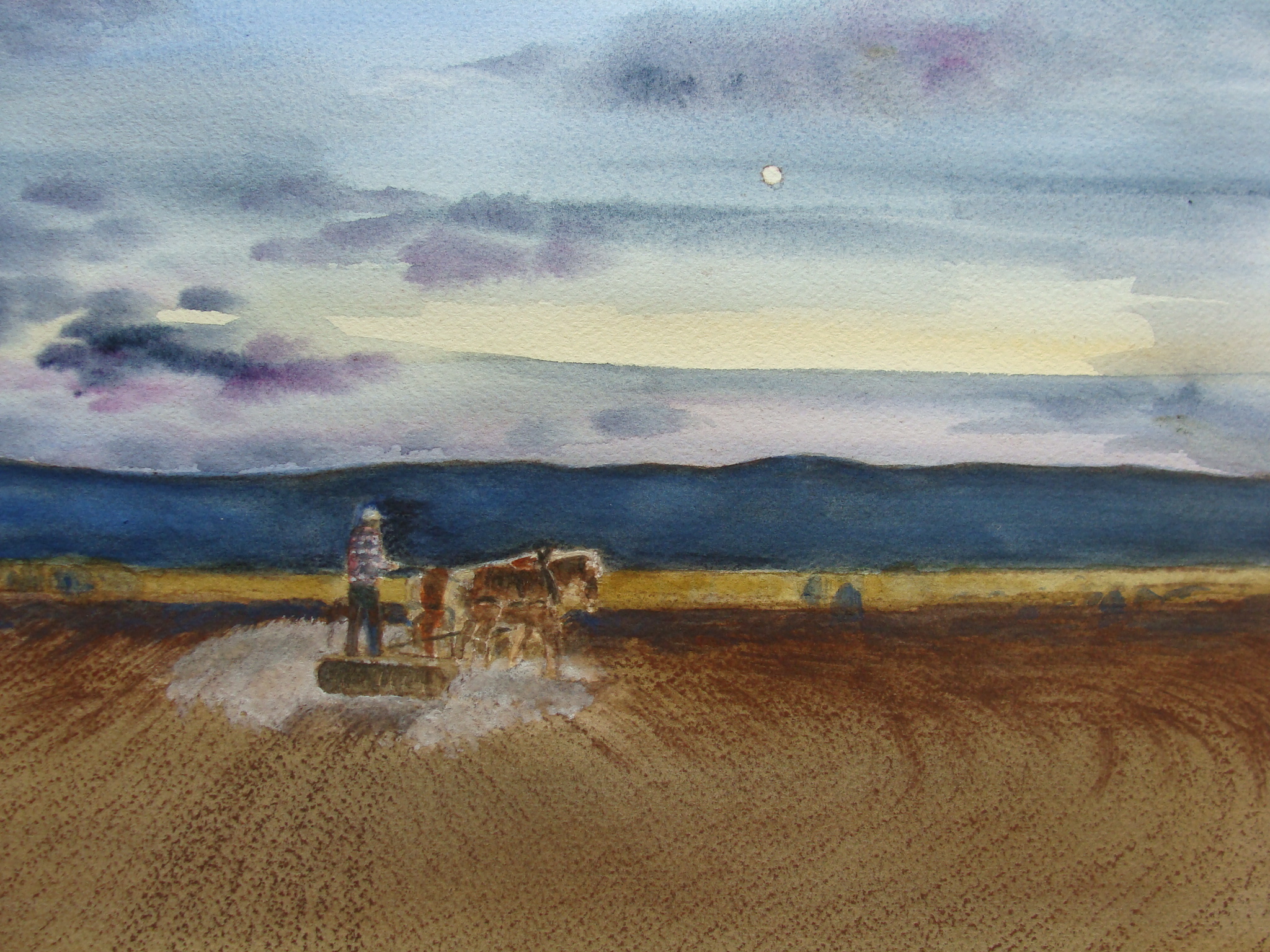
Belief in renewal is essential to living. Daily life brings both sorrow and joy; twenty-four hours a cycle of symbolic deaths and rebirths. The key is keeping confidence in continual change; it is good, it is necessary. The past, present and future tense bleed one to the other; each exhale a symbolic death, each breath a renewal of life.
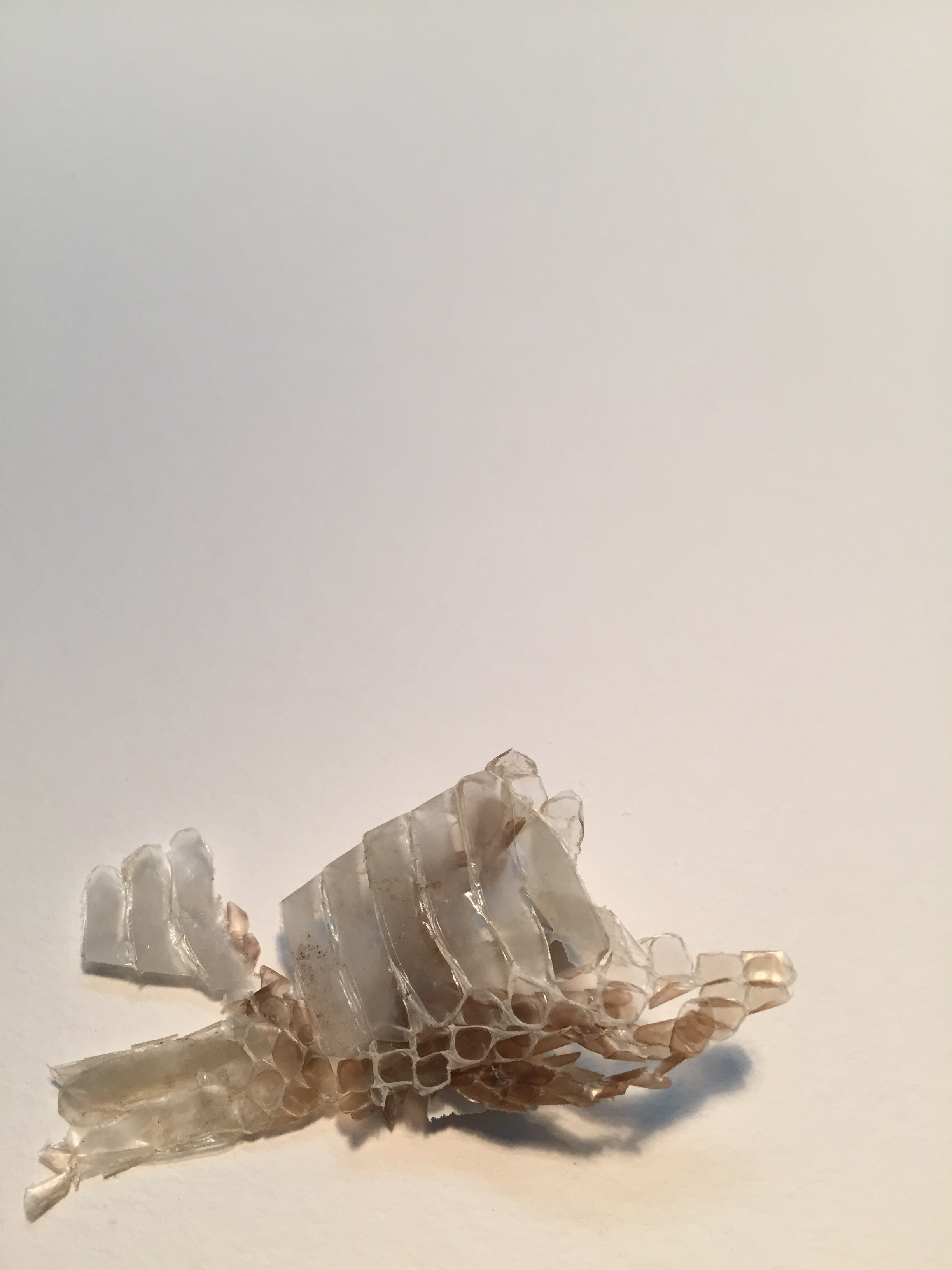
In his poem From the Mercury Fountain, Mahmoud, in his book Thread Michael Palmer wrote:
“…..present, infinite presents threading
now forward, now back. Amidst the
shattered symmetries and scattered fictions,
between actual river and imagined shore,
actual breath of wind through the frayed,
half open curtain…..”

“In poetry’s words, life calls to life with the same inevitability and gladness that bird calls to bird, whale to whale, frog to frog. Listening across the night or ocean or pond, they recognize one another and are warmed by that knowledge” writes Jane Hirshfield in her book Ten Windows: How Great Poems Transform the World. Waking in the night, each breath calls to yours, building a bridge between us, and I am warmed by that knowledge.
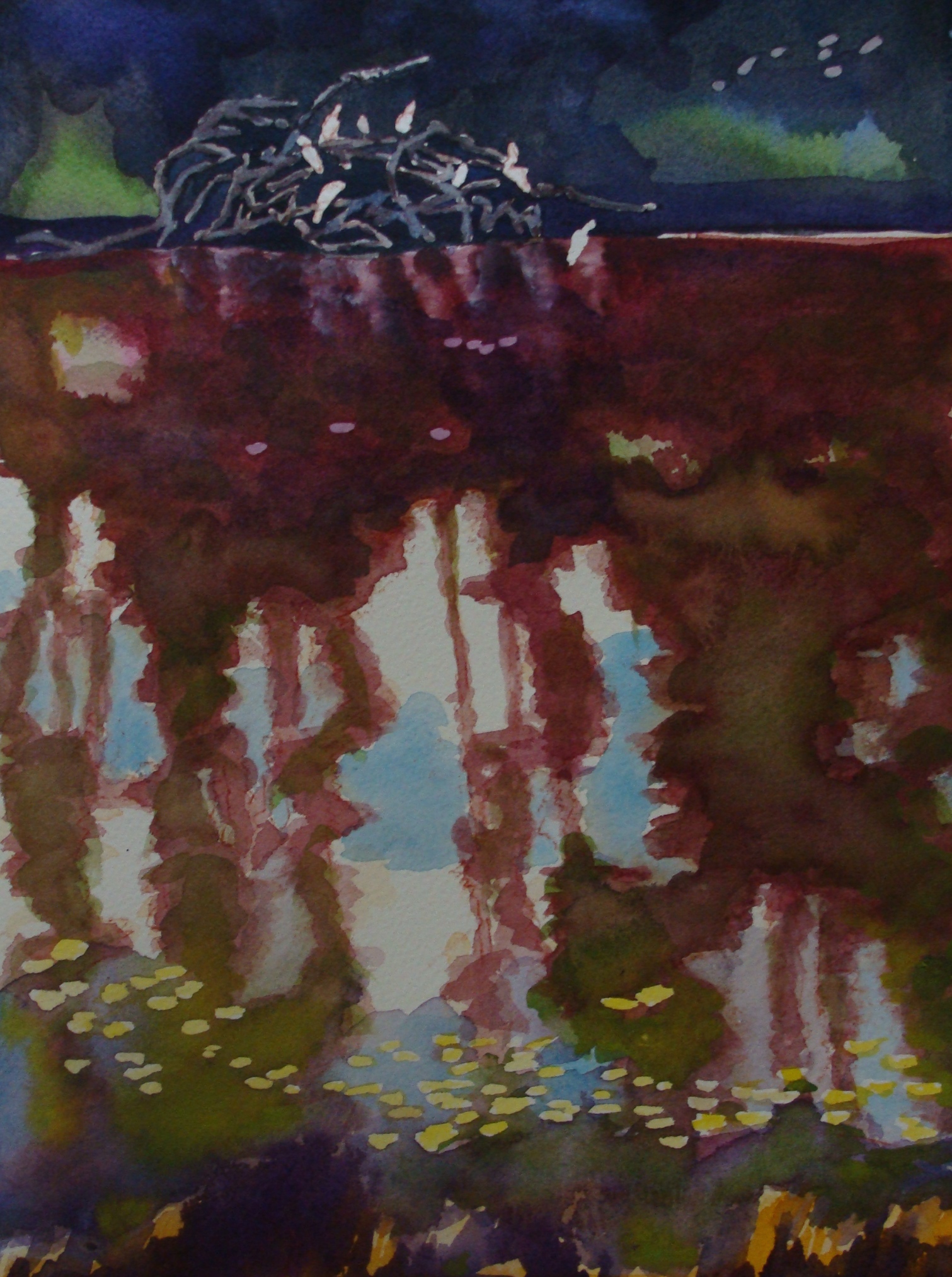
The sun was high in the sky: the light blinding and the air hot; no breeze. The egrets gathered as a rookery on the fallen trees by the lagoon in the Santa Cruz watershed, collecting themselves in the cool of the Eucalyptus trees, like sinners awaiting their baptism to wash away their sins. For a moment I lost myself in the other, the landscape. Quietly, I started to sing “yes, we’ll gather at the river, the beautiful, the beautiful river, gather with the saints at the river, that flows by the throne of God.” Shall We Gather at the River was a signature song for John Ford the filmmaker famous for his westerns shot in Monument Valley; the song became soundtrack in some of his most famous movies including My Darling Clementine, The Searchers, and Stagecoach. Ford often used the song as a means to define the boundary between the anglo-churchgoing community “civilizing” the frontier, and the “other ” community defined by their racial and ethnic differences; the “other’s” music emanated from saloons and was typically defined by Ford as minstrel songs and Spanish California folksongs.
Art and poetry are means to give voice to the other, be it individuals, communities, or the landscape. In his book, The Other Voice: Essays on Modern Poetry, the poet Octavio Paz wrote “all poets….if they are really poets, hear the other voice. It is their own, someone else’s, no one and everyone. Nothing distinguishes a poet from other men and women but these moments – rare yet frequent – in which being themselves they are other.”
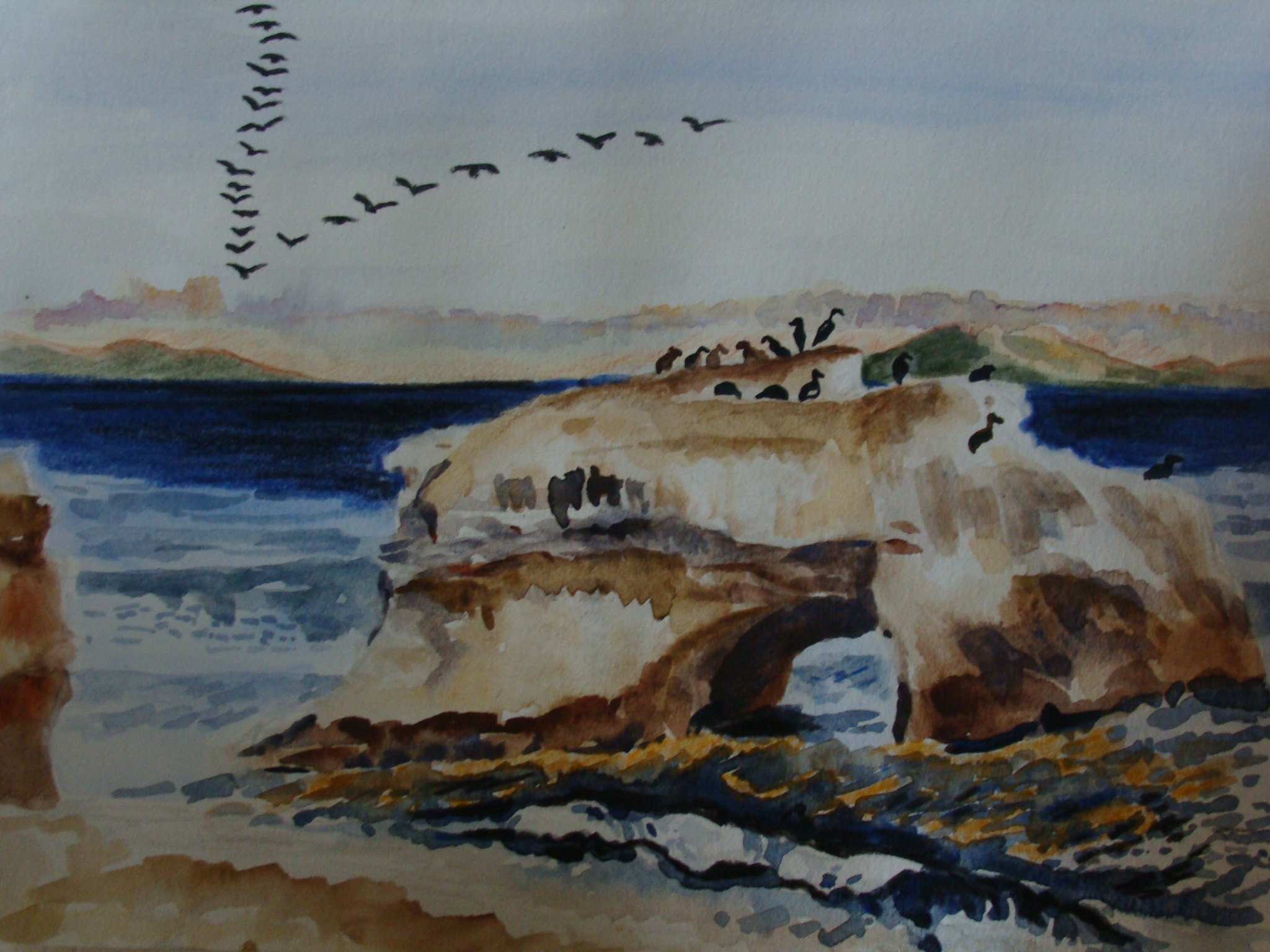
Wind and wave carved the barrel vault through which the tides pass. Frieze-like, cormorants and pelicans adorn the rock’s surface. Just offshore Santa Cruz, this nature-made arch stands proudly like a monument to stewardship of the Monterey Bay Marine Sanctuary. A bridge for centuries, the 1989 earthquake took only seconds to sculpt the arch from a span called Natural Bridges. Out in the bay waters, humpback whales feast on schools of anchovies. Early evening, living on the edge of the Pacific plate, my friend and I paint quickly attempting to capture this fleeting perfection with our brush marks. Thousands of miles away, seismic politics bring violence and death to innocents in Gaza and Ukraine airspace. All is suffering. A few lines from Robert Hass’ poem Bush’s War published in his book Time and Materials capture my sadness at this suffering:
“Someone will always want to mobilize
Death on a massive scale for economic
Domination or revenge…
Why do we do it? Certainly there’s a rage
To injure what’s injured us. Wars
Are always pitched to us that way…
The violence, it’s a taste for power
That amounts to contempt for the body…”
The history of all conflagrations ultimately includes the tallying of the dead, the wounded and the maimed. But they never tally the loss for the living. The black fonts on the white page cleanly mask the suffering. Colm Toibin’s closes The Testament of Mary with a conversation between Mary, the mother of Jesus, and a disciple, unidentified but likely John, one of the four evangelists. Mary spoke, her words brimming with her son’s suffering on the cross “I was there, I said. I fled before it was all over, but if you want witnesses then I am one and I can tell you now, when you say that he redeemed the world, I will say that it was not worth it. It was not worth it.”
Sometimes we paint to stave off despair. Chiura Obata the great Japanese American painter of Yosemite and the Sierras was interned at the Topaz War Relocation Center in Utah during WWII. Obata painted and wrote about the power of nature to absorb the scars of war. Writing about his series of Hiroshima inspired watercolors, Obata said “there is always harmony in nature, a balance between the dead and the living, between destruction and resurgence.” And so I rechristen Natural Bridges as Natural Arch, a monument to the cycle of life and to harmony, seeking balance between conquest and stewardship.

Lately, cycling has taken a prominent place in my life; it obsesses my thoughts and it floats through my dreams. I continually cruise peoples’ bikes comparing brands and components; I obsessively monitor my tire pressure; free moments catch me surfing the internet planning road rides; and sometimes in sleep I am climbing the Col du Tourmalet in the Pyrenees and see myself flying downhill, joyously singing, alive, transcendent. Cycling is my primary transportation to work in Santa Cruz and I love everything about it: my breath hanging in the cold morning air; the golden sunrise dancing on the waves; the smell of sardines in the harbor; the cormorants drying their wings at the mouth of the San Lorenzo; the sight of the Big Dipper at the Boardwalk; the red-shouldered hawk’s cry piercing the still meadow; and the steady rhythm of my heart. I’ve even come to humor the stiffness in my cranky knees. But lately, cycling has also become poignant. Riding has become a ritual of honor, an epic poem of remembrance, my song of mourning.
Every year the AIDS Lifecycle, the 545-mile weeklong bike ride from San Francisco to Los Angeles begins with a ceremony featuring the poignant entry of the riderless bike. The entourage escorting the bike includes self-identified HIV positive cyclists calling themselves the Positive Peddlers; the ritual honors those who have passed and those who are so ill they cannot ride. In the 1990s, I worked with a wonderful man and archivist named Willie Walker. A nurse on the SF General Hospital AIDS Ward, Walker, when he realized gay history was becoming a victim of the AIDS epidemic, founded the Gay, Lesbian, Bisexual and Transgender (GLBT) Historical Society of San Francisco, along with Alan Berube, Estelle Freedman, and several others. Walker was also the project archivist for the UC San Francisco (UCSF) Library AIDS History Project. During the 1990s, Walker was my colleague and friend when we collaborated at GLBT and UCSF. In June 2002, I did my first AIDS cycling event, the European AIDS Vaccine ride. This month, I registered to make this epic journey again. In June 2014, I will ride in the AIDS Lifecycle to raise money to help persons living with AIDS and HIV and to honor friends I have lost. We lost the generous, loving, and dedicated Walker several years ago, not to AIDS, but to other natural causes. But on the road to Los Angeles, I will honor and remember Walker and how he fought AIDS by keeping history alive.
A ghost bike is a bicycle painted white, serving as a roadside memorial when a cyclist has been injured or killed by a motorist. It is hoped that the memorial will remind drivers to slow down, share the road, and fully grasp the potential destructive capacity of the vehicles they drive. In early November, we lost Josh Alper while he was cycling north of Santa Cruz on Highway One. Josh was beloved by so many; he brought us music, humor and such sweetness. He was also so earnest about helping students and faculty at the UCSC Library. When shopping for a new bike, I purchased my new wheels at Santa Cruz’s Spokesman on Josh’s recommendation. Josh was a gearhead about bikes and Spokesman is a bike shop with a tip-top crew of gearheads; they, like Josh, know their stuff. From talking to Josh, it was clear he loved riding, building and maintaining his bike. He was also devoted to the history of the sport. Waiting in line for coffee, he often spoke to me about his deep respect for Greg LeMond, three-time winner of the Tour de France and the only American to win this epic contest. He urged me to read Slaying the Badger: Greg LeMond, Bernard Hinault, and the Greatest Tour de France; he loaned me his copy so I could understand the now mythologized rivalry between teammates LeMond and Hinault. In honor of Josh, the Spokesman bike crew assembled the ghost bike, one of many memorials to this young man. You are greatly missed Josh, and always will be. In early 2014, I will ride with other cyclists to honor, remember and mourn Josh as we escort his ghost bike to its final resting place.
Homer’s poetic narrative of the Trojan War, The Iliad ensures immortality for Achilles and his fellow warriors. Inscribing their glory in battle, their deeds live on, honored in perpetuity. In Ancient Greece, the recitation of the epic poem was an act of remembrance, honoring the glory of warriors. In 21st century California, with the act of cycling, I will honor, remember, and mourn the glory of lost comrades.
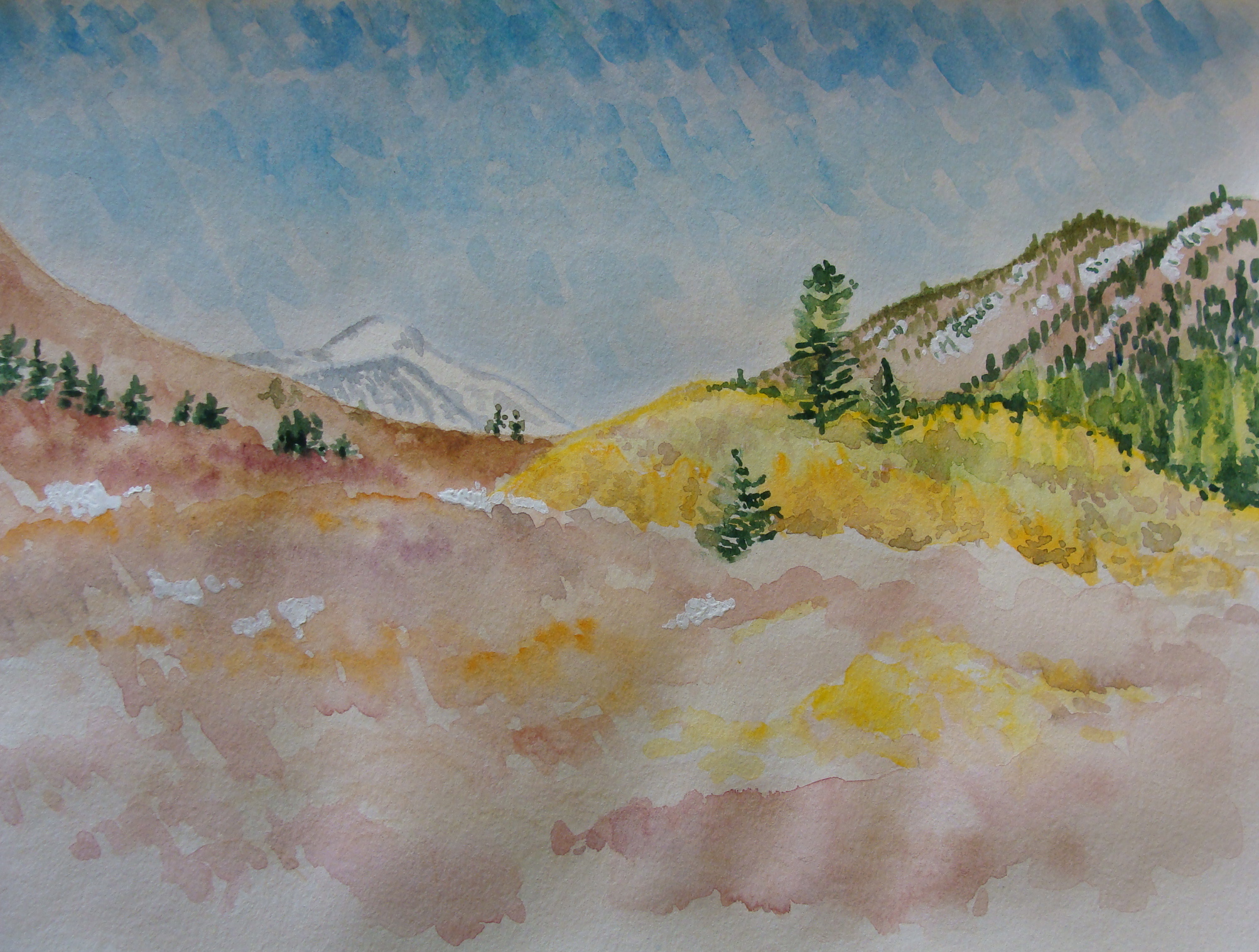
October’s government shutdown locked us out of our national parks. Fortunately, national forests are nearly impossible to fence in. Forest rangers closed visitor centers, but they could not padlock our public lands. The indifference, lack of connection, and abstract selfishness of a political minority – disregarding communities beyond their voting district – blocked passage of a federal budget, keeping government workers from their jobs – in this case stewardship of our natural resources – and held our country hostage, reeking havoc with local economies, such as businesses dependent on tourists to our national parks. Flouting our temerity, we voted with our feet gaining access to our birthright, our public lands. Entering Inyo National Forest, we found welcome amongst the wilderness of trees in the Eastern Sierra and Great Basin Desert, trees, blessed by their ignorance of Washington, D.C.’s theater of the absurd. I photographed our journey in addition to the watercolors in this blog entry.
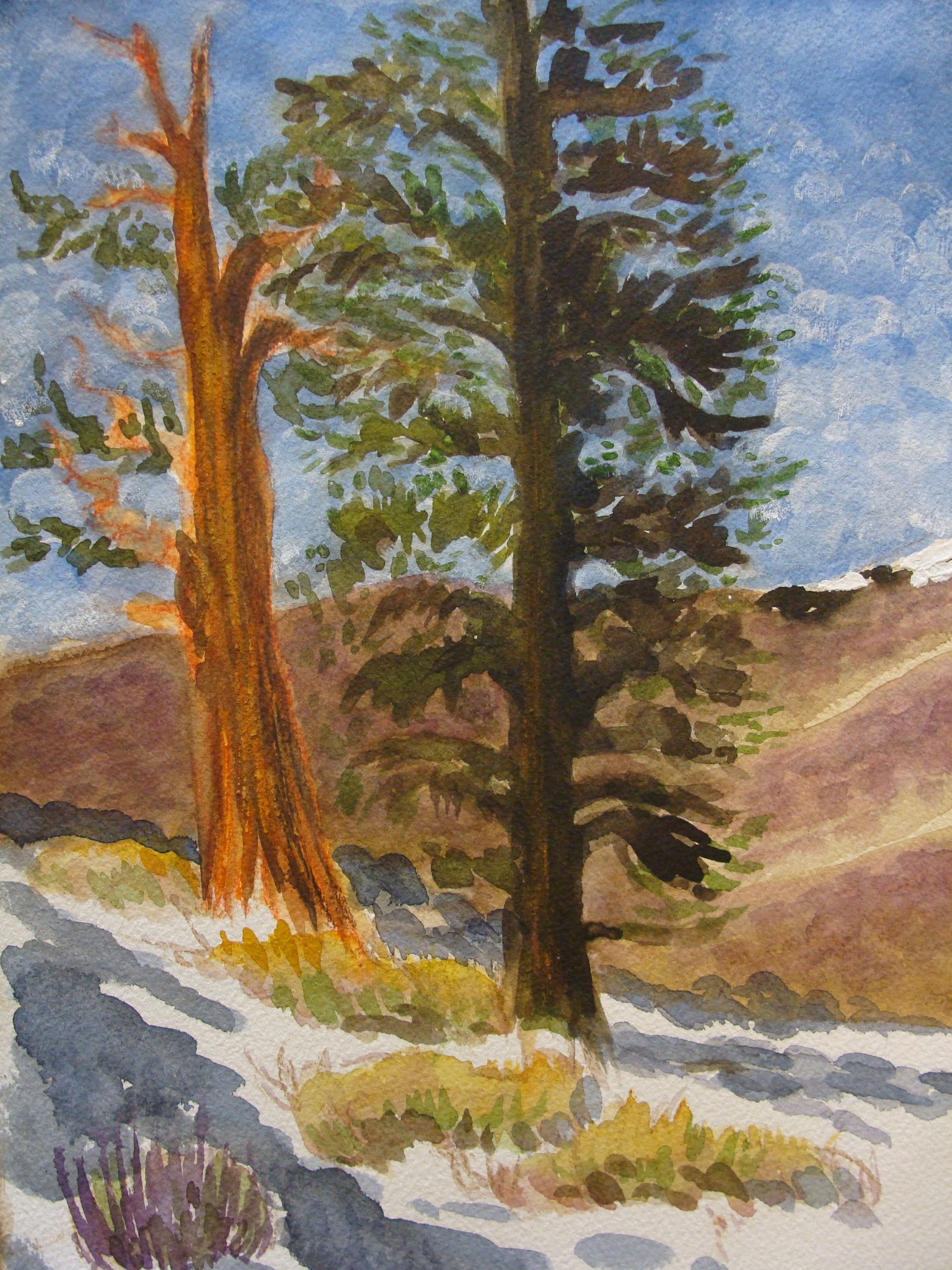
When its fall in the Eastern Sierra, trees dress in dramatic and painterly yellows and gold accented now and then with a touch of red and orange. Near sagebrush scrub in the yellow pine belt bioregion found at approximately 7,000 feet above the sea, the yellowing leaves of black cottonwoods are jewel-like on the landscape. Thriving on moisture, the cottonwoods grow where their roots find water near lakes, meadows, springs, and mountain streams. Higher in the Sierras, in the 9,000 – 11,000 foot elevation range, forests of jeffrey and lodgepole pines, red fir and western junipers are found, as well as stretches of quaking aspens, simply breathtaking to behold. Finding water amongst rocks at cliff bases, these trees sparkle in the sunlight, and the wind reveals their white trunks and stirs leaves in a continual flutter. Farther East in the Great Basin Desert, the White Mountains host magnificent ancient bristlecone pine forests. Methuselah, the oldest tree on earth, estimated at over 4,750 years in age, thrives in this arid, exposed landscape, requiring minimal water and finding just enough nutrients in the dolomitic and alkaline soils where few other trees can flourish. Keeping only essential parts alive during times of stress, the living tree is dressed in dead branches, made smooth over time by the forces of wind, ice and fire. The sculptural bristlecone pines seem to form a community of dancers moving nominally in a minimalist ballet for the ages. The beauty is sublime; this place opens our living souls and we are filled with affection.
For this trip, my book of choice was A Great Unrecorded History a biography of one of my favorite writers, E. M. Forster, written by Wendy Moffat. In 1909, just days after reading Walt Whitman’s Leaves of Grass, an inspired Forster sketched out the entire concept of one of his finest works, Howard’s End. Published in 1910, Forster explored several themes including developing urban industrial spaces juxtaposed with a rapidly eroding English countryside, and the human need to connect. A century later, Wendell Berry, who like Forster appreciated the value of community and place, was honored to give the 2012 Jefferson Lecture in the Humanities, which he titled It All Turns on Affection. Informed by Forster’s Howard’s End, Berry described the need for integrated local economies connecting cities with their surrounding rural landscapes “to bring producers and consumers…back within the bounds of the neighborhood…[within] effective reach of imagination, sympathy, affection…[gaining] a measure of security that cannot derive from a national or global economy controlled by people who, by principle have no local commitment.” In his talk, Berry described Forster’s foresight: “the existence of small farms were limited and that an industrial ugliness, was creeping out of the cities and into the countryside, and that this ugliness was characterized by the withdrawal of affection from places.” In Howard’s End climactic scene Margaret Schlegel talks to her husband Henry Wilcox, “a plain man of business who sees life realistically with a hardness of mind and heart only because it is expedient and because it subtracts from reality the life of imagination and affection, of living souls.” Margaret tells Henry “it all turns on affection now…affection. Don’t you see?”
In Song of Myself a poem from Leaves of Grass, Walt Whitman penned the line “the press of my foot to the earth springs a hundred affections.” May our political leaders in Washington remember their actions impact places and persons across our nation and the world. As they do their work, may they walk with affection, understand their commitments, and not trample – drunk with power – the places and communities – in the lands just beyond their own.
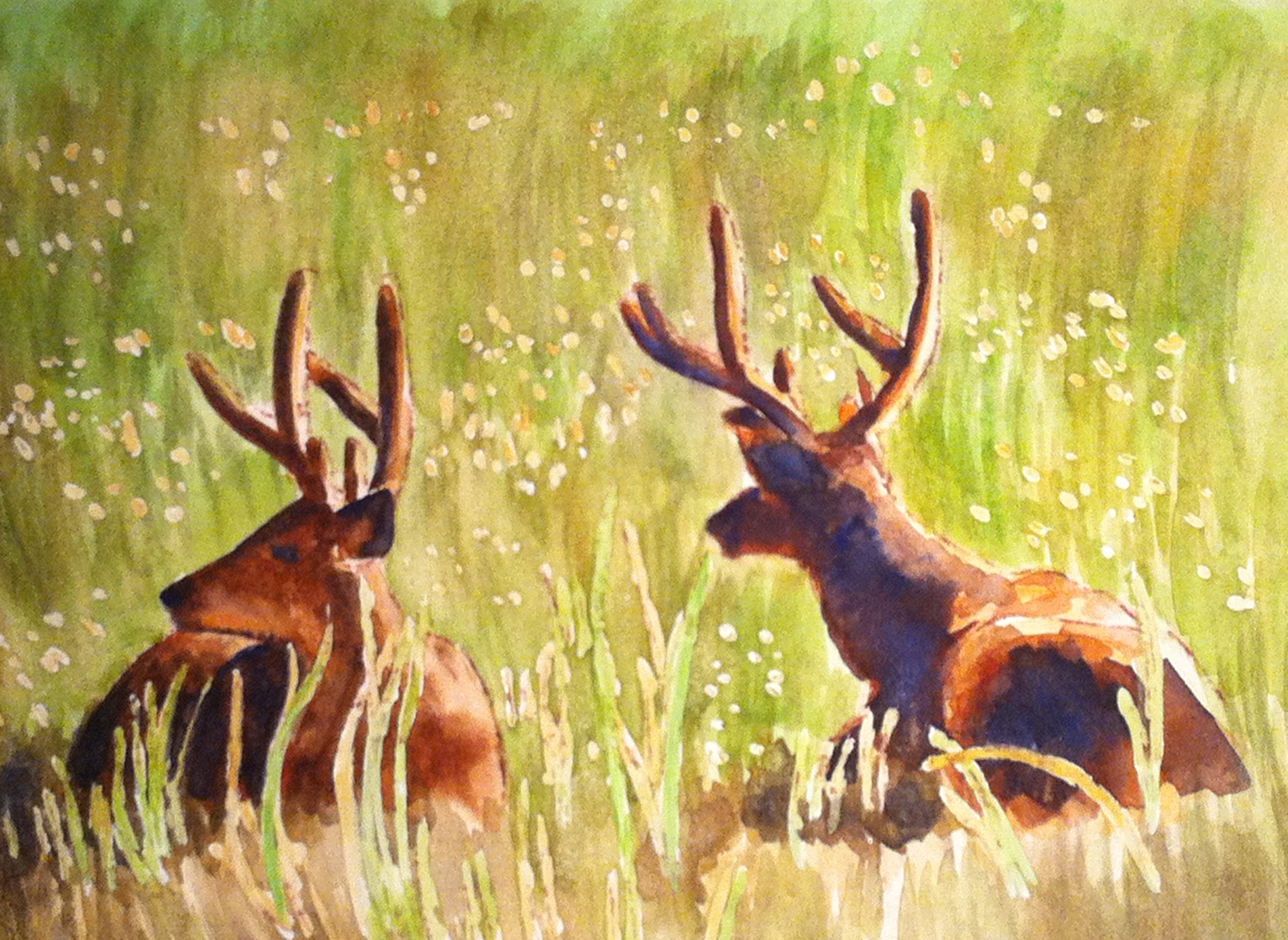
UC Santa Cruz is a special place; where else would you find a traffic sign flashing bright orange “be alert…deer crossing the roadway.” Cycling into work, I laughed lovingly acknowledging both the practical advice and the deeper meaning of mindfulness. Situated on a mountain overlooking the Pacific, the campus is replete with rolling meadows and coastal forests of tanoak, bay laurel, Pacific madrone and the regal Redwoods. An ecosystem intimately shared by animals, plants and people. After a quiet summer, September signals major events in certain campus populations: the academic cycle migration of homo sapiens and the advent of the breeding season for California mule deer. The traffic signal brings some needed intervention to manage the humans and deer inhabiting this space. All summer the bucks have roamed the meadows as a herd while their antlers grew big and strong preparing to compete for a mate. Next spring, fawns begin the cycle anew. Riding up the bike path through the thirsty meadow, I wonder from where the mountain lion watches these migrations and lifecycles. Will I ever see one?
Right mindfulness, an element of the Buddhist eight-fold path, teaches adherents to be alert, present, building awareness of the moment…the path to enlightenment. Earlier this year, I received a gift from the wife of a landscape painter whose work I greatly admire; she connected me to the work of Peter Matthiessen, Buddhist and writer of fiction and many well-respected books about the environment including the National Book Award winner The Snow Leopard. Trekking through Nepal with the ancient Buddhist shrine Shey Gompa on Crystal Mountain as their destination, Matthiessen and the field biologist George Schaller were seeking research data on the Blue Sheep and the Snow Leopard. Truly a book about his spiritual journey, Matthiessen finds the revered Lama of Shey who blesses him with a koan “Have you seen the snow leopard? No. Isn’t that wonderful!” Matthiessen writes “I feel great gratitude for being here, for being, rather for there is no need to hike oneself to the snow mountains in order to feel free. I am not here to seek the “crazy wisdom;” if I am, I shall never find it. I am here to be here, like these rocks and sky and snow, like this hail that is falling down out of the sun…the absurdity of a life that may well end before one understands it does not relieve one of the duty (to that self which is inseparable from others) to live it as bravely and generously as possible.”
It is the season when deer are on the minds of many. Last weekend we attended the fundraiser for the journal West Marin Review held by Point Reyes Books. Two great women poets read from their work: Kay Ryan and Jane Hirshfield and ironically among the many poems they read, they both chose to read works about deer. Selecting a poem from her book The Best of It, Ryan read “a buck looks up: the touch of his rack against wet bark whispers a syllable singular to deer; the next one hears and shifts; the next head stops and lifts; deeper and deeper into the park.” Hirschfeld choose a poem from The Lives of the Heart and read “a root seeks water. Tenderness only breaks open the earth. This morning, out the window, the deer stood like a blessing, then vanished.”
 alive in the sea of information