Driving through the neighborhoods and vineyards of Sonoma County, I am devastated by the October 2017 wildfire destruction and deeply saddened by the loss of life and home. Without words. I am humbled by and respectful of the latent power of nature. Nature shares: water, wind and fire; without words.
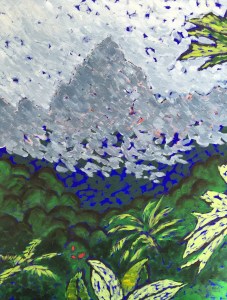
Mammoth Mountain from Minaret Summit. Robin L. Chandler, 2017.
The Tang Dynasty’s Wang Wei is revered in China as a poet, painter, and practitioner of Ch’an (Zen) Buddhism. And for good reason when you read and savor Wang Wei’s work. Wei is considered to be the first Chinese painter to capture the inner spirit of the landscape, originating the mountains-and-rivers tradition beloved by the Buddhist poet Gary Snyder. In his book Mountain Home, David Hinton writes “Wang Wei’s poetry is especially celebrated for the way he could make himself disappear into a landscape, and so dwell as belonging utterly to China’s wilderness cosmology. In Ch’an practice, the self and the constructions of the world dissolve until nothing remains but empty mind or “no-mind.”
A few weeks ago, I travelled with the best companions, reaching the Eastern Sierra and our campground at Convict Lake, after many hours of driving. During our respite, we visited Hot Creek, Long Valley Caldera, Mammoth Mountain, Minaret Summit, and Mono Lake. Walking or sitting amongst the beauty, we were emptied and replenished reaching an awakening, if not the hoped for enlightenment. Wang Wei’s poetry came to mind as I reached for and drank deeply from the cup of friendship and nature. In the Mountains, Sent to Ch’an Brothers and Sisters Wei wrote:
“Anthropocene is the voguish and not yet officially adopted term to describe the first geologic epoch in Earth’s history to be characterized primarily by the impacts of human activity, global warming foremost among them,” writes Glen Martin in the article Hell or High Water: How Will California Adapt to the Anthropocene?
How can I reach others and help them see that for the first time in humankind’s existence – a time now considered the Anthropocene – our actions are raising the temperature of the heavens, the oceans, and the land and thereby changing the fate of all creatures inhabiting these spheres. We must understand the actions we take today impact future generations. And we must understand that human consciousness is formed by our relationship to the sky, the seas and the land: the sky our infinite possibilities, the sea our mystery and the earth our enduring home. What will our consciousness become if the heavens, the oceans and the land are irrevocably changed? What if the air is too dirty to breathe? What if water is a scarce commodity? What if the land is stripped bare and emptied of the creatures with which we currently share this planet? What will it all mean? “We simply need wild country available to us, even if we never do more than drive to it’s edge and look in. For it can be a means of reassuring ourselves, of our sanity as creatures, a part of the geography of hope.”[1]
Now a week old, the Detwiler Fire has consumed 76,000 acres and is only forty percent contained. The windswept fire rages in the foothills, feeding on dry brush that grew intensely during our rainy winter. The fire has devastated a section of California State Route Forty-nine and threatens two historic Gold-Country towns Coulterville and Mariposa, the gateway to Yosemite. These places names trigger sweet memories of friends and shared adventures along the Don Pedro Reservoir, the Merced River, Yosemite Valley and the Eastern Sierras.
Fire, is a natural part of ecosystems. For many trees, such as the Coastal Redwood or the Giant Sequoia, fire opens seed cones required for germination. Simultaneously, fire helps clear-out dead wood and thus provides nutrients necessary for new plant growth. As towns and cities grow, encroaching upon once remote wilderness, human homes and livelihoods are increasingly threatened during fire season. But, when a wildfire rages, threatening your community, it is difficult to ponder the benefits to the natural ecosystem. You only pray the firefighters working night and day can save your home from advancing flames. The work of generations, the evidence of a lifetime’s progress, can be lost within seconds to fire. The poet Robinson Jeffers wrote in his poem Fire on the Hills
“The deer were bounding like blown leaves
Under the smoke in front of the roaring wave of the brushfire;
I thought of the smaller lives that were caught.
Beauty is not always lovely.”
Dust to dust: when catastrophe strikes we experience the harsh reality of how quickly life can change; we begin to comprehend that humility as a means of survival; and we ask ourselves the question what really endures?
Friday, my dear friend and I visited the Carmel home of Robinson Jeffers and his beloved wife Una. Apprenticed to a stonemason, Jeffers built his house, Tor House, and then later, working solo, built Hawk Tower. Jeffers personally chose and hauled each stone up from the beach to craft these dwellings. Jeffers understood ancient stones – when listened to – share the song cycle of wind, water and fire tirelessly grinding granite to sand over the eons. The stone circles at Callinish and Achmore on the Isle of Lewis, placed by Neolithic peoples, have stood for some four thousand years, surviving wind, water and fire as well as the follies of mankind. These stones have survived, and are now artifacts, surviving evidence of a people’s existence. Jeffers wrote in his poem Tor House
“If you should look for this place after a handful of lifetimes:
Perhaps of my planted forest a few
May stand yet, dark-leaved Australians or the coast cypress, haggard
With storm-drift; but fire and the axe are devils.
Look for foundations of sea-worn granite, my fingers had the art
To make stone love stone, you will find some remnant.”
The days are dark and grey; the skies stormy and the ocean restless. Will we reach the shore? Or will we be battered by the tides? A weak hand at the tiller, doubt and anxiety grip our ship. We take our stand, voicing our opinion. Unsure. Will our words be heard, or will they fall on deaf ears, lost in the chaos?
Heroic action is needed to fight the fear mongers, but my special powers come from the brush in my hand. Will art signify in such a time?
In Defiant Spirits: the Modernist Revolution of the Group of Seven, Ross King proposed that an artist, and in this case, Tom Thomson, the great Canadian landscape painter and outdoorsman, could be “the hero in a time of need, [who] goes forth from his homeland and into an underworld of dangerous wonders. Here he contends against mighty forces and undergoes a series of trials before returning home, armed with special powers that give vitality to his community.” As an artist, Tom Thomson was engaged in the vision quest, “the single most pervasive literary plot in western literature…from Homer and the Bible, to Grail legends and the Native American hanblecheya.”
At this time in the history of our country, I believe each of us must undertake the vision quest; it is the eleventh hour and our land, and the creatures inhabiting the land, are under attack. To defend what we cherish, the hero within is desperately needed.
“When the aboriginal man goes walkabout, traveling along his ancestral songline, he chants the verses originally sung by his dreaming ancestor, singing the land into view as he walks through it. And in this manner, he renews not only his own life, but the very life of the land itself.”[1] Each place has it’s story, a story of the land and the creatures native to that place and time, and those stories must be described and shared to be remembered, to remain alive. The Greek word Aesthesis, origin of aesthetics, means the “work of the senses: touching, hearing, seeing, smelling and tasting.” Stories are created from aesthetic experiences, but theses stories must be preserved to be remembered.
In his 1980 Nobel Prize for Literature lecture, the great poet Czelaw Milosz wrote that the poet must possess two qualities: to see and describe. The poet is the one “who flies above the Earth and looks at it from above, but at the same time see’s it in every detail.” Milosz makes the point “to see means not only to have before one’s eyes. It may mean also to preserve in memory. To see and to describe may also mean to reconstruct in imagination. A distance achieved, thanks to the mystery of time, must not change events, landscapes, human figures into a tangle of shadows growing paler and paler. On the contrary, it can show them in full light, so that every event, every date becomes expressive and persists as an eternal reminder of human depravity and human greatness. Those who are alive receive a mandate from those who are silent forever. They can fulfill their duties only by trying to reconstruct precisely things as they were, and by wresting the past from fictions and legends.”
We must see and describe, to make stories, to make memories and fight the nihilism lurking in the current chaos. And yes, using my special powers, brush in my hand, I will see and describe, I will spark the memory of particular stories, associated with particular places and times and particular creatures, and it will signify.
[1] David Abram. “Gary Snyder and the Renewal of Oral Culture.” A Sense of the Whole: Reading Gary Snyder’s Mountains and Rivers Without End. Counterpoint: Berkeley, 2015. p. 94
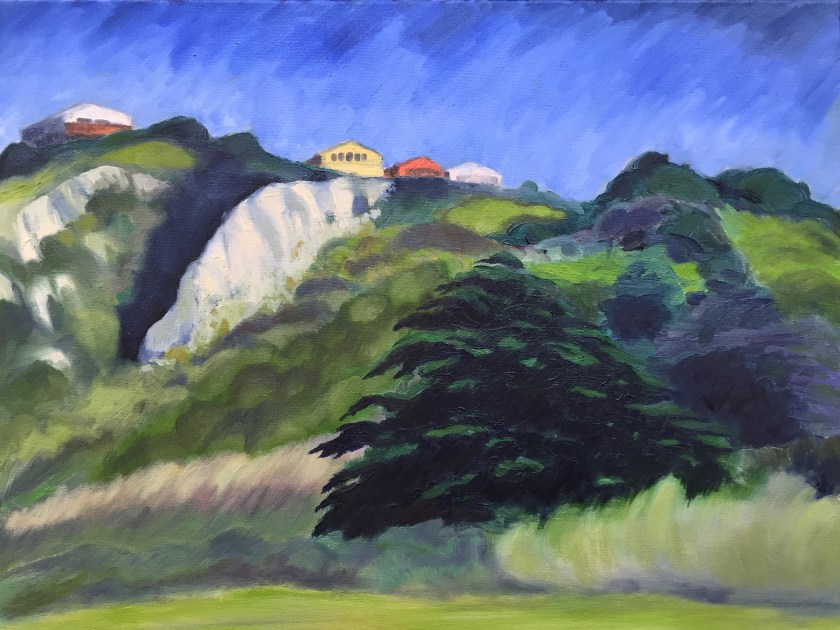
The cliff above Mussel Beach. Robin L. Chandler 2016.
In December, the sun sleeps late and lays to rest early. Short winter days bring cold nights and chilly mornings. Mid-afternoon, we rejoice in the sun’s warmth and bask in the bright light bringing intense colors and deep shadows. On windswept Mussel Rock Beach, I painted alongside my friends, also painters, grateful for the beautiful sunny day and the winter light striking the rain-restored landscape: so many greens. For the moment, darkness was banished beyond the horizon, the place where threatening storms lay in wait. Finding solace in this place, momentarily I put aside my fears.
The poet Michael Palmer gave the keynote address On the Sustaining of Culture in Dark Times for the February 2004 Sustainable Living Conference at Evergreen State College. Drawing upon the actions and imagery of 9/11 and the subsequent Iraq War, Palmer states “demagoguery, deceit, and denial of the other, such crimes against language are the grounds of despotism. And all in the trusted name of “liberty,” “freedom” and “democracy…yet, for brazen and blatant lies to work, there must be people to believe them, or choose to believe them, or simply be indifferent…” The United States initiated the Iraq War for several reasons: save the world from alleged weapons of mass destruction held by the despot Saddam Hussein, seek retribution for the destruction of the World Trade Center, and re-engineer a nation based on democracy and free trade. What did it achieve? Considered an act of rebellion against the Roman Republic, Julius Caesar, marched his troops across the Rubicon uttering the famous words alea iacta est “the die is cast.” When the United States “crossed the Tigres and Euphrates,” the die was cast, setting in motion events drastically reshaping geo-political alliances and pressuring democracies to choose security over freedom.
Later today, across the nation, the Electoral College will meet in fifty state capitals casting ballots for the next President of the United States. Electors will vote – another die will be cast – and there will be no going back. Noir flourishes in the light of day.
Cottonwood near Bishop, California. Robin L. Chandler, 2016.
The snow, fondant-like, blanketed the mountains. Rushing down the canyons, the rain wrote creeks on the landscape, like icing, on a cake. October brought me to the big empty, the Owens Valley, the tectonic, volcanic landscape, now a desert, once a vast ocean. The thirsty cottonwoods grow alongside the Zen-like creek, waiting months, sometimes years, for the river they know will come. In the big empty, I sang a prayer for this land. Staring deeply, intently at the mountains and the rivers, imagining the ocean that once was, I sang this blessing by Nanno Sakaki[1] for what was and what can be:
“One day from the ocean, from yesterday, I’m sure
A lost hump-back whale will swim up this river.
And someday, from the ocean, from tomorrow,
Countless whales will swim up the river
To revisit the ancient beech forest,
Whales swimming up the river, up the river.”
A few weeks later, I stand before a Marsden Hartley work, painted in 1918, entitled The Last of New England – the Beginning of New Mexico hanging in the Chicago Art Institute. Writing to his friend, Alfred Stieglitz, Hartley described the Southwest: “I like the country very well for it is big and clean and true, and there is nothing dirty standing between one and the sunlight.” Standing before this work, I absorbed the intensity of the landscape realized in the painter’s forms and colors. Like Proust and his tea and madeleines, the painting roused my memory of the Eastern Sierra desert, big and clean and true. Now more than ever, we need people to stand up and speak out like the Sioux tribal leaders now singing their prayers in protest of the pipeline at Standing Rock. We do not need anything dirty, like an unnecessary pipeline, standing between us and the sunlight on the land.
A great shadow threatens the land. Lies and abuse, dressed as truth and normalcy, threaten our democracy, so tenuous, so often taken for granted. To heal our selves, we must take our song to the streets and valleys and together loudly sing our prayers for our land, our peoples, and our democracy. It will be a tough fight, but we must continue to urge national investment in clean and renewable energies and demand the cessation of investments in projects like the pipeline perpetuating fossil fuel dependence. Here at home, the LA Times reports that California leads the nation in energy productivity, electricity from renewable resources, and reductions in carbon intensity. Like the Shaman, we will raise our voice in song to heal ourselves, each other, and our community. Together, open, guiding, we will sing our love of the land we hold so dear.
Because the whales will swim up river, only when they hear our song.
Kalalea revealed. Robin L. Chandler Copyright 2016.Kalalea obscured. Robin L. Chandler 2016.Kalalea in faith. Robin L. Chandler Copyright 2016.
Early in the morning, I meditated on the Kalalea Mountains while swimming in the waters of Kauai. Floating in the warm water, each wave washed through me, its action filling the emptiness in my soul. The sun shone on the mountaintop above me, but as quickly as the golden ridge appeared, it was gone. The Kalaleas were obscured, disappeared, in fact vanished. Had you just arrived you would never know the mountains existed. A cloudburst, a downpour, and then a waterfall tumbled down the mountains to the sea. Momentarily, the tempest ceased, the clouds parted and the sun returned to reign down upon the peak. And just as quickly the clouds returned, the mountains departed, and the waves again washed through me. I grasped the Buddhist understanding of faith.
Created by Tibetan monks, the great sand mandalas, objects of beauty, are readily swept away. By their impermanence, these objects teach us about truth. Their creation and their dissolution is an act of faith, revealing the beauty and truth of impermanence.
A haiku from Matsuo Basho captures this idea of impermanence well; beauty cannot be held captive. Beauty must be free, so it can return.
The salty taste of a brisk wind and the bright midday sun welcomed we plein air painters fleeing the sweltering inland heat. Time suspended, we set-up our easels and laid out our paints and brushes intent on capturing the moment. Painting the seascape, onsite, is a meditation, a chance to lose self, and by the act, find self again. The sea, sky and land fill the gaps, and the renewed soul sees the wonder of life everywhere.
Driving to the coast, the radio waves burst with information about the sea change in Britain, Brexit. A campaign of fear coaxed many to mortgage their future to recapture a time past. Examine wisely the evidence of history; think critically of the stories told by those who seek power. Myths are one interpretation of the past. Identify the evidential source, and ask for what purpose was it created, and for what goal it is used now. William Carlos Williams wrote In the American Grain “to try to find out for myself what the land of my more or less accidental birth might signify.” It is a very good book, a poet’s interpretation of my country’s history. William writes “History, history! We fools, what do we know or care? History begins for us with murder and enslavement, not with discovery.”
Oakland, California is my home. A politician once called my city one of the most dangerous place in the world. Biking Oakland’s streets or walking the sidewalks does not feel particularly scary to me. Of course one should always be aware and sensible of your surroundings while moving through the urban scape. But there is so much good at work and at play in this city, designating it simply as dangerous, dismisses it unfairly. Engaging with my fellow city dwellers at the farmer’s market, the YMCA, the coffee shop, or at Cato’s watching the Warriors, I become part of the city’s story. And it is wonderful to talk, walk and work with these diverse and special people and hear what makes us Oaklandish.
Oakland is a vital city undergoing change. San Francisco’s high cost-of-living has brought a wave of immigrants to Oaktown who live and work amongst longtime residents. New buildings are under construction and old buildings are being renovated. Change brings a new skyline, new traffic patterns, and new conversations and exchanges between people of differing genders, colors, sexual preferences, and creeds. And like many cities, experiencing a rebounding economy, crime, poverty, injustice and pain exist alongside the rebirth.
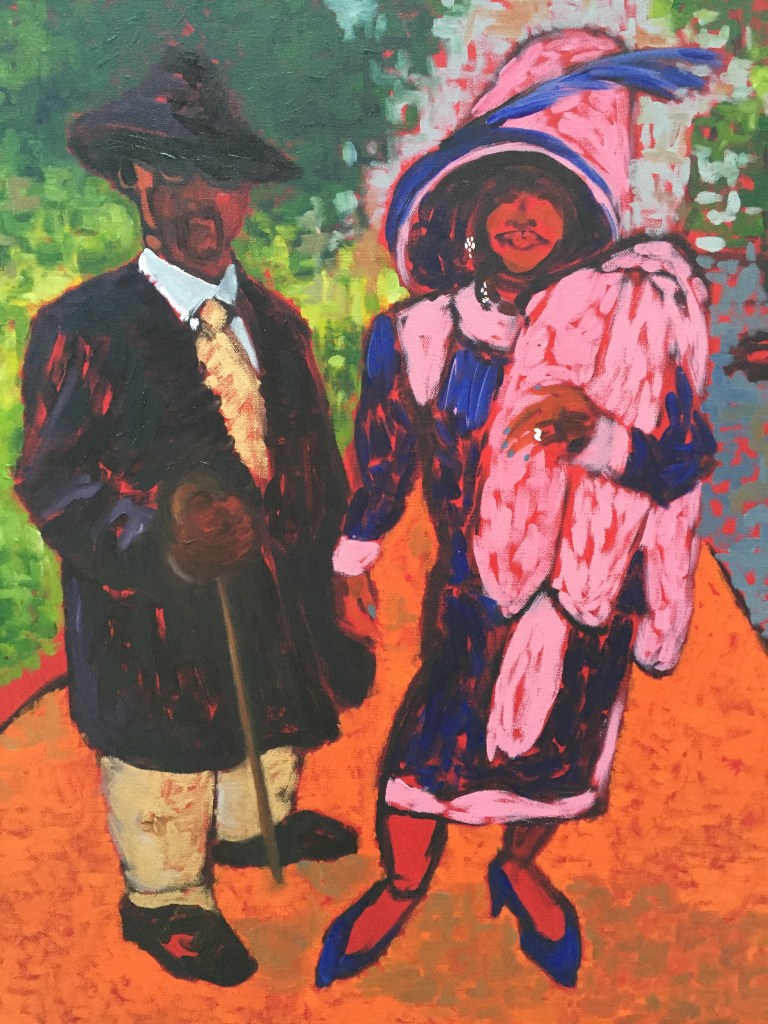
Lazarus was here. Robin L. Chandler Copyright 2016.
There are many stories to be told about Oakland: stories of success; stories of despair; stories of challenge; and stories of recovery. These are the stories that we who love Oakland want to tell and hear told. Irresponsible politicians write a city off when they label it dangerous without understanding the community, with little knowledge of individual stories, without context or perspective. It is criminal to disparage a town, without having a clear understanding of who lives there, their dreams and their capacity to achieve those dreams. It is criminal to dismiss a city without knowledge of the problems it faces, without a sincere concern for it’s people and without suggesting sustainable strategies to help resolve the challenges it faces. Stories, of poverty and pain, are rewritten by building faith in community, and keeping hope in individuals alive. Stories, of poverty and pain, are resolved with better access to education, a decent minimum wage, affordable housing, and health benefits funded by raising the taxes of the wealthiest 1%.
There are many ways to tell stories, and artistic works are usually at the forefront of engagement making the human connection, building awareness, and starting a dialogue. Thirty-second sound bites and 140 character tweets by grandstanding politicians can end a story before it has a chance to begin. The book arts, the dramatic arts, the performing arts, and the visual arts create spaces that reveal our experiences, open hearts and initiate listening. The great soul is in everyone and their stories should be told.