Borders deserve respect, but respect for asylum and respect for due process is deserved too. Danger lurks when we label others; people are not labels, they are human beings deserving dignity and respect. Human rights cannot be merely an abstraction, they must be the values by which we truly live every day. Human rights must be our primary colors; human rights cannot be whitewash. “The history of the Holocaust is not over. Its precedent is eternal, and its lessons have not yet been learned.”[1]
Living in the East Bay, our gaze draws westward, and this is not hard to understand. In the west looms San Francisco, our imperial city; our iconic bridges, the Golden Gate and the Bay Bridge; winter rainstorms are born there; and the sun, traversing the north-south longitude, sets in the west. And quietly, holding up the sky, Mount Tamalpais anchors my western horizon. Tamalpais is always there, grounding me; at times just in the corner of my eye, and other times commanding my full attention, whether near or far. My love for Mount Tamalpais has grown deep over the years – many chapters of my story feature this mountain. In the 19th century, the ukiyo-e artist Hokusai captured his love for a revered Japanese mountain with his famous series of woodblock prints Thirty-six Views of Mount Fuji.
Inspired by two books, Opening the Mountain: Circumambulating Mount Tamalpais A Ritual Walkby Mathew Davis & Michael Farrell Scott and Tamalpais Walking: Poetry, History and Prints by Tom Killion and Gary Snyder, I persuaded my dear friends, to walk from Muir Woods to East Peak, the top of Mount Tamalpais. At the end of March, we covered a distance of approximately twelve miles, spanning a range of plant communities, including redwoods, mixed evergreen forests, grasslands and chaparral, as well as plants, such as ceanothus, endemic to the mountain adapted to the Serpentine soils. Our journey gave amazing views of the greater Bay Area and we saw Mount Tam’s sister mountains: Black Mountain (west), Mount St. Helena (north), Mount Diablo (east) and Mount Hamilton (south). The artist Tom Killion began his love affair with Tamalpais as a young man, and inspired by Hokusai, he created beautiful prints of the mountain from multiple viewpoints, many of them featured in Tamalpais Walking.
Last week, cycling from Oakland to Richmond on the Bay Trail, I travelled a diverse landscape featuring mudflats so alive with plants and animals coexisting with trucks and cars speeding by on asphalt and cement highways. This is nature – mankind a dominating part of a community of flora and fauna; this is not wilderness. Throughout the journey, there was my friend Mount Tamalpais, on the horizon, a guidepost measuring my progress, a signpost holding close my memories.
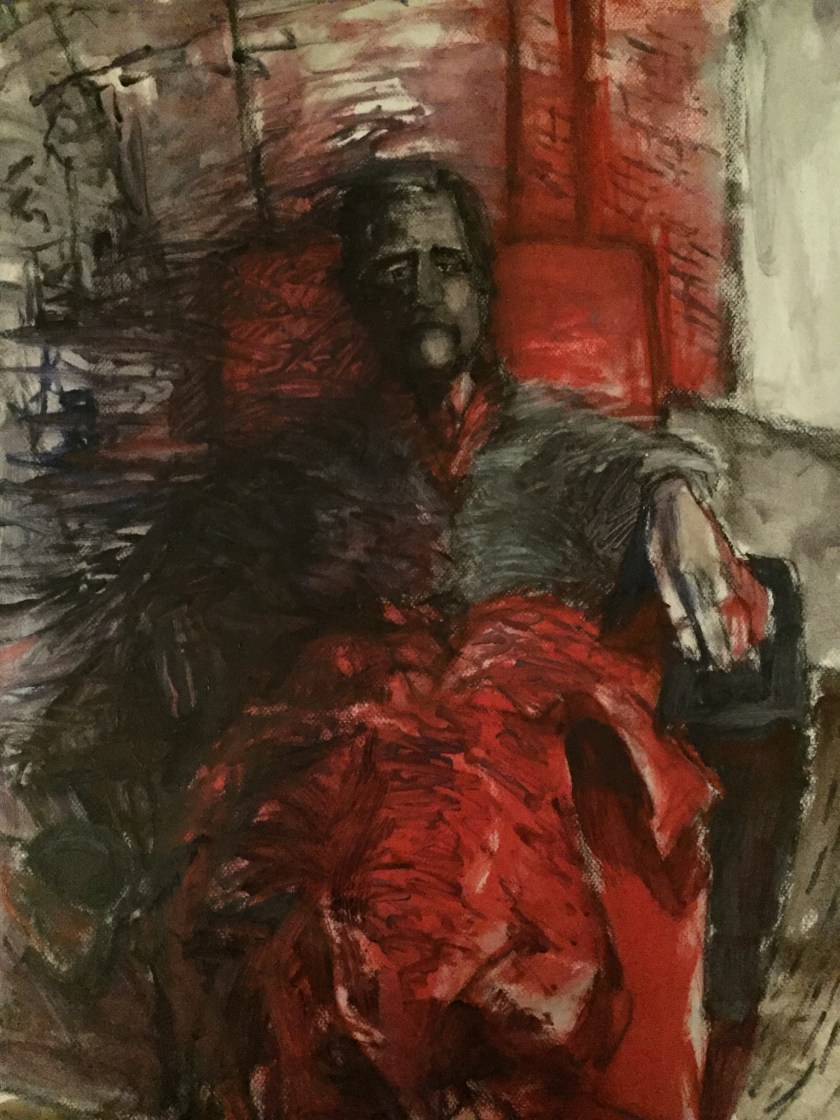
The room is charged. His eyes two points that arc, revealing his story. He has fought the pain. But there has been a price. He is so tired and there is so much he has forgotten.
“I sit with this room. With the grey walls that darken into corner. And one window with teeth in it. Sit so still you can hear your hair rustle in your shirt. Look away from the window when clouds and other things go by. [Ninety-seven] years old. There are no prizes.” [1]
A grave illness resides with my father and we, his family, breathe on, our minds plagued with a dull ache that cannot be suppressed. But what goes through a person’s mind at this time? Is death as simple as opening a window? Do you have a clear view of what lays beyond or are you adrift in the darkness?Czeslaw Milosz writes in his poem Winter:
“…when the sun rises beyond the borderlands of death,
I already see the mountain ridges in the heavenly forest
The gift he bestowed. Unaware – so absorbed by the struggle. We walked the line for many years never breaking step but the day came when the path branched. He said stay organized and keep your integrity. Comet-like, I return. Offering my stories, colored by the years and buffered by wisdom, born of sadness and joy. We sit side-by-side sharing memories, telling stories, gazing at infinite shadows. Untold devotion.