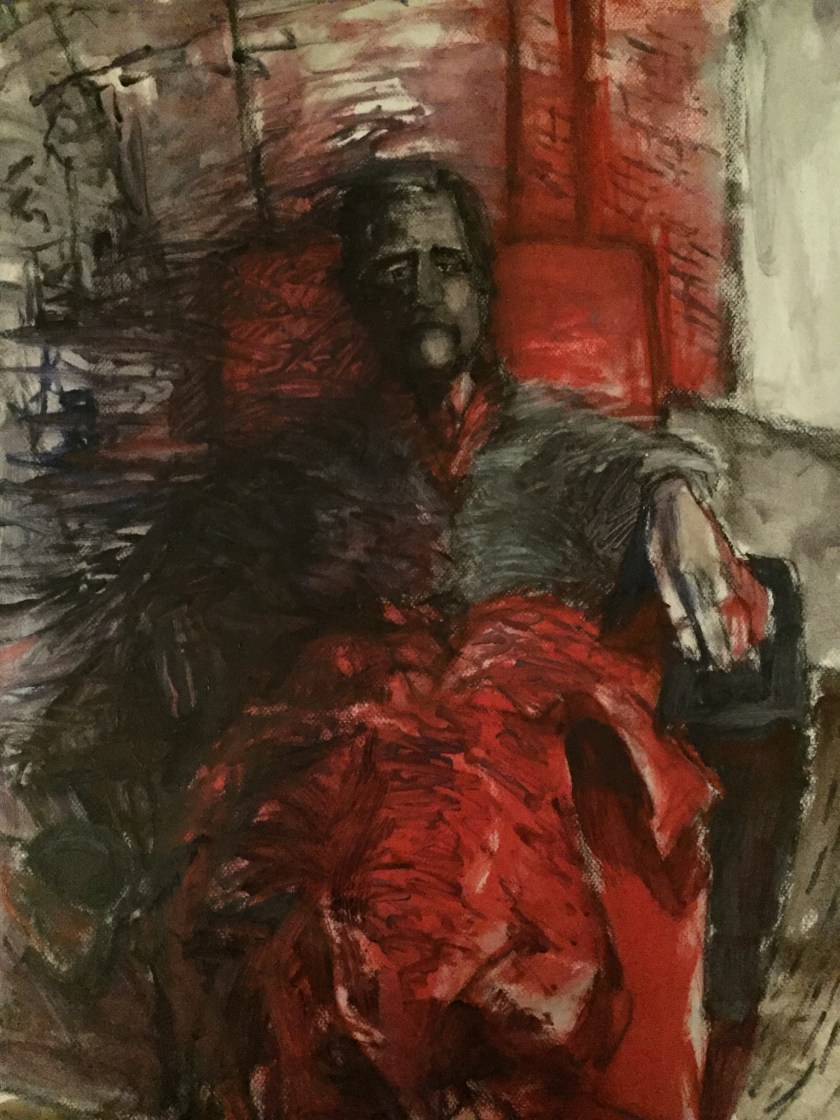
The room is charged. His eyes two points that arc, revealing his story. He has fought the pain. But there has been a price. He is so tired and there is so much he has forgotten.
“I sit with this room. With the grey walls that darken into corner. And one window with teeth in it. Sit so still you can hear your hair rustle in your shirt. Look away from the window when clouds and other things go by. [Ninety-seven] years old. There are no prizes.” [1]
A grave illness resides with my father and we, his family, breathe on, our minds plagued with a dull ache that cannot be suppressed. But what goes through a person’s mind at this time? Is death as simple as opening a window? Do you have a clear view of what lays beyond or are you adrift in the darkness?Czeslaw Milosz writes in his poem Winter:
“…when the sun rises beyond the borderlands of death,
I already see the mountain ridges in the heavenly forest
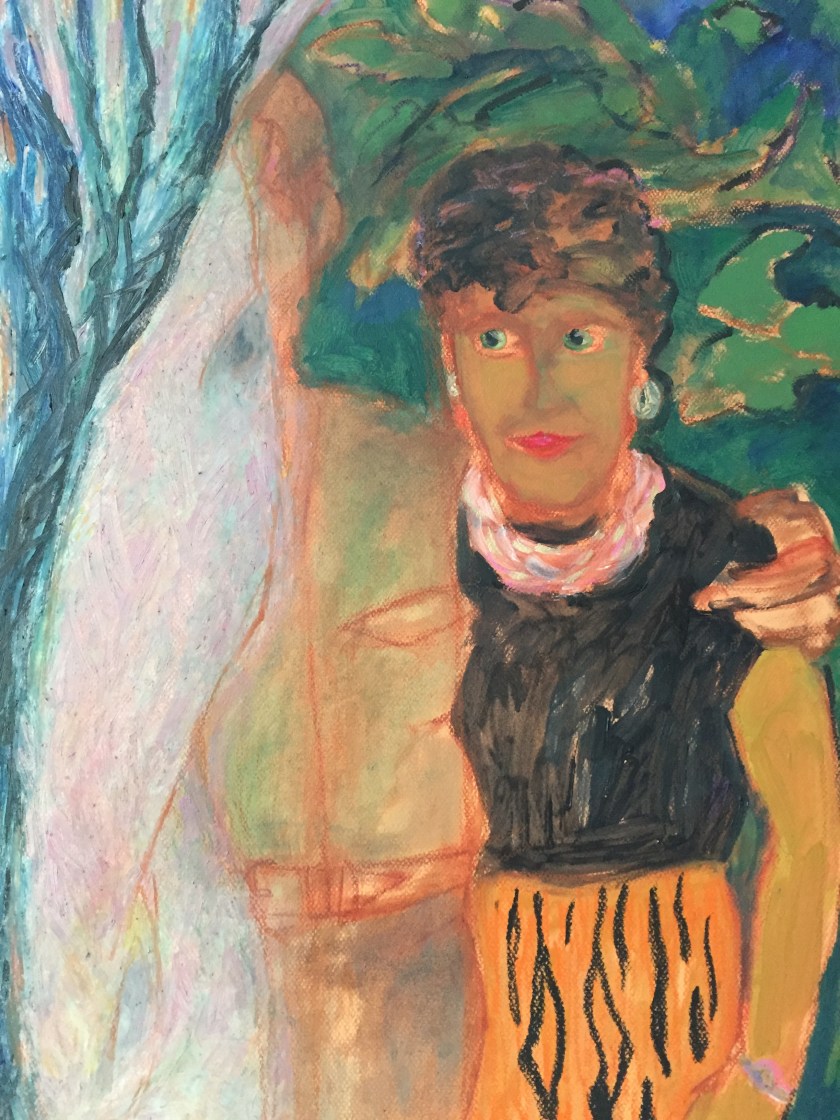
The gift he bestowed. Unaware – so absorbed by the struggle. We walked the line for many years never breaking step but the day came when the path branched. He said stay organized and keep your integrity. Comet-like, I return. Offering my stories, colored by the years and buffered by wisdom, born of sadness and joy. We sit side-by-side sharing memories, telling stories, gazing at infinite shadows. Untold devotion.
Driving through the neighborhoods and vineyards of Sonoma County, I am devastated by the October 2017 wildfire destruction and deeply saddened by the loss of life and home. Without words. I am humbled by and respectful of the latent power of nature. Nature shares: water, wind and fire; without words.
Mammoth Mountain from Minaret Summit. Robin L. Chandler, 2017.
The Tang Dynasty’s Wang Wei is revered in China as a poet, painter, and practitioner of Ch’an (Zen) Buddhism. And for good reason when you read and savor Wang Wei’s work. Wei is considered to be the first Chinese painter to capture the inner spirit of the landscape, originating the mountains-and-rivers tradition beloved by the Buddhist poet Gary Snyder. In his book Mountain Home, David Hinton writes “Wang Wei’s poetry is especially celebrated for the way he could make himself disappear into a landscape, and so dwell as belonging utterly to China’s wilderness cosmology. In Ch’an practice, the self and the constructions of the world dissolve until nothing remains but empty mind or “no-mind.”
A few weeks ago, I travelled with the best companions, reaching the Eastern Sierra and our campground at Convict Lake, after many hours of driving. During our respite, we visited Hot Creek, Long Valley Caldera, Mammoth Mountain, Minaret Summit, and Mono Lake. Walking or sitting amongst the beauty, we were emptied and replenished reaching an awakening, if not the hoped for enlightenment. Wang Wei’s poetry came to mind as I reached for and drank deeply from the cup of friendship and nature. In the Mountains, Sent to Ch’an Brothers and Sisters Wei wrote:
“Anthropocene is the voguish and not yet officially adopted term to describe the first geologic epoch in Earth’s history to be characterized primarily by the impacts of human activity, global warming foremost among them,” writes Glen Martin in the article Hell or High Water: How Will California Adapt to the Anthropocene?
How can I reach others and help them see that for the first time in humankind’s existence – a time now considered the Anthropocene – our actions are raising the temperature of the heavens, the oceans, and the land and thereby changing the fate of all creatures inhabiting these spheres. We must understand the actions we take today impact future generations. And we must understand that human consciousness is formed by our relationship to the sky, the seas and the land: the sky our infinite possibilities, the sea our mystery and the earth our enduring home. What will our consciousness become if the heavens, the oceans and the land are irrevocably changed? What if the air is too dirty to breathe? What if water is a scarce commodity? What if the land is stripped bare and emptied of the creatures with which we currently share this planet? What will it all mean? “We simply need wild country available to us, even if we never do more than drive to it’s edge and look in. For it can be a means of reassuring ourselves, of our sanity as creatures, a part of the geography of hope.”[1]
Now a week old, the Detwiler Fire has consumed 76,000 acres and is only forty percent contained. The windswept fire rages in the foothills, feeding on dry brush that grew intensely during our rainy winter. The fire has devastated a section of California State Route Forty-nine and threatens two historic Gold-Country towns Coulterville and Mariposa, the gateway to Yosemite. These places names trigger sweet memories of friends and shared adventures along the Don Pedro Reservoir, the Merced River, Yosemite Valley and the Eastern Sierras.
Fire, is a natural part of ecosystems. For many trees, such as the Coastal Redwood or the Giant Sequoia, fire opens seed cones required for germination. Simultaneously, fire helps clear-out dead wood and thus provides nutrients necessary for new plant growth. As towns and cities grow, encroaching upon once remote wilderness, human homes and livelihoods are increasingly threatened during fire season. But, when a wildfire rages, threatening your community, it is difficult to ponder the benefits to the natural ecosystem. You only pray the firefighters working night and day can save your home from advancing flames. The work of generations, the evidence of a lifetime’s progress, can be lost within seconds to fire. The poet Robinson Jeffers wrote in his poem Fire on the Hills
“The deer were bounding like blown leaves
Under the smoke in front of the roaring wave of the brushfire;
I thought of the smaller lives that were caught.
Beauty is not always lovely.”
Dust to dust: when catastrophe strikes we experience the harsh reality of how quickly life can change; we begin to comprehend that humility as a means of survival; and we ask ourselves the question what really endures?
Friday, my dear friend and I visited the Carmel home of Robinson Jeffers and his beloved wife Una. Apprenticed to a stonemason, Jeffers built his house, Tor House, and then later, working solo, built Hawk Tower. Jeffers personally chose and hauled each stone up from the beach to craft these dwellings. Jeffers understood ancient stones – when listened to – share the song cycle of wind, water and fire tirelessly grinding granite to sand over the eons. The stone circles at Callinish and Achmore on the Isle of Lewis, placed by Neolithic peoples, have stood for some four thousand years, surviving wind, water and fire as well as the follies of mankind. These stones have survived, and are now artifacts, surviving evidence of a people’s existence. Jeffers wrote in his poem Tor House
“If you should look for this place after a handful of lifetimes:
Perhaps of my planted forest a few
May stand yet, dark-leaved Australians or the coast cypress, haggard
With storm-drift; but fire and the axe are devils.
Look for foundations of sea-worn granite, my fingers had the art
To make stone love stone, you will find some remnant.”