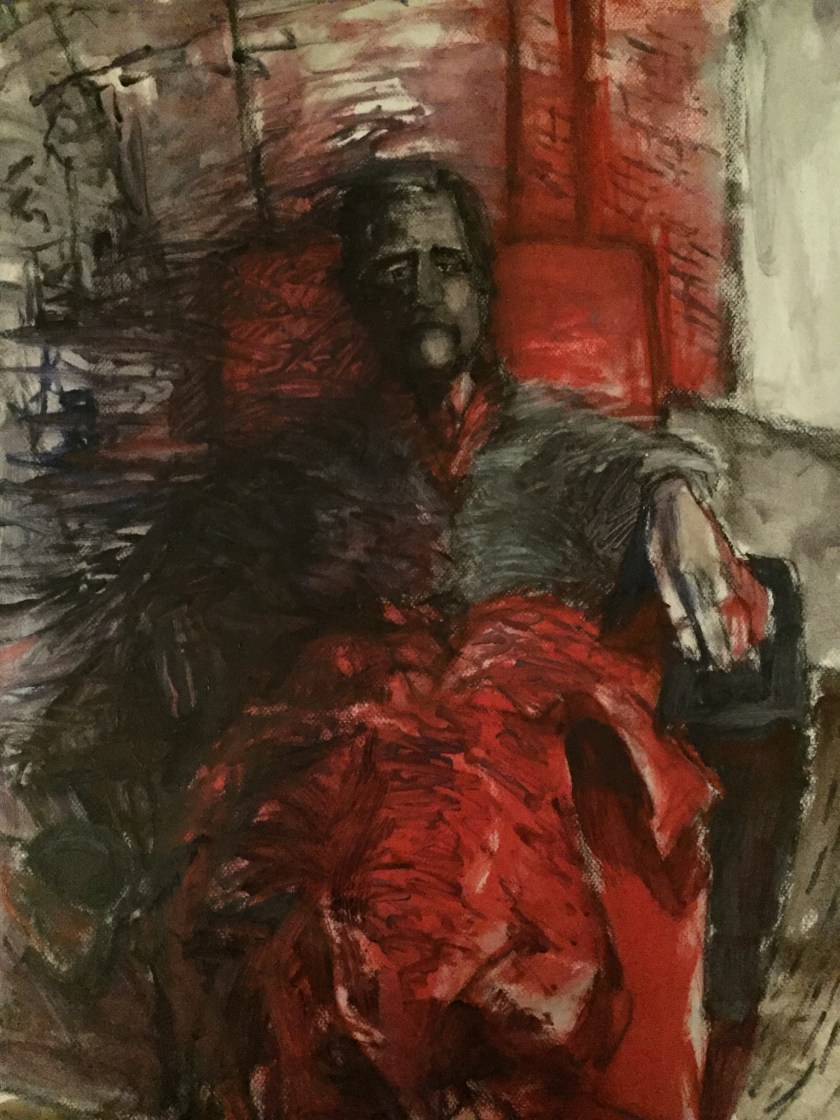
The room is charged. His eyes two points that arc, revealing his story. He has fought the pain. But there has been a price. He is so tired and there is so much he has forgotten.
“I sit with this room. With the grey walls that darken into corner. And one window with teeth in it. Sit so still you can hear your hair rustle in your shirt. Look away from the window when clouds and other things go by. [Ninety-seven] years old. There are no prizes.” [1]
Sloughs are narrow, winding waterways where fresh and salt water mix with the rising and ebbing of the tides – a cycle of life, death and rebirth. When the tide recedes the muddy, marshy banks are exposed teeming with life; crabs, shrimps, worms, snails, clams make these flats their home. When the tide rises, these creatures feed on a nutrient rich “soup” created by decomposing plants and other small animals; when the tide ebbs, these shellfish and mollusks become a feast for birds and fishes that also call the slough home. In their time, these birds and fishes provide nourishment to yet other predators. Sloughs are a place measuring time by the absence and presence of water. It is a place for the soul to replenish and connect the tidal rhythm to the rhythm of sustaining our energy and our breath: give and take, in and out, give and take, in and out. Buddha was a gentle human seated amongst the world’s phenomena, contemplating life’s multiple rhythms.
Recently we visited Edison in Skagit County Washington. Walking along Edison’s slough, I was mindful of Gary Snyder’s words in The Practice of the Wild “walking is the great adventure, the first meditation, a practice of heartiness and soul primary to humankind…the exact balance of spirit and humanity. Out walking, one notices where there is food…there are firsthand true stories of ‘your ass is somebody else’s meal’ a blunt way of saying interdependence, interconnection…give-and-take…what a big potlatch we are all members of! To acknowledge that each of us at the table will eventually be part of the meal is not just being ‘realistic.’ It is allowing the sacred to enter and accepting the sacramental aspect of our shaky temporary personal being.”
Myths and fairy tales are replete with enchantment; tales of magic, witchcraft and sorcery abound. Spells are cast and masks or disguises adorned. Beauty loved her beloved Beast, and Baucis and Philemon opened their home to Jupiter and Mercury disguised as mortals. But what are these disguises but masks, some donned purposefully, others worn in punishment. My mother was a tiger; she donned her mask daily fighting with purpose. She fought to keep us safe, fought to keep us fed, and she fought to get her children all we deserved and more. She donned her mask to attend to her duties as a mother and wife, but sometimes she fought with those she loved. The mask protected the sensitive intelligent woman underneath. We must all don masks to survive. Writing about the Mesoamerican mask traditions, Octavio Paz states “while we are alive we cannot escape from masks or names. We are inseparable from our fictions – our features. We are condemned to invent a mask for ourselves and afterward to discover that the mask is our true face.”* With that insight, I understand why, unfortunately, after a while my mother forgot to remove her mask.
*from Alberto Ruz Lhuillier, quoted in Peter T. Markman and Roberta H. Markman, Masks of the Spirit: Image and Metaphor in Mesoamerica (Berkeley: University of California Press, 1989), xxi; Octavio Paz, Posdata (Mexico City: Siglo XXI, 1970), II.
When I visit or talk with my father these days, the conversation turns to our shared stories. Several times he has with joy and relief told his version of a story about a day when I was three years old. Here is my version. Perhaps it was the call of the wild, but when my dog escaped, I followed, determined to bring her back home. Too young to venture outside my yard alone, but that fact never occurred to me. Single-minded, with purpose, I tracked my dog; when she crossed the creek, I walked into the water, unaware of the coming baptism. In a new world where the rules of gravity and locomotion no longer applied, my feet lost contact with the ground. Possessing no vocabulary to describe my new emotions, my grown self now describes the situation: panic flirted with me, but an increasing sense of calm flooded my body. Water felt like home, not enigma. I moved my arms and legs and reached the shore where my dog looked on; I grasped her collar and we began the walk home, my clothes completely soaked. Closer, fire engines wailed and police cars flashed. Neighbors ran excitedly in all directions looking for something. My frantic mother was yelling at my distraught father. I didn’t understand what was going on. Walking up to my speechless parents, I said, “I got my dog.” Suddenly strong emotions of happiness came from my parents. Once grown, I came to understand that adults thought I was lucky; they were probably right. But somewhere deep inside, some part of me understood my life’s journey had begun.
“Not drowned entirely, though. Rather carried down alive to wondrous depths, where strange shapes of the unwarped primal world glided to and fro before his passive eyes; and the misermerman, Wisdom, revealed his hoarded heaps…”
“Only in the heart of the quickest perils; only within the eddyings of his angry flukes; only on the profound unbounded sea, can the fully invested whale be truly and livingly found out.”
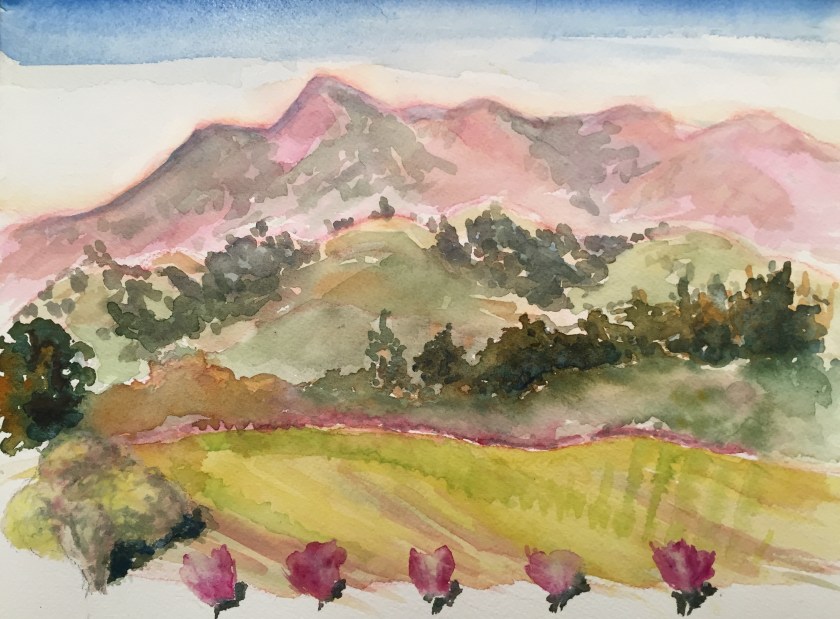
Mt. Saint Helena Spring 2018 after a dry Winter. Robin L. Chandler
Yesterday I returned to Chalk Hill. It’s been a year since my artist residency at this glorious Sonoma County vineyard. Twelve months ago we were happily besieged by winter storms bringing the desperately needed rain ending our drought of many years. At that time, mountains and hillsides were deep green and the skies dark grays and blues. My painting Mount Saint Helena after the rain describes this past. The storms replenished springs, and rivers and creeks fueled by the deluge, rushed powerfully to the sea. But the generous rain did not protect Napa and Sonoma County from the ravages of fire, indeed, the rain may have accelerated growth, fueling the devastation; it will be a long time before our memories of Atlas Peak and Tubbs firestorms dim.
And today’s Mt. Saint Helena watercolor captures Spring’s awakening, but my colors are pastels, the result of this season’s dry Winter. Last year’s oil paintings of the mountain tell a different story, intense dramatic Spring color born of a wet winter. The season cycle reminds us of our fragility, humbled by the earth’s beauty and power, aware of life’s precious gift.
“History is not what happened two hundred or two thousand years ago. It is a story about what happened two hundred or two thousand years ago…what survives the wreck of empires and the sack of cities is the sound of the human voice confronting it’s own mortality…the story painted on the old walls and printed in the old books is our own.”
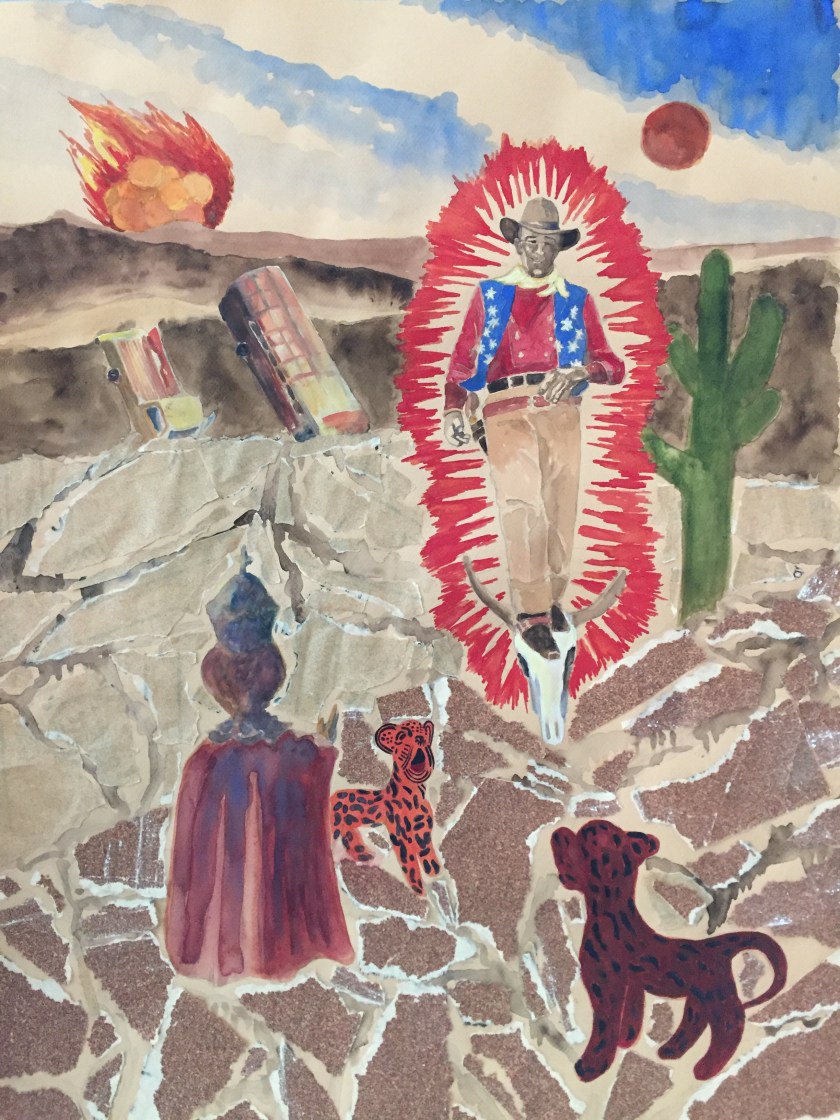
Texas was my home when I was very young; I was born not far from the Chisholm Trail. Images of cowhands, cattle, big skies and prairies where you can see storms approaching for miles shaped me. Coupled with Western films directed by John Ford and Howard Hawks, I have a rich mythology that feeds and inspires my imagination. And somewhere along the way, I gave my father the mantle of JohnWayne, taciturn hero, wise in the ways of the world, a man of justice who could always be trusted to save the day. Myths. The truth would be revealed later. Maybe, it was easier to survive living in a fairy tale. Grown now, I realize the unfairness of saddling my father with that unrealistic responsibility; humans are human: beloved and flawed. But you cannot blame a child seeking safety in heroes.
In today’s world, where leaders make rash decisions and speak loudly and endlessly about their strength and prowess, I imagine the mythological “Duke” as Pilgrim John of Guadalupe the perfect Yin and Yang balance of the masculine and feminine come to save us from destruction in our desolation. Did I say I have a good imagination? And I hear John Wayne in the character Tom Doniphon from the film The Man Who ShotLiberty Valance say “Whoa there, take ‘er easy there Pilgrim,” as if to say, let’s calm down, take life a step at a time, and think about what’s really important, the impact of our actions, and what would be best for all concerned. Amen. A myth, but a grand one. Life is never as simple as a Western film; the solutions Westerns offer will not resolve the complicated challenges we face. But what we truly value is often expressed well in the clear and simple myths we enjoy and share. Yes, please “take ‘er easy there Pilgrim.” Hold steady…the planet’s future rests in our hands.
A grave illness resides with my father and we, his family, breathe on, our minds plagued with a dull ache that cannot be suppressed. But what goes through a person’s mind at this time? Is death as simple as opening a window? Do you have a clear view of what lays beyond or are you adrift in the darkness?Czeslaw Milosz writes in his poem Winter:
“…when the sun rises beyond the borderlands of death,
I already see the mountain ridges in the heavenly forest



 alive in the sea of information