a dangerous place?

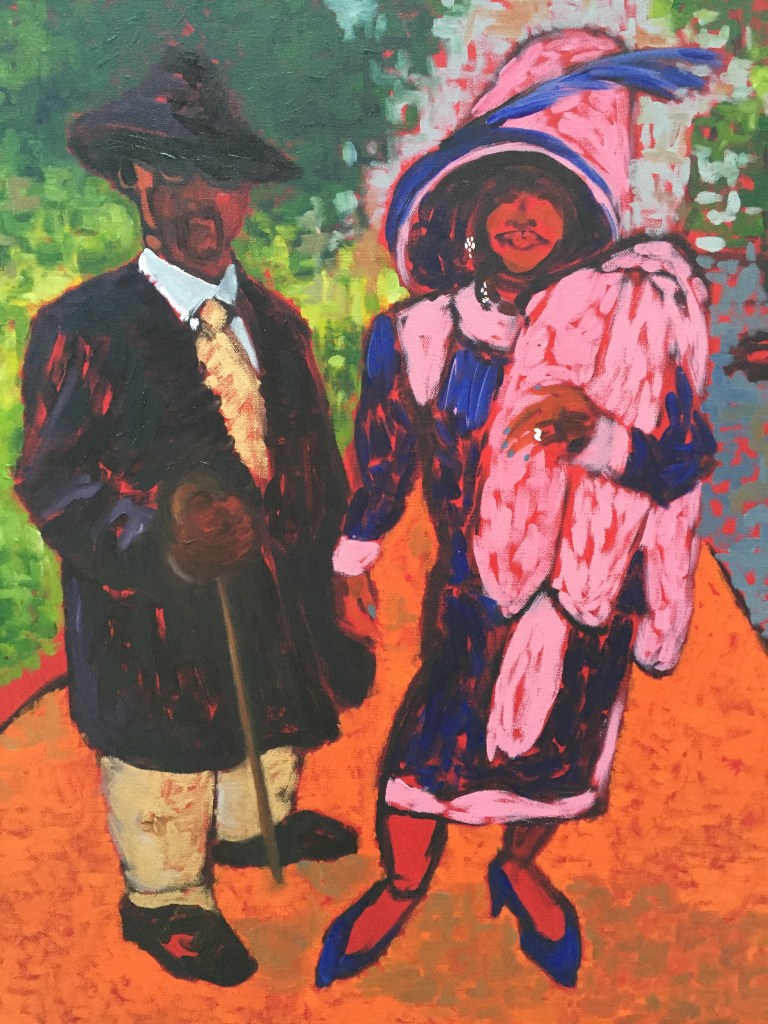
Oaklanders. Robin L. Chandler Copyright 2016.

Oakland, California is my home. A politician in a recent New York Times interview with Robert Draper told a story about Oakland — calling my city one of the most dangerous places in the world. Biking Oakland’s streets or walking the sidewalks does not feel particularly scary to me. Of course one should always be aware and sensible of your surroundings while moving through the urban scape. But there is so much good at work and at play in this city, designating it simply as dangerous, dismisses it unfairly. Engaging with my fellow city dwellers at the farmer’s market, the YMCA, the coffee shop, or at Cato’s watching the Warriors, I become part of the city’s story. And it is wonderful to talk, walk and work with these diverse and special people and hear what makes us Oaklandish.

Oakland is a vital city undergoing change. San Francisco’s high cost-of-living has brought a wave of immigrants to Oaktown who live and work amongst longtime residents. New buildings are under construction and old buildings are being renovated. Change brings a new skyline, new traffic patterns, and new conversations and exchanges between people of differing genders, colors, sexual preferences, and creeds. And like many cities, experiencing a rebounding economy, crime, poverty, injustice and pain exist alongside the rebirth.

Lazarus was here. Robin L. Chandler Copyright 2016.

There are many stories to be told about Oakland: stories of success; stories of despair; stories of challenge; and stories of recovery. These are the stories that we who love Oakland want to tell and hear told. Irresponsible politicians write a city off when they label it dangerous without understanding the community, with little knowledge of individual stories, without context or perspective. It is criminal to disparage a town, without having a clear understanding of who lives there, their dreams and their capacity to achieve those dreams. It is criminal to dismiss a city without knowledge of the problems it faces, without a sincere concern for it’s people and without suggesting sustainable strategies to help resolve the challenges it faces. Stories, of poverty and pain, are rewritten by building faith in community, and keeping hope in individuals alive. Stories, of poverty and pain, are resolved with better access to education, a decent minimum wage, affordable housing, and health benefits funded by raising the taxes of the wealthiest 1%.

There are many ways to tell stories, and artistic works are usually at the forefront of engagement making the human connection, building awareness, and starting a dialogue. Thirty-second sound bites and 140 character tweets by grandstanding politicians can end a story before it has a chance to begin. The book arts, the dramatic arts, the performing arts, and the visual arts create spaces that reveal our experiences, open hearts and initiate listening. The great soul is in everyone and their stories should be told.

The poet William Carlos Williams in his poem Asphodel, That Greeny Flower wrote:

“It is difficult

to get the news from poems

yet men die miserably every day

for lack

of what is found there.”

the price of temptation?

Eye ra. Robin L. Chandler Copyright 2016.

A cyclops is Eye ra the cat. Was he born so? Or when a young rake did he fall in with a bad lot and pay the price, tempted by their kind overtures and promises like poor Polyphemus wined and dined by Odysseus? We never heard Homer’s saga sung from the cyclops view. His impairment troubles Eye ra not, nor does his low-pressure like tabby stripe. No clouds or storms torment him, the sun shines from his soul, but toned with a mischievous humor. Describe Eye ra thus: laidback with a quirky twist of happiness; the epitome of the hipster cat; a born jazz player, always read to riff. Top Cat, the indisputable leader of the band. To a syncopated beat, I chant Eye ra, Eye ra, Eye ra, Eye ra, Eye ra.

The charm of a still life

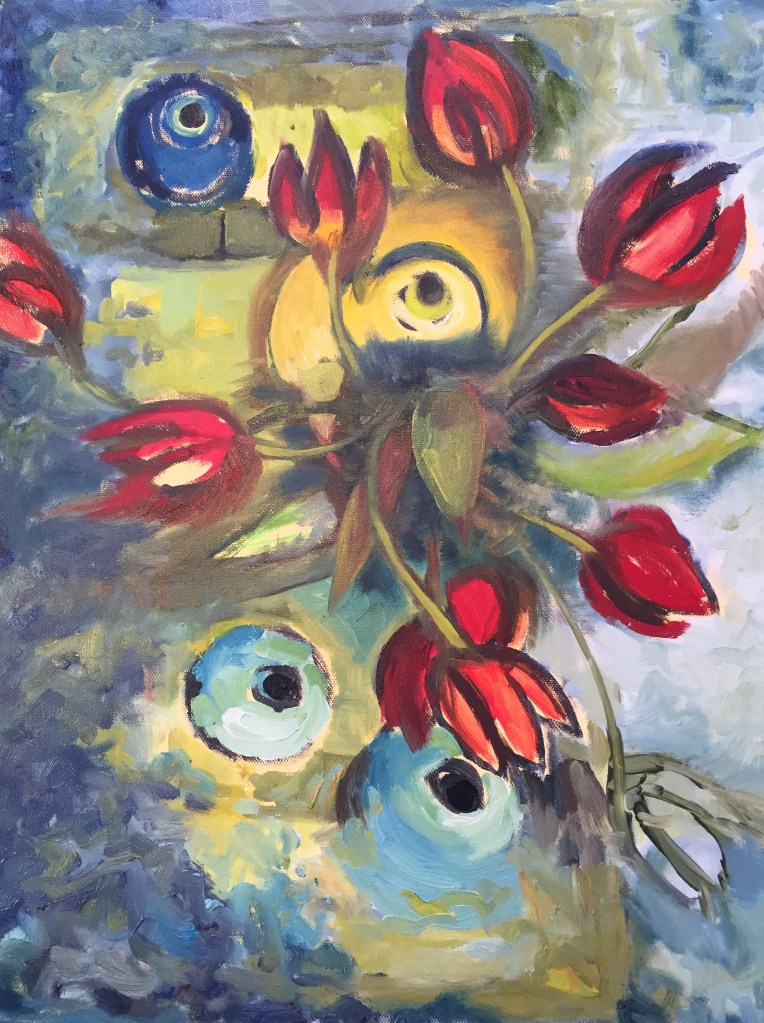
Tulips. Robin L. Chandler Copyright 2016.

Spring finds flowers in the house. Deep red tulips on the table; arranged with Heath ceramic vases of yellow, light grey and pale blue against a cloth of blue grey and green gold. Typically the landscape calls me to interpret the experience in paint. I choose the joy of sensing the world: feel the sun, smell the lavender, taste the sour grass, hear the redwing blackbird, and watch the trees bend in the wind. But the feast of colors on the table, the bold red, the pale green gold and vibrant blue grey charmed me. I was on borrowed time. The flowers would not last long, I needed to paint now. I began.

Last week, Darcy Grimaldo Grigsby lectured on plein air and urban landscape painting as part of her course Western Art from the Renaissance to the Present. Grigsby relayed a woman painter, of a respectable class in the 19th century, who lived in the world and was of the world was living on borrowed time. She would not be respectable for long if she stepped beyond her sphere and assumed the life of a flaneur. Berthe Morisot, the great French woman Impressionist painter was confined to painting the women’s sphere, and when she strayed outside to paint, her subjects were limited, and she was chaperoned. Charles Baudelaire (possibly describing his friend the painter Edouard Manet) wrote in The Painter of Modern Life (1863) the crowd is [the artist’s ] domain…to be away from home and yet to feel at home anywhere; to see the world, to be at the very center of the world, and yet to be unseen of the world…the observer is a prince enjoying his incognito wherever he goes.” The princely life was not possible for the 19th century woman painter, so she remained at home painting the inside world of children and flowers. Morisot admired and identified with the women painter Marie Bashkirtseff whose diaries are quoted in Jeffrey Meyer’s Impressionist Quartet, “what I long for is the liberty to ramble alone, to come and go, to seat myself on the benches in the garden of the Tuileries, and especially of the Luxembourg, to stop at the artistic shop windows, enter the churches, the museums, to ramble at night in the old streets, that is what I long for, and that is the liberty without which one can not become a true artist.”

Until I fell head-over-heels for the red tulips, I did not grasp the charm of a still life; I am a woman of my time, a woman of action, always moving, never still. In the 21st century, with my respectability intact, I can paint the world or paint my home, whenever I chose, whenever I choose. I can ramble at night in the old streets, and never on borrowed time.


catch a glimpse, overhear a whisper

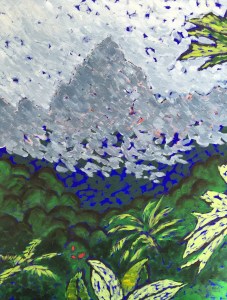
Mt. Whitney in winter. Robin L. Chandler 2016.
Mt. Whitney in winter. Robin L. Chandler  Copyright 2016.

This winter, we visited the Eastern side of the Sierras. We longed to see the snow covered mountains after so many years of drought. And frankly, I look forward to any chance to gaze upon Mount Whitney, the highest summit in the Sierras and in the contiguous United States at 14,505 feet. Waking early, I drove to the Alabama Hills awaiting the glorious winter light the sunrise would bring to Whitney’s face. Mount Whitney towers above the Alabama Hills, but both ranges are made of granite. The Alabama Hills are composed of two types of rock, an orange metamorphosed volcanic rock, and a type of granite that weathers into potato shaped boulders.

The highest peaks were covered in clouds, it was snowing in the mountains, and Whitney was not visible. I stomped my feet and blew on my fingers to stay warm in the cold, hoping with daylight Whitney would be visible. The sun rose, the clouds , like curtains, drew back and Mount Whitney whispered hello. Countless times, I have come to this place, to stare at this mountain, but I can never get enough. I always return. Joyous, I pondered the magic of what light can do, as Robert Hass wrote in the introduction to his book of the same name “the source of that authority is mysterious to me…but it is that thing in their images [the photography of Ansel and Robert Adams] that, when you look at them, compels you to keep looking.”

embark and enfold

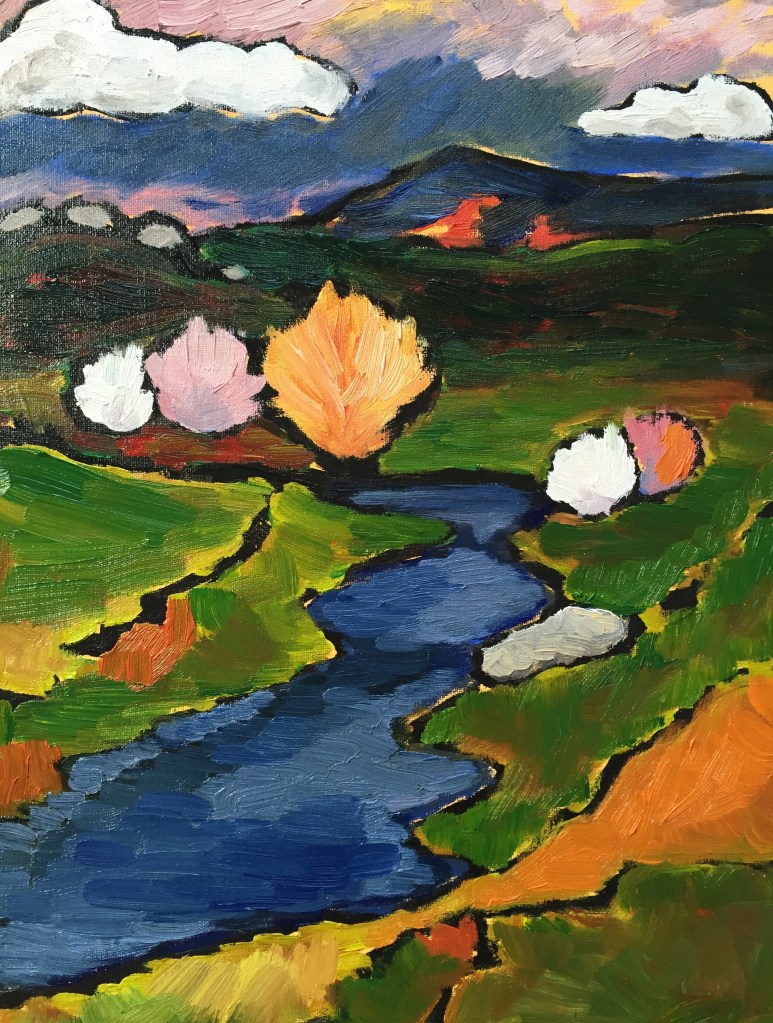
Spring San Joaquin Valley. Robin L. Chandler Copyright 2016.

Each painting is a journey: it begins, we embark on a veiled path, enfolded in process.

“The work of art is born of the artist in a mysterious and secret way. From him it gains life and being. Nor is its existence casual and inconsequent, but it has a definite and purposeful strength, alike in its material and spiritual life. It exists and has power to create spiritual atmosphere; and from this inner standpoint one judges whether it is a good work of art or a bad one. If its “form” is bad it means that the form is too feeble in meaning to call forth corresponding vibrations of the soul.”

Wassily Kandinsky, Conquering the Spiritual in Art

Delve into the depths of the sea

Stormy seas on Monterey Bay. Robin L. Chandler Copyright 2016.

The floating wreckage of a ship’s cargo, flotsam skims the surface of the sea, readily found and easily rescued. Perhaps jettisoned, with the hope of saving the ship, in time, the flotsam becomes derelict, sinking beneath the waves to the bottom of the sea, with little hope of reclaim.

In Herman Melville’s Moby Dick, Father Mapple preaches his sermon at the Whaleman’s Chapel in New Bedford about Jonah and the Whale:

”A dreadful storm comes on, the ship is like to break. But now the boatswain calls all hands to lighten her; when boxes, bales and jars are clattering overboard…for when Jonah not yet supplicating God for mercy, since he but too well knew the darkness of his deserts – when wretched Jonah cries out to them to take him and cast him forth into the sea, for he knew that for his sake the great tempest was upon them; they mercifully turn from him, and seek by other means to save the ship. But all is in vain; the indignant gale howls louder…and now behold Jonah taken up as an anchor and dropped into the sea; when instantly an oily calmness floats out from the east and the sea is still, as Jonah carries the gale with him, leaving smooth water behind…he drops seething into the yawning jaws awaiting him.”

Delve to the depths of the sea, in the belly of the whale, Jonah does not cry and wail, he keeps his faith, continuing to strive, to stay committed to the path, even when all around seemed dark and in shadows. By his continual striving, he will be reclaimed.

The Library restored: a place to nourish the soul and feed the imagination

Fortitude, Lion of the North guarding the NYPL's entrance. Robin L. Chandler Copyright 2016.
Fortitude, Lion of the North. guarding the NYPL’s entrance. Robin L. Chandler Copyright 2016.

The cold winter wind blew me up the stairs and past the Lions, Patience and Fortitude, guarding the entrance to the New York Public Library (NYPL). In my opinion, every trip to New York must include a visit to NYPL, or the trip is not properly consecrated. Designed in the classic beaux-art style by the architecture firm Carrere and Hastings, the building opened its doors to the public in 1911 with over one million items. Today, the collection numbers over fifty-one million items. Washington Irving, author of The Legend of Sleepy Hollow, was one of the first curators of the collection. A beacon and haven for scholars, the main reading room, the Rose Room, named for the generous donor family, and the Bill Blass Public Catalog Room are being restored and will reopen during the Fall 2016. The historian David McCullough places NYPL among the five most important Libraries in the United States including the Library of Congress, Boston Public Library and the university libraries of Harvard and Yale. The restoration includes, asbestos removal, reinforcing the ceiling and restoration of the Rose Room’s murals of blue skies and clouds.

Fred Lerner in his book The Story of Libraries from the Invention of Writing to the Computer Age described Vladimir Lenin’s admiration for NYPL. In 1913, the Russian Revolutionary wrote “…in the Western countries…they hold that great public libraries, with hundreds of thousands and millions of books, ought not to be the property only of scholars…they are anxious for readers to read books bought at public expense in their own homes; they see the pride and glory of the public library not in the number of rarities is possesses…but in the extent to which books circulate among the people”…..nourishing their souls and feeding their imagination.

Underneath the Rose Room’s spacious skies, many authors have nourished their souls, fed their imagination, and found context within the 40,000 volume reference collection housed in the reading room. Literary greats such as Issac Bashevis Singer, Elizabeth Bishop, E. L. Doctorow, Alfred Kazin, and Henry Miller found inspiration within the Rose Room’s walls. Many of these authors were immigrants, or their sons and daughters born in this new world, New York. The Library opened its doors and its books and gave these newcomers the world, restoring, nourishing and feeding their souls and imaginations. Excitedly, I await the next generation of immigrants, who will grapple with their ideas, applying patience and fortitude, as they create underneath these spacious skies.

Patience and fortitude are touchstones for life; wise words for guiding a lifetime of work, a long-term relationship, or perhaps just simply life. Leaving the library, I pause near Fortitude and whisper from the Mourner’s Kaddish “may there be abundant peace from heaven, and life for us all Israel, to which we say Amen.” Until we meet again Evelyn, daughter of immigrants, blessings on you on your next journey.

Washington Square. Robin L. Chandler Copyright 2016. Built to honor our first President, for me it is a monument for the departed.
Washington Square. Robin L. Chandler Copyright 2016. Built to honor our first President, for me it is a monument for the departed and a portal to the next journey.

Not to tarry, not to roam. We said we’d join her, she said she’ll meet us when we come

Winter plum. Robin L. Chandler Copyright 2016.

On his recent bluegrass album, The Happy Prisoner, Robert Earl Keen recorded the Wayfaring Stranger with Natalie Maines. The plaintive lyrics haunt me:

“I am a poor wayfaring stranger, while travelling through this world of woe. 

Yet there’s no sickness, toil or danger. In that bright world to which I go.

I’m going there to see my mother. She said she’d meet me when I come.

I’m only going over Jordan. I’m only going over home.”

A classic American folk and gospel song, it resonates with one of Buddhism’s four Noble Truths that all is suffering, all is woe, and impermanence is one of the great causes of suffering. But a bright world exists to which we can go.

Last week the rains stopped and the fruit trees blossomed, a month before expected, but nonetheless spectacular for their early arrival. The plum trees in my yard shimmered in the February sunset, still winter by the calendar. The blossoms will not remain long. But long enough to tarry in my dreams, haunt my imagination, and find their way from brush to canvas to capture the beauty of impermanence.

This weekend we will say goodbye to a good friend, my second mother, who has gone over Jordan. There is no sickness, toil or danger, in that bright world to which she goes. Someday we’ll join her, going there, no more to roam. She said she’d meet us when we come. She said she’s only going home.

Return, wander…..samsara

Near Zabriske Point, Death Valley. Robin L. Chandler Copyright 2016
Mountains near Zabriske Point, Death Valley. Robin L. Chandler Copyright 2016

The Sanskrit word samsara means to wander, and in the context of Buddhism it means to return, confined to rebirth, locked in an endless cycle of ignorance and suffering, until after dedicated work following the path to end suffering, enlightenment is reached, and the eyes are opened. According to Donald Lopez Jr. in The Story of Buddhism, “wisdom is the insight that everything is of the nature of consciousness and the product of one’s own projections.” To become a buddha, it is necessary to be empty, as the sutras repeatedly teach “not to see anything, is to see everything…..in Zen, there is the saying ‘mountains are mountains,’ referring to the dictum that before one begins the practice of Zen, mountains are mountains; during the practice of Zen, mountains are not mountains; after the practice of Zen, mountains are mountains.”

At the edge

Edge of the void. Robin L. Chandler Copyright 2016.

At the edge of the void, one can see the emptiness from which all matter comes into being, and from which all things evaporate. Form gives us a means to learn and build confidence; form provides a path to experience the teachings and verify the teacher. Like an elephant’s footprint, form is a sign, here today, but gone tomorrow. Objects are material, ever changing in state; the spirit alone is precious. Tibetan Buddhist Monks create beautiful sand mandalas only to sweep them away to symbolize the transitory nature of material life. Their creation and their dissolution is an act of faith, revealing the beauty and truth of impermanence. At the edge of the void, one finds the beginning of the possible.