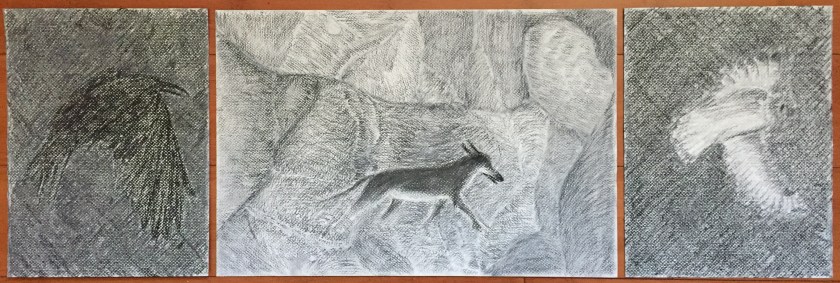
Driving through the neighborhoods and vineyards of Sonoma County, I am devastated by the October 2017 wildfire destruction and deeply saddened by the loss of life and home. Without words. I am humbled by and respectful of the latent power of nature. Nature shares: water, wind and fire; without words.
In the Sixteenth Century, French-Dutch mathematician and philosopher Rene Descartes, launched the modern age with his words Cogito ergo sum, I think therefore, I am. With this new framework, he separated the mind from the body, freeing the mind from the body’s passions, and banishing the idea that sickness came from a sinful and impure mind. This concept complemented Francis Bacon’s scientific methods based on empiricism and inductive reasoning, and consequentially, humans gradually separated from ourselves as natural beings, no longer in tune with the spiritual gifts of wilderness. In Western society, animals became creatures to be feared or resources to be exploited, instead of interconnected beings deserving respect as cohabitors of our planet. Animals became veiled in our fears, our greed and our separateness.
And animal names became epithets hurled to mock and mark, or threatening masks donned to wield power.
You are a vulture: They were tearing themselves to pieces, and their vulture lawyers, were picking at the carcass of their marriage.
You are a snake: You’re nothing more than a lecherous snake in the grass.
You are a wolf: Who do you feed to the media wolves?
In large part, we are divorced from nature. Wilderness and animals have become our adversaries instead of teachers with whom we share time and space. Indigenous peoples embraced animals as a bridge to the liminal, lifting the veil into the spirit world.
Hilary Stewart in Looking At Totem Poles writes “the people’s understanding of the interconnectedness of all living things and their dependence on certain animal and plant species fostered belief in the supernatural and spirit world. Life forms, especially those taken for food…each had their own spirit…certain birds and animals were associated with particular behaviors, powers or skills, and people sought their help to achieve success…in the dark of long winter nights, when fires burned…then the spirits drew close to the village…a time of ceremonies, speeches, singing, dancing and feasting…through costumed spiritual transformations and re-enactments, they brought past histories and adventures into the present…thus the carved beings of crest and legend portrayed on the totem poles, often recreated in masks worn by dancers, sprang to life.”
On this Halloween, as you engage in the ancient rituals of Samhain welcoming the end of harvest and the return of winter’s long nights, contemplate the true meaning of the mask you wear to celebrate the season. And while I will never advocate for discarding the benefits of the Age of Enlightenment, I would argue for the necessity of balance, and a framework that envisions humankind as a part of the natural world, instead of outside of the natural world, where it is all to easy to don the mask of conqueror and exploiter.
Early Sunday morning I walked the desert, my destination, four miles away and some two thousand feet above in the granite-mountains. I am on a pilgrimage of sorts, my feet drifting on the sands of an ancient lakebed, once home to mammoths, mastodons, and short-faced bears. Walking, hoping to reach stasis, seeking to regain what has been lost.
Reaching the hand built stone structure, an ashram, built by Franklin Merrell-Wolff, philosopher and mystic, almost a century ago, high in the Eastern Sierras between two forks of Tuttle Creek, I sat down to refresh and ponder. Below, I could see the valley and the steep trail now ascended, a metaphor for my journey. Yesterday, I knew little about the pinyon pine’s importance to the people who have called this valley home for thousands of years. My time at the Paiute Shoshone Cultural Center in Bishop opened my mind and my heart. Yesterday, they were pinyon pines a part of the ecosystem. Today, I knew the pinyons, scattered throughout the landscape, were foundational to the preservation of a people and a culture. Looking closely at the precious nuts growing within the cones – a vital source of protein – I understood what stewardship meant, to ensure a good fall harvest for a long cold winter.
On your journey, be present, with an open mind and an open heart. It is never too late to learn and it is never too late to teach. It is never too late to love and it is never too late to forgive.
Texas Desert. Robin L. Chandler, 2017.Texas Storm. Robin L. Chandler, 2017.
In the desert, on the plains, stripped of all familiar opaque comforts, under the hot sun, at the mercy of storms, we are exposed; and naked before the universe you find the truth. There will be chaos, there will be demons, but maybe there will be the blessing of silence – the pause that saves – contemplation bringing redemption.
Mammoth Mountain from Minaret Summit. Robin L. Chandler, 2017.
The Tang Dynasty’s Wang Wei is revered in China as a poet, painter, and practitioner of Ch’an (Zen) Buddhism. And for good reason when you read and savor Wang Wei’s work. Wei is considered to be the first Chinese painter to capture the inner spirit of the landscape, originating the mountains-and-rivers tradition beloved by the Buddhist poet Gary Snyder. In his book Mountain Home, David Hinton writes “Wang Wei’s poetry is especially celebrated for the way he could make himself disappear into a landscape, and so dwell as belonging utterly to China’s wilderness cosmology. In Ch’an practice, the self and the constructions of the world dissolve until nothing remains but empty mind or “no-mind.”
A few weeks ago, I travelled with the best companions, reaching the Eastern Sierra and our campground at Convict Lake, after many hours of driving. During our respite, we visited Hot Creek, Long Valley Caldera, Mammoth Mountain, Minaret Summit, and Mono Lake. Walking or sitting amongst the beauty, we were emptied and replenished reaching an awakening, if not the hoped for enlightenment. Wang Wei’s poetry came to mind as I reached for and drank deeply from the cup of friendship and nature. In the Mountains, Sent to Ch’an Brothers and Sisters Wei wrote:
“Anthropocene is the voguish and not yet officially adopted term to describe the first geologic epoch in Earth’s history to be characterized primarily by the impacts of human activity, global warming foremost among them,” writes Glen Martin in the article Hell or High Water: How Will California Adapt to the Anthropocene?
How can I reach others and help them see that for the first time in humankind’s existence – a time now considered the Anthropocene – our actions are raising the temperature of the heavens, the oceans, and the land and thereby changing the fate of all creatures inhabiting these spheres. We must understand the actions we take today impact future generations. And we must understand that human consciousness is formed by our relationship to the sky, the seas and the land: the sky our infinite possibilities, the sea our mystery and the earth our enduring home. What will our consciousness become if the heavens, the oceans and the land are irrevocably changed? What if the air is too dirty to breathe? What if water is a scarce commodity? What if the land is stripped bare and emptied of the creatures with which we currently share this planet? What will it all mean? “We simply need wild country available to us, even if we never do more than drive to it’s edge and look in. For it can be a means of reassuring ourselves, of our sanity as creatures, a part of the geography of hope.”[1]
We live in an era where many people have ready access to technology able to track our current position in time and space. No doubt it took a long time and we travelled a long distance to reach this particular spot. We know where we are; we have the coordinates. But does this precise knowledge of when and where we currently “be” satisfy our soul? Do we long for a home, a home of memory or a vision of the future? If we are lucky enough to “be” at home are we shouldering our responsibility to care for and sustain it?
Claude McKay, Jamaican born, living in New York City, and writing during the Harlem Renaissance penned these words in his poem The Tropics of New York:
“My eyes grow dim, and I could no more gaze;
A wave of longing through my body swept,
And hungry for the old familiar ways
I turned aside and bowed my head and wept.”
Watching 24/7 news coverage of the destruction wrought by hurricanes Harvey and Irma, I despair at the loss of home, community and livelihoods for millions of people in Texas, Florida and the Caribbean Islands. For many, life will never be the same. Lives will be measured in increments of time and space: before and after the hurricane.
In June 2017, the scientists from thirteen federal agencies released a report revealing U.S. Citizens are feeling the results of Climate Change now. The reports states “the last few years have seen record-breaking, climate-related weather extremes, the three warmest years on record for the globe, and continued decline in arctic sea ice. These trends are expected to continue in the future over climate (multidecadal) timescales. Significant advances have also been made in our understanding of extreme weather events and how they relate to increasing global temperatures and associated climate changes. Since 1980, the cost of extreme events for the United States has exceeded $ 1.1 trillion, there better understanding of the frequency and severity of these events in the context of a changing climate is warranted.”
In a recent New York Times op-ed, London School of Economics Professor Rebecca Elliot asked “in a world of more Harveys, rising sea levels, heat waves and droughts, what do we owe each other? The political trajectory we have been on suggests that the answer is, “Very little.” Elliott urges us to develop a new social contract, a Green New Deal, calling for public investment in science and education to train the next generation of engineers to build new homes and infrastructure that will help ordinary Americans adapt to climate change, retrofit their homes, move to safer ground and at the same time address issues of local poverty as well as invest in clean energy, and public transportation. Elliott makes a strong economic case for wise use of our public funds.
Beautiful orb: Earth, the perfect gift – spinning and moving through time and space. I pray we do not find ourselves longing for a remembered home; a home squandered through our negligence and our failure to shoulder our responsibility to care and sustain this special planet.
On a recent trip to paint the landscape of Chalk Hill, Sonoma County, I had the great fortune of encountering a coyote, a flock of crows and a rattlesnake. The summer grasses were golden and red with just a few hints of winter’s green. Sketching in an oak tree’s shade, I could see the sun drenched heat rising from the land. As afternoon became evening, I walked amongst the new grapes and vines and met coyote, crow and rattlesnake. We, all of us, were not immune to our physical presence and we each, gave the other, a respectful berth, content to observe from a distance. I reflected on their spiritual meaning, because forms and symbols are the essence by which many live and breath. Indigenous peoples of the American Southwest consider coyote, a trickster or the one who brings gifts but sometimes takes those gifts back; crow, the one who warns of attack or is the harbinger of change; and rattlesnake, a messenger carrying prayers for life-sustaining rain and one whose dens are portals to the spirit world. As the evening shadows deepened, I packed up my paints, and headed home, considering the meaning of these encounters.
This week’s total solar eclipse brought a great shadow to our land, both literally and metaphorically. It was a magical experience; a reminder of our planet’s dance within the universe and a chance to participate in an event that has captured the imagination of humankind for thousands of years. But for many of us the shadow brought by the solar eclipse, served as metaphor. We see trickster roaming our land spreading lies and hate and laughing at the results, causing a shadow now darkening our democracy. We see the warning signs; and soberly we know the situation will worsen before it gets better. But we must be strong and have resolve. We must act and make our voices heard to sustain the social and environmental justice principles we hold dear in our communities, in our county, and on our planet.
Now a week old, the Detwiler Fire has consumed 76,000 acres and is only forty percent contained. The windswept fire rages in the foothills, feeding on dry brush that grew intensely during our rainy winter. The fire has devastated a section of California State Route Forty-nine and threatens two historic Gold-Country towns Coulterville and Mariposa, the gateway to Yosemite. These places names trigger sweet memories of friends and shared adventures along the Don Pedro Reservoir, the Merced River, Yosemite Valley and the Eastern Sierras.
Fire, is a natural part of ecosystems. For many trees, such as the Coastal Redwood or the Giant Sequoia, fire opens seed cones required for germination. Simultaneously, fire helps clear-out dead wood and thus provides nutrients necessary for new plant growth. As towns and cities grow, encroaching upon once remote wilderness, human homes and livelihoods are increasingly threatened during fire season. But, when a wildfire rages, threatening your community, it is difficult to ponder the benefits to the natural ecosystem. You only pray the firefighters working night and day can save your home from advancing flames. The work of generations, the evidence of a lifetime’s progress, can be lost within seconds to fire. The poet Robinson Jeffers wrote in his poem Fire on the Hills
“The deer were bounding like blown leaves
Under the smoke in front of the roaring wave of the brushfire;
I thought of the smaller lives that were caught.
Beauty is not always lovely.”
Dust to dust: when catastrophe strikes we experience the harsh reality of how quickly life can change; we begin to comprehend that humility as a means of survival; and we ask ourselves the question what really endures?
Friday, my dear friend and I visited the Carmel home of Robinson Jeffers and his beloved wife Una. Apprenticed to a stonemason, Jeffers built his house, Tor House, and then later, working solo, built Hawk Tower. Jeffers personally chose and hauled each stone up from the beach to craft these dwellings. Jeffers understood ancient stones – when listened to – share the song cycle of wind, water and fire tirelessly grinding granite to sand over the eons. The stone circles at Callinish and Achmore on the Isle of Lewis, placed by Neolithic peoples, have stood for some four thousand years, surviving wind, water and fire as well as the follies of mankind. These stones have survived, and are now artifacts, surviving evidence of a people’s existence. Jeffers wrote in his poem Tor House
“If you should look for this place after a handful of lifetimes:
Perhaps of my planted forest a few
May stand yet, dark-leaved Australians or the coast cypress, haggard
With storm-drift; but fire and the axe are devils.
Look for foundations of sea-worn granite, my fingers had the art
To make stone love stone, you will find some remnant.”
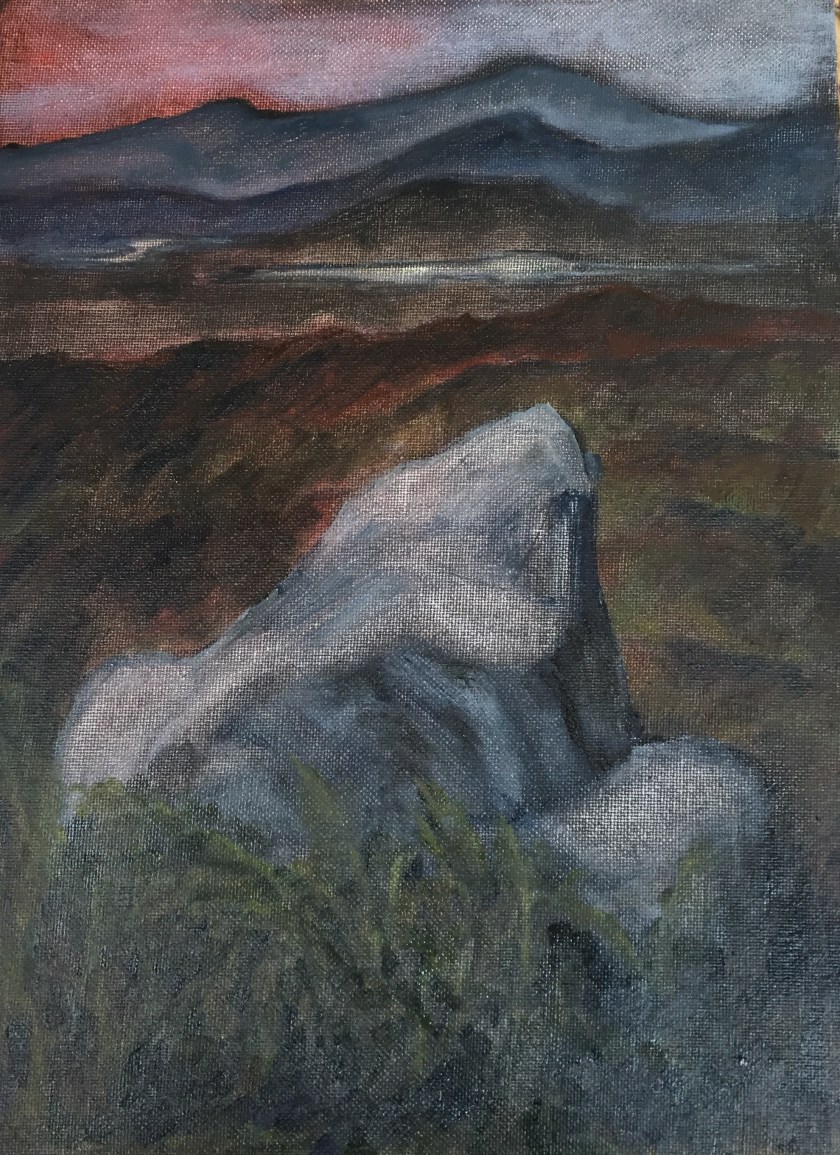
Achmore Stone Circle Megalith looking southwest at the Old Woman mountain range. Isle of Lewis, Scotland. Robin L. Chandler 2017
Gray skies and drizzle we drove the narrow track through the moors on the Isle of Lewis. Fresh from the Skye ferry, we were bound for the Callinish Stones, when we crested a hill and the sky opened upon a vista of mountain and sea. It was beautiful in a Brontë Sisters sort of way, the promise of redemption beyond the horizon, but a long troubled journey ahead with no certain success. We stopped to absorb this compelling view. Was it Providence, or was it simply a universal acknowledgement of beauty that had made us stop here? A windswept, rain-drenched patch of stone not far removed from the sound of the sea. Our rest to gaze at the magical landscape was serendipitous as we soon realized that nearby, barely acknowledged by signposts, was a nearly invisible stone circle built by peoples of the Neolithic British Isles. Situated near the village of Achmore, the stones, now unintended memorials, were monuments placed some four thousand years ago by peoples tracking the cycles of the sun and moon. With our reverence at these monuments, we seek connection to ancestors, and hoped for insight into the human condition. All the while looking southwest toward the mountain range known locally as the Old Woman; the hypnotic mountain range directing us to stop and commune with this place.
Memorials and the need to learn from the past are much on my mind these days. In Glasgow, I spoke with historian, Valentina Rozas-Krause, who writes about memorials: “monuments are as old as civilization. Whether with stones, totems, trees, stone plaques, busts, arches, or sculptures, the ways of materializing memories are as varied as the cultural manifestations that exist.” In her article, Challenging the Traditional Monument: Four Reviews Applied to Santiago and Buenos Aires, Rozas-Krause writes about archaeological memorials serving as material witnesses to a harrowing past. She raises an important question “how do we live with the ruins?” I ask myself: how do we live with ruins, both literal and figurative? Can we learn from the ruins so the past is not forever doomed to repeat itself? Two books I read while traversing Scotland serve as literary memorials, built around past ruins, crimes against humanity: Han Kang’s Human Actsand W.G. Sebald’s Austerlitz. Phenomenal works of literature. Difficult journeys both, but sad depths to which a reader must travel if we are to learn from the past. We must traverse difficult roads, we must live with these ruins and encourage others to make the journey as well, if we are to have any chance at acquiring the empathy essential to ensure the future of humankind.
Much later in the day, I queued up a song called The Old Woman by Skippenish, from their album The Seventh Wave. In a small store near the Callinish Stones, the album had spoken to me in that way that happens only when you’re browsing in uncharted territory. Something reaches out and says: “stop, look at me, learn from me, I’m the soundtrack you’ve been looking for.” And indeed, suddenly, the track The Old Woman meant so much more, after our visit to stones at Achmore. As I wander, as I wonder, no matter how much sadness I see or learn about, I cannot shake my sincere belief that by understanding the past, we can gain the empathy we need, to ensure our future.
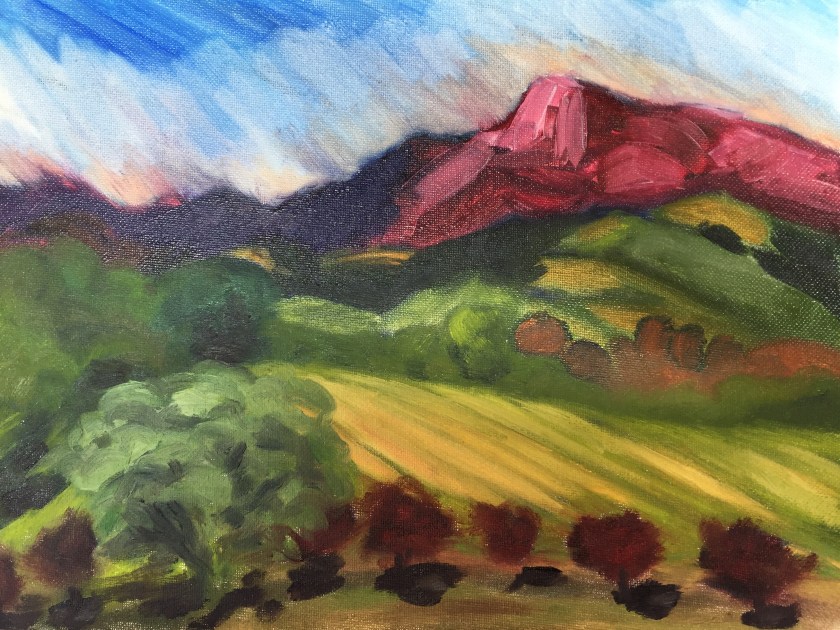
Mt. Ste. Helena in Spring. Robin L. Chandler, 2017.
Since my March 2017 artist residency, I have returned many times to the vineyard at Chalk Hill to gaze and make some oil sketches and watercolors of Mt. Ste. Helena, the defining mountain of the Napa-Sonoma region. It captivates my imagination. In the last few months winter has become spring has become summer; the weekly changes subtle, the seasonal changes dramatic. Green has become gold. Gray has become blue. And with my art I have tried to render this transformation.
In Cezanne: A Study of his Development, the art historian Roger Fry described the artist’s attachment to the landscape of Aix, France: “Cezanne devoted himself so constantly to interpreting that part of the countryside….that is dominated by the great buttressed ridge of Mt. Ste. Victoire. It is a mountain that impresses one rather by the strangeness of it’s ‘personality’ than by it’s height or it’s precipitousness…..no mountain has ever been explored by an artist so persistently, so incessantly as this…..his interpretation is extremely personal…..it is characteristic of Cezanne’s method of interpreting form, thus to seize on a few clearly related, almost geometrical elements, and then on top of this clearly held framework, to give to every part of the contour the utmost subtlety of variation which his visual sensibility could discover…..”
My great friend and teacher, the artist Anthony Dubovsky, writes about the importance of place, time and memory to an artist’s work; the artist’s challenge to find the right balance between story and form and; through the artist’s work bring some understanding to the meaning of life. In his book Jerusalem: To Know By Living, Tony writes “and yet the rhythm of the life here – the dailiness of it, the meaning of the dailiness, where making one’s way up Rehov Ba’al ha-Tanya at dawn is already to be a part of it. To know it. And to know it is to know life, slowly, day by day…..to know by living, to know by living.” Slowly, day by day, I am coming to know my Mt. Ste Helena, as other artist’s in other times and places have come to know their mountains.