green fire

Hiking on the Bolinas Ridge Trail at the Geography of Hope. Copyright Robin L. Chandler
Hiking on the Bolinas Ridge Trail at the Geography of Hope. Copyright 2013 Robin L. Chandler

In his essay Thinking Like a Mountain, Aldo Leopold recorded the moment his ecological thinking evolved. “We reached the old wolf in time to watch a fierce green fire dying in her eyes.  I realized then, and I have known ever since, that there was something new to me in those eyes – something known only to her and to the mountain.  I was young then and full of trigger-itch; I thought that because wolves meant fewer deer, that no wolves would mean hunter’s paradise.  But after seeing the green fire die, I sensed that neither the wolf nor the mountain agreed with me.”

Leopold spent a lifetime as a forester, a professor and an environmentalist developing his ideas and perspectives on the ethics of nature and wildlife preservation. Ultimately, his philosophy, evolving over years of observation and contemplation became known as his Land Ethic, which is at the core of his most beloved book A Sand County Almanac.  Aldo Leopold joins Henry David Thoreau and John Muir as one of our three great American wilderness visionaries and writers.

This weekend March 15 – 17, 2013, Point Reyes Books (near Tomales Bay) is hosting its 4th Geography of Hope Conference entitled Igniting the Green Fire: Finding the Hope in Aldo Leopold’s Land Ethic. Typically held in March, these intellectual and spiritual gatherings are a gift to celebrate the coming of spring and rebirth encouraging us to think deeply about our relationships with the earth and our fellow living beings. At the conference’s center is the film Green Fire: Aldo Leopold and a Land Ethic for Our Time, a wonderful film directed by Steve Dunsky, edited by Ann Dunsky, written by Stephen Most and narrated by Curt Meine.  It was announced at the conference that the film would be shown on PBS stations nationwide in April 2013.

Surrounding the film is a series of panel discussions with writers, thinkers and doers engaged the building of communities, the importance of stewardship and discussing our responsibilities to the land and to each other. One of the most compelling conversations has been with Michael Howard, Director of Eden Place Nature Center (part of the Fuller Park Community Development Corporation).  Inspired by Leopold’s belief in the importance of community and the land, Michael Howard has built a park and a farm for the African-American community on Chicago’s South Side.  “Eden” is in a place that was the former site of meat packing industry slaughterhouses, also polluted with lead poisoning which has impacted the ability of children to learn for generations.  Howard deeply moved me with his work to try to persuade a people about the benefit of having a relationship with the land; a people whose daily concerns are about having money to pay bills and feed their children and who have spent years running away from a specter of linking the land to sharecropping and slavery.  Michael Howard’s experience evoked for many conferee’s Paul Hawken’s Blessed Unrest about the emergence of non-profit and community organizations engaged in the environmental and social justice movement.

There is so much wisdom flowing from this conference, I will need days, weeks, perhaps a lifetime to really grasp and understand it all, and to see my thinking evolve as Aldo Leopold has demonstrated.  But what rings clear and true is this: we need to understand that change is something that happens gradually, and it comes by engaging in deep listening, exchange with and respect for both humans and the land. We must learn to “think like a mountain.”

Constellation Cetus and a shooting star

Farallon Islands from Point Reyes on a winter day.  Copyright Robin L. Chandler.
Farallon Islands from Point Reyes on a winter day. Copyright 2012 Robin L. Chandler.

It’s late afternoon on the last day of December 2012 and the annual Pacific migration of the gray whales from the Arctic to Baja is underway. On a spectacular day the air is clear and crisp, the sea is still – little movement on the waves, a cold rainy front moves south towards Southern California just skirting the Bay Area. Miles-at-sea, there is a flash of lightening. From the cliffs at Point Reyes National Seashore we look south towards the Farallon Islands. Wave gazes out at the infinite horizon and happily finds a small pod of whales. One fluke breaks the plane, and a bushy kind of heart shaped blow emerges nearby. “A whale spout is like catching a glimpse of a shooting star,” she says.

Antoine de Saint-Exupery’s 1943 novel The Little Prince comes to mind:

“All men have the stars,” he answered, “but they are not the same things for different people. For some, who are travellers, the stars are guides. For others they are no more than little lights in the sky. For others, who are scholars, they are problems. For my businessman they were wealth. But all the stars are silent. You–you alone–will have the stars as no one else has them–”

Footnote: this afternoon Public Radio International interviewed the iconic American folksinger Pete Seeger about the beloved Chilean poet and musican Victor Jara who wrote and sang songs about love, peace and social justice. Jara was brutally murdered during the 1973 Chilean military coup that ousted President Salvador Allende and finally last week a Chilean judge issued an international arrest warrant for his killers and their accomplices.  Pete sang the words “Victor Jara lived like a shooting star, a shooting star.”

Prosperity is right around the corner

Grain elevators, Thorndale, Texas. Copyright Robin L. Chandler
Grain elevators, Thorndale, Texas. Copyright 2012 Robin L. Chandler

“What do you want to do,” he asked. “Thorndale…I want to visit the Texas town where you were born and grew up.” We drive through Milam County listening to my Father’s stories as he points out his life landmarks. Travelling the farm-to-market roads in cotton country, we pass through mostly ghost towns like Bartlett, a once thriving farming community and sometime Hollywood location shoot, and San Gabriel, originally a Spanish mission.  Under gray winter skies, the soil, where corn and cotton were recently harvested, still look rich and black. Farmers still grow these crops here, but you get the feeling, people don’t do much of their living here anymore. Living might be a few miles to the south where the economy has shifted to the technology industries surrounding Austin.

It’s Christmas Eve and Thorndale is quiet. Thorndale is about ten miles east of Taylor where my grandparents and my mother are buried and about forty miles from Temple where I was born. A few trucks are parked in front of the main street café where we get a last cup of black coffee before they close down for the holiday. A main state highway cuts through town paralleling the railroad tracks.  Pick-up trucks roar by and now and again the sound of a Santa Fe diesel train engine horn moans lonesomely in the distance. We walk around town visiting the Victorian era farmhouse where my Father was born and grew up during the Great Depression. Living mostly in busy urban centers, it’s hard to believe that many of these ramshackle wood frame houses – that a strong wind might scatter – are still lived in.

Looking north from Temple, Texas at an oncoming cold front.  Copyright Robin L. Chandler.
Looking north from Temple, Texas at an oncoming cold front. Copyright 2012 Robin L. Chandler.

When my Father was a boy, more than one thousand people lived in Thorndale. Ironically, the 2010 US Census counts the town’s population at over one thousand. As we walk, my father points out the now boarded-up movie theater where he watched Tom Mix movies, and the abandoned car dealership. Some businesses from his childhood remain, including Mr. Butts’s dry goods store where you can still buy a good pair of work boots. I feel like a human Historypin, my imagination does the work of the computer overlaying linked-data historic photographs of a busy farm town on the now sadly deserted streets. Down the street, stands a small brick building framed with Doric columns, still housing the Prosperity Bank; I laugh to myself, recalling a scene from the 1936 film My Man Godfrey.

Set in a “Hooverville” along New York’s East River, Godfrey Park (the actor William Powell) and Mike (the actor Pat Flaherty) exchange a few words. “Mike, I wouldn’t worry.  Prosperity’s right around the corner.” “Yeah. It’s been there a long time.  I just wish I knew which corner.” Prosperity’s right around the corner was a phrase employed by Republican Party members advising the country after the Wall Street Crash to be patient and trust the free market’s ability to right itself.  Will patience serve us today as our Congress and President tango close to the fiscal cliff? As we stand in front of the bank, my Dad recounts a sight that remains stamped on his brain.  As a young man in the early 1930s, he witnessed grown men leaving the bank with tears streaming down their faces when the bank foreclosed on their farms.  He recalls they didn’t know how they were going to feed their families and hoping the federal government would continue to provide the five-pound sack of flour for free.  Woody Guthrie’s song about the bank robber Pretty Boy Floyd comes to mind.  The Smithsonian Folkway released a wonderful collection of his songs this year celebrating the centennial of his birth.

“Well, you say that I’m an outlaw, You say that I’m a thief. Here’s a Christmas dinner, for the families on relief.”

“Yes, as through this world I’ve wandered, I’ve seen lots of funny men; Some will rob you with a six-gun, and some with a fountain pen.”

“And as through your life you travel, yes, as through your life you roam. You won’t never see an outlaw, drive a family from their home.”

Burning Bright

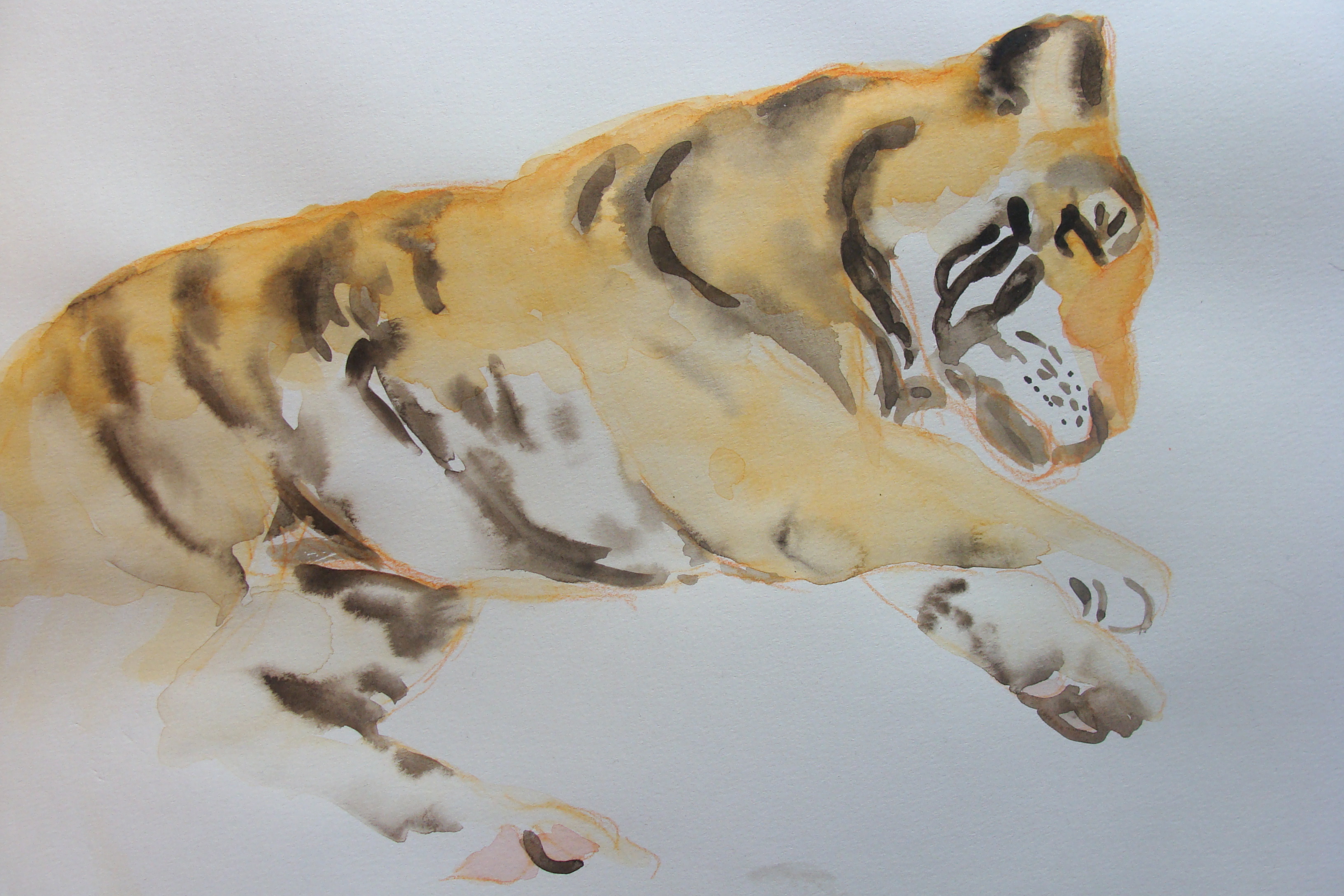
The Tiger Copyright 2012 Robin L. Chandler

Durga, all fearlessness, patience, full of humor and creative feminine force, rides her tiger onto the field of battle, her eighteen arms holding weapons, the gifts of Hindu gods.  Fiercely compassionate, astride her tiger, the warrior goddess engages in epic spiritual battles to protect virtue and subdue the evil chaos unleashed upon the world by demons.  Durga rides a tiger because it is a symbol of unlimited power; the tiger is the king of the forest, a power on earth beyond the reach of any mortal.  An important figure in Hindu mythology, today the tiger is the national animal of India.

Inspired by Tea Obreht’s talk at Bookshop Santa Cruz about her magical story The Tiger’s Wife, I went to the Oakland Zoo to paint the tiger.  Obreht’s book examines how myths and stories can be a force for good or fuel for fear running “like secret rivers through all the other stories of a life.”  Obreht engages animal symbols to examine our fears about people – their race, culture and religion.   For Obreht animals in our myths and stories are symbolic catalysts for choice as we navigate life.  Is that animal an “it” or a “thou”?  The answer will determine how you act. You have a choice.  And by extension is the stranger an “it,” or perhaps someone with relationships, hopes and dreams just like you?  Pondering human nature in terms of communication taking the form of a monologue or a dialogue, the Jewish philosopher Martin Buber described human existence in categories of consciousness, interaction and being in his book I and Thou.

Myths and stories can be a force for good. Durga and her tiger subdueing evil chaos on a daily basis is a story that strengthens me while navigating a chaotic and unjust world.   But Obreht weaves a different story.  In her tale, the outsider – a person from a different culture and religion  – through circumstance, becomes the Tiger’s wife, a person, perceived by villagers afraid of “the other,” as a powerful mythical devil hell bent on bringing destruction.  Obreht’s grandather tells Natalia “there are some stories you keep to yourself – it belongs only to you.”   But Obreht’s tale is not a story you keep to yourself, it is one share.

After reading The Tiger’s Wife, I found myself acting out the pilgrimage of Natalia and her grandfather seeking Shere Kahn, immortal tiger of The Jungle Book. Last Fall, the Oakland Zoo rescued four young tigers, sisters all: Ginger, Grace, Milou, and Molly. Privately owned, a divorce suddenly rendered the young tigers homeless. The Oakland Zoo gave these magnificent and powerful animals a home, respecting the need to keep them as a family.  While there are only 3,500 wild tigers worldwide, it’s estimated there are more than 8,000 tigers privately owned in the U.S. and only a few of those are found in zoos. Tigers once ranged across Asia from Turkey to the eastern coast of Russia, as well as Java and Bali. Today they are an endangered species having lost 93% of their historic range and their dwindling numbers in the wild are now found only in India, Nepal, Russia, China and Southern Asia.  If tigers are to survive in the wild and in captivity, we must see them as beings worthy of our respect; they must be “thou” and not “it.”   As Obreht writes “he was only half wild and in his partial tameness…..he missed…..the companionship and predictability of life at the <zoo>…..however expertly he learned to fend for himself, his life as a tiger had been tainted since birth – maybe that great Shere Kahn light my grandfather believed in had already been extinguished….. but that is not the tiger on whose account my grandfather carried The Jungle Book in his pocket every day for the rest of his life….. it was <the Tiger’s Wife’s> great fortune…..to encounter a tiger that was not all tiger…..maybe it’s enough to say he enjoyed the sensation of her hand between his eyes…..she liked the way his flank smelled when she curled up against him to sleep.” Animals in our myths and stories are symbolic catalysts for choice as we navigate life.  And in reality, how we choose to honor the lives of animals, reveals much about how we choose to honor life itself.

Auld Lang Syne

Farmer’s Market, Splashpad Park, Oakland. Copyright 2011 Robin L. Chandler

“How do you do that?” said Terrell.  About six years old, my admirer sat beside me on the concrete wall.  “I like to paint too…Santa brought me some paints, brushes and paper.”  While his grandmother watched, I loaned my new friend some paper and a brush and, we painted together in the brilliant sunshine of this last day of 2011.  The Saturday Farmer’s Market is a worthy subject: a unique cityscape with the mixing and mingling of so many kinds of people engaged in reaping the fruits of farmer’s labor.  As I walk through the market and see the bounty of the harvest, I recall the stories from a wonderful book  Cultivating a Movement. Edited by Irene Reti and Sarah Rabkin, the book draws from oral histories documenting the lives of individuals engaged in organic farming and sustainable agriculture on California’s Central Coast. The interviews dig deep into the social, cultural and environmental history of California on a range of topics concerning organic / sustainable agriculture including the influence of the hippie movement of the 1960s and 1970s; the influence of Alan Chadwick on farming; the organizing of Mexican-American farm workers resulting in the formation of the United Farm Workers (UFW) union; the publication of Rachel Carson’s Silent Spring; the creation of the California Certified Organic Farmers (CCOF); and the influence of the UC Santa Cruz Center for Agroecology and Sustainable Food Systems. Recommended reading!

Our urban life blossoms in this space called Splashpad Park; an island of trees, shrub and grass floating between a major freeway and busy city streets.  Cars rush by; children and their parents line-up to see movies at the Grand Lake Theater; activists pass-out buttons and leaflets for Occupy Oakland while others gather signatures for a referendum against the death penalty; musicians play folk songs and Grateful Dead tunes; and shoppers visit the bakery, dry cleaners and other specialty shops as well as the Farmer’s Market.   Oakland’s community awakens on Saturday mornings, re-energized after the busy workweek, engaging in the timeless ritual of gathering those items necessary for sustenance.    Not sure if his little self will grasp all I wish him to know, but I pass on to Terrell the wise words of my drawing teacher Rob Anderson “draw what you know, what you see, what you feel, continue on until it is what you are.”  Grandmother gently urges Terrell that its time to leave; she rattles off the items they still need to buy: navel oranges, beets, radichio and arugula.

Turning back to my painting, I modestly attempt to capture on paper something reminiscent of the grand American Experiment performed by the Ashcan Painters – including Robert Henri, John Sloan, George Luks, William Glackens and Everett Shinn – a vivid description of America’s bustling cities and her people. My favorite painter of this Group – George Bellows – created some of the most moving depictions of the urban landscape: “The Lone Tenement”  and “Blue Morning.”  So, on this December 31, 2011 I raise my brush in celebration of painters old long ago, always brought to mind.

Ghosts of Aprils Past

Cotton. Copyright 2011 Robin L. Chandler

Guarded by the monuments honoring the defenders from the northern aggression

A town square, now sits quiet

Bypassed

The highway  leads to the WalMart suburbs, spaces filled with fast food and fast fun, a drive through espresso and a MySpace page

The rhythms of cicadas, drowned by the roar of air conditioners

In the shade of live oaks, by the County Courthouse, I sit with my father and uncle

They speak of my grandfather – Eph – Manager of the cotton gin in Thorndale, Texas

With their voices the past comes alive:

The wagons creaking under their load

Bales of cotton

Products of hours of picking under a hot sun

Sweat streaming

Backs bent with pain

Bloody hands

Callused hands scarred by the thorns of the south’s cash crop

White hands and black hands made equal

By the pain and the heat

Sunlight streams through the cracks

Revealing cotton dust rising

Filling the spaces between breaths

The cotton enters the gin

Separating fibers from seeds

Long white fibers

To form the clothes on our backs

Dark seeds pressed

Oil for margarine, meal to feed cattle

They say the cotton gin killed Eph

Years of dust caused the cancer in his brain

A working man

A hard man

No time for tenderness

Love meant food on the table and a roof over their heads

My father’s sense of duty and responsibility flow from him

Father buried Eph in Taylor – as he asked — with a good view of the  road to Thorndale

Later that evening, we watch a little league game, April brings the nation’s pastime

A hot wind blows across the field

A reminder of the scorching Texas day

Grasshoppers by the hundreds fly towards the electric lights.

A black child walks by

Interrupting the serenity of our colorless existence

Watch him, a stranger says, he may have a knife

Shaken, I am horrified: the cotton gin cranks on, separating the light from the dark

Suburban streets cannot mask

Centuries of hurt, neglect and segregation

Revisiting our country’s Civil War, April resonates: Sumter, Appomattox, Lincoln’s Assassination

Bypass not these one-hundred and fifty years

Bypass not these struggles for justice

Mold not history to political need

Pick not the path of easy memory and least resistance

Sift the evidence, seek the truths

For we hold these truths to be self-evident

That “all” are created equal

Long before his death in Memphis in April 1968

Dr. King dreamed on the 100th Anniversary of the Emancipation Proclamation at the  steps of the Lincoln Memorial:

“…..we will be able to transform the jangly discords of our nation into a beautiful symphony of brother hood.”

part of something greater

Between the Dark and the Light. Copyright 2010 Robin L. Chandler

The Rabbi’s words from Psalm 23 hang in the stillness of the First Congregational Church.  Her clear strong soprano sings “yeah that I walk through the valley of death, I shall fear no evil, for you are with me.”  Some two hundred voices join her singing the prayer; my voice cracks a little, overcome with feelings I didn’t realize were buried.  On January 13, I attended the “American Unity Town Hall” in Santa Cruz hosted by the Honorable Sam Farr seventeen term Member of Congress from 17th Congressional District of California.  The church’s pastor opened the meeting with the words “I need to be with a group of people tonight for healing and growth.”  Congressman Farr followed reflecting on Congresswoman Gabriele Giffords “for all the wrong reasons, the world is now aware of how special you are” and “our children are being raised on hate talk…..a democracy based on negative talk cannot survive.”

A community gathered that night in an ecumenical setting to seek meaning from tragedy and reaffirm belief in our republic’s democratic process.  Wendell Berry wrote in The Way of Ignorance “our religious principles are justice, mercy, peaceableness, and loving kindness toward fellow humans and the gifts of nature, as our political principles are freedom confirmed in law, honesty, and public accountability.  These are not the principles of a party. These are our free inheritance as human beings and citizens living under the Constitution of the United States.”

The senseless shooting of Congreswoman Giffords and the deaths of six others in Tucson are a tragedy;  the impact of that moment resonates in Santa Cruz in many ways.  We lost Gabe Zimmerman, Director of Community Outreach for Congresswoman Giffords; he was a University of California, Santa Cruz (UCSC) 2002 graduate in Sociology.  UCSC Professor Paul Lubek said “Gabe fulfilled the ideals of the University….he engaged in public service to perform social justice.” A few days after we absorbed the events in Tucson,  campus administration announced the threat of a possible active shooter at UCSC on January 18.  Living with guns and acquiring the skills to survive an active shooter attack are sadly becoming the norm, and I ask: was this the intended outcome of our Constitution’s Second Amendment the right of the people to keep and bear arms shall not be infringed?  Sometimes it feels like Frederick Jackson Turner ‘s historical thesis has been revised:  the American Frontier was closed, but now it’s officially reopened! Life is mimicking the final scenes from Gunfight at the OK Corralthe great vendetta myth of the American West. Yeah, that was in Tombstone….Arizona. Irony or foreshadowing?

In the last week my healing has begun, but as January – the gateway to the new year —  closes I wonder what the rest of the year will bring.  Ever hopeful, I walk through the doorway inspired to climb the mountains ahead and committed to being a better listener  and more attuned to sufferings around me.  Speaking at the Memorial Service in Tucson, President Obama quoted from the Book of Job “I looked for light and found darkness” and he asked us all  “to expand our moral imaginations” and “to talk with each other in a way that heals, not in a way that wounds.” Because “how we treat one another is entirely up to us” and  “the forces that divide us are not as strong as the forces that unite us.”  And in his State of the Union address, he said “amid all the noise and passion and rancor of our public debate, Tucson reminded us that no matter who we are or where we came from, each of us is part of something greater – something more consequential than party or political preference…..we are still bound together as a people [and] what we can do  – what America does better than anyone else – is spark the creativity and imagination of our people…..we do big things.” We can climb the mountains ahead of us.

The Jewel of Turtle Island – Part Two

Another winter day at Lake Merritt. Copyright 2011 Robin L. Chandler

Last week we began the new chapter in our community history, Jean Quan was inaugurated as the first Asian and first woman Mayor of Oakland!  Quan brings over twenty years of experience on Oakland’s School Boards and City Council as well as the strong belief that communities and neighborhoods can work together to face the city’s challenges.  We find ourselves in challenging economic times: a deep gap exists between our expectations of government and society and the funding resources to realize these expectations.   We face tough choices in the years ahead, but we must trust and work together as a community to find the right balance. With the shooting of U.S. Congressman Gabrielle Giffords yesterday in Arizona, our society has received a startling wake-up call, and the dawn appears bleak, fueling trepidation about our abilities to discuss painful choices and work together to bring about non-violent change.  We must continue to engage each other in civil discourse to resolve our societal challenges. Our rallying cry will be a recommitment to our community, to our Turtle Island, because the alternative would be a geography of no-hope, and that simply is not an option.

Gary Snyder wrote in his book A Place in Space: Ethics, Aesthetics and Watersheds “Bioregionalism calls for commitment to this continent place by place in terms of biographical regions and watersheds.  It calls us to see our country in terms of its landforms, plant life, weather patterns, and seasonal changes….before the net of political jurisdictions was cast over it….it doesn’t mean some return to a primitive lifestyle or utopian provincialism; it simply implies an engagement with community…..some of the best bioregional work is being done in cities as people try to restore both human and ecological neighborhoods……such people are becoming natives of Turtle Island.”

The Jewel of Turtle Island – Part One

Winter day at Lake Merritt. Copyright 2011 Robin L. Chandler

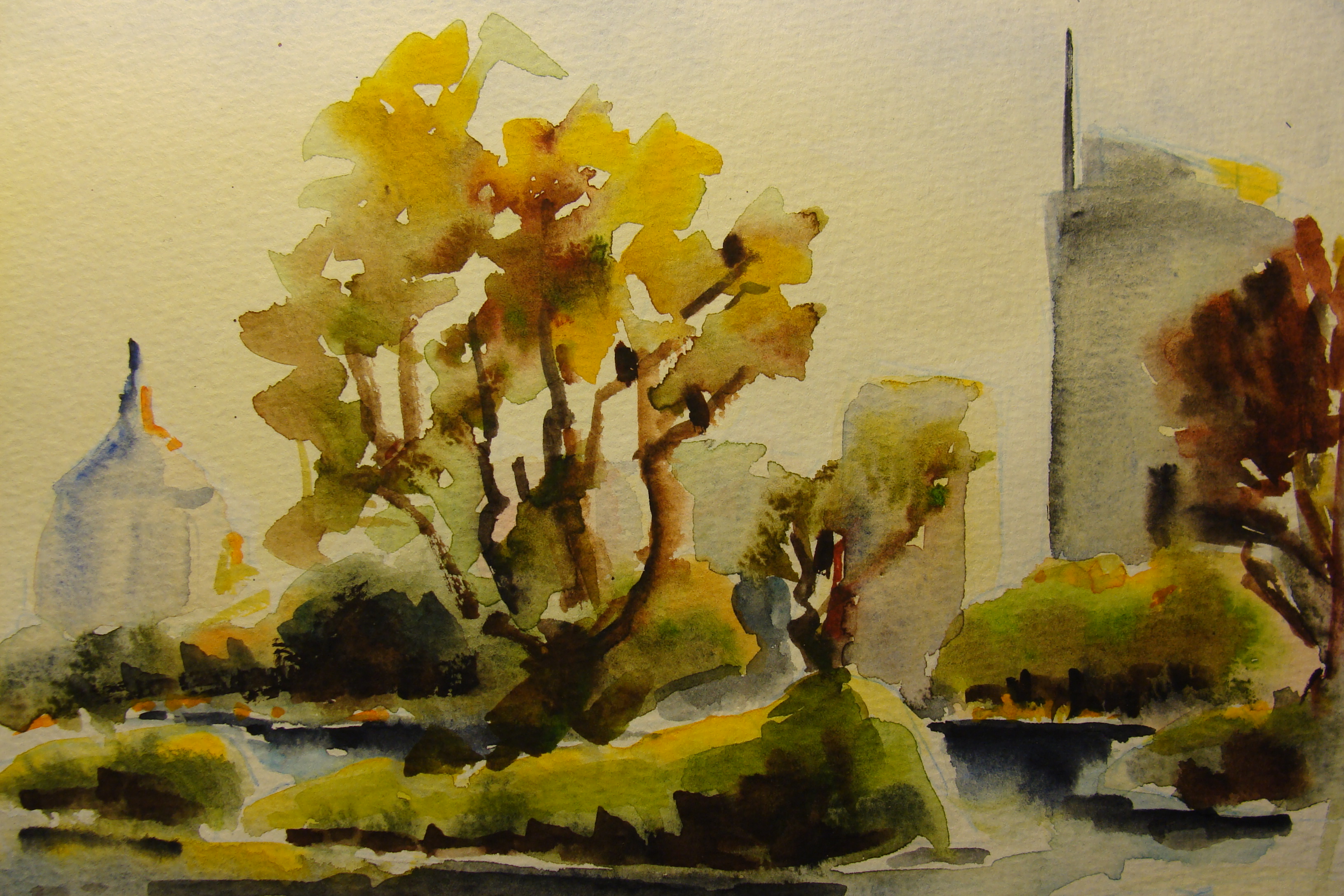
Glen Echo Creek flows through Oakland’s Rockridge and Piedmont neighborhoods meandering from the East Bay Hills into Lake Merritt.  We first discovered this creek on a December Sunday afternoon after an IPA and a good game of scrabble at Catos our local pub. Glen Echo Creek daylights briefly paralleling Broadway and Piedmont for a mile before being channeled through underground culverts resurfacing to flow into Lake Merritt near the Veterans Memorial Building on Grand Avenue.   Walking home we traced the creek’s path and final destination, enjoying the reflection of Oakland’s twilight skyline and the “necklace of lights” in the water.   It was beautiful.

Walking on this cold January morning, the fresh water creeks and salty tidal flow create a flux where brown pelicans, snowy egrets, herons and cormorants seek fish and seagulls dive for mussels amongst the creek and sewer runoff, and stream of trash – a beer can, a plastic water bottle, a tennis shoe, a Christmas wreath, oil residue and the carcass of a possum – deposited after the heavy rains of December. Passing a homeless gentleman just beginning his day’s journey, I imagine this space two centuries ago when coho salmon and steelhead trout entered the estuary on their journey to spawn in one of the watershed’s four creeks** then sheltered among the redwood trees but now largely hidden, paved over with asphalt.

Ishmael Reed in his book Blues City: A Walk in Oakland describes Lake Merritt as the “largest saltwater lake in the United States….and before it was dammed it was part of the larger San Francisco Bay.”  In his discussions with Malcolm Margolin author of The  Ohlone Way and with naturalist and historian Stephanie Benevides, Reed learned the lake was originally an estuary and part of one of the largest marshlands on the Pacific Coast, a major stop of the Pacific Flyway for migrating birds coming south from Canada and Alaska for the winter. The marshlands were part of the larger ecosystem of grasslands and oak trees rising to hillsides with crevices cradling creeks and redwood trees.  Wildlife included grizzly bears, mountain lions, condors, bald eagles, deer and wolves.  In 1869, Dr. Samuel Merritt worked with the California State Legislature to make Lake Merritt the first wildlife refuge in North America.

Many an early morning, I have circumnavigated this body of water andcontemplated what an amalgam the estuary is and how this mixture serves as a metaphor for the City of Oakland.   Literally the lake is a mixture of fresh and salt water, their balances dictated by tidal influx and watershed creek runoff; and it is an urban park which merges the sublime natural beauty of  migrating winter birds, such as canvasbacks, goldeneyes and scaups, with the urban discharge of trash and waste.   Figuratively, Oakland’s jewel is a dynamic public space – a cultural estuary – where mingle peoples of many cultures, races, creeds, gender identity and sexual preference: rich and poor, young and old, the fortunate and desperate, those with homes and those heartbreakingly homeless.  They come seeking a safe harbor in which to play, exercise, rest, and draw inspiration from the tranquil beauty of the lake and its surroundings.   As Wallace Stegner wrote in his Wilderness Letter “we simply need that wild country available to us, even if we never do more than drive to its edge and look in.  For it can be a means of measuring ourselves of our sanity as creatures, a part of the geography of hope. “  Lake Merritt is Oakland’s geography of hope.

In November 2002, more than  80 % of Oakland voters passed measure DD, a $ 198.25 million bond measure to improve and restore Lake Merritt including reducing traffic, improving pedestrian and bicycle access to the park, renovating historic buildings such as the Boat House, landscaping and improving water quality through the upgrading of creek culverts and opening of the channel to the Oakland estuary.  Work has been proceeding the last several years, and we are benefitting from the fruits of these labors. New life is breathing into the lake and it’s surroundings.    But the story doesn’t end with the completion of the project — it is just the beginning of a new chapter of our community responsibility for this jewel of Turtle Island.

*for many months this homeless gentleman employed a car battery to power his television and a hotplate, setting-up camp near the Alameda County Courthouse

**the four creeks are Glen Echo, Pleasant Valley, Trestle Glen and Park Boulevard

To shape the future

There are two holidays that serve as book ends for my mother’s life: the 4th of July marks her death and Labor day marks her birth. This year – 2009 – marks the 20th anniversary of her passing and would have been her 92nd birthday were she still with us. My mother was an energetic woman hugely impacting my life; it wasn’t always easy, but I know and love the gifts she gave me. She loved making music and creating things. Growing up, there was always some kind of project in the works be it making candles  (and spray painting them gold for whatever reason), sewing clothes for me and my sister, or preparing for her teaching job or her girl scout troop. She had so much energy and intelligence and she was driven to do something helpful for others.

When I was very young, my mom worked as an occupational therapist. One of her patients was a young man with polio confined to an iron lung. I remember that he painted the most wonderful paintings using only the movements he could make with his big toe. My mother had built a splint for that big toe enabled to cradle a paint brush and she spent hours with him making sure it fit correctly and gave him the support he needed to do his art. From my mother I learned that a person could do anything with a little help and kindness, and beautiful artwork flows from everyone.

healthcare
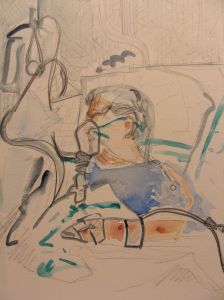
Pain. Copyright 1989 Robin L. Chandler

Unfortunately, the last years of my mother’s life were spent in nursing facilities and hospitals. Our family was fortunate, because the government’s Medicare provision and my father’s health insurance covered those expenses. During the last few weeks of her life, I visited my mom in the hospital and I tried to capture those moments in watercolor. Robert Henri wrote in his book Art Spirit “the beauty of the lines of the drawing rest in the fact that you do not realize them as lines, but are only conscious of what they state of the living person…you have been let into that life.” It was important to paint her, so that I would never forget her pain. Over the years I have returned to those paintings to remember my mother and think about the good things she did for others. I share one with you now to serve as a call to action. This is our time we can make a difference and help others.

In the middle of August 2009, the group Remote Area Medical provided free health care services to some 10,000 residents of Los Angeles for eight days providing the uninsured with routine services like eye and dental exams, mammograms and access to special treatments like kidney dialysis. There is a crying need for healthcare reform in this country. We need to find the right model so that no one is without healthcare in our country. The latest recession figures indicate there are 40 million Americans living in poverty and they cannot afford healthcare. T. R. Reid’s book The Healing of America: A Global Quest for Better, Cheaper, and Fairer Health Care describes four basic models of health care at work in the world: Britain’s Beveridge Model where health care is provided and financed by the government; Germany and France’s Bismark Model where private insurance funds — financed by employers and employees — cover everyone and are government regulated to keep costs low; Canada’s National Health Insurance model which uses private-sector providers financed by government insurance plans into which every citizen pays; and lastly the “out-of-pocket” model most found in undeveloped nations where you get what you can pay for. We can do better than the last model. Wednesday night, President Obama laid out his vision of healthcare reform stating “if you’re one of the tens of millions of Americans who don’t currently have health insurance, the second part of this plan will finally offer you quality, affordable choices. If you lose your job or change your job, you will be able to get coverage.” He went onto say we can help people in need and we can solve this big problem. When I remember my mom, I think of someone who was always trying to do something useful to help someone in need. Like my mother, everyone deserves access to healthcare through every stage of their life. Now it’s our generation’s turn to help others. Lets bring about healthcare reform and shape the future by our actions.