The Jewel of Turtle Island – Part One

Winter day at Lake Merritt. Copyright 2011 Robin L. Chandler

Glen Echo Creek flows through Oakland’s Rockridge and Piedmont neighborhoods meandering from the East Bay Hills into Lake Merritt.  We first discovered this creek on a December Sunday afternoon after an IPA and a good game of scrabble at Catos our local pub. Glen Echo Creek daylights briefly paralleling Broadway and Piedmont for a mile before being channeled through underground culverts resurfacing to flow into Lake Merritt near the Veterans Memorial Building on Grand Avenue.   Walking home we traced the creek’s path and final destination, enjoying the reflection of Oakland’s twilight skyline and the “necklace of lights” in the water.   It was beautiful.

Walking on this cold January morning, the fresh water creeks and salty tidal flow create a flux where brown pelicans, snowy egrets, herons and cormorants seek fish and seagulls dive for mussels amongst the creek and sewer runoff, and stream of trash – a beer can, a plastic water bottle, a tennis shoe, a Christmas wreath, oil residue and the carcass of a possum – deposited after the heavy rains of December. Passing a homeless gentleman just beginning his day’s journey, I imagine this space two centuries ago when coho salmon and steelhead trout entered the estuary on their journey to spawn in one of the watershed’s four creeks** then sheltered among the redwood trees but now largely hidden, paved over with asphalt.

Ishmael Reed in his book Blues City: A Walk in Oakland describes Lake Merritt as the “largest saltwater lake in the United States….and before it was dammed it was part of the larger San Francisco Bay.”  In his discussions with Malcolm Margolin author of The  Ohlone Way and with naturalist and historian Stephanie Benevides, Reed learned the lake was originally an estuary and part of one of the largest marshlands on the Pacific Coast, a major stop of the Pacific Flyway for migrating birds coming south from Canada and Alaska for the winter. The marshlands were part of the larger ecosystem of grasslands and oak trees rising to hillsides with crevices cradling creeks and redwood trees.  Wildlife included grizzly bears, mountain lions, condors, bald eagles, deer and wolves.  In 1869, Dr. Samuel Merritt worked with the California State Legislature to make Lake Merritt the first wildlife refuge in North America.

Many an early morning, I have circumnavigated this body of water andcontemplated what an amalgam the estuary is and how this mixture serves as a metaphor for the City of Oakland.   Literally the lake is a mixture of fresh and salt water, their balances dictated by tidal influx and watershed creek runoff; and it is an urban park which merges the sublime natural beauty of  migrating winter birds, such as canvasbacks, goldeneyes and scaups, with the urban discharge of trash and waste.   Figuratively, Oakland’s jewel is a dynamic public space – a cultural estuary – where mingle peoples of many cultures, races, creeds, gender identity and sexual preference: rich and poor, young and old, the fortunate and desperate, those with homes and those heartbreakingly homeless.  They come seeking a safe harbor in which to play, exercise, rest, and draw inspiration from the tranquil beauty of the lake and its surroundings.   As Wallace Stegner wrote in his Wilderness Letter “we simply need that wild country available to us, even if we never do more than drive to its edge and look in.  For it can be a means of measuring ourselves of our sanity as creatures, a part of the geography of hope. “  Lake Merritt is Oakland’s geography of hope.

In November 2002, more than  80 % of Oakland voters passed measure DD, a $ 198.25 million bond measure to improve and restore Lake Merritt including reducing traffic, improving pedestrian and bicycle access to the park, renovating historic buildings such as the Boat House, landscaping and improving water quality through the upgrading of creek culverts and opening of the channel to the Oakland estuary.  Work has been proceeding the last several years, and we are benefitting from the fruits of these labors. New life is breathing into the lake and it’s surroundings.    But the story doesn’t end with the completion of the project — it is just the beginning of a new chapter of our community responsibility for this jewel of Turtle Island.

*for many months this homeless gentleman employed a car battery to power his television and a hotplate, setting-up camp near the Alameda County Courthouse

**the four creeks are Glen Echo, Pleasant Valley, Trestle Glen and Park Boulevard
To shape the future

There are two holidays that serve as book ends for my mother’s life: the 4th of July marks her death and Labor day marks her birth. This year – 2009 – marks the 20th anniversary of her passing and would have been her 92nd birthday were she still with us. My mother was an energetic woman hugely impacting my life; it wasn’t always easy, but I know and love the gifts she gave me. She loved making music and creating things. Growing up, there was always some kind of project in the works be it making candles  (and spray painting them gold for whatever reason), sewing clothes for me and my sister, or preparing for her teaching job or her girl scout troop. She had so much energy and intelligence and she was driven to do something helpful for others.

When I was very young, my mom worked as an occupational therapist. One of her patients was a young man with polio confined to an iron lung. I remember that he painted the most wonderful paintings using only the movements he could make with his big toe. My mother had built a splint for that big toe enabled to cradle a paint brush and she spent hours with him making sure it fit correctly and gave him the support he needed to do his art. From my mother I learned that a person could do anything with a little help and kindness, and beautiful artwork flows from everyone.

healthcare
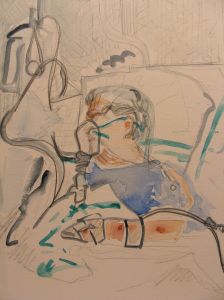
Pain. Copyright 1989 Robin L. Chandler

Unfortunately, the last years of my mother’s life were spent in nursing facilities and hospitals. Our family was fortunate, because the government’s Medicare provision and my father’s health insurance covered those expenses. During the last few weeks of her life, I visited my mom in the hospital and I tried to capture those moments in watercolor. Robert Henri wrote in his book Art Spirit “the beauty of the lines of the drawing rest in the fact that you do not realize them as lines, but are only conscious of what they state of the living person…you have been let into that life.” It was important to paint her, so that I would never forget her pain. Over the years I have returned to those paintings to remember my mother and think about the good things she did for others. I share one with you now to serve as a call to action. This is our time we can make a difference and help others.

In the middle of August 2009, the group Remote Area Medical provided free health care services to some 10,000 residents of Los Angeles for eight days providing the uninsured with routine services like eye and dental exams, mammograms and access to special treatments like kidney dialysis. There is a crying need for healthcare reform in this country. We need to find the right model so that no one is without healthcare in our country. The latest recession figures indicate there are 40 million Americans living in poverty and they cannot afford healthcare. T. R. Reid’s book The Healing of America: A Global Quest for Better, Cheaper, and Fairer Health Care describes four basic models of health care at work in the world: Britain’s Beveridge Model where health care is provided and financed by the government; Germany and France’s Bismark Model where private insurance funds — financed by employers and employees — cover everyone and are government regulated to keep costs low; Canada’s National Health Insurance model which uses private-sector providers financed by government insurance plans into which every citizen pays; and lastly the “out-of-pocket” model most found in undeveloped nations where you get what you can pay for. We can do better than the last model. Wednesday night, President Obama laid out his vision of healthcare reform stating “if you’re one of the tens of millions of Americans who don’t currently have health insurance, the second part of this plan will finally offer you quality, affordable choices. If you lose your job or change your job, you will be able to get coverage.” He went onto say we can help people in need and we can solve this big problem. When I remember my mom, I think of someone who was always trying to do something useful to help someone in need. Like my mother, everyone deserves access to healthcare through every stage of their life. Now it’s our generation’s turn to help others. Lets bring about healthcare reform and shape the future by our actions.

Ben and Jerry got married

Celebrating the legalization of gay marriage in Vermont, Ben and Jerry’s ice cream makers have for the month of September renamed their popular ‘Chubby Hubby’ flavor ‘Hubby Hubby.’ I completely understand why ‘Wifey, Wifey’ wasn’t an option and I will forgive them for my sadness at this momentary gender exclusion. So three cheers for Ben and Jerry’s and pass me that pint of Cherry Garcia! (lovingly named in honor of the late Jerry Garcia legendary guitarist of the Grateful Dead). In August, my wife and I celebrated our one year anniversary as a married couple — one of the 18,000 or so couples that tied the knot when gay marriage was briefly legal in California. Our anniversary was a very special occasion graced with champagne and a piece of the wedding cake.  For our wedding announcement, we used a watercolor I painted of Isola Bella in Taormina, Sicily

Isola Bella, Taormina, Sicily
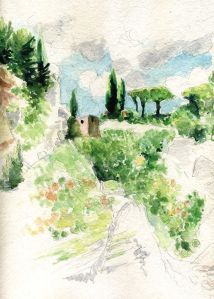
Isola Bella, Taormina, Sicily. Copyright 2005  Robin L. Chandler

the beautiful place where we celebrated our 20th anniversary as a couple.   So though we’ve only legally been married in California for just over a year, we’ve been a couple for nearly twenty-five wonderful years. Some day in the future, gay marriage will be the norm in our country, and not the exception or blasphemy as some see it today.

There is that wonderful saying “as California goes, so goes the country,” which in my mind translates as California sets the trends and others follow a good idea. But that hasn’t always been the case. Many of the leading abolitionists fighting to end the practice of slavery in the United States were from New England including Ralph Waldo Emerson, William Lloyd Garrison, Henry David Thoreau and John Greenleaf Whittier. Interesting coincidence but Connecticut, Maine, Massachusetts, New Hampshire, and Vermont — all New England states — have legalized gay marriage.   Plucky Iowa has too, but that’s another longitude.  Slavery was an inhuman practice codified in the Constitutional Convention of 1787, but the rhetoric of the New England abolitionists served as the country’s conscience arguing slavery must end, and all must be free and equal.   Equality under the law is a fundamental freedom was the argument against Proposition 8 heard by the California Supreme Court.  While the court upheld Proposition 8 ending gay marriage in my state, the fight will continue here in California and throughout our country.   Equality is one of those fine old New England traditions that runs deep.   I look forward to the day I can say ” as New England goes, so goes the country.”