Poinciana on Central Avenue

Circuit M.T.G.: Yumiko Koshima, Adrian Turner and Darrell Morgan.  Copyright 2013 Robin L. Chandler
Circuit M.T.G.: Yumiko Koshima, Adrian Turner and Darrell Morgan. Copyright 2013 Robin L. Chandler

“Check this out.” I listened closely as Adrian Turner queued up Poinciana by the Ahmad Jamal Trio.  “It’s highly structured and orchestrated…the spaces deliberate, equal to the sounds.”  In his book The History of Jazz, Ted Gioia wrote “Jamal was a harbinger of the future of jazz…his studied use of space influenced Miles Davis and anticipated the later work of Bill Evans…the charm of Jamal’s music came rather from his ability to maintain the swing, emotional conviction, and mood of his music even when playing the fewest notes.” Moments later, Adrian and his friends Darrell Morgan and Yumiko Koshima took up the bass, drums and piano, respectively, and the trio began the hard work of crafting their original compositions into a performance, inspired by the sparse, cool sounds of Ahmad’s piano and his colleagues Vernal Fournier on drums and Israel Crosby on bass (archival film footage of the Ahmad Jamal Trio in 1959 is available on YouTube). Three months later in June 2013 the trio  – Adrian, Darrell and Yumi –  now calling themselves Circuit M.T.G  – are joined by saxaphonist Dereck Mclyn and vocalist Annabel Lee for an evening of jazz and dance called Prime Spirit at ArtShare L.A. (a sanctuary for the arts in downtown Los Angeles providing live/work lofts and spaces for performance and exhibition). Their music is sublime; inspired, I sketch while they perform. It is a perfect evening, and I hope the music never ends; it brings me such joy to experience my good friend Adrian’s art, and although I’ve only briefly spent time with Darrell and Yumi I feel connected to them by experiencing their love for and commitment to jazz.

ArtShare L.A. is near the Fashion District and a couple of blocks from South Central; the steamy hot day is coming to closure as the sun sets behind the high rises of Bunker Hill. There is historical context for jazz performance in this place. In his forward to Central Avenue Sounds, Steven Isoardi, a cultural history writer and oral historian states “from the 1920s through the early 1950s…Central Avenue, extending from downtown Los Angeles south through Watts, was the economic and social center of the black population of a segregated Los Angeles…at night it became a social and cultural mecca, attracting thousands of people from throughout southern California to its eateries, theaters, nightclubs and music venues…this nonstop, vibrant club scene produced some of the major voices in jazz and rhythm and blues and it was the only integrated setting in Los Angeles.”  The book is based on excerpts from the UCLA Oral History Program’s interviews with musicians such as female trumpeter Clora Bryant (who played with Count Basie and Duke Ellington) and Buddy Collette (well known as a member of Chico Hamilton’s quintet).  Looking West at the sunset for a moment I imagine the community, so vibrant in the years just before I was born, documented pictorially in Carolyn Kozo Cole’s Shades of L.A.: Pictures from Ethnic Family Albums and captured by Walter Mosley’s hero Easy Rawlins in a series of novels starting with Devil in a Blue Dress.  Paraphrasing the historian Mina Yang, many factors played a role in the demise of Central Avenue: a downsizing post-WWII economy deprived many African-Americans of jobs; upwardly mobile black families were able to move out of South Central with the U.S. Supreme Court 1948 ruling making housing covenants illegal; and the merger of formerly segregated musician’s unions permitted black musicians to play in venues in other parts of Los Angeles.  But for insight into the role police played in the destruction of the neighborhood read Yang’s article A Thin Blue Line down Central Avenue: The LAPD and the Demise of a Musical Hub.

The Swanton Loop

Swanton Pacific Ranch. Copyright 2013 Robin L. Chandler

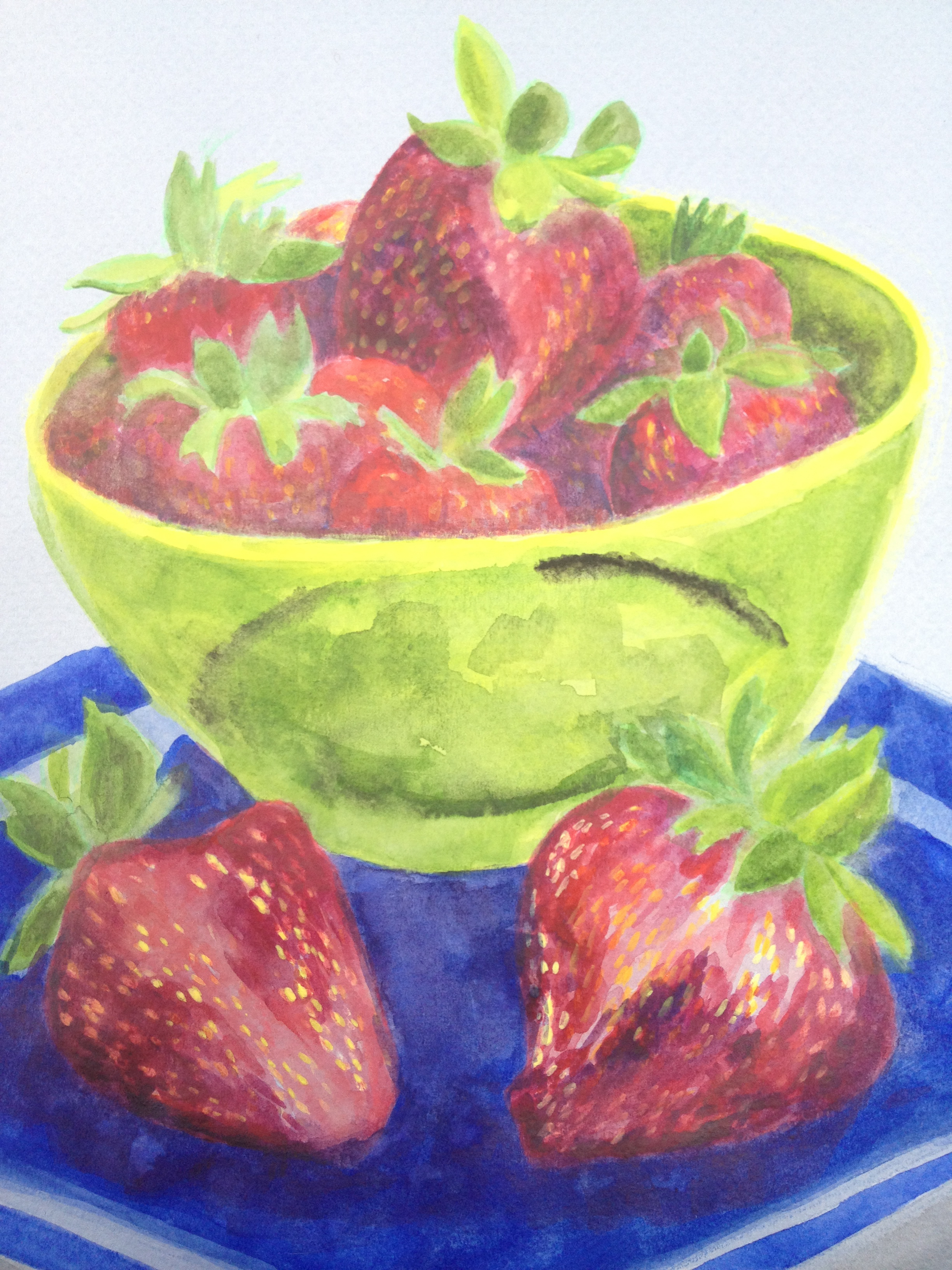
June and we are blessed again with strawberries. It’s after 5:30PM when I leave work, but the summer sun remains sky high moving towards the solstice. Driving north from Santa Cruz towards Davenport, the Pacific flashes brilliantly on this clear and hot day; along the coast farmers are irrigating their crops. The infinite horizontality brings mindfulness; the day falls away and clarity about the scheme of things returns.  Listening to the Blessed Are album, and I find the Woody Guthrie track Deportee and I softly sing with Joan Baez:

 Is this the best way we can grow our big orchards? Is this the best way we can grow our good fruit? To fall like dry leaves to rot on my topsoil. And be called by no name except “deportees.”

Swanton Berry Farm is my destination. Founded in 1989 by UC Santa Cruz graduate Jim Cochran, Swanton’s is the first commercial organic strawberry farm in California; it is also the first certified organic farm in the United States to sign a labor contract with the United Farm Workers (UFW). The farm stand, where I purchase my two pints of bright red strawberries, proudly displays the UFW flag bearing the black eagle on a field of red.  The UFW was formed as a result of Cesar Chavez’s organizing of Mexican-American and Fillipino American farmworkers to engage in boycotts, hunger strikes and strikes (all based on pacifism) to gain their rights.  The successful 1965 Delano grape strike is the most famous effort. The strawberries are amazing; a delight to see, smell, and taste the sweet and tart delight grown in the sandy soils of the coastline routinely kissed by the sea air. Last year, when Irene Reti’s & Sarah Rabkin’s oral history Cultivating a Movement was published, I read about Jim Cochran’s sustainable practices. Jim described using the Brassica family of plants— broccoli, cauliflower and mustard greens— in crop rotation to improve soil health instead of traditional strawberry farming practices using methyl bromide and Chloropicrin to kill soil disease. At Swanton’s you will never see the plastic covering the fields of commercial growers, indicating chemical fumigation is underway.

This month is also the 38th anniversary of the California Agricultural Labor Relations Act that became law on June 5, 1975 giving farm workers the right to collective bargaining and ensuring “peace in the agricultural fields by guaranteeing justice for all agricultural workers and stability in labor relations.” The act allowed union organizers to meet with farm workers in the fields and for farm workers to select representation by unions such as the UFW to engage in collective bargaining to negotiate conditions of employment.

Strawberries. Copyright 2013 Robin L. Chandler

After purchasing my strawberries, I drive out Swanton Road a beautiful loop curving through the Swanton Pacific Ranch, crossing Scott Creek a riparian corridor for Coho Salmon and Steelhead Trout, and winding through forests of Redwoods, Douglas Fir, and Monterey Pine. Surfers say the waves where Scott Creek estuary greets the ocean are the same as Swami’s Beach in San Diego County. The Ranch is beautiful. The furrows nestled amongst the coastal ecosystem; mankind’s geometric abstractions seeking to tame the wilderness topography. Recently I learned about the plein-air painter Sheridan Lord whose inspiring works are with us in the book Things in Place. Sheridan’s farm paintings are pictures “of breathtaking simplicity: the whole surface is occupied by the towering sky and broad fields, which are separated by a mere strip of trees.” Lord’s paintings evoke the environmental writer Peter Matthiessen who quotes the Ojibwa people in his book Nine-Headed Dragon River writing “sometimes I go about in pity for myself, and all the while a great wind is bearing me across the sky.”  Mindfulness is found in many ways: in a song, in a vista, in a painting, in a koan, or in a strawberry.

Women: a greater force challenging authority and tradition

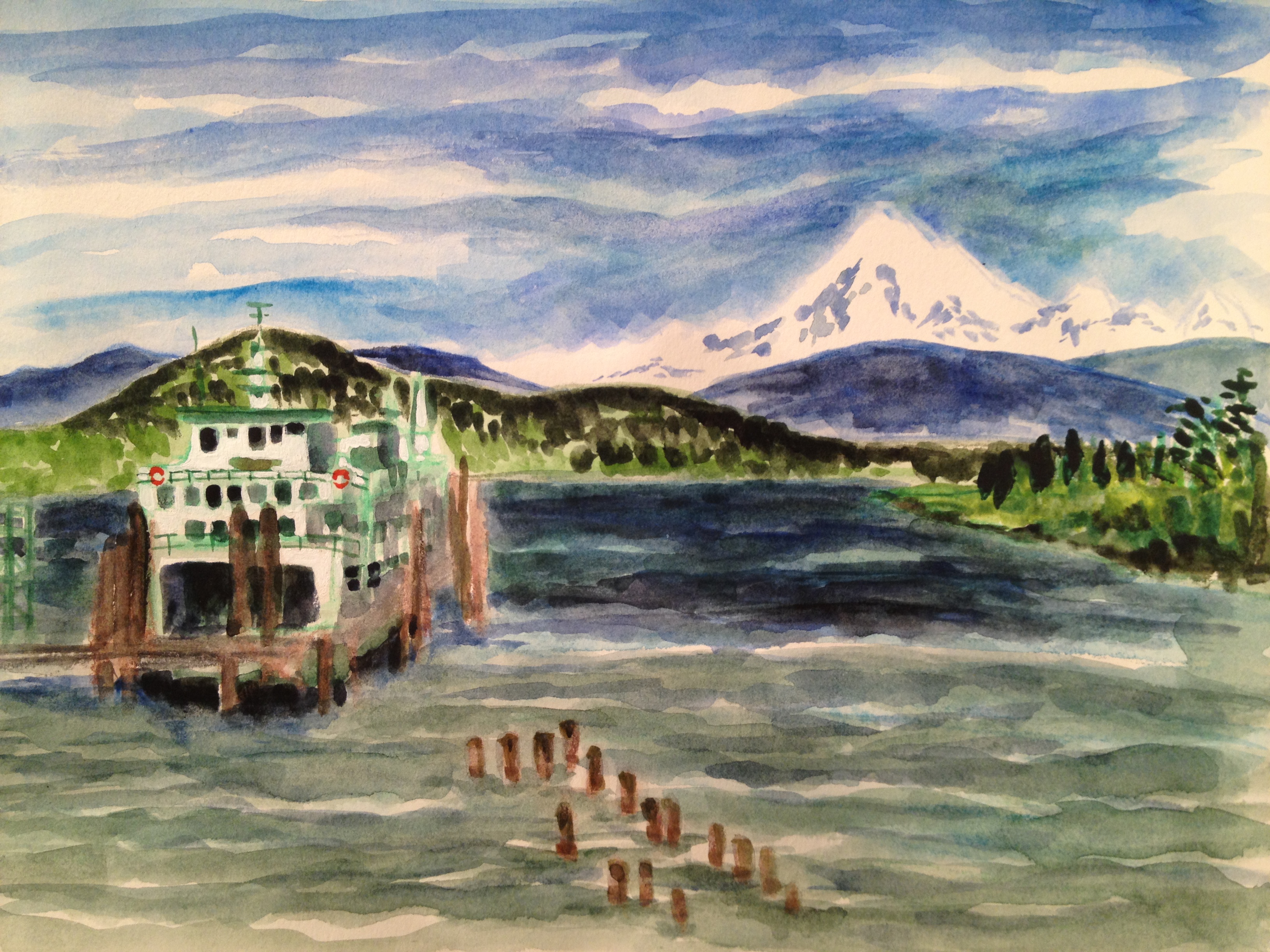
View of Mt. Baker from the Anacortes ferry landing. Copyright 2013 Robin L. Chandler

It’s spring on Orcas, in the San Juan Islands, and we are hiking from Cascade Falls via Mountain Lake to Mount Constitution; at the summit, the view of Mt. Baker across the sound is glorious. It is a day so hot and clear, that even Mt. Rainier, nearly 100 miles to the south, sheds the hazy cloak, granting a glimpse of inspiring wonder. The Pacific Northwest has a quality reminiscent yet distinct from the Grand Canyon. Looking across the vast expanse of Puget Sound, we are flotsam in time, humbled by the knowledge that our lives are defined by tides, wind and volcanism; at the Grand Canyon, we witness the passage of time humbled by the expanse of history portrayed by the simple act of water coursing the land.  In these moments, when we glimpse our place in the scheme of things, we honor the greater forces at work on our planet.

On the trail, my feet seem to find every small cone shed by the Western Red Cedars populating this coastal forest;* the crunch seems deafening in the stillness. The air tastes salty, tinged by the scent of wood smoke, and the forest is quiet except for birdsong and the infrequent hiker or mountain biker. Rounding the turn, we discover a bald eagle perched on a partially submerged log near the shoreline, fishing. My friend whispers, “amazing to think that the removal of one chemical <DDT> from the environment made seeing this bald eagle possible.”

Today is Mother’s Day, a fitting day to honor women. According to Rebecca Solnit, in the early 1960s three women writers changed our thinking about the nature of authority and tradition in the world into which I was born: Jane Jacobs with The Death and Life of Great American Cities, Betty Friedan with The Feminine Mystique and Rachel Carson with Silent Spring. Jacobs assailed the postwar restructuring of cities resulting in suburbia; Friedan questioned the patriarchy of middle-class suburbia and the assigned gender roles of women; and Carson argued on behalf of ecosystems exposing fatal flaws in Big Science and industry’s broad stroke solutions. As Solnit describes in her essay Other Daughters, Other American Revolutions published in Storming the Gates of Paradise: Landscapes for Politics, Carson was “the first to describe the scope of the sinister consequences of a chemical society, the possibility that herbicides, pesticides and the like were poisoning not just pests – or pests, and some songbirds and farmworkers – but everyone and everything for a long time forward.”

Rachel Carson was able to communicate very technical information and inspire the general public to care about the environment. According to Solnit, Carson’s “book had a colossal impact from the beginning and is often credited with inspiring the DDT ban that went into effect nationwide in 1972. Though some now challenge the relationship between DDT and eggshell-thinning in species, wild birds from brown pelicans to bald eagles and peregrine falcons have rebounded from the brink of extinction since the ban.” Rachel Carson’s closing words say it best “the ‘control of nature’ is a phrase conceived in arrogance, born of the Neanderthal age of biology and philosophy, when it was supposed that nature exists for the convenience of man…it is our alarming misfortune that so primitive a science has armed itself with the most modern and terrible weapons, and that in turning them against the insects it has also turned them against the earth.” Thank you Rachel Carson; your “words are deeds.”** We honor your greater feminine force that gave us this bald eagle today.

* The San Juan Islands forest typically includes Western Red Cedars, Douglas Fir, Western Hemlock, Big Leaf Maples and Pacific Madrone.

** Lord Risley speaking to Maurice Hall from E.M. Forster’s novel Maurice.

in every grain of sand there is a story

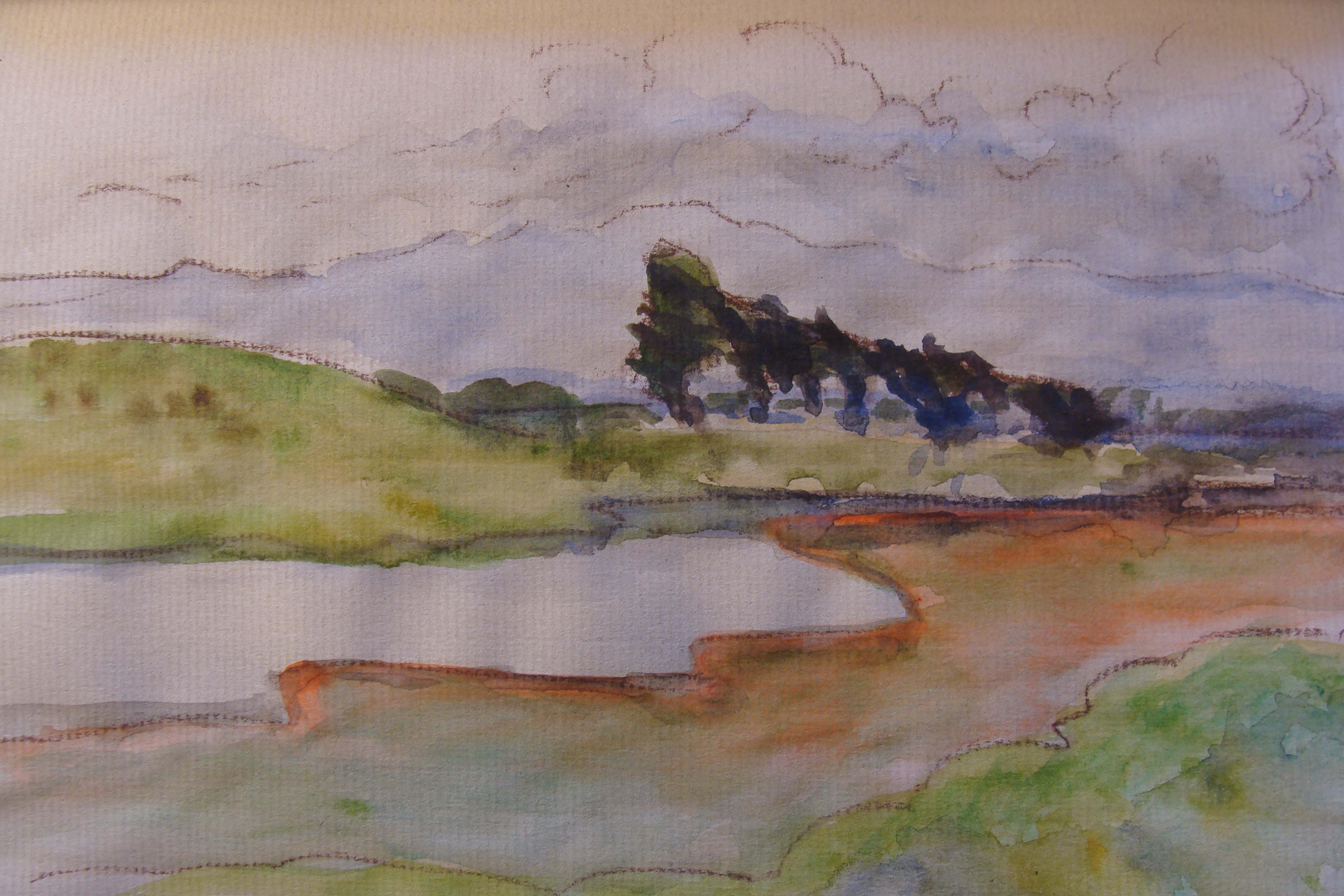
Otters at Elkhorn Slough. Copyright 2012 Robin L. Chandler

The thirty-eight miles from Santa Cruz to Monterey can be a very busy road to navigate.  Route One is a major corridor with trucks carrying produce from the fields, and cars transporting farm workers, fishermen, tourists, recreation seekers of every stripe, and people like me who live and work at least part of their lives in this region.  Hurtling through space, my eye catches glimpses of life’s daily epic poem acted-out by the inhabitants – people, plants and animals – of this region.

Our Elkhorn Slough epic begins near Moss Landing, now a man-made harbor, but once an estuary, part of the Pajaro-Salinas river system that historically shared a common entrance to the Pacific Ocean.  Launching kayaks recently on a cold gray Sunday morning, we were treated to a new chapter in this epic story.  An important component of the Pacific Flyway for migratory birds, the harbor and slough are populated with many species. This day we spotted Bandt’s, Double-crested, and Pelagic Cormorants; Brown and White Pelicans; Common Loons; Clark’s, Western and Horned Grebes; Forester’s Terns,  and shorebirds including Curlews, Dowitchers and Godwits.  Elkhorn is also home to many marine mammals.  Hauled out on the beaches and mud banks, harbor seals and pups nap after a busy night seeking nourishment in the waters of the Pacific.  Sea Lions rest comfortably piled-up on man-made docks. At low-tide, we spot Sea Anenome’s anchored to pilings and there secure amongst the now visible Eel Grass and occasional wayward kelp strand, we find mother Otters and their pups.  The epic story of one such Otter pup is told in the movie Otter 501, a visual poem to stewardship.  Paradoxically, Elkhorn Slough  –  a safety net to many animals and plants –  is situated amongst a complex and encroaching human ecosystem including a  vibrant agricultural economy, a regional power plant, an active fisherman’s harbor, recreational area for birders, hikers and kayakers, and a major north-south highway transporting people and goods.   It is through tireless stewardship that these animals and plants survive in this amazing place.

To the uninitiated speeding by in their cars, Elkhorn Slough is just a flash of light reflecting off water, punctuated mostly by the two power-plant towers dominating the skyline.  But for the animals and plants it is a sanctuary part of the Monterey Bay National Marine Sanctuary (MBNMS).  In 1992, MBNMS became a Federally protected marine area offshore California’s Central Coast. Stretching from Marin County to Cambria near Hearst’s Castle San Simeon, the sanctuary encompasses some 276 miles of shoreline and over 6,000 square miles of ocean.  MBNMS is the home to one of the most diverse ecosystems in the world with more than 33 species of marine mammals, 94 species of birds and 345 species of fish.  MBNMS partners with organizations and institutions such as the Elkhorn Slough Foundation, the Monterey Bay Aquarium and research universities including the University of California and Stanford to preserve, perform research, and educate citizens about co-existing as members of this ecosystem on the central coast.

Elkhorn Slough is a fragile marine ecosystem.  Most of us quickly drive by the Slough, preoccupied with getting to our next destination. Most of us don’t grasp the Slough’s role as a sanctuary in an epic poem, and fewer grasp that we are actors in the story and that have responsibilities to co-exist with the animals and plants as members of this ecosystem.  We can actively choose to act as stewards; we can choose to oversee and protect places like Elkhorn Slough, places worth caring for and preserving because they provide sanctuary to living creatures  that enrich our lives and ensure our survival both spiritually and physically. Anyone can be a steward; it can be as simple as recycling plastic bottles and composting vegetable waste or casting a vote to raise tax revenue to keep California State Parks open and education affordable for students at the University of California.  Stewardship is becoming a member of the Elkhorn Slough Foundation to help create conservation easements or becoming a volunteer naturalist with the MBNMS or taking a child to the Monterey Bay Aquarium to teach them about the wonders of the ocean.

Stewardship is a story that must be shared with others, repeatedly.  Saddened, I fear that for every story told, there are thousands of people who will never hear the story, therefore never be educated to learn about and understand their role as stewards.  With education, we build empowerment, foster discussion, enable understanding, and  realize just actions through compromise.  These are noble aspirations, and evidence abounds that it is always an uphill battle.   However, as the church of baseball teaches and Yogi Berra preaches, “it ain’t over till its over.”   At the bottom of the ninth with two outs and down by five runs, the Sisyphus at the plate knows heaven is found in the uphill struggle (described in the The Great Wave blog entry).   And so we must continue the hard work to learn and to teach each other about our responsibilities as stewards of ecosystems, no matter how great the odds.  As Rachel Carson wrote in her 1958 article Our Ever Changing Shore republished the book Lost Woods: The Discovered Writing of Rachel Carson, “in every out thrust headland, in every curving beach, in every grain of sand there is the story of the earth.”

Burning Bright

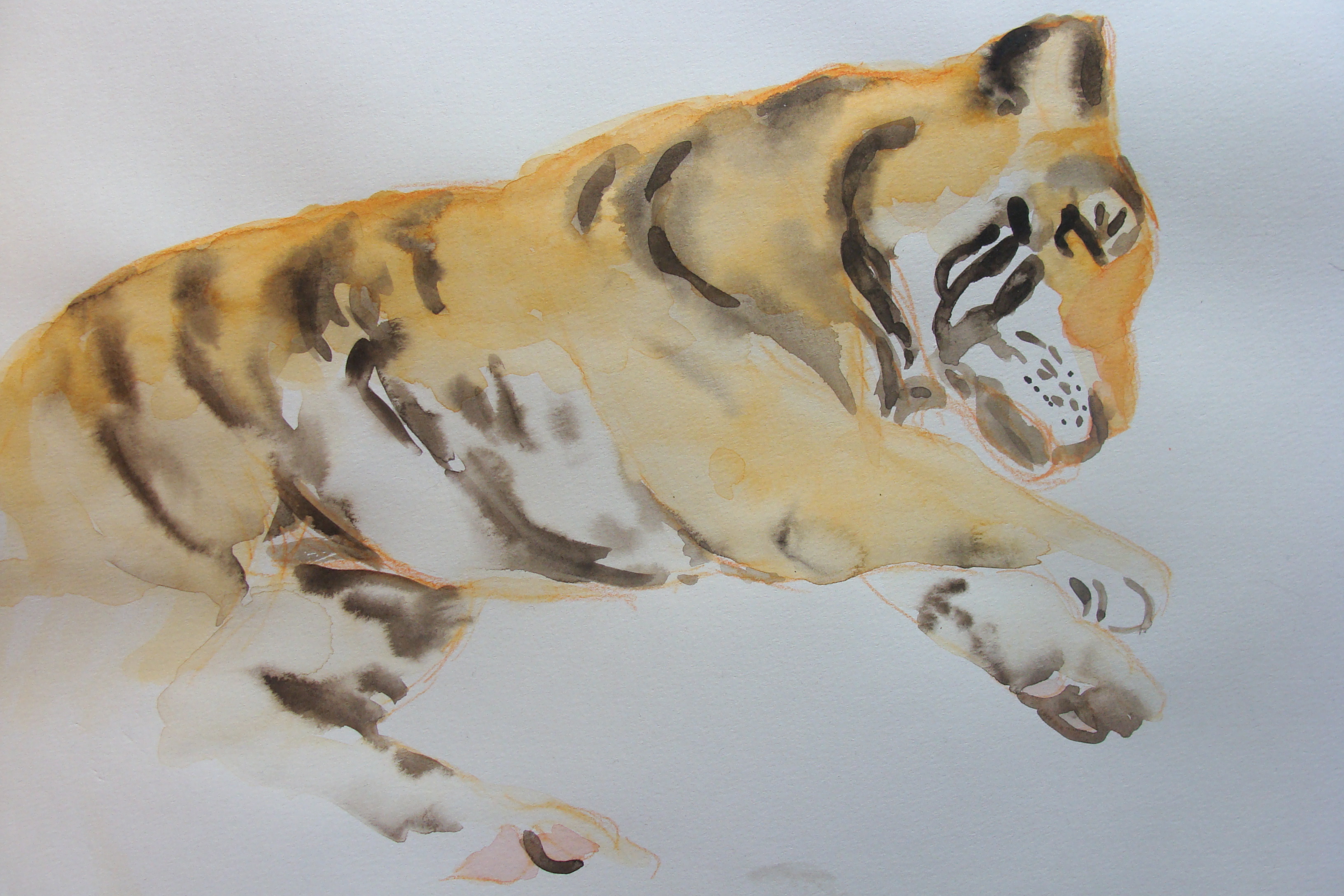
The Tiger Copyright 2012 Robin L. Chandler

Durga, all fearlessness, patience, full of humor and creative feminine force, rides her tiger onto the field of battle, her eighteen arms holding weapons, the gifts of Hindu gods.  Fiercely compassionate, astride her tiger, the warrior goddess engages in epic spiritual battles to protect virtue and subdue the evil chaos unleashed upon the world by demons.  Durga rides a tiger because it is a symbol of unlimited power; the tiger is the king of the forest, a power on earth beyond the reach of any mortal.  An important figure in Hindu mythology, today the tiger is the national animal of India.

Inspired by Tea Obreht’s talk at Bookshop Santa Cruz about her magical story The Tiger’s Wife, I went to the Oakland Zoo to paint the tiger.  Obreht’s book examines how myths and stories can be a force for good or fuel for fear running “like secret rivers through all the other stories of a life.”  Obreht engages animal symbols to examine our fears about people – their race, culture and religion.   For Obreht animals in our myths and stories are symbolic catalysts for choice as we navigate life.  Is that animal an “it” or a “thou”?  The answer will determine how you act. You have a choice.  And by extension is the stranger an “it,” or perhaps someone with relationships, hopes and dreams just like you?  Pondering human nature in terms of communication taking the form of a monologue or a dialogue, the Jewish philosopher Martin Buber described human existence in categories of consciousness, interaction and being in his book I and Thou.

Myths and stories can be a force for good. Durga and her tiger subdueing evil chaos on a daily basis is a story that strengthens me while navigating a chaotic and unjust world.   But Obreht weaves a different story.  In her tale, the outsider – a person from a different culture and religion  – through circumstance, becomes the Tiger’s wife, a person, perceived by villagers afraid of “the other,” as a powerful mythical devil hell bent on bringing destruction.  Obreht’s grandather tells Natalia “there are some stories you keep to yourself – it belongs only to you.”   But Obreht’s tale is not a story you keep to yourself, it is one share.

After reading The Tiger’s Wife, I found myself acting out the pilgrimage of Natalia and her grandfather seeking Shere Kahn, immortal tiger of The Jungle Book. Last Fall, the Oakland Zoo rescued four young tigers, sisters all: Ginger, Grace, Milou, and Molly. Privately owned, a divorce suddenly rendered the young tigers homeless. The Oakland Zoo gave these magnificent and powerful animals a home, respecting the need to keep them as a family.  While there are only 3,500 wild tigers worldwide, it’s estimated there are more than 8,000 tigers privately owned in the U.S. and only a few of those are found in zoos. Tigers once ranged across Asia from Turkey to the eastern coast of Russia, as well as Java and Bali. Today they are an endangered species having lost 93% of their historic range and their dwindling numbers in the wild are now found only in India, Nepal, Russia, China and Southern Asia.  If tigers are to survive in the wild and in captivity, we must see them as beings worthy of our respect; they must be “thou” and not “it.”   As Obreht writes “he was only half wild and in his partial tameness…..he missed…..the companionship and predictability of life at the <zoo>…..however expertly he learned to fend for himself, his life as a tiger had been tainted since birth – maybe that great Shere Kahn light my grandfather believed in had already been extinguished….. but that is not the tiger on whose account my grandfather carried The Jungle Book in his pocket every day for the rest of his life….. it was <the Tiger’s Wife’s> great fortune…..to encounter a tiger that was not all tiger…..maybe it’s enough to say he enjoyed the sensation of her hand between his eyes…..she liked the way his flank smelled when she curled up against him to sleep.” Animals in our myths and stories are symbolic catalysts for choice as we navigate life.  And in reality, how we choose to honor the lives of animals, reveals much about how we choose to honor life itself.

Auld Lang Syne

Farmer’s Market, Splashpad Park, Oakland. Copyright 2011 Robin L. Chandler

“How do you do that?” said Terrell.  About six years old, my admirer sat beside me on the concrete wall.  “I like to paint too…Santa brought me some paints, brushes and paper.”  While his grandmother watched, I loaned my new friend some paper and a brush and, we painted together in the brilliant sunshine of this last day of 2011.  The Saturday Farmer’s Market is a worthy subject: a unique cityscape with the mixing and mingling of so many kinds of people engaged in reaping the fruits of farmer’s labor.  As I walk through the market and see the bounty of the harvest, I recall the stories from a wonderful book  Cultivating a Movement. Edited by Irene Reti and Sarah Rabkin, the book draws from oral histories documenting the lives of individuals engaged in organic farming and sustainable agriculture on California’s Central Coast. The interviews dig deep into the social, cultural and environmental history of California on a range of topics concerning organic / sustainable agriculture including the influence of the hippie movement of the 1960s and 1970s; the influence of Alan Chadwick on farming; the organizing of Mexican-American farm workers resulting in the formation of the United Farm Workers (UFW) union; the publication of Rachel Carson’s Silent Spring; the creation of the California Certified Organic Farmers (CCOF); and the influence of the UC Santa Cruz Center for Agroecology and Sustainable Food Systems. Recommended reading!

Our urban life blossoms in this space called Splashpad Park; an island of trees, shrub and grass floating between a major freeway and busy city streets.  Cars rush by; children and their parents line-up to see movies at the Grand Lake Theater; activists pass-out buttons and leaflets for Occupy Oakland while others gather signatures for a referendum against the death penalty; musicians play folk songs and Grateful Dead tunes; and shoppers visit the bakery, dry cleaners and other specialty shops as well as the Farmer’s Market.   Oakland’s community awakens on Saturday mornings, re-energized after the busy workweek, engaging in the timeless ritual of gathering those items necessary for sustenance.    Not sure if his little self will grasp all I wish him to know, but I pass on to Terrell the wise words of my drawing teacher Rob Anderson “draw what you know, what you see, what you feel, continue on until it is what you are.”  Grandmother gently urges Terrell that its time to leave; she rattles off the items they still need to buy: navel oranges, beets, radichio and arugula.

Turning back to my painting, I modestly attempt to capture on paper something reminiscent of the grand American Experiment performed by the Ashcan Painters – including Robert Henri, John Sloan, George Luks, William Glackens and Everett Shinn – a vivid description of America’s bustling cities and her people. My favorite painter of this Group – George Bellows – created some of the most moving depictions of the urban landscape: “The Lone Tenement”  and “Blue Morning.”  So, on this December 31, 2011 I raise my brush in celebration of painters old long ago, always brought to mind.

Just off the beaten path….our precious California State Parks

New Brighton State Beach. Copyright 2011 Robin L. Chandler

On May 21st we started our journey at the Salinas River National Wildlife Refuge and ended some eight hours later at the wharf in Monterey.  On three sequential Saturdays some fifty adventurers hiked thirty miles in the distinguished company of Sandy Lydon, Historian and Cabrillo College faculty, and Gary Griggs, Director of UC Santa Cruz Institute of Marine Science. Today would be the final ten-mile leg of  Monterey Bay Walk 3. May 7th we hiked from New Brighton State Beach in Capitola to just north of the Pajaro Dunes.  May 14th we ambled from Zmudowski State Beach to the Salinas River.  This morning a flock of Caspian Terns greeted us by the riverbank as we walked through the refuge to the beach. All was beautiful: endless sky, sea and sand.  My day’s walk would be measured by miles of words and punctuated by meters of awed silence –  awe inspired by the magnificent Monterey Bay. My companions on this adventure included my amazing friends Irene Reti and Sarah Rabkin.  Both passionate environmentalists, they have shared their love of nature, understanding of human frailty and hopes for the future in their recent books: Reti’s Kabbalah of Stone and Rabkin’s What I Learned at Bug Camp: Essays on Finding a Home in the World.   I am grateful for all the knowledge they shared with me about the human and natural history of lands between Santa Cruz and Monterey on these special  Saturdays in May.

Sandholdt State Park. Copyright 2011 Robin L. Chandler

Reflecting on the walks, many images delight my mind — images conjured by the stories of Sandy and Gary, the two  trip leaders: the realization that Monterey Bay is not a pristine environment, no location on the Bay has been spared the impact of humankind; the image of Chinese fishing sampans on the beach now known as New Brighton; the impact of earthquakes, erosion and tidal forces on the coastline; the story of Gaspar de Portola and his Spanish troops walking what would become the El Camino Reale as he searched in vain for Monterey Bay; developers’ insistence on building at the ocean’s edge, imperiously disregarding the cycle of el nino and la nina climate patterns on urban planning; the mother gray whale and her baby breaking the surface with their spouts; the enormous American bullfrog, an invasive species found on the shore of the Salinas River; the bachelor otter pod at Moss Landing; the snowy plovers guarding their nests and chicks on the beaches near to Monterey; and the clouds: light fogs at a far distance resting lightly on the water — quickly burning back leaving a brilliantly bright day where sunlight danced crisply on the waves, or the dramatic bands of clouds moving fast north to south, precursors of the front that would bring unseasonal rain from Santa Cruz to San Diego.

Fort Ord State Park. Copyright 2011 Robin L. Chandler

For thirty miles from Santa Cruz to Monterey we walked on the beach  – a pathway formed from a patchwork of California State Parks and Federal Wildlife Refuges  — a ring of bright white sand circling the Monterey Bay Marine Sanctuary.  Seventy California State Parks will be closed because of our state budget crisis.  Four of these parks are beach parks found along the shores of Monterey Bay, and two of them we crossed during our bayside journey: Zmudowski State Beach and Moss Landing State Beach.  In November 2010, the majority of California’s citizens elected NOT to  pass Proposition 21, a referendum proposing an annual $18.00 vehicle license fee.  Such a small price to pay for so much beauty….. just off the beaten path…..our precious California State Parks.

floating world: arancia hearts

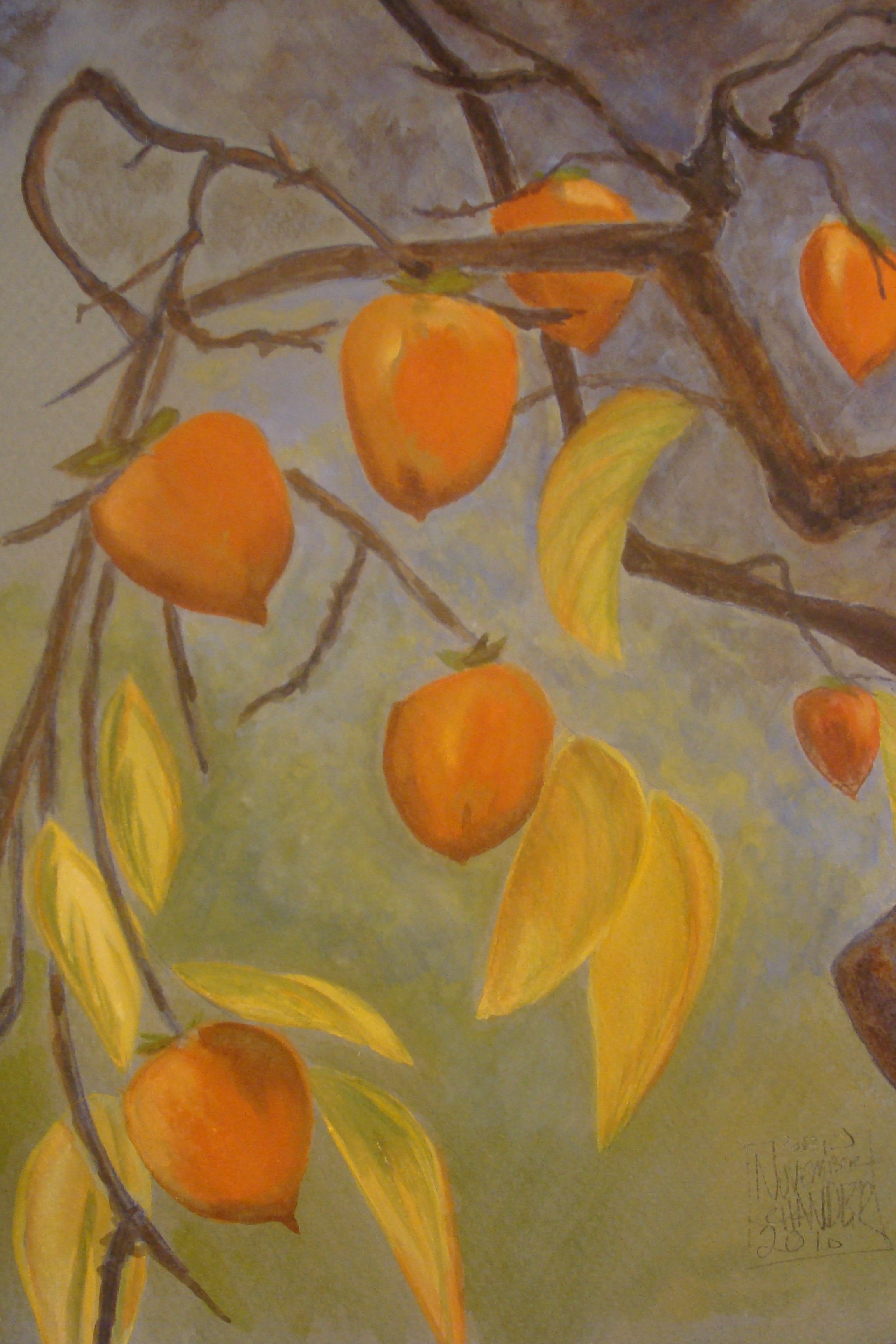
With the coming of the cross-quarter,  winter begins.  Leaves in artful decay proclaim the changing season.  Gone are summer’s limbs heavy with ripened apricot and plum.   From the corner of my eye, the persimmon, branches nearly bare, adorned with amarillo bangles and arancia hearts. Floating. Breathtaking in the fading light.  I paint; a deep sense of connection between myself and everything. For the moment, I fade away, lost in the act.  Later, steady cold rains: the kind we welcome to keep the drought years at bay.   Mugs of hot matcha take the edge from chilled hands.   In the oven, persimmon cookies bake, the golden taste of connection. (San Francisco) California dreamin’ on such a winter’s day.

Persimmon Tree. Copyright 2010 Robin L. Chandler

Legends tell us the heart-shaped Hachiya fondly called kaki was introduced to Japan from China in the 8th century by a wandering Buddhist. The monk traveled Japan subsisting on persimmons spreading seeds “Johnny Appleseed-like” throughout the land.  Masaoka Shiki a 19th century Japanese author helped revive waka and haiku poetry and introduced the concept of nature sketching or shashei honored the fruit’s place in Japanese culture with this poem composed while stopped at Nara on his journey to Tokyo:

I bite a persimmon

the bell tolls

Horyu-ji Temple

In her book Nine Gates: Entering the Mind of Poetry, Jane Hirshfield writes that “every good poem begins in language awake to its own connections….it begins…in the body and mind of concentration….true concentration appears paradoxically at the moment willed effort drops away….the self disappears ….we seem to fall utterly into the object of our attention, or else vanish into attentiveness itself.”  Echoing Jane Hirshfield, Phil Lesh lovingly described his life with the Grateful Dead in  Searching for the Sound . “We were in the music and the music was playing us. To loose oneself completely in a spontaneous flow of music is one of the great human joys: one is creating, but being created. In fact, one no longer exists. At the same time, there’s a give-and-take a handing off of ideas that mimics the process of thought itself….Bobby and I left holes for each other’s notes, creating an interlocking constantly changing rhythm.”

A New Deal

Born in the 1970s in the African American, Afro-Carribean and Latino communities of the Bronx, Hip Hop culture includes DJing, breakdancing, graffiti writing and rapping.  According to Johnny Otis, rhythm and blues musician and teacher, in 1975, Mayor Abe Beame was faced with New York City going bankrupt. His choices were few as neither the federal or state governments would come to his aid.  So, to solve his problem he fired over 19,000 city workers, and 15,000 of those workers were teachers responsible for instruction in the humanities: literature, art and music.  Suddenly a generation of children had no access to instruments and formal music instruction.   But ever resilient, these communities looked inward, drew upon their cultural heritage and created a new musical genre “rap,” one of the pillars of hip hop culture, using all that was available to them: language and percussion.  The human spirit creates no matter how stripped bare. 

Despair
Despair. Copyright 2007 Robin L. Chandler

Today our society, and by default, our educational systems are undergoing transformative change. To manage the fiscal crisis, our California state government is making deep cuts to our public universities, and campus and university administrators are now struggling with how to manage these reductions that will no doubt profoundly change our educational system. They will be faced with choices making decisions about what programs, what departments what campus units are sustainable and support the core mission of the university.  External funding from public and private sources, though comprised during this economic crisis, continues to be available to support research in medicine, science and engineering, but not so readily available to the arts and humanities, Institute Museum Library Services (IMLS), National Endowment for the Arts (NEA), National Endowment for the Humanites (NEH), National Historic Publications Record Commission (NHPRC) and the Mellon Foundation being among the most valiant exceptions.  Writing in the New York Times recently, Drew Gilpin Faust, President of Harvard University wrote “since the 1970s there has been a steep decline in the percentage of students majoring in the liberal arts and sciences, and an accompanying increase in pre-professional undergraduate degrees. Business is now by far the most popular undergraduate major, with twice as many bachelor’s degrees awarded in this area than in any other field of study. In the era of economic constraint before us, the pressure toward vocational pursuits is likely only to intensify.  As a nation, we need to ask more than this from our universities. Higher learning can offer individuals and societies a depth and breadth of vision absent from the inevitably myopic present. Human beings need meaning, understanding and perspective as well as jobs. The question should not be whether we can afford to believe in such purposes in these times, but whether we can afford not to.”

gritty
Oakland gritty streets. Copyright 2007 Robin L. Chandler

In the September issue of Harpers Magazine, Mark Slouka (Professor of Creative Writing at Columbia University) wrote “the humanities, done right, are the crucible within which our evolving notions of what it means to be fully human are put to the test; they teach us, incrementally, endlessly, not what to do but how to be. Their method is confrontational, their domain unlimited, their “product” not truth but the reasoned search for truth.”  Slouka also wrote “By downsizing what is most dangerous (and most essential) about our education, namely the deep civic function of the arts and the humanities, we’re well on the way to producing a nation of employees, not citizens. Thus is the world made safe for commerce, but not safe.”

During the Great Depression, Franklin Roosevelt’s New Deal Works Progress Administration invested in creating jobs across a wide spectrum including the arts and humanities. These became the Federal Art Project, the Federal Music Project, the Federal Theater Project and the Federal Writer’s Project.  There was also the Historic Records Survey which employed archivists to identify, collect and conserve historic records throughout the United States.  Rand Jimerson writes in the introduction to his recently published book Archives Power: Memory, Accountability, and Social Justice “Archivists [can] contribute to a richer human experience of understanding and compassion. They can help protect the rights of citizens, and to hold public figures in government and business accountable for their actions. Archivists provide resources for people to examine the past, to understand themselves in relation to others, and to deepen their appreciation of people with different backgrounds and perspectives. This is the essence of our common humanity.” Archives and teaching in the humanities are crucial to the formation of citizens able to participate fully in our democracy.

In February 2009, Congress passed and President Obama signed into law the American Recovery and Reinvestment Act ARRA which included stimulus funding making investments in infrastructure such as transportation, public schools, college financial aid, renewable energy programs, healthcare and homeland security.  Conspicuously absent is direct funding for teaching and research in the arts and  humanities, nor for libraries and archives. In his public high school rhetoric class Marcus Eure provides students with critical thinking skills as they study issues about civic morality.  Eure believes “every marriage, every job, every parent-teacher meeting hinges in some way on the ability to understand and empathize with others, to challenge one’s beliefs, to strive for reason and clarity. “  The time is now to invest and provide federal stimulus packages in our arts, humanities, libraries and archives.  It is our duty and obligation to the future, to build citizens to grapple with the challenges of today.

Toeing potshards

Monument Valley. Copyright 2009 Robin L. Chandler

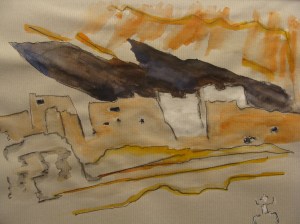
In the late Spring, when we vacationed on the Colorado Plateau, I discovered a book by Patricia Limerick called Desert Passages.  Dr. Limerick describes the American encounter with deserts in terms of three attitudes towards nature “as a biological reality in human life…hunger, thirst, injury, disease and death….as an economic resource…a container of treasures awaiting extraction…or as an aesthetic spectacle. “  We affectionately called our trip the archaeology tour as we visited the ruins of the Ancient Pueblo Peoples at Wupatki, Monument  Valley, Mesa Verde, and Canyon de Chelly. Wave and I spent many hours at the ruins in quiet meditation while I attempted to capture the  essence of these amazing cultural resources on watercolor paper.

White House ruin, Canyon de Chelly
White House ruin, Canyon de Chelly. Copyright 2009 Robin L. Chandler

One of the great mysteries is what happened to the ancient peoples?  Archaeological evidence reveals that sometime in the late 13th century these peoples abandoned their homes amongst the mesas and canyon walls and it is theorized that environmental changes —  possibly extreme drought — caused these peoples to abandon their homes.  One feels a certain twinge given the current state of  drought in San Diego, Los Angeles and the rest of California, and of course the fire still burning in the San Gabriel mountains.   It is believed that they left the Colorado Plateau and migrated to join other pueblos along the Rio Grande river in New Mexico.   How would we best characterize the Ancient Pueblo peoples encounters with the desert?  As a biological reality?  Probably yes.  As an economic resource?  Probably yes.  As an aesthetic spectacle?  Probably yes.  We  preserve the artifacts they left us and look for answers in the patterns as we piece the pot shards together.   Ann Weiler Walka’s poem  “Other Dreams: Grand Gulch”  in Waterlines: Journeys on a Desert River gives us something to ponder.  “My thumb polishes the fragment of a bowl, its shallow curve delicately cross hatched with black…some woman dug this clay from a slip of mud…she kneaded the clay with sand and spun a ball into coils….she painted the bowl with a yucca leaf…and dreamed the design from her fingers…she blessed the bowl…that night in her sleep she saw clouds piling over a mesa, spirits coming home. She dreamed of the clay along the creek cool and slippery as a freshly opened heart.”