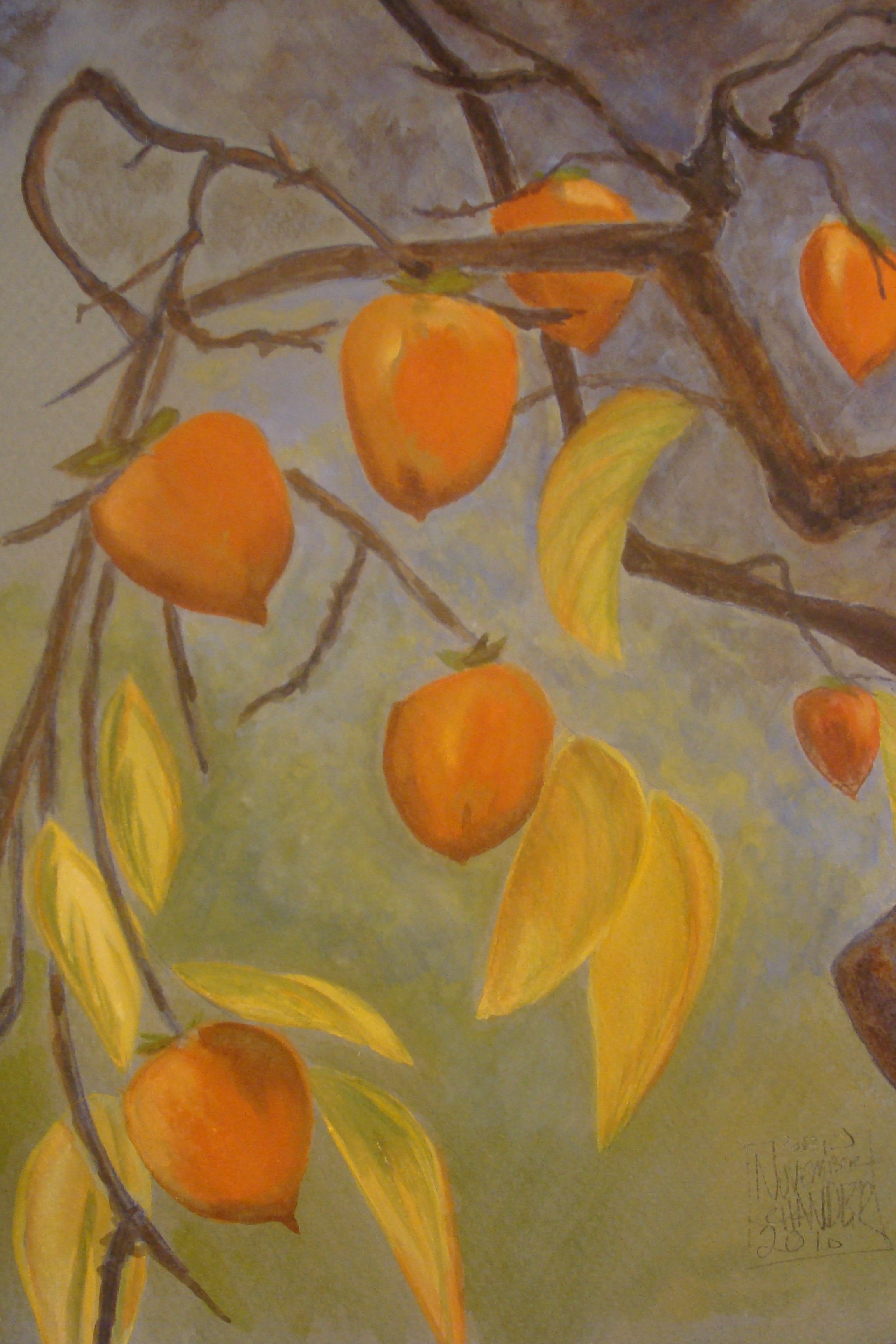
With the coming of the cross-quarter, winter begins. Leaves in artful decay proclaim the changing season. Gone are summer’s limbs heavy with ripened apricot and plum. From the corner of my eye, the persimmon, branches nearly bare, adorned with amarillo bangles and arancia hearts. Floating. Breathtaking in the fading light. I paint; a deep sense of connection between myself and everything. For the moment, I fade away, lost in the act. Later, steady cold rains: the kind we welcome to keep the drought years at bay. Mugs of hot matcha take the edge from chilled hands. In the oven, persimmon cookies bake, the golden taste of connection. (San Francisco) California dreamin’ on such a winter’s day.
Persimmon Tree. Copyright 2010 Robin L. Chandler
Legends tell us the heart-shaped Hachiya fondly called kaki was introduced to Japan from China in the 8th century by a wandering Buddhist. The monk traveled Japan subsisting on persimmons spreading seeds “Johnny Appleseed-like” throughout the land. Masaoka Shiki a 19th century Japanese author helped revive waka and haiku poetry and introduced the concept of nature sketching or shashei honored the fruit’s place in Japanese culture with this poem composed while stopped at Nara on his journey to Tokyo:
I bite a persimmon
the bell tolls
Horyu-ji Temple
In her book Nine Gates: Entering the Mind of Poetry, Jane Hirshfield writes that “every good poem begins in language awake to its own connections….it begins…in the body and mind of concentration….true concentration appears paradoxically at the moment willed effort drops away….the self disappears ….we seem to fall utterly into the object of our attention, or else vanish into attentiveness itself.” Echoing Jane Hirshfield, Phil Lesh lovingly described his life with the Grateful Dead in Searching for the Sound . “We were in the music and the music was playing us. To loose oneself completely in a spontaneous flow of music is one of the great human joys: one is creating, but being created. In fact, one no longer exists. At the same time, there’s a give-and-take a handing off of ideas that mimics the process of thought itself….Bobby and I left holes for each other’s notes, creating an interlocking constantly changing rhythm.”
Born in the 1970s in the African American, Afro-Carribean and Latino communities of the Bronx, Hip Hop culture includes DJing, breakdancing, graffiti writing and rapping. According to Johnny Otis, rhythm and blues musician and teacher, in 1975, Mayor Abe Beame was faced with New York City going bankrupt. His choices were few as neither the federal or state governments would come to his aid. So, to solve his problem he fired over 19,000 city workers, and 15,000 of those workers were teachers responsible for instruction in the humanities: literature, art and music. Suddenly a generation of children had no access to instruments and formal music instruction. But ever resilient, these communities looked inward, drew upon their cultural heritage and created a new musical genre “rap,” one of the pillars of hip hop culture, using all that was available to them: language and percussion. The human spirit creates no matter how stripped bare.
Despair. Copyright 2007 Robin L. Chandler
Today our society, and by default, our educational systems are undergoing transformative change. To manage the fiscal crisis, our California state government is making deep cuts to our public universities, and campus and university administrators are now struggling with how to manage these reductions that will no doubt profoundly change our educational system. They will be faced with choices making decisions about what programs, what departments what campus units are sustainable and support the core mission of the university. External funding from public and private sources, though comprised during this economic crisis, continues to be available to support research in medicine, science and engineering, but not so readily available to the arts and humanities, Institute Museum Library Services (IMLS), National Endowment for the Arts (NEA), National Endowment for the Humanites (NEH), National Historic Publications Record Commission (NHPRC) and the Mellon Foundation being among the most valiant exceptions. Writing in the New York Times recently, Drew Gilpin Faust, President of Harvard University wrote “since the 1970s there has been a steep decline in the percentage of students majoring in the liberal arts and sciences, and an accompanying increase in pre-professional undergraduate degrees. Business is now by far the most popular undergraduate major, with twice as many bachelor’s degrees awarded in this area than in any other field of study. In the era of economic constraint before us, the pressure toward vocational pursuits is likely only to intensify. As a nation, we need to ask more than this from our universities. Higher learning can offer individuals and societies a depth and breadth of vision absent from the inevitably myopic present. Human beings need meaning, understanding and perspective as well as jobs. The question should not be whether we can afford to believe in such purposes in these times, but whether we can afford not to.”
Oakland gritty streets. Copyright 2007 Robin L. Chandler
In the September issue of Harpers Magazine, Mark Slouka (Professor of Creative Writing at Columbia University) wrote “the humanities, done right, are the crucible within which our evolving notions of what it means to be fully human are put to the test; they teach us, incrementally, endlessly, not what to do but how to be. Their method is confrontational, their domain unlimited, their “product” not truth but the reasoned search for truth.” Slouka also wrote “By downsizing what is most dangerous (and most essential) about our education, namely the deep civic function of the arts and the humanities, we’re well on the way to producing a nation of employees, not citizens. Thus is the world made safe for commerce, but not safe.”
During the Great Depression, Franklin Roosevelt’s New Deal Works Progress Administration invested in creating jobs across a wide spectrum including the arts and humanities. These became the Federal Art Project, the Federal Music Project, the Federal Theater Project and the Federal Writer’s Project. There was also the Historic Records Survey which employed archivists to identify, collect and conserve historic records throughout the United States. Rand Jimerson writes in the introduction to his recently published book Archives Power: Memory, Accountability, and Social Justice “Archivists [can] contribute to a richer human experience of understanding and compassion. They can help protect the rights of citizens, and to hold public figures in government and business accountable for their actions. Archivists provide resources for people to examine the past, to understand themselves in relation to others, and to deepen their appreciation of people with different backgrounds and perspectives. This is the essence of our common humanity.” Archives and teaching in the humanities are crucial to the formation of citizens able to participate fully in our democracy.
In February 2009, Congress passed and President Obama signed into law the American Recovery and Reinvestment Act ARRA which included stimulus funding making investments in infrastructure such as transportation, public schools, college financial aid, renewable energy programs, healthcare and homeland security. Conspicuously absent is direct funding for teaching and research in the arts and humanities, nor for libraries and archives. In his public high school rhetoric class Marcus Eure provides students with critical thinking skills as they study issues about civic morality. Eure believes “every marriage, every job, every parent-teacher meeting hinges in some way on the ability to understand and empathize with others, to challenge one’s beliefs, to strive for reason and clarity. “ The time is now to invest and provide federal stimulus packages in our arts, humanities, libraries and archives. It is our duty and obligation to the future, to build citizens to grapple with the challenges of today.
In the late Spring, when we vacationed on the Colorado Plateau, I discovered a book by Patricia Limerick called Desert Passages. Dr. Limerick describes the American encounter with deserts in terms of three attitudes towards nature “as a biological reality in human life…hunger, thirst, injury, disease and death….as an economic resource…a container of treasures awaiting extraction…or as an aesthetic spectacle. “ We affectionately called our trip the archaeology tour as we visited the ruins of the Ancient Pueblo Peoples at Wupatki, Monument Valley, Mesa Verde, and Canyon de Chelly. Wave and I spent many hours at the ruins in quiet meditation while I attempted to capture the essence of these amazing cultural resources on watercolor paper.
White House ruin, Canyon de Chelly. Copyright 2009 Robin L. Chandler
One of the great mysteries is what happened to the ancient peoples? Archaeological evidence reveals that sometime in the late 13th century these peoples abandoned their homes amongst the mesas and canyon walls and it is theorized that environmental changes — possibly extreme drought — caused these peoples to abandon their homes. One feels a certain twinge given the current state of drought in San Diego, Los Angeles and the rest of California, and of course the fire still burning in the San Gabriel mountains. It is believed that they left the Colorado Plateau and migrated to join other pueblos along the Rio Grande river in New Mexico. How would we best characterize the Ancient Pueblo peoples encounters with the desert? As a biological reality? Probably yes. As an economic resource? Probably yes. As an aesthetic spectacle? Probably yes. We preserve the artifacts they left us and look for answers in the patterns as we piece the pot shards together. Ann Weiler Walka’s poem “Other Dreams: Grand Gulch” in Waterlines: Journeys on a Desert Rivergives us something to ponder. “My thumb polishes the fragment of a bowl, its shallow curve delicately cross hatched with black…some woman dug this clay from a slip of mud…she kneaded the clay with sand and spun a ball into coils….she painted the bowl with a yucca leaf…and dreamed the design from her fingers…she blessed the bowl…that night in her sleep she saw clouds piling over a mesa, spirits coming home. She dreamed of the clay along the creek cool and slippery as a freshly opened heart.”
Sunday afternoon I swam on campus at the Canyonview pool. The cool water was delicious as I did my laps, a good way to exercise on a hot day! Built on a mesa, the pool provides a great view down the canyon to the northeastern section of San Diego County. On a typical Summer’s day the view from this part of UC San Diego extends across the Carmel Valley to the foothills southwest of Escondido. I’ve tried to capture this summertime view in my ink and watercolor drawing.
Canyon view. Copyright 2009 Robin L. Chandler
On a crisp clear day in Winter after a cold rain, one can see a dusting of snow on the hills — sometimes catching a glimpse of a snow capped Palomar Mountain (some 5300 feet above sea level) in the Agua Tibia mountain range. In August, however, snow is a distant promise, and on this day the sky was a very hazy and thick gray-pink color, a result I believe of the fires burning in the San Gabriel mountains north of Los Angeles. Crossing the Tehacapi and the San Gabriel mountains is the final driving test before Northern Californians — tired from slogging through the endless miles of Interstate 5 — are permitted to enter the City of Angels. It is dramatic country. The San Andreas rift zone lies on the San Gabriel ridgeline neatly separating the Mojave Desert from the Los Angeles Basin. The San Gabriels are also the majestic backdrop to the craftsman bungalows of Pasadena. In the autumn of 1888, Mary Austin — future author of The Land of Little Rain — journeyed from Pasadena to the San Joaquin valley. The journey — described in her book One Hundred Miles on Horseback — took her across the San Gabriels via the towns of San Fernando and Newhall and up the San Francisquito Canyon to the ridgeline and finally Tejon Pass. On her way to San Fernando she ambled past orchards and vineyards alternating with stony stretches “marking the wash of some mountain stream and covered with brown tangled chapparal, bristling with the dried stalks of that species of yucca known as the Spanish Bayonet…these stony places are the favorite haunts of the prickly pear.” Once she began to climb the walls of the San Francisquito canyon she encountered the “dark red satin smooth stems, and olive green foliage of the manzanita; sometimes bare and ragged cliffs with strata turned and twisted, and folded back upon itself, bearing on its face the marks of primeval fire and flood.” California has a summer drought followed by a risky fire season and native plants many of which have adapted so well to this climate that they don’t reproduce until after a fire. As Californians we all know that flood, fire and earthquake are part of living in this beautiful place, and many of us prepare as best we can, but their significance as life changing events cannot be overstated.