“Mass extinctions are extremely rare and catastrophic events, but the human-driven one is seldom deemed newsworthy by the dominant media. This is not an incidental oversight: the destruction of life’s diversity must remain invisible or obscure in the public domain, because it is fully entangled with the freedoms that people (are goaded to) value and seek.”
“With [Charles] Olson his identity with the place, with Gloucester, give his major work, The Maximus Letters, a deep emotional center. The only other American writer who gives me the same sense of responding to a place, in both an historical and philosophic sense is Thoreau in his first book, A Week On the Concord And Merrimack Rivers.”
“Olson, in one of the Letters’ most persistent themes, uses Gloucester as a poetic expression of the realities of history…..the sense of place in the letters is – in a final sense – so compelling because what Olsen is trying to hold on to is the sense of place in time, as well as the sense of the immediate place of Gloucester.”
“The Letters become less of the poet’s expression and more the historian’s as they go on, even though the history is handled as poetic material. In any of the single Letters the history is almost without meaning – odd facts, lists of provisions, inserted paragraphs on the fishing industry – but with the growth of the poem as a whole it is clear that something else is involved.”
“Sometimes I find myself thinking of Olson as an artisan, a worker with his hands, a carpenter, New England journeyman…..It is difficult to be both a historian and a poet, but by using some of his materials as an artisan he is usually able to keep the two together within the poem.”
“The fullest aspect of the poem is still its involvement with Gloucester, but it is also about the painter Marsden Hartley – the period of his work in Gloucester, the powerful, mythic, almost folk paintings of the 1930s. The emphasis of the Letter is still circular – within, from, and to Gloucester – but Olson has separated out a part of this experience, and given it a distinct, separate identity outside of the main currents of the rest of the Letters.”
“I’ve never decided whether or not Olson considers his poems difficult to follow or if he cares, but he is difficult, one of the most difficult of the modern poets to follow…sometimes as in the inner references of Letter 7 its because he doesn’t give enough away – at other times, as in the overall structure of the Letters, because he includes a maze of only distantly related material.
“The glimpse that Olson gives of Hartley does have its inner intensity. Is it only for someone who knows the paintings? Who is already familiar with Hartley’s life? It could be. The response to anything in Maximus has to be personal. For someone already deeply familiar with the painter and his work Olson’s poem, with all it’s rambling and discursion, is a sensitive, moving portrait…..whatever someone decides about the poem any American poet beginning to sort out his poetic background will have to find his own place in the Letters – to find his own place in the American vision of Charles Olson’s Gloucester.”
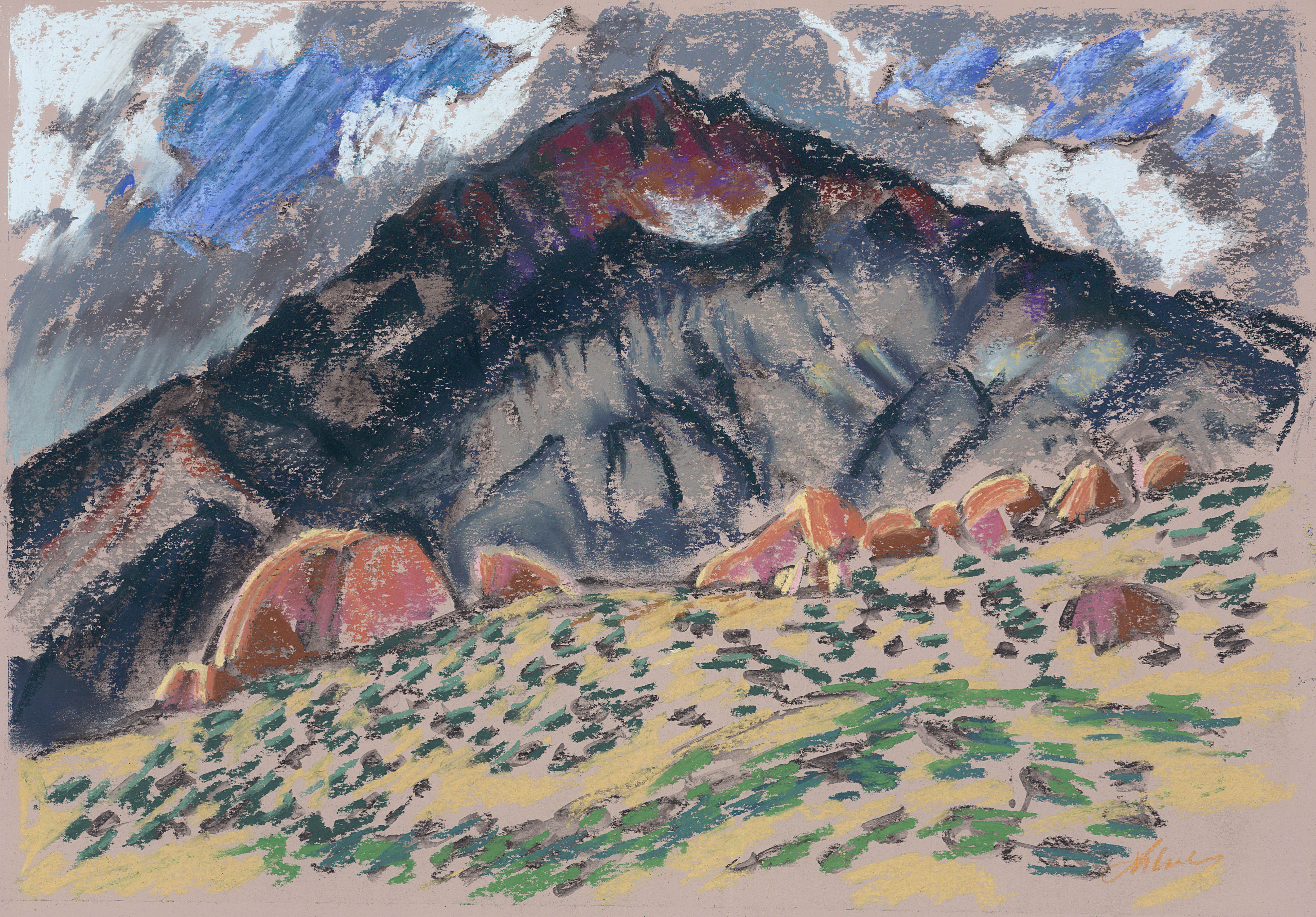
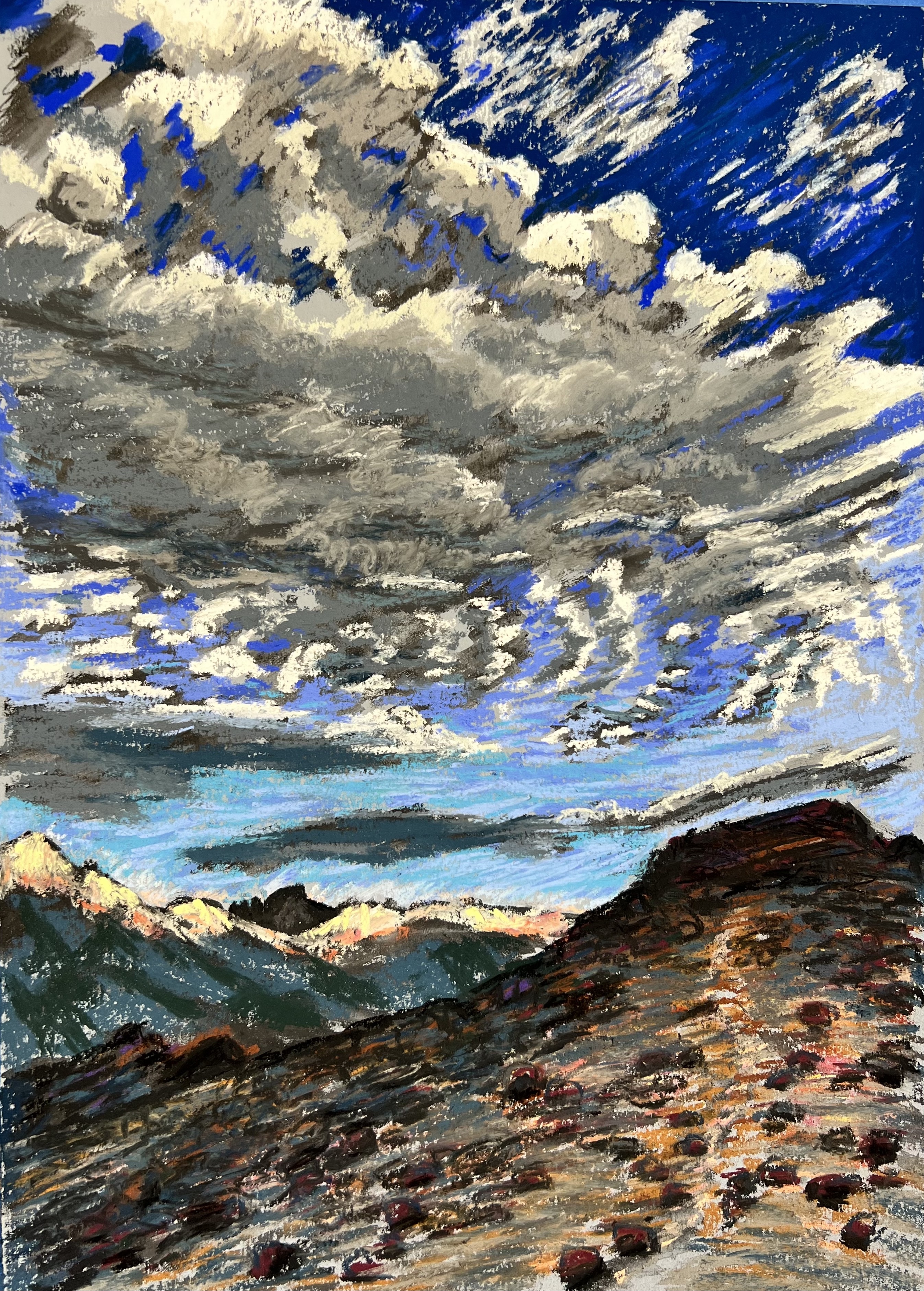
“…..on a September afternoon…..I return to the Buttermilks, walking about six miles roundtrip on the wash-boarded and rutted road up to the monster boulders known as Grandma and Grandpa Peabody, a favorite haunt of rock climbers. It is an amazing hike. I meet and talk with several people who call Payahuunadu their home. I am hooked on the Buttermilks! Storms linger in the valley and the day is a patchwork of blue skies, rainbows, and occasional downpours, but mostly a sensational cloud cover frames the mountain the Numu Paiute called Winuba (“Standing Tall”). Winuba is known to many as Mount Tom, and at 13,658 feet is the commanding peak of the Upper Owens Valley. I scramble amongst the granite boulders and marvel at their size. Grandpa Peabody is 50 feet high and 65 feet in diameter. Based on analysis of the boulders’ composition, geologists conclude that earthquakes shook these boulders loose from the ridgecrest and they rolled downslope, coming to rest in this field. I made this pastel in the studio from a photograph I took that day; the large pink boulder on the left is Grandpa Peabody.”
“Over that [1929] summer, [Georgia] O’Keefe worked her way through the standard paintings of santos, Ranchos de Taos church, and Taos Pueblo itself, but hints of her later work appeared as well. Particularly in a series of paintings of penitence crosses against a backdrop of a southwestern night sky, O’Keefe illustrated the spiritual inspiration she found in the New Mexico landscape. Perhaps the best-known painting from the summer, however, is The Lawrence Tree…..O’Keefe described the painting…..’I had one particular painting, that tree in Lawrence’s front yard as you see when you lie under it on the table with the stars it looks as tho it is standing on its head.’…..the work shows O’Keefe’s sensual appreciation of New Mexico as well as her engagement with [D. H.] Lawrence‘s writing. Lawrence had described the tree himself in St. Mawr, and Lawrence’s work remained in O’Keefe’s library throughout her life. Although Lawrence typically saw the tree with some ambivalence, O’Keefe made it entirely her own. In the painting, the tree reaches up and seems to kiss the sky, much as O’Keefe herself once said she wanted to do.” (177)
Excerpt from Flannery Burke‘s From Greenwich Village to Taos: Primitivism and Place at Mabel Dodge Luhan’s (Lawrence, Kansas: University of Kansas Press, 2008)
“The rivers of fluid fire that suddenly fell out of the sky and exploded on the earth near by, as if the whole earth had burst like a bomb, frightened her from the very core of her, and made her know secretly and with cynical certainty, that there was no merciful God in the heavens. A very tall, elegant pine-tree just above her cabin took the lightning, and stood tall and elegant as before, but with a white seam spiraling from its crest, all down its tall trunk, to earth. The perfect scar, white and long as lightning itself. And every time she looked at it, she said to herself, in spite of herself: There is no Almighty loving God. The God there is shaggy as the pine-trees, and horrible as the lightning. Outwardly, she never confessed this. Openly, she thought of her dear New England Church as usual. But in the violent undercurrent of her woman’s soul, after the storms, she would look at that living seamed tree, and the voice would say in her, almost savagely: What nonsense about Jesus and God of Love, in a place like this!This is more awful and more splendid. I like it better. The very chipmunks, in their jerky helter-skelter, the blue jays wrangling in the pine-tree in the dawn, the grey squirrel undulating to the tree-trunk, then pausing to chatter at her and scold her, with a show of fearlessness, as if she were the alien, the outsider, the creature that should not be permitted among the trees, all destroyed the illusion she cherished, of love, universal love. There was no love on this ranch. There was life, intense, bristling life, full of energy, but also, with an undertone of savage sordidness.” (167-168)
Mt. Whitney from a hilltop near Tuttle Creek. Robin L. Chandler, 2024
“…Beauty in the Song is clearly not the idealized, symmetrical, or abstract beauty of the Greeks, although occasional references to symmetry occur as in the images of twin gazelles and twin teeth (4:3, 4:5, 6:6, 7:4). The poet presents impressionistic images rather than a definitive likeness. Beauty in the song is visual, aromatic and tactile; it is textured and complex – a synesthetic experience. Beauty is a function of the abundance of the natural world. It is a function of aliveness. Beauty only becomes intelligible through the Song’s figurative language, which collapses the distance between the lovers and the land they inhabit. What beauty actually looks like in the Song is a luxurious land, alive with sheep grazing on hillsides, gazelles bounding through mountains, and trees laden with fruit.” (p.22)
White Mountains outside Laws, 2023. Robin L. Chandler
“During the more than thirty years that I did not make my home in Kentucky, much that I did not like about life in my home state (the cruel racist exploitation and oppression that continued from slavery into the present day, the disenfranchisement of poor and/or hillbilly people, the relentless assault on nature) was swiftly becoming the norm everywhere. Throughout our nation the dehumanization of poor people, the destruction of nature for capitalist development, the disenfranchisement of people of color, especially, African-Americans, the resurgence of white supremacy and with plantation culture has become an accepted way of life. Yet returning to my home state all the years that I was living away, I found there essential remnants of a culture of belonging, a sense of the meaning and vitality of geographical place (p.23) .”
“In ring composition, the narrative appears to meander away into a digression (the point of departure from the main narrative being marked by a formulaic line or stock scene), although the digression, the ostensible straying, turns out in the end to be a circle, since the narration will return to the precise point in the action from which it had strayed, that return marked by the repetition of the very formulaic line or scene that had indicated the point of departure…..interlocked narratives, each nested within another in the manner of Chinese boxes or Russian dolls (p.13)…..so we will leave our wanderer there and not bother him with all this history, the vast chain of events that has brought him back to the coastline where all the myths began, because, as we know, obscurity has its uses, too: can be as solid and productive, as concrete and real, as illumination is. We do not want to distract him. Now it is time for this exile to set upon his great work, a book that will begin with an account of a technique that is as old as Homer, known as ring composition: a wandering technique that yet always finds its way home, a technique which, with its sunny Mediterranean assumption that there is indeed a connection between all things, the German Jew Erich Auerbach – no doubt forgivably just now, given the awful and twisted route that has brought him here, the dark road, which yet, as he will one day finally admit, made his book possible – considers a little too good to be true (p.113).”




 alive in the sea of information