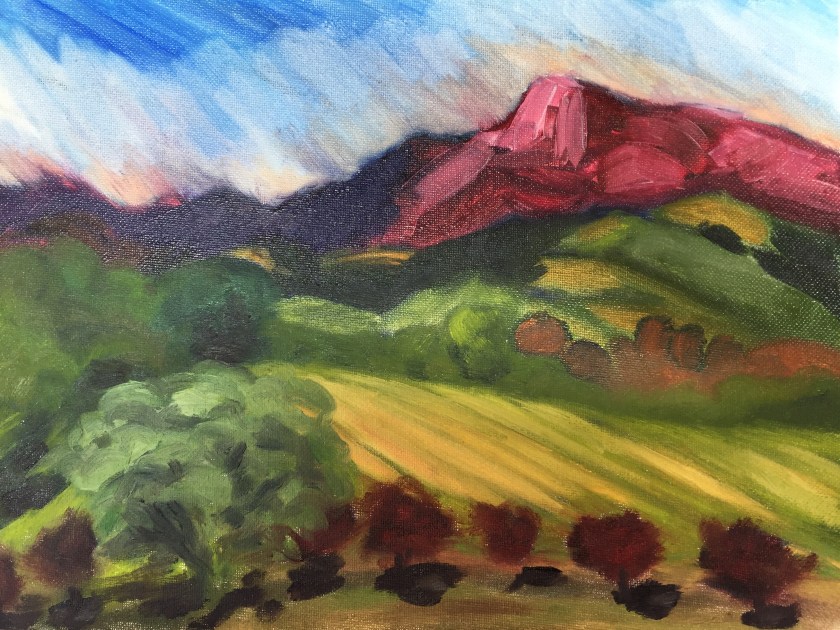
Mount Saint Helena after the rain. Robin L. Chandler 2017.
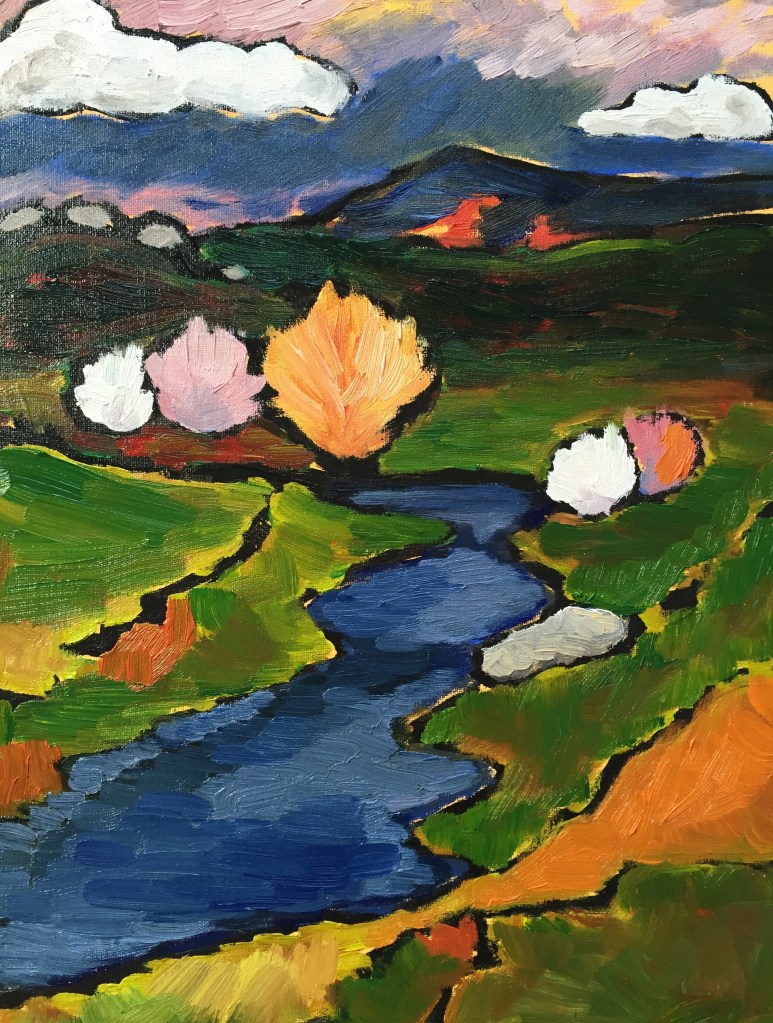
This morning brought another glorious day of painting here at my Chalk Hill Artist’s Residency. For the last three weeks, I have walked acres of vineyards cradled between the Russian River and Mount Saint Helena here in beautiful Sonoma County. During this time, I’ve forged deep connections with this beautiful landscape and the people, animals and birds that call this place home, and I’ve tried my best to put those feelings into my paintings.
The morning also brought a couple of “lost” dogs: Okie and Shadow. Out in my yard, I found these two out and about. They weren’t really lost, they were just not where they were supposed to be. But that said, I was happy they graced my porch and gave me their joy and friendship on such a beautiful day. Dogs and people soon all fell in to place, and they were on the next stage of their journey, and I was off to my studio to paint and paint some more!
Recently, my good friend Pam introduced me to a very talented musician Sarah Jarosz who is also a gifted songwriter. I can’t get this beautiful song Sarah wrote out of my head: Lost Dog. Maybe it sticks with me because all of us, bury old bones and find new ones, and all of us lose ourselves, and with determination, talent, good friends, and a wee bit of luck, find ourselves, again.
The days are dark and grey; the skies stormy and the ocean restless. Will we reach the shore? Or will we be battered by the tides? A weak hand at the tiller, doubt and anxiety grip our ship. We take our stand, voicing our opinion. Unsure. Will our words be heard, or will they fall on deaf ears, lost in the chaos?
Heroic action is needed to fight the fear mongers, but my special powers come from the brush in my hand. Will art signify in such a time?
In Defiant Spirits: the Modernist Revolution of the Group of Seven, Ross King proposed that an artist, and in this case, Tom Thomson, the great Canadian landscape painter and outdoorsman, could be “the hero in a time of need, [who] goes forth from his homeland and into an underworld of dangerous wonders. Here he contends against mighty forces and undergoes a series of trials before returning home, armed with special powers that give vitality to his community.” As an artist, Tom Thomson was engaged in the vision quest, “the single most pervasive literary plot in western literature…from Homer and the Bible, to Grail legends and the Native American hanblecheya.”
At this time in the history of our country, I believe each of us must undertake the vision quest; it is the eleventh hour and our land, and the creatures inhabiting the land, are under attack. To defend what we cherish, the hero within is desperately needed.
“When the aboriginal man goes walkabout, traveling along his ancestral songline, he chants the verses originally sung by his dreaming ancestor, singing the land into view as he walks through it. And in this manner, he renews not only his own life, but the very life of the land itself.”[1] Each place has it’s story, a story of the land and the creatures native to that place and time, and those stories must be described and shared to be remembered, to remain alive. The Greek word Aesthesis, origin of aesthetics, means the “work of the senses: touching, hearing, seeing, smelling and tasting.” Stories are created from aesthetic experiences, but theses stories must be preserved to be remembered.
In his 1980 Nobel Prize for Literature lecture, the great poet Czelaw Milosz wrote that the poet must possess two qualities: to see and describe. The poet is the one “who flies above the Earth and looks at it from above, but at the same time see’s it in every detail.” Milosz makes the point “to see means not only to have before one’s eyes. It may mean also to preserve in memory. To see and to describe may also mean to reconstruct in imagination. A distance achieved, thanks to the mystery of time, must not change events, landscapes, human figures into a tangle of shadows growing paler and paler. On the contrary, it can show them in full light, so that every event, every date becomes expressive and persists as an eternal reminder of human depravity and human greatness. Those who are alive receive a mandate from those who are silent forever. They can fulfill their duties only by trying to reconstruct precisely things as they were, and by wresting the past from fictions and legends.”
We must see and describe, to make stories, to make memories and fight the nihilism lurking in the current chaos. And yes, using my special powers, brush in my hand, I will see and describe, I will spark the memory of particular stories, associated with particular places and times and particular creatures, and it will signify.
[1] David Abram. “Gary Snyder and the Renewal of Oral Culture.” A Sense of the Whole: Reading Gary Snyder’s Mountains and Rivers Without End. Counterpoint: Berkeley, 2015. p. 94
The break between storms brought me to the beach. Oh the rain! Such a much needed gift. But I am glad for this day to enjoy the hazy winter sunshine. Meeting my friend, we set up our easels and started sketching in oil, the sun at our backs and the wind in our faces, capturing the coming storm moving eastward over the Pacific. It was a beautiful day – cool and grey – and I lost myself in its splendor while trying to capture it on canvas. On my way home, I stopped in Pescadero purchasing some hot chocolate and fresh baked artichoke bread to warm my body and soul and celebrate this precious life after growing cold and warn by hours of plein air painting.
The wonderful novel I am reading is called War and Turpentine; Stefan Hertman’s homage to his grandfather, awarded the 2014 AKO Literature prize, is the story of a man “tossed back and forth between the soldier he had to be and the artist he wished to become.” War and turpentine. Painting the seascape, this passage from the book came to mind:
“There is a great deal on this planet to arouse an enduring sense of wonder, especially when seen in the light of one’s impending departure. The way molecules move in the water, for instance, yielding the subtlest play of shifting light as evening falls over the sea in a southern bay – say, on the rocky beach of the Italian coastal town of Rapallo, when the wind has dropped and the pink of the evening clouds performs endless variations with the deepening blue or the sky mirrored in the sea – and how living beings with eyes and consciousness, two incomprehensibly complex adaptations to this whole wondrous biosphere, can take it all for granted and go on breathing, flawlessly designed for just this sort of system.”
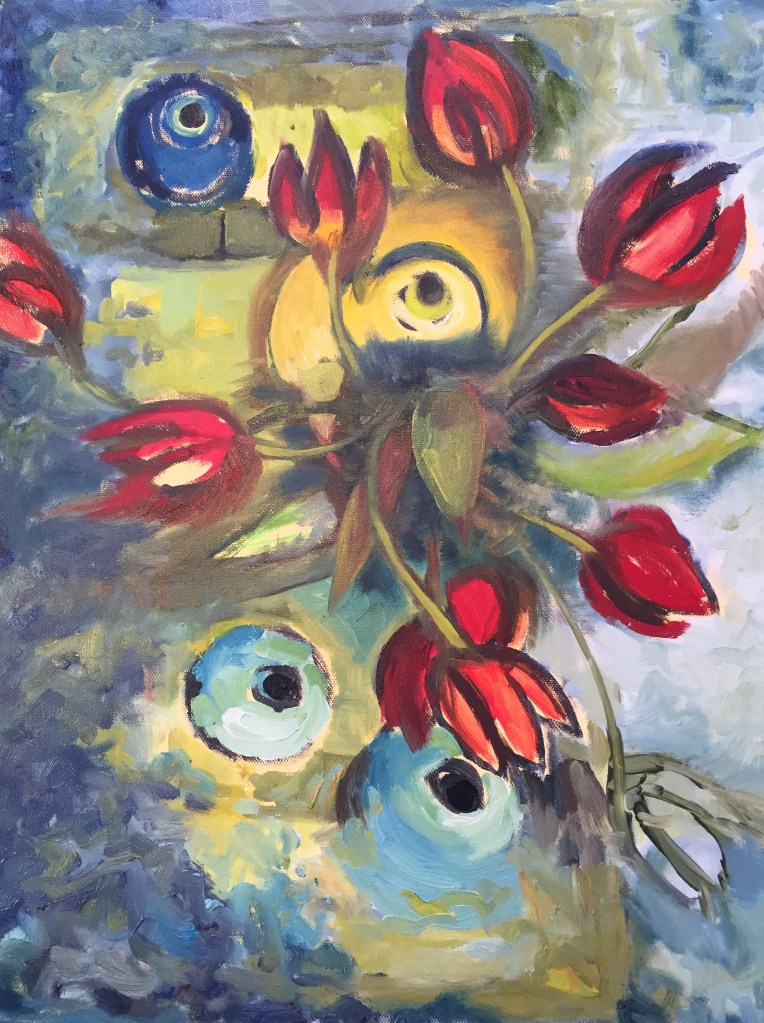
Spring finds flowers in the house. Deep red tulips on the table; arranged with Heath ceramic vases of yellow, light grey and pale blue against a cloth of blue grey and green gold. Typically the landscape calls me to interpret the experience in paint. I choose the joy of sensing the world: feel the sun, smell the lavender, taste the sour grass, hear the redwing blackbird, and watch the trees bend in the wind. But the feast of colors on the table, the bold red, the pale green gold and vibrant blue grey charmed me. I was on borrowed time. The flowers would not last long, I needed to paint now. I began.
Last week, Darcy Grimaldo Grigsby lectured on plein air and urban landscape painting as part of her course Western Art from the Renaissance to the Present. Grigsby relayed a woman painter, of a respectable class in the 19th century, who lived in the world and was of the world was living on borrowed time. She would not be respectable for long if she stepped beyond her sphere and assumed the life of a flaneur. Berthe Morisot, the great French woman Impressionist painter was confined to painting the women’s sphere, and when she strayed outside to paint, her subjects were limited, and she was chaperoned. Charles Baudelaire (possibly describing his friend the painter Edouard Manet) wrote in The Painter of Modern Life (1863) the crowd is [the artist’s ] domain…to be away from home and yet to feel at home anywhere; to see the world, to be at the very center of the world, and yet to be unseen of the world…the observer is a prince enjoying his incognito wherever he goes.” The princely life was not possible for the 19th century woman painter, so she remained at home painting the inside world of children and flowers. Morisot admired and identified with the women painter Marie Bashkirtseff whose diaries are quoted in Jeffrey Meyer’s Impressionist Quartet, “what I long for is the liberty to ramble alone, to come and go, to seat myself on the benches in the garden of the Tuileries, and especially of the Luxembourg, to stop at the artistic shop windows, enter the churches, the museums, to ramble at night in the old streets, that is what I long for, and that is the liberty without which one can not become a true artist.”
Until I fell head-over-heels for the red tulips, I did not grasp the charm of a still life; I am a woman of my time, a woman of action, always moving, never still. In the 21st century, with my respectability intact, I can paint the world or paint my home, whenever I chose, whenever I choose. I can ramble at night in the old streets, and never on borrowed time.
Spring San Joaquin Valley. Robin L. Chandler Copyright 2016.
Each painting is a journey: it begins, we embark on a veiled path, enfolded in process.
“The work of art is born of the artist in a mysterious and secret way. From him it gains life and being. Nor is its existence casual and inconsequent, but it has a definite and purposeful strength, alike in its material and spiritual life. It exists and has power to create spiritual atmosphere; and from this inner standpoint one judges whether it is a good work of art or a bad one. If its “form” is bad it means that the form is too feeble in meaning to call forth corresponding vibrations of the soul.”
Laurel Canyon Trail, Winter rain. Robin L. Chandler Copyright 2016.
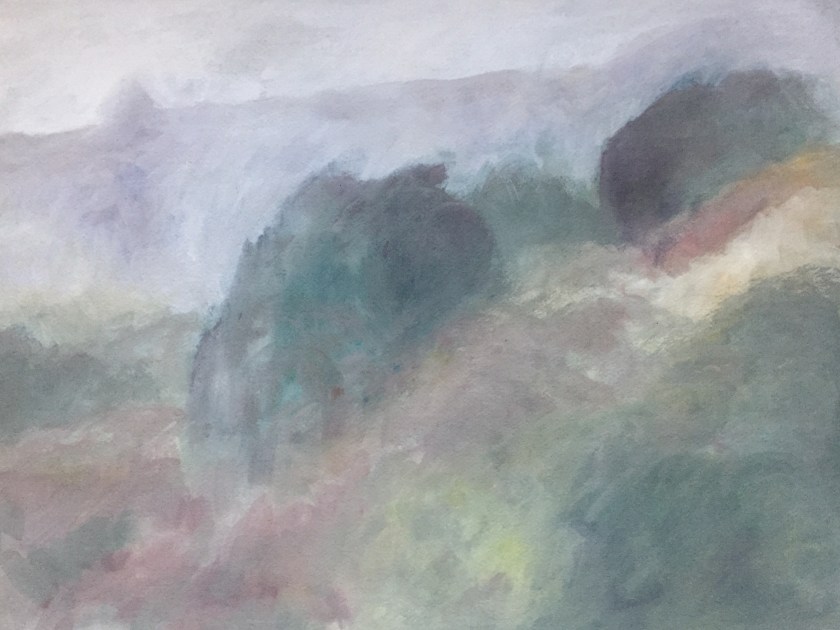
Rainy days are magical. Swaddled by the silvery mist, the grey-like sound of the hoot owl haunted the coastal live oak and eucalyptus forest of the East Bay hills near Oakland. Enchanted by the muted colors and subdued sounds we hiked the muddy Laurel Canyon trail. Twelve hundred feet above the sea promises a fair prospect. But reaching the hilltop, we found Wildcat Peak cloaked in a thick woolly rain cloud. Playfully, I imagined the peaks marking the compass points obscured by inclemency: Mount St. Helena (North), Mount Diablo (East), Mountain Hamilton (South), and Mount Tamalpais (West). Few hikers joined us on this cold, leaden day, but we found great warmth in our companionship and the grey solitude.
The artist and writer David Batchelor in The Luminous and the Grey surfaced the painter Vincent Van Gogh’s thoughts about the colour grey. Writing to his brother Theo in the 1880s, Van Gogh came to grey’s defence pointing to the “endless variations of greys, red-grey, yellow-grey, blue-grey, green-grey, orange grey, and purple grey…..it is impossible to say, for instance, how many green greys there are, it varies endlessly.” Continuing on this theme, Batchelor quotes the Bauhaus painter and color theorist Johannes Itten “[grey] is mute, but easily excited to thrilling resonances.” Batchelor opines “a small amount of any colour can and does transform grey…..into something subtle, complex and even thrilling.”
The Japanese poet Matsuo Basho describes this atmosphere – the solitude of grey – best with his haiku:
Cold December Dawn. Robin L. Chandler Copyright 2015.
The Society of Six, led by Selden Gile, part of the San Francisco Bay Area modernist art scene, painted plein air from 1917 to 1927. William Clapp, later Curator of the Oakland Museum and one of the Six, described their work as the intent “to produce joy through the use of the eyes.” After hiking short distances in the East Bay Hills or along the Oakland waterfront they painted small canvases that could be done quickly and “on the spot” creating a visual language defined by distinctive color and spatial relationships. Louis Siegriest, Maurice Logan, August Gay and Bernard von Eichman completed the close-knit group working from Gile’s cabin on Chabot Road, Oakland.
Led by the great artist Professor Anthony Dubovsky, our Visual Studies seminar Fall 2015, met weekly to discuss the Art History spectrum considering visual language, layers of meaning, and methods to organize expression. Mr. Dubovsky’s exhaustive knowledge of art and culture and the special insights provided by my fellow students, fueled our discussion to understand what is intentional and what is discovered in the artist’s creative act. Our goal was to grasp the diversity of visual language and nurture our own voice through individual art practice and group discussion. Tony introduced me to the work of Selden Gile suggesting the spontaneous plein air approach of the Society of Six might inform my art practice. The seminar experience was rich and priceless. Because of the seminar, I have renewed the exploration of visual language. What is my current painting vocabulary? It is time to let the painting speak for itself. Now, when I pick up my brush, dip into the paint, and connect with the canvas, I bring intent, and also the courage to let go. What will the painting be? What will I discover? I draw inspiration from the poet Paul Valery in Mauvaises Pensées et Autres: “the painter should not paint what he sees, but what will be seen.”
Before leaving town, I drove over to my friend’s house to say goodbye and thank her again for the paddleboard adventure. My memories duly recorded of a beautiful November afternoon, the sun warm on my face as we glided on Elkhorn Slough off Monterey Bay. The wind picked up in the afternoon, bringing a slight chill. The breeze also brought waves rocking the board, challenging my core. Only my second time out on the board, I was still learning to balance…still learning to trust my ability to dance gracefully on a fluid surface, keeping time with water’s rhythms. Dancing the cha-cha, badly, with the wind and the waves. But when I relaxed, letting my mind and body live in the moment, I walked on the water.
Dogen meditates in his Mountain and Water Sutra “all waters appear at the foot of the eastern mountains. Above all waters are all mountains. Walking beyond and walking within are both done on water. All mountains walk with their toes on all waters and splash there.”
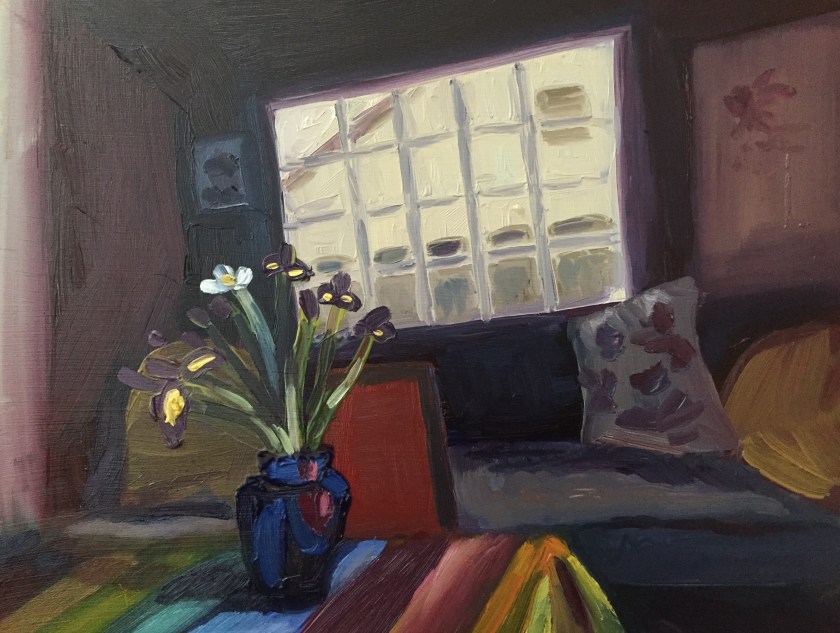
My friend was in the garden, cutting a single white flower, a dietes, a wild iris, from her garden, to place among the blue iris, waiting in the vase on her table. It was a beautiful juxtaposition: backlit, the iris emerged from the darkness, well situated on the tablecloth, a spectrum of colors. The image cried out to be painted in oil, but I am a watercolorist. With limited experience in oil paints, I have no trust in my abilities, in my mind and body to work together, no confidence that I could walk on water.
Gary Snyder writes in his essay Blue Mountains Constantly Walking published in The Practice of the Wild “there’s all sorts of walking – from heading out across the desert in a straight line to a sinuous weaving through the undergrowth. Descending rocky ridges and talus slopes is a specialty in itself. It is an irregular dancing – always shifting – step or walk on slabs and scree. The breath and eye are always following this uneven rhythm…the alert eye looking ahead, picking the footholds to come, while never missing the step of the moment. The body-mind is so at one with this rough world that it makes these moves effortlessly once it has had a bit of practice.”
So, I just said, just dive in, walking on water will come…with practice, and really, the journey is all that really matters. Diving into the deep end starts the learning. So, I painted with oil, the iris emerging from the darkness, well situated on the tablecloth, a spectrum of colors. So, I say, trust your mind and body, and never forget, the darker the night, the brighter the stars.
San Francisco seen from the Port of Oakland. Robin L. Chandler Copyright 2015.
Saturday morning we woke to rain. It was a happy shock, given California’s drought. Dropping off the car for an oil change, I asked the mechanics to install new wiper blades. Overreaction? Overly optimistic? Only time will tell. Regardless, the skies put on a tremendous show as the front pushed across the region. It was an opportunity to paint a special place where sky, sea and scape meet with spectacular results. Shoreline Park operated by the Port of Oakland offered a grand stand to capture the atmospheric show: cumulous clouds towering over the San Francisco skyline situated on a bay reflecting the sun’s blinding light. It is a rare gift to live near a city blessed with the drama of sea and sky providing artists an opportunity to capture light reflective and translucent.
J. M. W. Turner lived along the London’s river Thames and visited Venice with its Grand Canal. This summer the De Young Museum hosted an exhibit “Painting Set Free” sharing Turner’s landscapes drawn from the last fifteen years of his career. It is a show not to be missed. Peter Ackroyd’s biography of Turner explains the artist’s first encounter with Venice in 1819: “his first thoughts on seeing the floating city are not recorded but we may imagine the response of one who was so deeply attuned to the movement of water, to the passage of light, and the intermingling of the sun among the waves…..he stayed for only five days on this occasion but the city seized his imagination; he filled some 160 pages of his sketchbooks with drawings and groups of drawings. He also executed some wonderful watercolors of the Venetian morning, where the translucent and ethereal light of the city is evoked in washes of yellow and blue. That sense of light never left him. It irradiates much of the rest of his work.”
Mt. Whitney at sunrise. Robin L. Chandler copyright 2014.
In Bernard Berenson: A Life in the Picture Trade, Rachel Cohen describes how Berenson, revolutionized art history by his beliefs that “one did not need to be steeped in history or iconography in order to respond to paintings…one could be in an active relationship with paintings…one’s own private and profound experiences of them was not just for the rich or gifted but a natural capacity of the human mind and therefore available to everybody.” Paintings, wrote Berenson, “hate people that come to them with anything but perfect abandon.” This month an exhibit of my watercolors hangs at the Sweet Adeline Bakeshop in Berkeley. Watercolors lend themselves well to my life in transit: they are light to carry, rapidly used, and quick to dry. As I walk and bike near home and work, or travel, I discover stories in the landscape. Watercolors and brushes at the ready, I stop to capture the moment with quick sketches. Some of these sketches mature into more detailed works created back in the studio.
While I firmly believe historical context is not required to enjoy art, it does, without a doubt, add to the experience. Depicting wild or urban settings, my paintings draw inspiration from the Hudson River School and Tonalism, groups of artists who expressed their experience of nature in very different terms. Hudson River School painters – including Frederic Church and Albert Bierstadt – wrought panoramic vistas celebrating the magnificence of the land in sharply defining light. Emphasizing mood and shadow, the breaking dawn, gray or misty days, or light bleaching out sharp contrasts, Tonalist painters – such as George Inness and James McNeill Whistler – softly rendered landscape forms in their paintings. Published in A Life in Photography, the painter and photographer Edward Steichen wrote “by taking a streetcar out to the end of the line and walking a short distance, I find a few wood lots. These became my stomping grounds, especially during autumn, winter and early spring. They were particularly appealing on gray or misty days, or very late in the afternoon or twilight. Under those conditions the woods had moods and the moods aroused emotional reactions that I tried to render…”For those of you unable to see the exhibit in person, I share the paintings with you now. Bring your perfect abandon and choose your perfect soundtrack to view the pictures at the exhibition. Some may choose Mussorgsky, but for today’s viewing I choose Rufus Wainright‘s Release the Stars.
Torrey Pines early morning. Robin L. Chandler Copyright 2015.Swami’s Beach at sunset looking south. Robin L. Chandler Copyright 2014.Swami’s Beach at sunset looking north. Robin L. Chandler Copyright 2015.Swami’s Beach at sunset on a rainy day looking south. Robin L. Chandler Copyright 2014.View of Santa Cruz coastline and Monterey Bay National Marine Sanctuary. Copyright Robin L. Chandler 2014Natural Bridges late afternoon. Copyright Robin L. Chandler 2014Elkhorn Slough wetlands mid-morning. Robin L. Chandler Copyright 2014.Moss Landing at sunrise. Robin L. Chandler Copyright 2015Pt. Lobos near Carmel mid-afternoon. Robin L. Chandler Copyright 2015.Sailboats on Alameda Estuary mid-day. Robin L. Chandler Copyright 2015.Oakland Skyline mid-day. Robin L. Chandler Copyright 2015.Oakland Terminal on Alameda Estuary mid-day. Robin L. Chandler Copyright 2015.Storm over San Francisco view from Richmond wetlands. Robin L. Chandler Copyright 2015.Grazing Sheep north of Point Reyes Station high-noon. Robin L. Chandler Copyright 2015.Black Mountain late afternoon. Robin L. Chandler Copyright 2015.Nicasio Reservoir at sunset.Tomales Bay from Point Reyes Station storm moving in. Robin L. Chandler Copyright 2015.Mt. Whitney at sunrise. Robin L. Chandler copyright 2014View of Half Dome in Yosemite Valley. Copyright Robin L. Chandler 2014.