Chief Skedans Totem. Copyright 2012 Robin L. Chandler.
Brahms’ Requiem is a prayer for the living, and it begins “blessed are they that mourn, for they shall have comfort.” I’ve been listening to it for days, seeking comfort, because a dear friend passed away on Saturday night. Last week, I found myself standing in Stanley Park, Vancouver, awestricken before a totem carved by Haida artist Bill Reid. Recreating a pole carved in 1870 in the village of Skidegate, Queen Charlotte Islands, the totem honors the passing of the Raven Chief Skedans; images of the Moon, Mountain Goat, Grizzly Bear and the Whale grace its visage. The Chief’s daughter erected the pole as a memorial honoring her father’s passing. I was in Victoria when Laura Tatum passed away. In the tradition of the memorial totem, I offer these watercolors today in remembrance of Laura. My friend Laura brought an extraordinary sparkle and passion to all aspects of her life. Laura had a smile that could light up the darkest of rooms. She was a superb archivist who specialized in architectural records and broke new ground engaging architects in arrangement and description of their archival collections.
Mount Rainier, Seattle, Sunrise. Copyright 2012 Robin L. Chandler
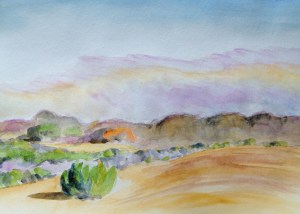
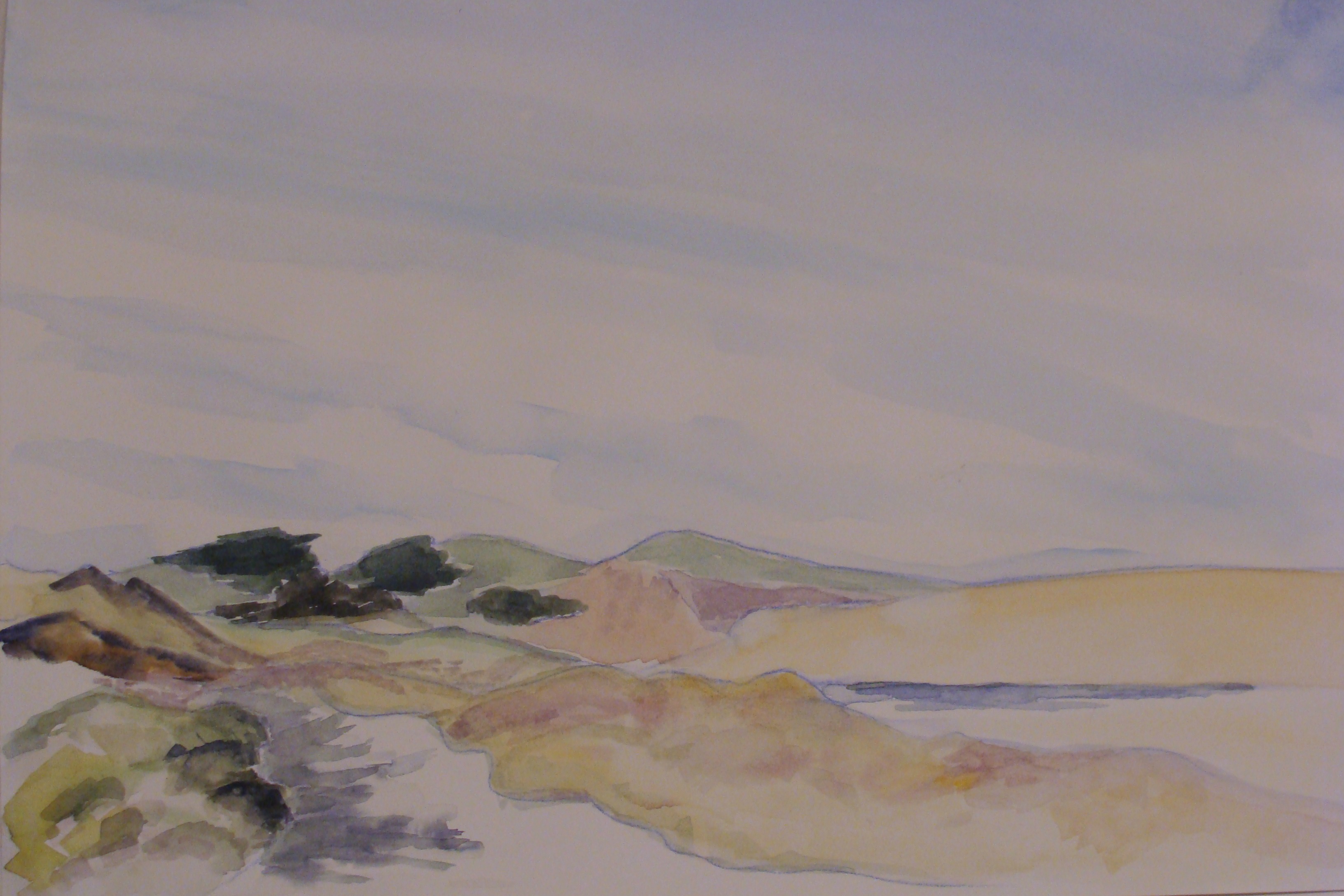
Work has brought me to the Pacific Northwest & British Columbia several times in the last year: Portland, Seattle, Vancouver, and Victoria. I have attempted to capture the region’s beauty in my watercolors.
View of the Olympic Range from Victoria. Copyright 2012 Robin L. Chandler.
In my mind’s eye, I see Laura, a native Oregonian, flying magically and Marc Chagall-like in the heavens over the rooftops and green space of the Pacific Northwest and British Columbia. Her journey takes her northward from Oregon along the Cascade Range to Mount Rainier, westward to the Olympic Range, and northward again across the Strait of Juan de Fuca towards Vancouver and Victoria, her spirit living and loving, ever inspiring us to live life to the fullest. With this magic, I shall have comfort.
Two years ago, I came to the UC Santa Cruz University Library to manage the project team building GDAO, the Grateful Dead Archive Online. The petals have all unfolded and the roses are now in bloom. On June 29, 2012 – just another day at Redwoodstock – we celebrated the opening of the Grateful Dead Archive and the Dead Central Exhibit space and the launching of GDAO. We sang the song electric for the living archive of all things dead. From the attics of their lives, full of cloudy dreams unreal, all lights all eyes can see, all that’s still unsung. In just over twenty-four hours, almost ten-thousand visitors from around the world from China to Iran have browsed and searched GDAO and contributed content. Building GDAO, has been a long strange trip taken with some amazing pranksters dedicated to digitizing the collection, creating metadata, designing the website, considering fair use, searching for rights holders, programming GDAO’s functions and building the virtual machine. So, as this spectacular tour comes to a close, we know another show lays ahead just a little further down the road. Update from goin’ down the road and feelin’ “glad”: electronic records archivist Jeanne Kramer-Smythe blogged so sweetly about GDAO in her recent entry Grateful Dead Archive Online: First Impressions Yee Hah!
Early morning and first day of the New Year, dinner was already in the bag. The black-eyed peas were cooked and we still had a little smoked turkey from “Tejas” – my Dad’s annual holiday gift. We were ready for our traditional new years pilgrimage to the ocean. The truck easily covered the fifty-mile distance seamlessly crossing the once Spanish and Mexican ranchos — remembered now mostly as streets, colleges, landmarks or towns named for land grants – Peralta, San Pedro, Nicasio, Tomales and de Los Reyes. Sir Francis Drake Boulevard holds some thirty years of memories: the old white horse in the corral just west of Lagunitas (a toy horse perched on the fence has sadly replaced the original); seeing my first Steelhead with Jane in Lagunitas Creek on our bike-camping trip from Santa Rosa to San Francisco; watching the Salmon with Wave as they lay their eggs in redds just below Kent Lake; and the journey to Bolinas in the old VW bug for my first kayaking adventure with Glo, John and Carol.
Before reaching the beach, two mandatory stops are necessary. Ginger & Chocolate-Chocolate-Cherry cookies from the Bovine Bakery are a must: necessary fuel for the hike ahead. Stocking up on our reading materials was another must at the Point Reyes Books. We are members of their Community Supported Bookstore Program a cool new idea inspired by community supported agriculture to help sustain independent book sellers. Supporters make a deposit with the bookstore and draw upon that amount for future purchases. Brilliant! I hope other bookstores start this program! A lover of browsing, I bought my first book of 2012, a volume by the roots music guitarist Ry Cooder: Los Angeles Stories. Looks like my kind of book. Fiction, but the kind of stories you might gather by sitting down with the everyday folks in your community over a cup of coffee and listening to their life; learning about their part in our shared history. Revived both gastronomically and intellectually, we headed on down the road to Limantour Beach to let the ocean ions do their purifying thang. We walked the beach length in the bright sunshine, the waves gently lapping at our feet and the sweet ocean air wafting through us. Later, alone in the truck for a few minutes while Wave lingered to capture a last image of a beautiful day, I queued Mary Gautier’s Mercy Now. As I look to the year ahead may everyone have “ a little mercy now.”
May you go Furthur in the New Year. Copyright 2010 Robin L. Chandler
Thirty minutes after the doors opened, I walk off BART and onto the dance floor of the Bill Graham Auditorium, the party in full swing. Cannabis clouds envelope me, crowds of swirling dervishes surround me, the lights paint me surreally and the band welcomes me, the words of an Estimated Prophet hang in the air “I’m in no hurry, no no no. I know where to go….California, preaching on the burning shore…..California, I’ll be knocking on the golden door…..like an angel, standing in a shaft of light. Rising up to paradise, I know I’m gonna shine.” Synchronicity. I am here.
Hours before I’d burned the two thousand miles from Austin to San Francisco; a western pilgrimage branded by rain, snow and wind. Somehow synched, the band breaks into Cold Rain and Snow “run me out in the cold rain and snow….and I’m going where those chilly winds don’t blow.“ Our road home through Abilene, San Angelo, Midlands, Van Horn, El Paso, Lordsburg, Tucson, Blythe and Los Angeles shared most of the 2,765-mile route of the Butterfield Overland Mail Trail. The stagecoach operated from 1857- 1861 traversing the Great Plains, the Sonoran Desert and the San Joaquin Valley connecting St. Louis to San Francisco. Evidence of ruts left by Butterfield stagecoach wheels, formed more than one hundred and fifty years ago, remains visible to hikers in the Anza Borrego Desert (East of San Diego). Sobering is the power of mankind to create lasting change, or in the desert wilderness, permanent damage. Leave no trace. Good advice in the wilderness, but judging from the energy around me, the Grateful Dead left an important lasting impression.
The band breaks into Tennessee Jed singing “there ain’t no place I’d rather be, baby won’t you carry me.” My mind flashes back to John Ford’s masterpiece Stagecoach the first film with a soundtrack scored entirely on American folksongs combining traditional Texas and ballads, Stephen Foster compositions, hymns, tin-pan alley tunes and minstrel songs. Stagecoach’s theme contain the lyrics “O bury me not on the lone prairie….. Where coyotes howl and the wind blows free…..By my father’s grave, there let me be…. O bury me not on the lone prairie.” Roots of the Dead. Synchronicity yet again. As if a messenger sent, my dear friend emerges from the seven-thousand year-end revelers while the band sings Scarlett Begonias “once in a while you get shown the light, in the strangest of places, if you look at it right.” Synched once more. My friend leans over and whispers “the jam builds with Phil and Bobby at the core, the keyboard and lead guitar forming the outer rings of sound….all echoed in the movements of the dancers.” May we all be blessed in this New Year with such joyous synchronicity.
Behind the wheel, I’d been putting miles between us and our cameos in that timeless bittersweet holiday love story; the laughter and tears of parents and children. We’d had the joy of loving those in need and receiving their blessings in return. Needed warmth in the oft-desolate wasteland of the heart. Suddenly, I am shaken from my journey in the land of existential (“dust storms may exist”; “zero visibility possible”*). Deep in the heart of Texas,** the temperature gauge spiked. Oh, shit! Was our good luck running thin? Ahead the two-lane road came to a rise. We pulled off the road feeling small and alone amidst the vast sparse plains and endless blue sky. Prickly pair cactus for miles around and a little Armadillo road kill on the side. Nearby, a hawk perched hungrily watching a meadowlark dart across the road. Mockingbirds and ravens settled on the mesquite trees as if taking their seats for the show. Feeling a little like the wilderness comic, I bowed to the audience and lifted the hood dreading the voice of doom. Somewhere in the midst of that fine German engineering the car sizzled. I knew then we wouldn’t be sleeping that night in New Mexico. Under my breath I hummed the Grateful Dead lyrics “Casey Jones you better watch your speed…trouble ahead, trouble behind.”
The miles of country behind – cotton fields, pecan trees, goats, and the occasional steer – had been punctuated with cell towers. We might feel a bit lost out here in the desert, but we could be found; GPS and handhelds with bars serving as a strong substitute for a bright guiding star. Seconds later Google maps located the nearest VW dealer some 150 miles northwest. Plan B began to take shape. Later that night in an Abilene Best Western, that had room for us, we mused about our best-laid plans and what a roll of the dice can bring. Our luck never really ran thin. It was quite the opposite. Bearing gifts they came to us one following the other. John, our Abilene VW service manager, although miles away inspired confidence as we collaborated via cell phone to diagnose the problem and how to resolve it; Mrs. Wise, a local rancher, stopped and offered comfort making sure we had water and a way forward; and Sergeant-Major, twenty-year career soldier and medic, gave us command over the problem all the while laughing and sharing stories of his life in the army as he towed us west towards the stable, excuse me, garage managed by Donna (where they affectionately called her Ma). We will never forget the Texas magi and their gifts.
* Actual road signs in New Mexico, Land of Enchantment
** In 1923, Brady, Texas was officially designated as the “heart of Texas.”
Yesterday morning I woke up to an National Public Radio (NPR) story about the sounds of Haiti one week after the devastating earthquake. My ears were filled with the voices of children singing joyously in French about Joshua tumbling down the walls of Jericho. Ironic choice of song, but I was deeply moved by the music and I began to think how music sometimes breaks down walls between people. And then Kate McGarrigle passed away on January 18th, 2010. What a loss. So much music and joy came from Kate and her sister Anna and their collaborations over the years with Emmylou Harris, Linda Ronstadt, Joan Baez, Leonard Cohen and The Chieftans to name but a few. Last weekend I was in New England and I got the chance to make music with a couple of wonderful people – Keith and Mickey. Keith is one of my oldest and dearest friends and music has always been a part of our bond. Sometimes I sang, sometimes I listened, and sometimes I tried to paint them playing, happy to be a part of the music.
Mickey. Copyright 2010 Robin L. Chandler
Mike Rigenstrief wrote in the Montreal Gazette this week “but perhaps Kate and Anna’s most enduring musical legacy is communal music-making: the way they’d gather friends and family together in concerts….and make thousands of people, most of whom they’d never met, all feel like they were sitting around the kitchen table or in a living room, making music together. That is the essence of folk music. “ I think about all of the people I’ve shared or made music with over the years in all the living rooms, kitchens, stairwells and cars on road trips. Music is the tie that binds and can help to heal sadness, loss and despair.
Keith. Copyright 2010 Robin L. Chandler
Musicians are reaching out to Haiti with “Download to Donate – Songs for Haiti” with 100% of the funds going to Doctors Without Borders, the Red Cross and Wyclef Jean’s Yele Haiti Earthquake Fund. If she was with us, I’m sure Kate would be a part of this music for relief. Kate you raced the Matapedia, you could not slow down, and you were not afraid.
Born in the 1970s in the African American, Afro-Carribean and Latino communities of the Bronx, Hip Hop culture includes DJing, breakdancing, graffiti writing and rapping. According to Johnny Otis, rhythm and blues musician and teacher, in 1975, Mayor Abe Beame was faced with New York City going bankrupt. His choices were few as neither the federal or state governments would come to his aid. So, to solve his problem he fired over 19,000 city workers, and 15,000 of those workers were teachers responsible for instruction in the humanities: literature, art and music. Suddenly a generation of children had no access to instruments and formal music instruction. But ever resilient, these communities looked inward, drew upon their cultural heritage and created a new musical genre “rap,” one of the pillars of hip hop culture, using all that was available to them: language and percussion. The human spirit creates no matter how stripped bare.
Despair. Copyright 2007 Robin L. Chandler
Today our society, and by default, our educational systems are undergoing transformative change. To manage the fiscal crisis, our California state government is making deep cuts to our public universities, and campus and university administrators are now struggling with how to manage these reductions that will no doubt profoundly change our educational system. They will be faced with choices making decisions about what programs, what departments what campus units are sustainable and support the core mission of the university. External funding from public and private sources, though comprised during this economic crisis, continues to be available to support research in medicine, science and engineering, but not so readily available to the arts and humanities, Institute Museum Library Services (IMLS), National Endowment for the Arts (NEA), National Endowment for the Humanites (NEH), National Historic Publications Record Commission (NHPRC) and the Mellon Foundation being among the most valiant exceptions. Writing in the New York Times recently, Drew Gilpin Faust, President of Harvard University wrote “since the 1970s there has been a steep decline in the percentage of students majoring in the liberal arts and sciences, and an accompanying increase in pre-professional undergraduate degrees. Business is now by far the most popular undergraduate major, with twice as many bachelor’s degrees awarded in this area than in any other field of study. In the era of economic constraint before us, the pressure toward vocational pursuits is likely only to intensify. As a nation, we need to ask more than this from our universities. Higher learning can offer individuals and societies a depth and breadth of vision absent from the inevitably myopic present. Human beings need meaning, understanding and perspective as well as jobs. The question should not be whether we can afford to believe in such purposes in these times, but whether we can afford not to.”
Oakland gritty streets. Copyright 2007 Robin L. Chandler
In the September issue of Harpers Magazine, Mark Slouka (Professor of Creative Writing at Columbia University) wrote “the humanities, done right, are the crucible within which our evolving notions of what it means to be fully human are put to the test; they teach us, incrementally, endlessly, not what to do but how to be. Their method is confrontational, their domain unlimited, their “product” not truth but the reasoned search for truth.” Slouka also wrote “By downsizing what is most dangerous (and most essential) about our education, namely the deep civic function of the arts and the humanities, we’re well on the way to producing a nation of employees, not citizens. Thus is the world made safe for commerce, but not safe.”
During the Great Depression, Franklin Roosevelt’s New Deal Works Progress Administration invested in creating jobs across a wide spectrum including the arts and humanities. These became the Federal Art Project, the Federal Music Project, the Federal Theater Project and the Federal Writer’s Project. There was also the Historic Records Survey which employed archivists to identify, collect and conserve historic records throughout the United States. Rand Jimerson writes in the introduction to his recently published book Archives Power: Memory, Accountability, and Social Justice “Archivists [can] contribute to a richer human experience of understanding and compassion. They can help protect the rights of citizens, and to hold public figures in government and business accountable for their actions. Archivists provide resources for people to examine the past, to understand themselves in relation to others, and to deepen their appreciation of people with different backgrounds and perspectives. This is the essence of our common humanity.” Archives and teaching in the humanities are crucial to the formation of citizens able to participate fully in our democracy.
In February 2009, Congress passed and President Obama signed into law the American Recovery and Reinvestment Act ARRA which included stimulus funding making investments in infrastructure such as transportation, public schools, college financial aid, renewable energy programs, healthcare and homeland security. Conspicuously absent is direct funding for teaching and research in the arts and humanities, nor for libraries and archives. In his public high school rhetoric class Marcus Eure provides students with critical thinking skills as they study issues about civic morality. Eure believes “every marriage, every job, every parent-teacher meeting hinges in some way on the ability to understand and empathize with others, to challenge one’s beliefs, to strive for reason and clarity. “ The time is now to invest and provide federal stimulus packages in our arts, humanities, libraries and archives. It is our duty and obligation to the future, to build citizens to grapple with the challenges of today.