Music was her life. As a child she had run and jumped and played, but as she grew older the disease encoded in her DNA began shaping her body, and over time leaving her limbs increasingly useless…hands, arms, and legs noodle like and unresponsive to her wishes….unable to hold on to someone’s hand, and making standing impossible without holding on to crutches for support. It didn’t happen overnight. It was gradual, the strength ebbing a little more each day. Family photo albums revealed the truth. A young child jumped rope, played hopscotch and softball; looking at the pictures, you could almost hear her giggling and screeching with delight as she played tag with her friends. Only later, when she reached adolescence, did the braces, the crutches, and ultimately the wheelchair, banish her to the wings, while others moved their bodies effortlessly on center stage. Thankfully the disease would not reach her heart and lungs for years to come. But when she sang, she felt free and unbound by the disease that gripped her body. When she sang, she soared, holding on to each note fully, cherishing the place where the music took her. She deeply loved Brahms‘ Requiem. And when she took her place as a soprano in Robert Shaw’s chorus, performing the masterpiece at San Francisco’s St. Mary’s Cathedral, I cried for joy. Because in those moments, her inner self ran unchained at the speed of light, living fully outside her body’s limits, roaming freely and playing, defying all gravity’s laws.
Cottonwood in the Owens Valley. Robin L. Chandler 2016
The lights dimmed and the spotlight focused on the figure center stage guitar in hand; she began to sing, the voice a little smoky and raspy, working towards the high, round notes so clear in my memory. Soon, “Saint” Joan Baez sang two of my favorites by Bob Dylan and Woody Guthrie respectively, “With God on Our Side” and “Deportee,”. Both songs are stories of love and tragic loss. Each story holding forth the possibility of redemption, that we can learn from our mistakes and take right action.
Election eve, the significance of this sainted singer was not lost on any of us in the audience. This deeply disturbing election season nearly over, we drank deeply of the songs offered us, believing in the promise of a world where all persons count, no matter their origin or identity, and that the fabric of our society is stronger, when our diverse threads are woven together. Listening, my heart responds, I will march again to her call to action to build a better and loving world.
Between songs, she spoke about her belief in the ideas and aspirations expressed by Bernie Saunders as he crossed the county this year connecting with the hopes and ideals of a new generation. But she also spoke admiringly of the courage of Hilary Clinton, withstanding the barrage of lies and intimidation hurled at her these last months.
On my recent trip to the Eastern Sierras, many a cottonwood was growing, singularly, isolated from other trees in the valley, telling a story, stately and proud. In some cases, it was unclear if a tree was near death because of lack of water, or if it was merely beginning the long winter sleep. These trees standing statuesque on a parched landscape, with the majestic sierras as their backdrop, called to mind the elm trees, deemed Liberty Trees by the colonists turned patriots at the time of our Revolution. The first such elm was located in Boston and celebrated in the revolutionary poetry of Thomas Paine. Soon Liberty Trees were anointed in towns and cities throughout the colonies; these majestic trees witnessed calls to action, celebrated victories, and mourned defeats. Trees bear witness to our story, and with this act they become part of our own story, symbols of strength, longevity, knowledge, loss, and redemption.
We are participating in the most historic election of our time. The stakes are high; it feels like the future of our nation and perhaps the world weighs upon our ballot box. At times, I have been paralyzed with fear of what may come. But I also know that there are persons, my fellow citizens, who think differently than I and will vote differently than I, and they too are fearful of change. And yet, we are all part of the same country, and we must move forward together, whatever changes comes. I think of the lone cottonwood in the Owens Valley, thirsty. Is the tree telling a story of suffering brought on by a changing climate? Is it hanging on for dear life hoping for the redemption winter snow in the mountains will bring? Is this cottonwood a symbol of my republic gasping, near death? Listening to the tree, my heart responds. While I fear the change that the election could bring, I will be strong like a tree, making connections, bringing the long-view, and sharing all the knowledge and wisdom found deep in my core. I will take right action continuing to build a better and loving world respecting the rights of all living beings.
September brings cooler nights and turning leaves. The fruit trees are bringing forth figs, pears and persimmons and our thoughts turn to the harvest holidays. Morning skies are gray and foggy and afternoons are blessed with golden sunshine from a southern exposure. A melancholy rests lightly on my shoulders, realizing we’ve nearly completed the ritual cycle round the solar system, another year gone, mourning lost loves, preciously cradling what we hold dear, the future a mystery.
The song’s roots lay in Depression riddled Georgia, written and first performed in 1933 by Oliver Hood, a poem to lost love. A local bard, Hood’s authorship remained anonymous for many years, a man who loved music and making music every Sunday after church and dinner, sitting on his front porch with his friends and neighbors sharing songs and tunes. As Alan Lomax writes in The Folk Songs of North America describing the white ballad singer of roots music “carefully tune [s] his voice…his latent emotions must be kept under control…his solo…an act of memory, almost ritualistic.” A sharer of songs, Hood was not concerned about copyright in the early years of his music writing. Governor Jimmie Davis, bought the rights from the Rice Brothers, who recorded the song in 1939 claiming authorship.
The other night dear, as I lay sleeping I dreamed I held you in my arms But when I awoke, dear, I was mistaken So I hung my head and I cried.
You are my sunshine, my only sunshine You make me happy when skies are gray You’ll never know dear, how much I love you Please don’t take my sunshine away
I’ll always love you and make you happy, If you will only say the same. But if you leave me and love another, You’ll regret it all some day
You are my sunshine, my only sunshine You make me happy when skies are gray You’ll never know dear, how much I love you Please don’t take my sunshine away
You told me once, dear, you really loved me And no one else could come between. But now you’ve left me and love another; You have shattered all of my dreams
You are my sunshine, my only sunshine You make me happy when skies are gray You’ll never know dear, how much I love you Please don’t take my sunshine away
In all my dreams, dear, you seem to leave me When I awake my poor heart pains. So when you come back and make me happy I’ll forgive you dear, I’ll take all the blame.
You are my sunshine, my only sunshine You make me happy when skies are gray You’ll never know dear, how much I love you Please don’t take my sunshine away
Bristlecone Pine in the White Mountains. Robin L. Chandler Copyright 2016.
The White Mountains are a high desert range situated between the Sierra Nevada Mountains and the Great Basin Desert and overlooking Death Valley to the South and the Owens Valley to the West. White Mountain Peak at 14,252 feet is third highest mountain in California following Mt. Whitney and Mt. Williamson. A big, empty, solitary place, created by dynamic geologic forces; it is a place where, Ancient Bristlecone Pines teach pilgrims about a higher consciousness. Time stands still, and peering down in the valley, pilgrims can see life’s journey, the forks in-the-road ahead, and path choices, guided by the wisdom discovered amongst trees – like the Bodhi Tree – over four thousand years old.
In the late 1930s, the ethnomusicologist Alan Lomax preserved for the Library of Congress Archive of Folk Song Down in the Valley. Captured in the Great Smokey Mountains of North Carolina, the song is written from the perspective of an empty, solitary, place – prison – where time also stands still. Peering into space, cut off from the earth and sky, the prisoner sees deep into life’s chasm, the forks in the road behind, and reflects sadly on choices made.
Down in the valley valley so low Hang your head over hear the wind blow Hear the wind blow dear hear the wind blow Hang your head over hear the wind blow.
Roses love sunshine violets love dew Angels in heaven know I love you Know I love you dear know I love you Angels in heaven know I love you.
If you don’t love me love whom you please Throw your arms ’round me give my heart ease Give my heart ease love give my heart ease Throw your arms round me give my heart ease.
Build me a castle forty feet high So I can see him as he rides by As he rides by love as he rides by So I can see him as he rides by.
Write me a letter send it by mail Send it in care of Birmingham jail Birmingham jail love Birmingham jail Send it in care of Birmingham jail.
Going fishing with Dad was fun. Hot & humid Saturday mornings, piling into the station wagon with our poles, thermos or two, and bologna sandwiches. I had a spincast, pretty basic, the kind you had to bait yourself; the worms squirming in a Styrofoam cup filled with a bit of dirt and old coffee grounds. Dad was a fly fisherman; I was fascinated by the hours he spent tying his own flies in his basement workshop; I was also captivated by the ballet of the line striking the water. What an elegant and enigmatic ritual of rod and line dancing on the surface, breaking the serene plane. We fished in lakes and rivers of our Southern homeland, first Texas and later Virginia. I never caught many, and I know he spent hours helping me when he could have been fishing. But I remember the early mornings, alone together adrift in time, the sound of still water and rich dirt, the smell of dawn, before the fish bit.
Driving home, my father always sang to me, and I loved his tenor, cigarette scratchy. Sometimes, he made me laugh with a song from his days in the Air Force; “Old King Cole was a merry old soul, and a merry old soul was he, and he called for his pipe and he called for his bowl and he called for his privates three,” laughing and singing our way through the ranks to the general.
But more often than naught he sang Johnny Mercer and Harold Arlen’s The Blues in the Night. For me it was a song of mystery, filled with exotic places, the sound of whistlin’ trains, of pain, darkness and loneliness beyond my age of understanding. But I felt the sadness, the melancholy, and the blues in his voice. It touched me deeply. He explained to me that Natchez and Mobile, Memphis and St. Joe were all cities on the deep and long Mississippi River with headwaters near St. Paul, Minnesota rolling all the way to New Orleans and the Gulf, the land of dreams. Our river, became the river of song. Magic. Later, when I was able, I purchased a recording of Louis Armstrong singing and playing his trumpet with Oscar Peterson on piano. Listening now, I bring my own archaeology of understanding to this song and what it says about the space and time from which it sprang…a place limiting relationships between genders and races. But Louis’ deep growly voice always takes me back to the riverside where song began for me.
My mama done tol’ me, when I was in knee pants My mama done tol’ me…
“son, a woman’ll sweet talk,
And she’ll give ya the big eye, but when the sweet talkin’s done
A woman’s a two-face, a worrisome thing who’ll leave ya to sing
the blues in the night”
Now the rain’s a-fallin’, hear the train’s a-callin, “whooee!” (my mama done tol’ me) hear dat lonesome whistle blowin’ ‘cross the trestle, “whooee!” (my mama done tol’ me) a-whooee-ah-whooee ol’ clickety-clack’s a-echoin’ back the blues in the night The evenin’ breeze will start the trees to cryin’ and the moon will hide it’s light when you get the blues in the night Take my word, the mockingbird’ll sing the saddest kind o’ song, he knows things are wrong, and he’s right
From natchez to mobile, from memphis to st. joe, wherever the four winds blow I been in some big towns an’ heard me some big talk, but there is one thing I know A woman’s a two-face, a worrisome thing who’ll leave ya to sing the blues in the night
So, let me give ya fair warnin’ You may feel fine in the mornin’ But look out for those blues in the night
Exalting in the moment. Robin L. Chandler Copyright 2016.
It starts with the sound of a gong, and the tenor saxophone begins to glide like a hawk soaring on the winds. The piano an asymmetric counterpoint, a successive burst on the cymbal, and then the foundational heartbeat of the bass begins, the vibrations a syncopation. Led by John Coltrane on sax, Elvin Jones on drums, McCoy Tyner on piano and Jimmy Garrison on bass, exalted and soared. A Love Supreme, was born. A masterpiece in four movements: Acknowledgement, Resolution. Pursuance, Psalm; a spiritual path. Elvin Jones wrote “every time someone hears it, that music touches them somehow, even people who are churchgoers and have always thought that popular music or jazz was influenced by the devil.” John Coltrane wrote a benediction in the album’s liner notes: “I will do all I can to be worthy of thee o’ Lord. It all has to do with it…thought waves – heat waves – all vibrations – all paths lead to God. His way – it is lovely – it is gracious – it is merciful…one thought can produce millions of vibrations and they all go back to God. Everything does.”
Last weekend I read Dr. Paul Kalanithi’s When Breath Becomes Air; a book with tremendous impact in which Dr. Kalanithi grapples with the meaning of life when diagnosed with a fatal cancer. Cherishing every moment with his wife and baby, he closed with the following: “everyone succumbs to finitude. I suspect I am not the only one who reaches this pluperfect state. Most ambitions are either achieved or abandoned; either way, they belong to the past. The future, instead of the ladder toward the goals of life, flattens out into a perpetual present. Money, status, all the vanities the preacher of Ecclesiastes described hold so little interest: a chasing after wind indeed.” Instead of chasing the wind, may we soar on the wind, exalting in each moment’s wonder as we travel our spiritual path.
“I am a poor wayfaring stranger, while travelling through this world of woe.
Yet there’s no sickness, toil or danger. In that bright world to which I go.
I’m going there to see my mother. She said she’d meet me when I come.
I’m only going over Jordan. I’m only going over home.”
A classic American folk and gospel song, it resonates with one of Buddhism’s four Noble Truths that all is suffering, all is woe, and impermanence is one of the great causes of suffering. But a bright world exists to which we can go.
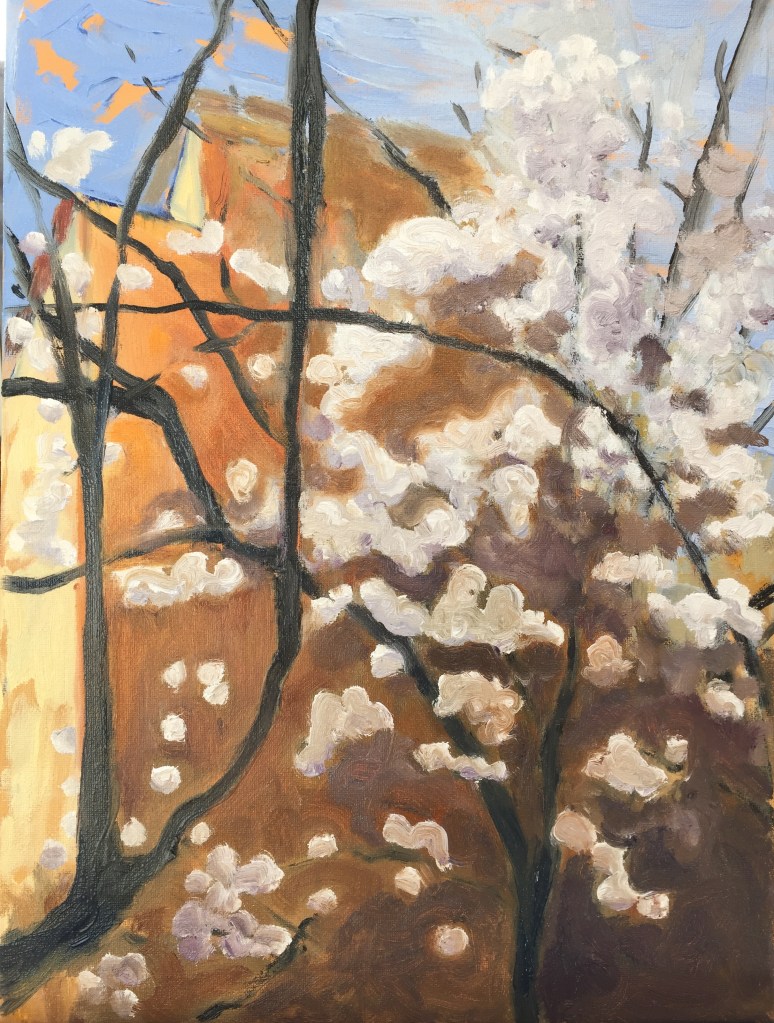
Last week the rains stopped and the fruit trees blossomed, a month before expected, but nonetheless spectacular for their early arrival. The plum trees in my yard shimmered in the February sunset, still winter by the calendar. The blossoms will not remain long. But long enough to tarry in my dreams, haunt my imagination, and find their way from brush to canvas to capture the beauty of impermanence.
This weekend we will say goodbye to a good friend, my second mother, who has gone over Jordan. There is no sickness, toil or danger, in that bright world to which she goes. Someday we’ll join her, going there, no more to roam. She said she’d meet us when we come. She said she’s only going home.
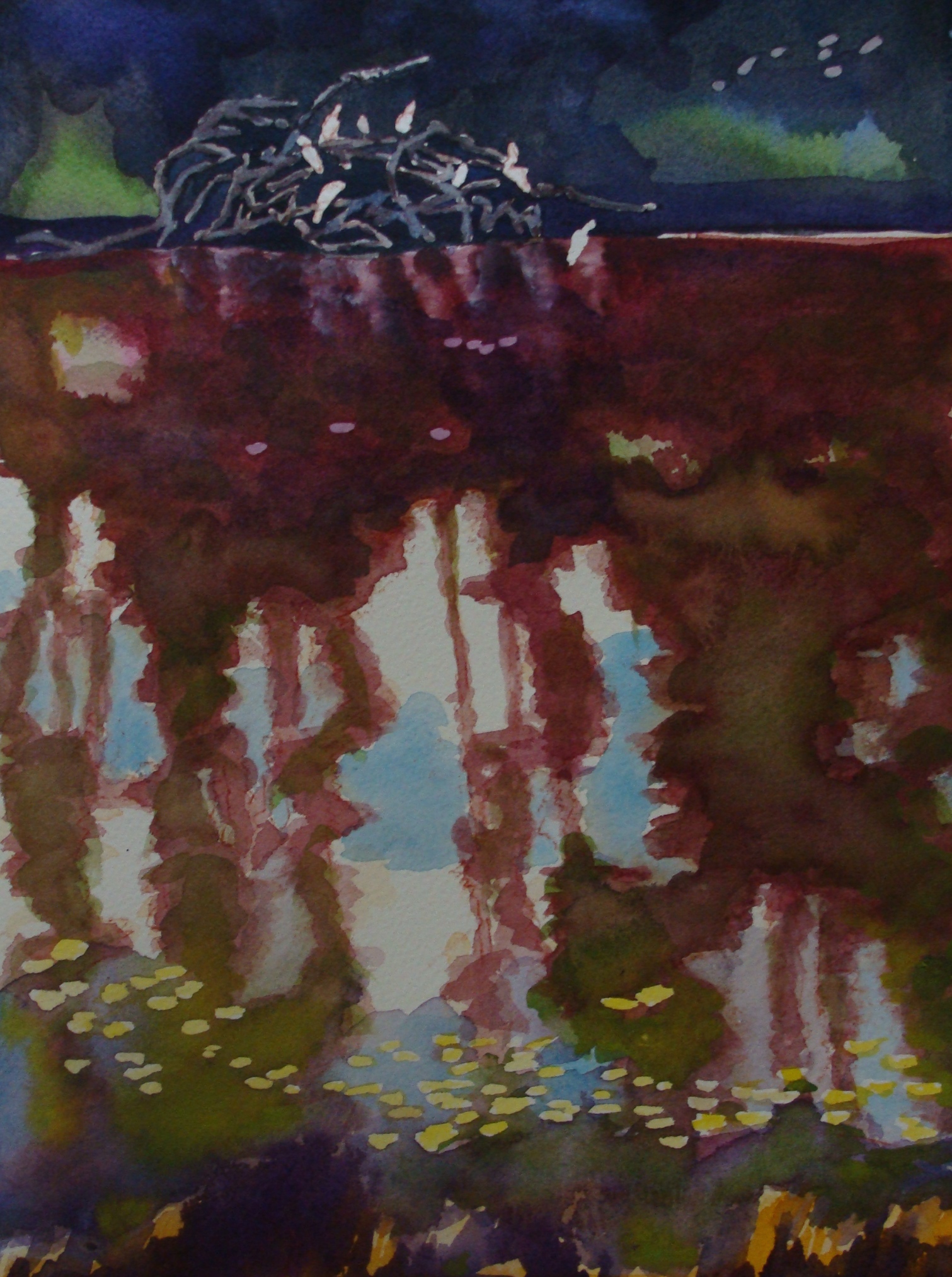
Santa Cruz lagoon. Robin L. Chandler Copyright 2015.
The sun was high in the sky: the light blinding and the air hot; no breeze. The egrets gathered as a rookery on the fallen trees by the lagoon in the Santa Cruz watershed, collecting themselves in the cool of the Eucalyptus trees, like sinners awaiting their baptism to wash away their sins. For a moment I lost myself in the other, the landscape. Quietly, I started to sing “yes, we’ll gather at the river, the beautiful, the beautiful river, gather with the saints at the river, that flows by the throne of God.” Shall We Gather at the River was a signature song for John Ford the filmmaker famous for his westerns shot in Monument Valley; the song became soundtrack in some of his most famous movies including My Darling Clementine, The Searchers, and Stagecoach. Ford often used the song as a means to define the boundary between the anglo-churchgoing community “civilizing” the frontier, and the “other ” community defined by their racial and ethnic differences; the “other’s” music emanated from saloons and was typically defined by Ford as minstrel songs and Spanish California folksongs.
Art and poetry are means to give voice to the other, be it individuals, communities, or the landscape. In his book, The Other Voice: Essays on Modern Poetry, the poet Octavio Paz wrote “all poets….if they are really poets, hear the other voice. It is their own, someone else’s, no one and everyone. Nothing distinguishes a poet from other men and women but these moments – rare yet frequent – in which being themselves they are other.”
Raven on a misty morning. Robin L. Chandler Copyright 2015.
Last Wednesday was a beautiful misty morning; perfect weather for a bike ride through the great meadow. Everywhere the fragrance of sweet wet grass, and fog covered my Santa Cruz campus like a blanket. Damp air kissed my face making rivulets of sweat and rain. Up ahead a great black raven perched on a young Douglas Fir calling out percussively toc toc toc; I responded with a smile singing “packed up all my care and woe, here I go singing low, bye, bye, blackbird.” Written in 1926, Bye, Bye Blackbird became a popular standard covered over the decades by jazz singers such as Ella Fitzgerald, Carmen McRae, and Nina Simone. I climb the hill, my crank spinning deliberately, a revolution at a time, while I riff on John Coltrane’s cover of Bye, Bye, Blackbird. The great jazz saxophonist believed deeply in music’s power. In a 1966 interview with Frank Kofsky, published in Black Nationalism and the Revolution in Music, Coltrane said “music is an expression of higher ideals…brotherhood is there; and I believe with brotherhood, there would be no poverty…and there would be no war…I know that there are bad forces, forces put here that bring suffering to others and misery to the world, but I want to be a force which is truly for good.” It gives me great pleasure to write that the UC Santa Cruz Library Special Collections & Archives preserves and makes accessible the Frank Kofsky Audio and Photo Collection of the Jazz and Rock Movement 1966-1968. Selected photographs from the collection are available online including an image of John Coltrane and his wife Alice (on piano) in performance.
Field of Rainbows. Robin L. Chandler Copyright 2015.
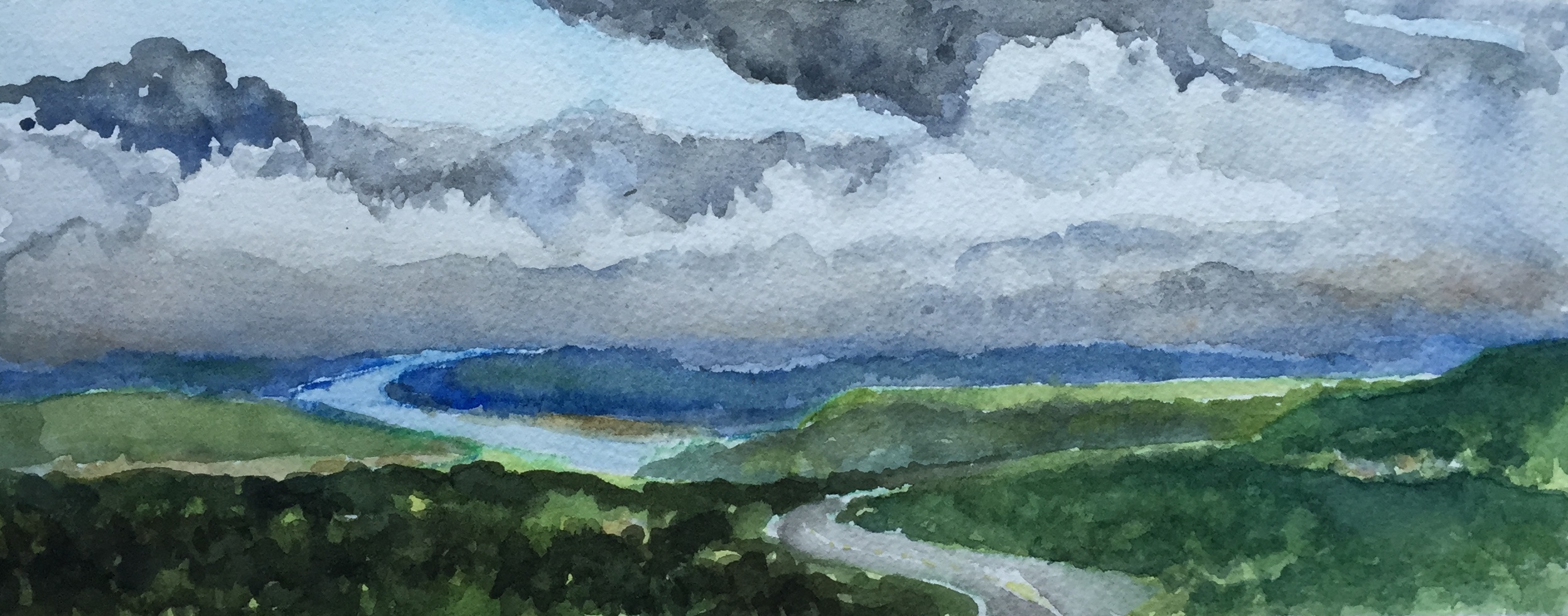
The Colorado River of Texas. Copyright Robin L. Chandler 2015.
Storm fed by New Mexican arroyos, the Colorado River winds across the Texas plains and prairies nurtured by springs, through the Hill Country and the fertile black bottom land, gathering steam as the Concho, Llano, Perdnales and San Saba rivers contribute on the journey to the Gulf of Mexico. Great forces tell the story of this country, some natural and some manmade. Wind and rain, lightening and thunder, sun and drought, the migration of creatures in the air, on the land, and through the water dialogue with man’s domestication of the landscape, wrestling nature to some kind of tenuous draw.
In a collection of essay’s Sacagawea’s Nickname: Essays on the American West, Larry McMurtry wrote “man may have seven ages, but the West has had only three: the age of Heroes (Lewis and Clark), the age of Publicity (Buffalo Bill), and the age of Suburbia, for which the preferred term is Urban Sprawl. How we got from the first age to the third, and what we have destroyed in the process, is a story historians will be worrying for a long time.”
Leaving Austin meandering the back roads towards Waco, I purposefully took a slight detour to the northwest to visit the Balcones Canyonlands National Wildlife Refuge. Spring is the perfect time to catch the wild flowers and glimpse migratory birds nesting in the Texas Hill Country. Austin’s culture of great music and good food combined with Texas’ tax incentives are attracting the computer industry and the countryside is increasingly being developed into suburban housing enclaves. My journey is a series of interstates, highways, and two-lane roads that are increasingly developed. Thank goodness the Refuge was formed in 1992 to ensure some land would forgo development and protect the habitat of two endangered birds: the Golden-cheeked Warbler and the Black-capped Vireo. And refuge it is. Although it is hard to completely loose sight or sound of the farm to market road, it is possible to loose yourself briefly in the surrounding natural history. Hiking on a ridge in the refuge, populated with juniper trees (known as cedars in Texas), I was rewarded with sightings of the nesting Warbler and a full stereophonic soundtrack of the bird’s beautiful song juxtaposed by distant thunder. My found treasure included a gorgeous view of the Colorado River of Texas with a threatening lightening storm looming on the western horizon.
I am conscious of the looming suburbs on the horizon, threatening like a storm this precious refuge. Back in the car, heading towards my Dad’s home, I queue up The Mountain on Steve Earle and Del McCoury Band’s album of the same name. I know the odds are stacked against nature; mankind’s greed and hunger scar the landscape with glacier like force. But I know we need to come to some compromise with nature, something more than this tenuous draw. We need to live and breathe stewardship; because the land helps keep us from worry and woe. As I merge onto the highway, Steve Earle sings:
“I was born on this mountain a long time ago
Before they knocked down the timber and strip-mined the coal
When you rose in the mornin’ before it was light
To go down in that dark hole and come back up at night
I was born on this mountain, this mountain’s my home
She holds me and keeps me from worry and woe
Well, they took everything that she gave, now they’re gone
But I’ll die on this mountain, this mountain’s my home”





 alive in the sea of information