snapshot

Search 1. Robin L. Chandler Copyright 2015.
Search 2. Robin L. Chandler Copyright 2015.
Search 3. Robin L. Chandler Copyright 2015.
Search 4. Robin L. Chandler Copyright 2015.

They are often found by browsing. We find them in antique shops, or abandoned on that hard-to-reach shelf: forgotten. You can randomly encounter them preserved in an archival collection, displayed on a museum wall, or even in a digital library like Calisphere. The snapshot: a random glimpse of the world capturing someone you’ll never meet and a story you will never know. But yet, it draws us. We search for meaning. Vivian Maier’s street photographs come to mind. The composition, the lines, the color, or lack of, and the emphasis all conspire to spark the imagination and engage us.

Consciously or unconsciously made, art stands on its own authority; the artwork must exist successfully regardless of the creator’s context. The use of light, space, movement, rhythms, and textures must interact so compellingly that we gain insight on the human experience regardless of the work’s origin. The creator’s story can shape and enrich the work, but our engagement, that “snapshot” moment the work captures the viewer’s imagination, is the starting point. We want to understand the human experience. Can we solve the mystery?

The creation of and engagement with art is, among other things, a deep and personal search for knowledge, for certainty. It is a search for meaning. But this thirst for knowledge is a double-edged sword: overexposure can lead to wisdom or paralysis; underexposure to bliss or ignorance. Perhaps we must be both overexposed and underexposed to truly understand the meaning of being human. Understanding is not found in a single snapshot, but awareness is, and consciousness is a good place to start.

In Ten Windows: How Great Poems Transform the World Jane Hirshfield writes about the Heian era Japanese poet Izumi Shikibu stating [his] poem reminds its reader that the moon’s beauty, and also the Buddhist awakening…will come to a person, only if the full range of events and feelings are allowed in as well.

Although the wind

Blows terribly here,

moonlight

also leaks between the roof planks

of this ruined house.

Figasus: what do you tend to?

Figtree for Morris Graves. Robin L. Chandler Copyright 2015.

Our backyard is blessed with fruit trees. In early summer, the apricots and plums ripen and soon find their way as jam, the taste of sunshine on a winter’s day. And now with fall’s arrival the Flanders Fig has ripened; with the pear and persimmon trees soon to follow. This week we will celebrate Sukkot, the Jewish agricultural festival celebrating the harvest. And so we tend to our figs. Even in this severe drought the trees are doing their utmost to participate in the cycle of life; and for this I am grateful and give thanks. But I worry. How much longer can they last with such little rain? Come hither El Nino, and when you come, don’t be shy, bring your entire Cumulonimbus family.

Harvested figs have become star performers in a galette, in salads, and rumors in our home, suggest a caramelized future for pizza pies. We planted the fig tree five years ago and over the years, we have tended the tree, watering, pruning branches, and building supports ensuring it would could grow tall and strong. This is the first bountiful harvest, so we eagerly await the fruit. The tree stands over fifteen feet in height, it’s branches tending towards the sun to help ripen the fruit. Figs are a favorite of the creatures with which we share this Oakland neighborhood; so, fig picking must be timed perfectly. The fruit needs to be ripe enough, but not so ripe as to become easy pickings for the raccoons, jays and squirrels that call our backyard home.

Tending my ripening figs, I contemplated their figgy future. What if the figs could break Newton’s Law of Gravity (avoiding a Fig Newton future) and fly like Pegasus? If figs could fly, what would they intend: remain on the branch, the majority content to a predetermined future filling the stomach’s of mammals and birds; or continue the cycle of rebirth, gravitating to mother earth seeding a new fig tree? If figs could fly, would they break their natural tendency and fly away: planting themselves in a land of gentle rain, or perhaps seek further enlightenment through a closer relationship with the sun? For the remainder of this day, I shall remain in this peaceful garden, seeking liberation from my own samsara by practicing self-discipline, participating in meditative concentration, and considering the wisdom of emptiness. Hoping that should I ever achieve nirvana, I would return as a Bodhisattva, attending to Figuasus and fig lovers on their flightpaths to enlightenment.

Beauty appears when one feels deeply

Sketch of a Coastal Live Oak in the UC Santa Cruz meadow. Robin L. Chandler, Copyright 2015.

Who could imagine a university nestled amongst stands of redwood trees and situated upon a hilltop meadow on the edge of the Monterey Bay. In this aspect, and in many other ways, UC Santa Cruz is extraordinary. Every morning I bike up the hill through the meadow to campus, a worthy challenge, and every evening, work complete for this day, I descend the pasturage, enjoying the emerging stars cast against a Technicolor ocean sunset. When I can take a midday break, I walk to the meadow and sketch. There, amazing Coastal Live Oaks, joined by their companion Bay Laurels and Buckeyes, bridge the forest and the meadow. A particularly compelling Quercus Agrifolia has caught my attention; a massive tree that must be at least sixty feet high, and could be over 250 years old. The change it has witnessed. It’s trunk is massive, contorted and gnarled, its branches an intricate web, and its crown rounded and dense. It sits majestically at the crest of the hill, the redwoods, the meadow and the bay as it’s theatrical backdrop. Beauty was the subject of my last blog and my search, blessedly continues.

It is difficult to take a break from the demands of a busy work schedule, but sketching the tree offers food for my imagination, an opportunity to refresh my soul, and ground myself before returning to my responsibilities. Henry David Thoreau danced on the edge of a Buddhist koan, with this 1859 journal entry “I have many affairs to attend to, and feel hurried these days. Great works of art have endless leisure for a background, as the universe has space. Time stands still while they are created. The artist cannot be in a hurry. The earth moves round the sun with inconceivable rapidity, and yet the surface of the lake is not ruffled.” My friend Chip Sullivan, artist and author, states in Drawing the Landscape that we “draw because it is the act of seeing and thinking clearly…it allows a concept to evolve…it resides between freedom and structure…drawing can also be a meditation…Zen art is the expression of the artist’s own inner state of going nowhere to a timeless dimension.

A few months ago, a very dear friend was reading a book about the National Archives historic photograph collection. The page was open to an iconic photograph taken by Dorothea Lange of hungry people in breadlines in San Francisco during the Great Depression. That single moment, set me on a journey of discovery, a road I still travel – reading about Dorothea and her first husband Maynard Dixon and viewing reproductions of their work in books, films and in museums. In the Fall 2014, PBS American Masters series broadcast the film Grab a Hunk of Lightning portraying the life and work of the masterful artist Dorothea Lange. A section of the film included Lange speaking about the meditative experience of making art:

“When you are working well, it is first of all, a process of getting lost, so that you live for maybe 2 – 3 hours as completely as possible the visual experience…you feel you have lost yourself, your identity, you are only an observer…all your instinctive powers are in operation and you don’t know why you are doing things really. Sometimes you annihilate yourself; that is something one needs to be able to do. There are moments when time stands still. You hope it will wait for you that fraction of a second…beauty appears when one feels deeply. Art is an act of total attention.”

landscape with flatiron

Bobcat. Copyright Robin L. Chandler 2014

Haruki Murakami’s short story characters in After the Quake confront their emptiness when the massive 1995 Kobe earthquake in Japan becomes a turning point in their lives.

“I call it Landscape with Flatiron. I finished it three days ago.

It’s just a picture of an iron in a room.”

“Why is that so tough to explain?”

“Because it’s not really an iron.”

She looked up at him. “The iron is not an iron?”

“That’s right.”

“Meaning it stands for something else?”

“Probably.”

Zen Buddhists believe that Buddha Nature – the true nature of reality and being – is impermanence, becoming, and a vast emptiness. And Satori,the sudden flash, leads to great insight into the vast emptiness. The earthquake provides Murakami’s characters with that sudden jolt providing insight into the emptiness…insight to grasp how an iron is more than an iron.

Last weekend, we visited our friends at Live Power Community Farm in Round Valley, California, where master farmers and apprentices continue in the footsteps of Alan Chadwick to sow and reap a bountiful harvest according to the principles of Biodynamic farming. Words cannot adequately describe the deep connection one forges with the land and the community when working side by side in the fields, making and sharing meals, and sleeping outside in the hay barn near to dozing horses, cows and sheep. It is sublime.

Arriving at the farm, we felt like understudies in a play whose curtain rose hours ago. We found ourselves reading lines in a well-thumbed script; and one of the acts was about this farm besieged for weeks by bobcats. Two weeks ago there were over forty egg laying chickens in the hen house; today there were less than nineteen. Eggs provide needed protein to feed the farmers. Late afternoon, we were hoeing and raking beds for planting, when news reached us that a bobcat had been caught in the trap near the horse pasture. We walked to the trap, fascinated and horrified at what we might find. There in a cage was the proud and beautiful creature, watching our every move, so alive, and so intense. This was the villain of the act in this play, but it was not really a villain, it was something else.

Our proud and beautiful bobcat would not live to see another sunrise, and that reality was like the sudden jolt of an earthquake providing insight into the true nature of reality and being, the impermanence, the becoming, and a vast emptiness. A coincidence, but a 6.0 earthquake occurred in Napa, California the next day; jolting our world with insight. And now a week later, while absent, the bobcat remains with me. And like the negative space in a painting, the absence of the subject, and not the subject itself, has become the most relevant, and the real subject of this story. It is the journey to understand the importance of impermanence, becoming and emptiness.

Sacred Path of the Warrior

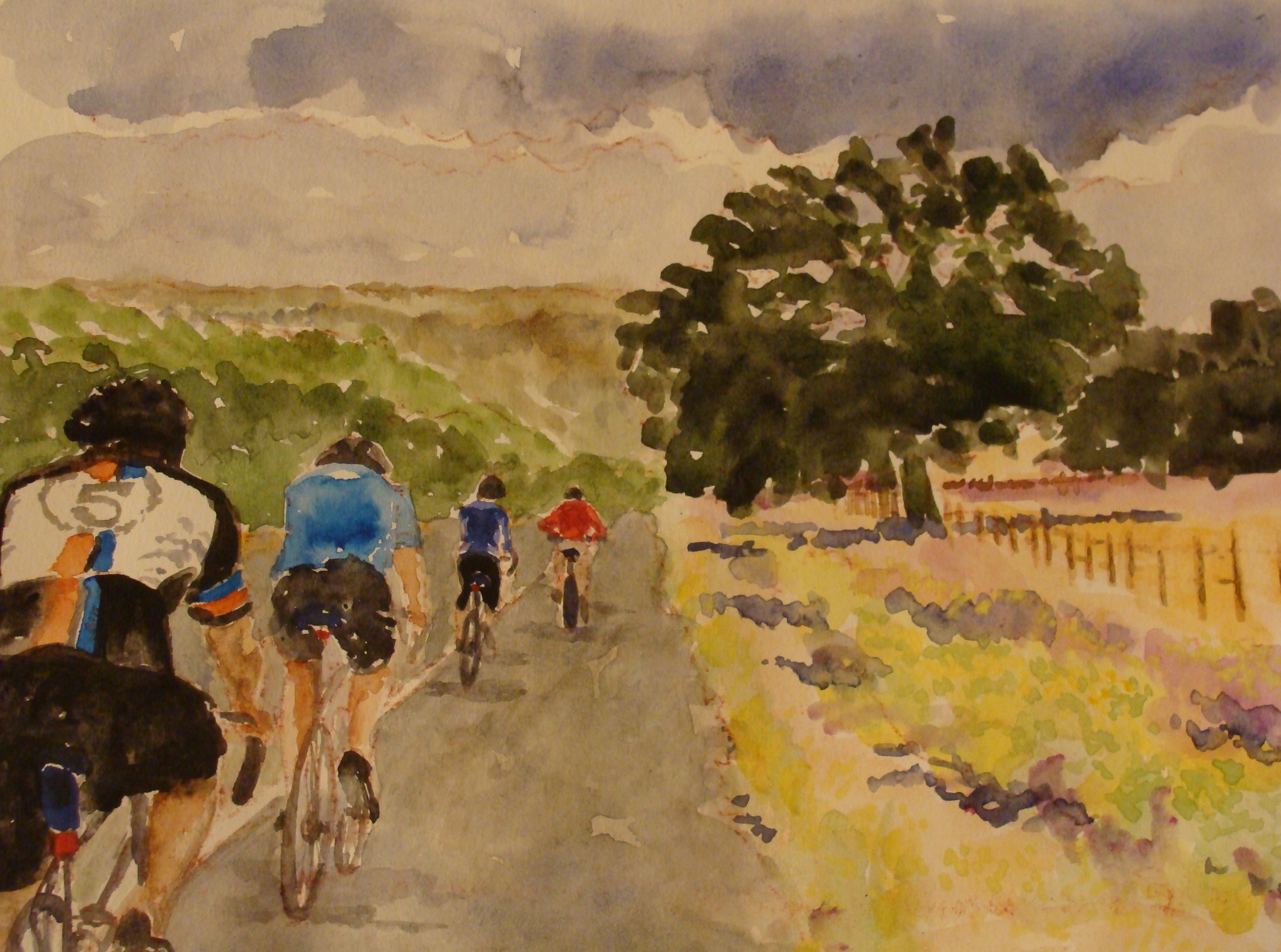
Day 3: King City to Paso Robles; starting up Quadbuster. Robin L. Chandler 2014
Day 3: King City to Paso Robles; starting up Quadbuster. Copyright Robin L. Chandler 2014

In Shambhala: The Sacred Path of the Warrior  Chogyam Trungpa wrote “the essence of human bravery, is refusing to give up on anyone or anything….and the master warrior is extremely humble….humbleness comes from working with others…to give space and time to others to develop their own understanding of goodness and of warriorship…patience is extending gentleness and faith to others all the time.” The warrior possesses faith in the basic goodness of others, a fearless expression of gentleness and genuineness on behalf of all sentient beings, and understands that tenderness comes from strength…stable, solid and true. Yesterday,  I reconnected with friends and fellow travelers riding in the AIDS LifeCycle 2014 contingent of the San Francisco Pride parade. The Ferry Building behind us, we cyclists, some two hundred strong, rolled out on to Market Street just behind the roaring engines of our beloved Dykes on Bikes. Peddling through the cheering crowd lining the route, my tears and laughter surfaced. On our helmets and bikes we all wore the number 1371 for Edna Flores-Lagunte, ALC rider, fundraiser, training ride leader and roadie, who sadly passed away this year on this her 13th LifeCycle. Edna was a warrior on the sacred path; she was loving, generous, joyous and so committed to helping others. Edna changed lives making them better. During the seven days riding from San Francisco to LA, I kept hearing the mantra “this ride will change your life.” By the time we left San Francisco on June 1, it already had.  Physically stronger and mentally more disciplined than a year earlier, I had also deepened friendships through honest conversations that happen during a long-distance training ride. But my most important life insight was yet to be revealed. Cycling 545 miles opens your eyes and your heart to yourself and to others. During the ride, I learned that tenderness grows from strength. With strength, I changed a rider’s flat tire when I worried I’d be sagged. With strength, I helped a tired rider set-up their tent when I was hungry. With strength, I let a weary rider take a hot shower before me when I was cold. And perhaps most importantly, with strength, I aspire to be as loving, generous, joyous and committed a person as Edna.

Itinerannia

Montserrat Abbey at sunrise. Copyright Robin L. Chandler 2014.
Sunrise at Montserrat Abbey. Copyright Robin L. Chandler 2014.

No matter where you find yourself, walking or cycling connect you to place. On foot or on a bike, life slows down and ceases to rush by in a blur. The smells, tastes, sounds, and sights of a landscape can be discovered, lingered over, and remembered. This rings true in both urban settings and the countryside where the aroma of paella cooking, the taste of locally made vermouth, the sound of church bells ringing, or the sight of the remaining fall leaves colorful against a winter sky are savored and stored like Proust’s memories of things past. Or as the landscape writer and teacher, J.B. Jackson wrote in his essay Sense of Place, Sense of Time the atmosphere…the quality of the environment…have an attraction…we want to return to, time and again.” So, after days of walking and gathering our own observational data about Barcelona, we set out to walk in some of Catalonia’s regions known as comarcas.

In the comarca of Pla de Barges, home to cava grapes, we arrived at Catalonia’s iconic mountain Montserrat to visit the Benedictine abbey Santa Maria de Montserrat in which the Mare de Deu de Montserrat – the black Madonna known as La Moreneta – greets pilgrim’s seeking to touch her hand to receive her blessing. The Montserrat range is Spain’s first national park and features formations composed of pink conglomerate and limestone rock visible from a distance as serrated ridges. The park draws hikers, rock climbers, nature lovers, tourists, and pilgrims to traverse the park’s miles of trails. On clear days visitors can see Mallorca one of Spain’s Balearic Islands in the Mediterranean; unfortunately for us, it was hazy. At sunrise the rocks and abbey are bathed in pinks and oranges and the Llobregat river valley below the mountain is covered with a blanket of fog. The Llobregat river flows from the Pyranees to enter the Mediterranean at Tarragona, the Roman imperial city of Iberia. The mountains above the abbey host chapels and the ruins of hermitages dating back over ten centuries. We walked the Cami de Sant Miquel through a Mediterranean Oak forest to Sant Joan’s chapel, the hermitage of Sant Onofre and the Stairway of the Poor. On the trail to the hermitage, I was moved by the stones worn smooth by centuries of pilgrims climbing the trail. My thoughts travelled to the Zen Buddhist, Matsuo Basho, the great master of haiku who wandered Japan writing poetry during the 17th century. Bashho drew inspiration from his environment, capturing his experience beautifully in a few short lines. Reaching the summit, I heard the abbey’s bells ring the quarter hour hundreds of meters below.

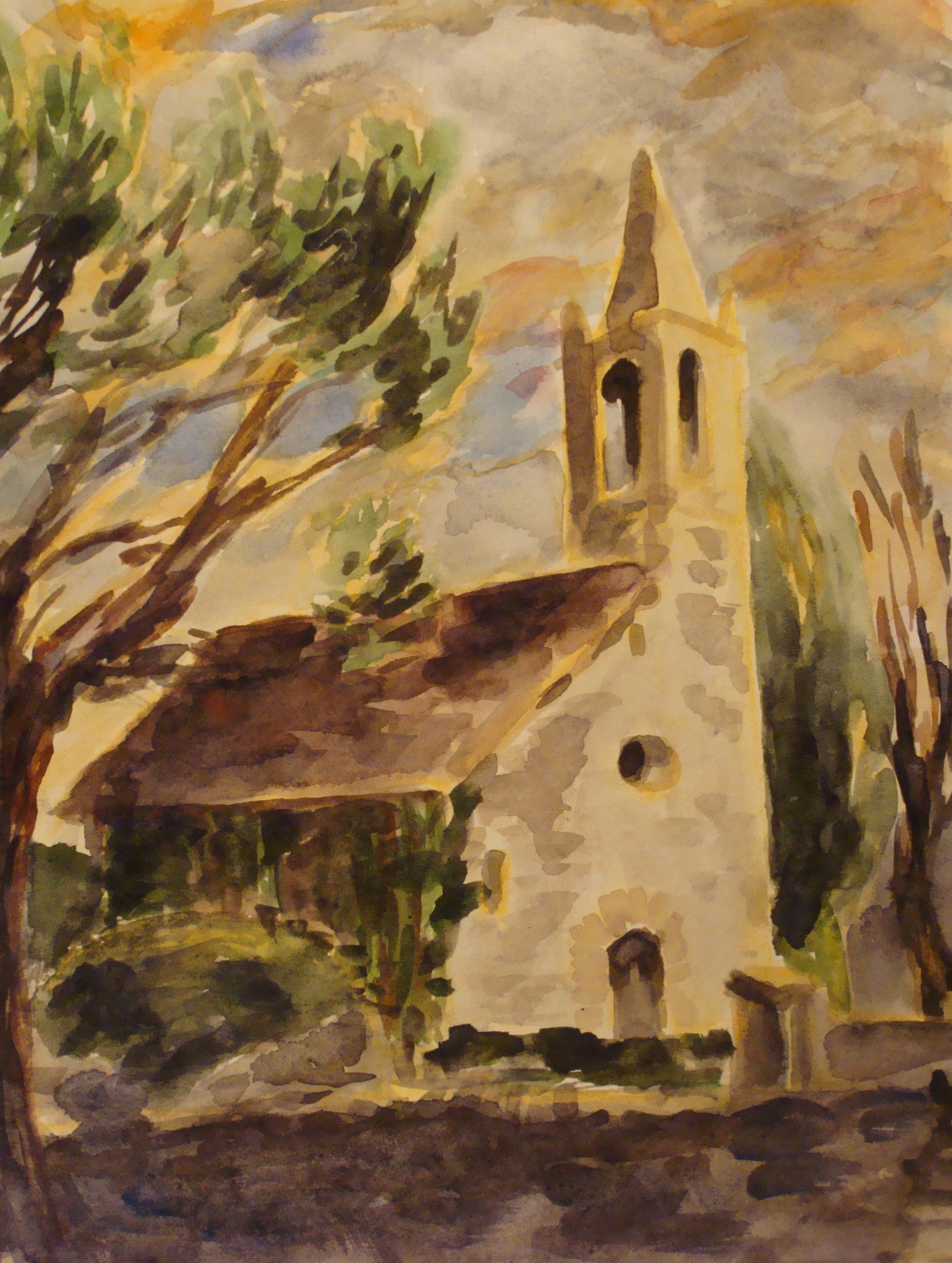
Sunset at La Rectoria de Sant Miquel de Pineda. Copyright Robin L. Chandler 2014.

Later in the trip, we visited the volcanic comarca of La Garrotxa, staying at the lovely bed and breakfast La Rectoria Sant Miquel de Pineda beside a restored 12th century chapel situated on the Ruta del Carrilet part of the itinerannia, a network of historical paths connecting three comarcs: El Ripolies (Pyranees mountains), La Garrotxa (the volcanic park) and L’Alt Emporda (rolling hills teased by the offshore dry, cold Tramuntana wind ). This network of trails is ideal for avid hikers and mountain bikers who enjoy exploring nature, touring farms, and sampling local cheeses, hazelnuts, pinenuts, honeys and breads, as well as learning about the history of the area. We walked the path leading to La Rectoria once the bed of the narrow gauge railroad connecting the ancient cities of Girona and Olot.  We also explored the cobblestone alleys of the medieval towns of Besalu and Sant Pau discovering the traces of Jewish communities tragically expelled by their majesties Ferdinand and Isabella’s Alhambra Decree in 1492 after the Reqonquista of Muslim Iberia in 1491. We visited these towns on the celebration of Treis Reis (Three Kings day) or the Epiphany, when the Magi visited the infant Jesus celebrating the revelation of the Son of God as a human being. Parades arrived at the main town plaça where the Kings presented gifts to eager children and on January 6 we ate the Tortell de Reis. Each night at dinner our host Roy Lawson and his wife Garrotti created delicious meals featuring fare from local farms including haricot beans, truffles, goat cheese soufflé, and buckwheat pancakes. Roy and Garrotti’s hospitality, comfortable and welcoming accommodations, fabulous food are a must if you are travelling in Catalonia; and the people you meet at their B & B are great!  Roy and Garrotti also have a blog for La Rectoria.

And then we came home and began thumbing our new Catalan cookbook!

Be Alert! Deer Crossing the Roadway!

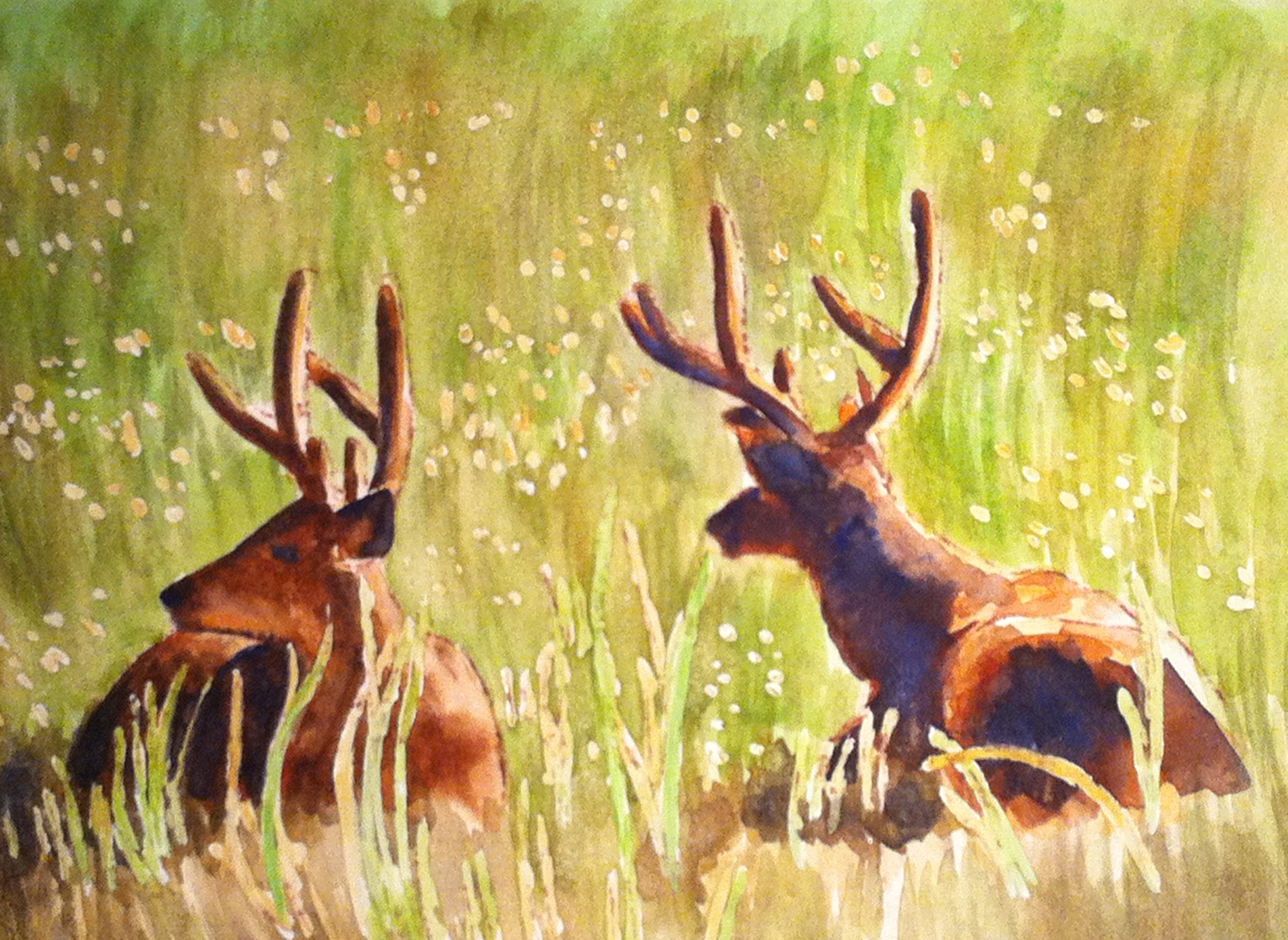
Young deer in the Santa Cruz meadow. Copyright 2013 Robin L. Chandler.

UC Santa Cruz is a special place; where else would you find a traffic sign flashing bright orange “be alert…deer crossing the roadway.” Cycling into work, I laughed lovingly acknowledging both the practical advice and the deeper meaning of mindfulness. Situated on a mountain overlooking the Pacific, the campus is replete with rolling meadows and coastal forests of tanoak, bay laurel, Pacific madrone and the regal Redwoods. An ecosystem intimately shared by animals, plants and people. After a quiet summer, September signals major events in certain campus populations: the academic cycle migration of homo sapiens and the advent of the breeding season for California mule deer. The traffic signal brings some needed intervention to manage the humans and deer inhabiting this space. All summer the bucks have roamed the meadows as a herd while their antlers grew big and strong preparing to compete for a mate. Next spring, fawns begin the cycle anew. Riding up the bike path through the thirsty meadow, I wonder from where the mountain lion watches these migrations and lifecycles. Will I ever see one?

Right mindfulness, an element of the Buddhist eight-fold path, teaches adherents to be alert, present, building awareness of the moment…the path to enlightenment. Earlier this year, I received a gift from the wife of a landscape painter whose work I greatly admire; she connected me to the work of Peter Matthiessen, Buddhist and writer of fiction and many well-respected books about the environment including the National Book Award winner The Snow Leopard.  Trekking through Nepal with the ancient Buddhist shrine Shey Gompa on Crystal Mountain as their destination, Matthiessen and the field biologist George Schaller were seeking research data on the Blue Sheep and the Snow Leopard.  Truly a book about his spiritual journey, Matthiessen finds the revered Lama of Shey who blesses him with a koan “Have you seen the snow leopard? No. Isn’t that wonderful!”  Matthiessen writes “I feel great gratitude for being here, for being, rather for there is no need to hike oneself to the snow mountains in order to feel free.  I am not here to seek the “crazy wisdom;” if I am, I shall never find it. I am here to be here, like these rocks and sky and snow, like this hail that is falling down out of the sun…the absurdity of a life that may well end before one understands it does not relieve one of the duty (to that self which is inseparable from others) to live it as bravely and generously as possible.”

It is the season when deer are on the minds of many. Last weekend we attended the fundraiser for the journal West Marin Review held by Point Reyes Books. Two great women poets read from their work: Kay Ryan and Jane Hirshfield and ironically among the many poems they read, they both chose to read works about deer. Selecting a poem from her book The Best of It, Ryan read “a buck looks up: the touch of his rack against wet bark whispers a syllable singular to deer; the next one hears and shifts; the next head stops and lifts; deeper and deeper into the park.” Hirschfeld choose a poem from The Lives of the Heart and read “a root seeks water. Tenderness only breaks open the earth. This morning, out the window, the deer stood like a blessing, then vanished.

The Swanton Loop

Swanton Pacific Ranch. Copyright 2013 Robin L. Chandler

June and we are blessed again with strawberries. It’s after 5:30PM when I leave work, but the summer sun remains sky high moving towards the solstice. Driving north from Santa Cruz towards Davenport, the Pacific flashes brilliantly on this clear and hot day; along the coast farmers are irrigating their crops. The infinite horizontality brings mindfulness; the day falls away and clarity about the scheme of things returns.  Listening to the Blessed Are album, and I find the Woody Guthrie track Deportee and I softly sing with Joan Baez:

 Is this the best way we can grow our big orchards? Is this the best way we can grow our good fruit? To fall like dry leaves to rot on my topsoil. And be called by no name except “deportees.”

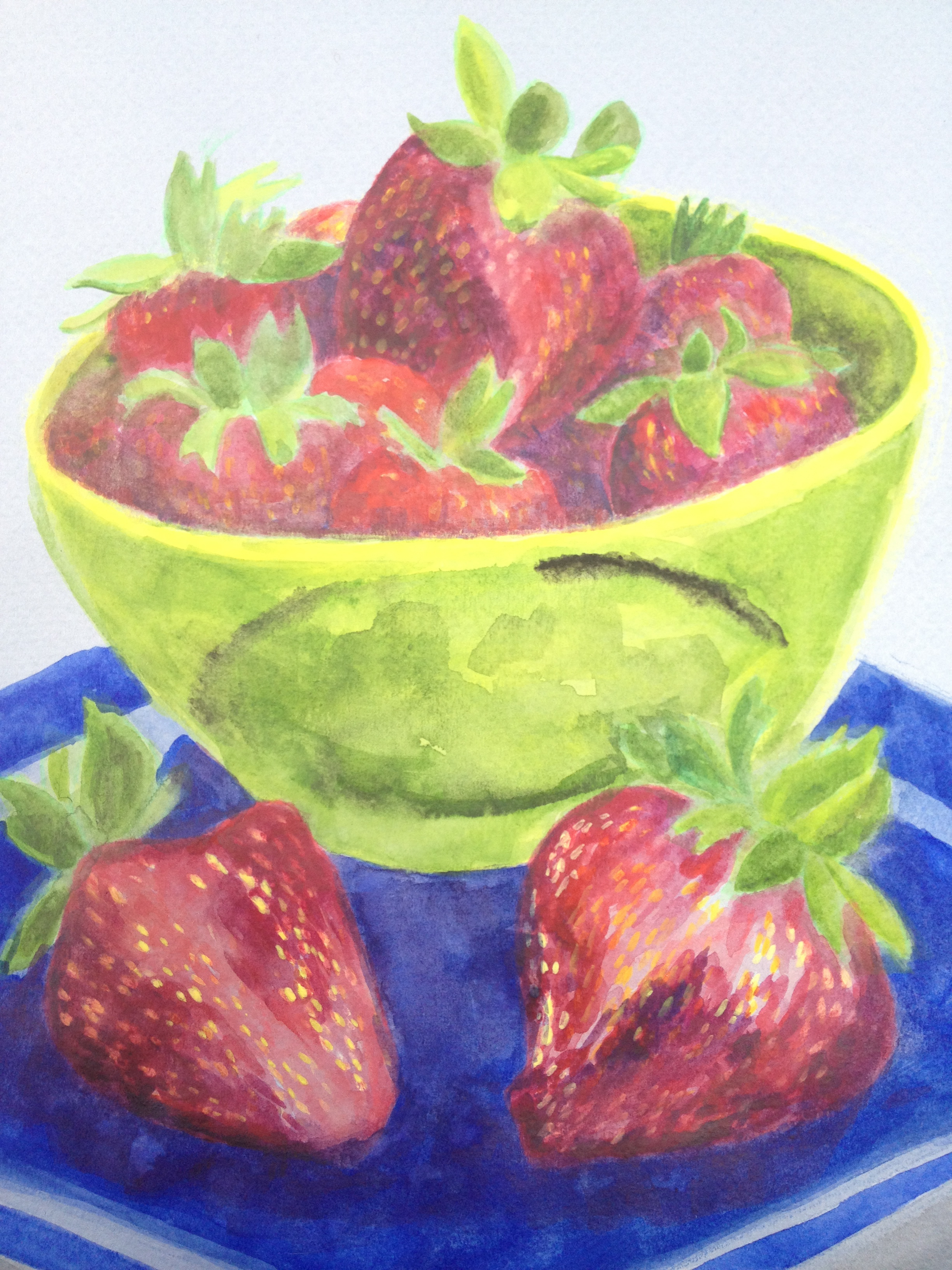
Swanton Berry Farm is my destination. Founded in 1989 by UC Santa Cruz graduate Jim Cochran, Swanton’s is the first commercial organic strawberry farm in California; it is also the first certified organic farm in the United States to sign a labor contract with the United Farm Workers (UFW). The farm stand, where I purchase my two pints of bright red strawberries, proudly displays the UFW flag bearing the black eagle on a field of red.  The UFW was formed as a result of Cesar Chavez’s organizing of Mexican-American and Fillipino American farmworkers to engage in boycotts, hunger strikes and strikes (all based on pacifism) to gain their rights.  The successful 1965 Delano grape strike is the most famous effort. The strawberries are amazing; a delight to see, smell, and taste the sweet and tart delight grown in the sandy soils of the coastline routinely kissed by the sea air. Last year, when Irene Reti’s & Sarah Rabkin’s oral history Cultivating a Movement was published, I read about Jim Cochran’s sustainable practices. Jim described using the Brassica family of plants— broccoli, cauliflower and mustard greens— in crop rotation to improve soil health instead of traditional strawberry farming practices using methyl bromide and Chloropicrin to kill soil disease. At Swanton’s you will never see the plastic covering the fields of commercial growers, indicating chemical fumigation is underway.

This month is also the 38th anniversary of the California Agricultural Labor Relations Act that became law on June 5, 1975 giving farm workers the right to collective bargaining and ensuring “peace in the agricultural fields by guaranteeing justice for all agricultural workers and stability in labor relations.” The act allowed union organizers to meet with farm workers in the fields and for farm workers to select representation by unions such as the UFW to engage in collective bargaining to negotiate conditions of employment.

Strawberries. Copyright 2013 Robin L. Chandler

After purchasing my strawberries, I drive out Swanton Road a beautiful loop curving through the Swanton Pacific Ranch, crossing Scott Creek a riparian corridor for Coho Salmon and Steelhead Trout, and winding through forests of Redwoods, Douglas Fir, and Monterey Pine. Surfers say the waves where Scott Creek estuary greets the ocean are the same as Swami’s Beach in San Diego County. The Ranch is beautiful. The furrows nestled amongst the coastal ecosystem; mankind’s geometric abstractions seeking to tame the wilderness topography. Recently I learned about the plein-air painter Sheridan Lord whose inspiring works are with us in the book Things in Place. Sheridan’s farm paintings are pictures “of breathtaking simplicity: the whole surface is occupied by the towering sky and broad fields, which are separated by a mere strip of trees.” Lord’s paintings evoke the environmental writer Peter Matthiessen who quotes the Ojibwa people in his book Nine-Headed Dragon River writing “sometimes I go about in pity for myself, and all the while a great wind is bearing me across the sky.”  Mindfulness is found in many ways: in a song, in a vista, in a painting, in a koan, or in a strawberry.

floating world: arancia hearts

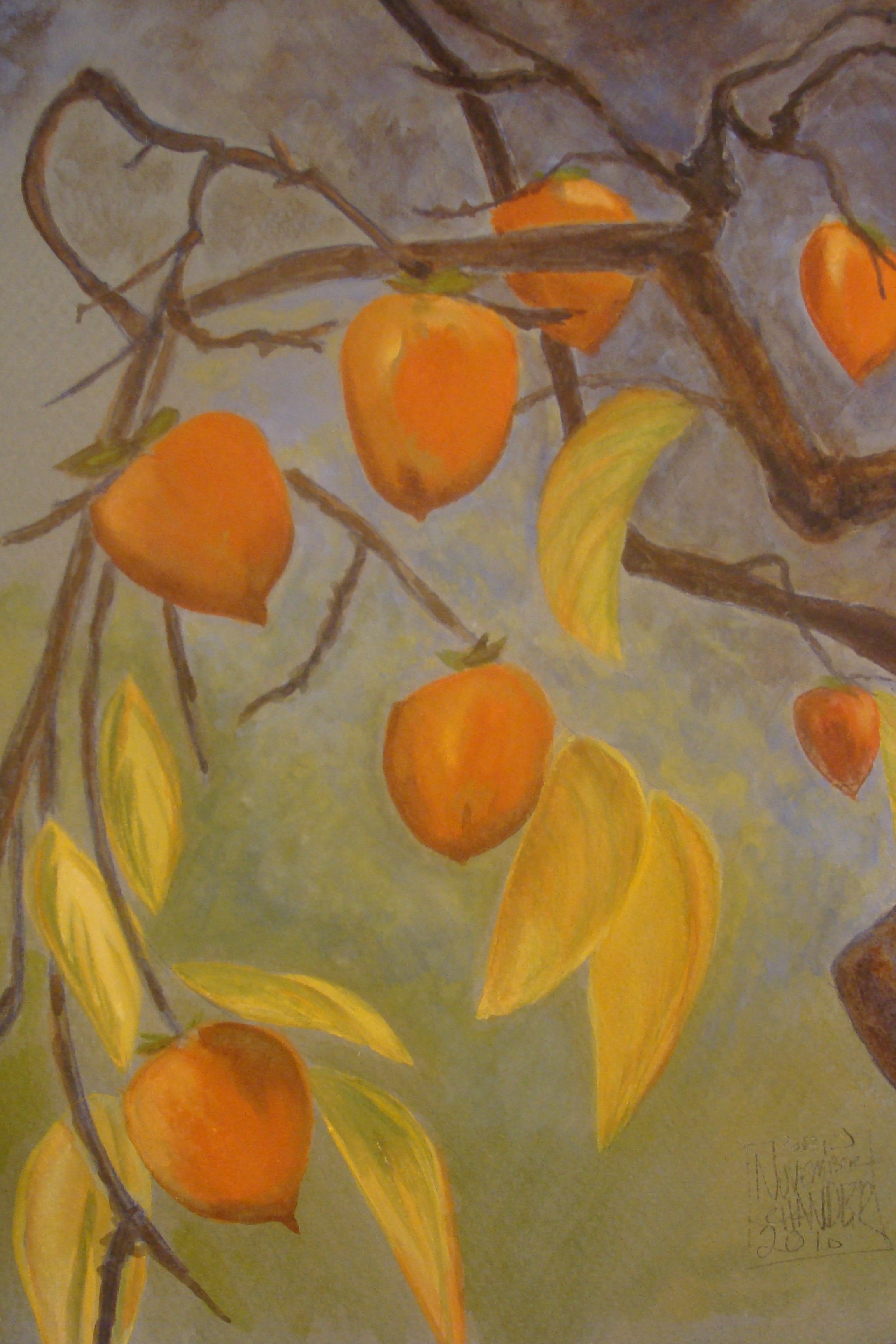
With the coming of the cross-quarter,  winter begins.  Leaves in artful decay proclaim the changing season.  Gone are summer’s limbs heavy with ripened apricot and plum.   From the corner of my eye, the persimmon, branches nearly bare, adorned with amarillo bangles and arancia hearts. Floating. Breathtaking in the fading light.  I paint; a deep sense of connection between myself and everything. For the moment, I fade away, lost in the act.  Later, steady cold rains: the kind we welcome to keep the drought years at bay.   Mugs of hot matcha take the edge from chilled hands.   In the oven, persimmon cookies bake, the golden taste of connection. (San Francisco) California dreamin’ on such a winter’s day.

Persimmon Tree. Copyright 2010 Robin L. Chandler

Legends tell us the heart-shaped Hachiya fondly called kaki was introduced to Japan from China in the 8th century by a wandering Buddhist. The monk traveled Japan subsisting on persimmons spreading seeds “Johnny Appleseed-like” throughout the land.  Masaoka Shiki a 19th century Japanese author helped revive waka and haiku poetry and introduced the concept of nature sketching or shashei honored the fruit’s place in Japanese culture with this poem composed while stopped at Nara on his journey to Tokyo:

I bite a persimmon

the bell tolls

Horyu-ji Temple

In her book Nine Gates: Entering the Mind of Poetry, Jane Hirshfield writes that “every good poem begins in language awake to its own connections….it begins…in the body and mind of concentration….true concentration appears paradoxically at the moment willed effort drops away….the self disappears ….we seem to fall utterly into the object of our attention, or else vanish into attentiveness itself.”  Echoing Jane Hirshfield, Phil Lesh lovingly described his life with the Grateful Dead in  Searching for the Sound . “We were in the music and the music was playing us. To loose oneself completely in a spontaneous flow of music is one of the great human joys: one is creating, but being created. In fact, one no longer exists. At the same time, there’s a give-and-take a handing off of ideas that mimics the process of thought itself….Bobby and I left holes for each other’s notes, creating an interlocking constantly changing rhythm.”

The Great Wave

On Labor Day I kayaked on Tomales Bay.  2PM and it was high tide when I launched near the town of Marshall and the wind was dancing across the water leaving whitecaps in its wake. It was the first time I would be taking my new single kayak on the water. Wave and I have safely captained a two-person kayack on many trips on Tomales Bay  where the center of gravity is low and the craft moves very deliberately through water.  In my watercolors, I’ve documented kayackers  in singles paddling across this water and now it would be my turn.  Wave ably helped me launch the craft, and just after my paddle cut through the water,  I heard a voice from the shore  asking if I had a plan should I capsize out on the Bay. Well, the truth was, no, I didn’t have a plan. I didn’t think I needed a plan. I felt I had the experience to handle any situation that might come up. I just wanted to get out and enjoy the last few hours of sunshine on a laborless day.

Kayaking near Hog Island, Tomales Bay
Kayaking near Hog Island, Tomales Bay. Copyright 2009 Robin L. Chandler

I was eager to feel  the joy of moving across the water, and  have the wind and spray on my face and see the sun dappling the water. I imagined the feel of my arms working hard to create forward movement against the wind blown waves breaking across the bow. I imagined the moment, when one turns and  with the wind at your back, experience the joy of being rocked forward momentarily airborne on the back of a breaking wave. But the voice spoke a truth that suggested listening.  One of the staff for onsite operations  for Blue Water kayaks on Tomales Bay took a few minutes out of her busy life and reviewed  with me how to manage the unimaginable. A little later I was on the water and the wind was strong and the waves presented a fun challenge. I was deeply grateful that a person previously unknown to me spontaneously showed concern, and I was able to hear the truth of the concern, put my eagerness in check and gently accept the gift.

Later that day driving home, I thought of learning life lessons aknew. While one gleans much knowledge over the years, one must embrace daily life with the openness of a beginner. Christopher Benfey in his book The Great Wave describes an essay by Shuzo Kuki called “Considerations on Time.” Written in 1928, the essay describes two Japanese responses to the theme “man and time.” These are the  Buddhist annihilation of the will, i.e. extinction of desire,  and the Samurai’s bushido, i.e.  affirmation of the will. Kuki saw the myth of Sisyphus as the very embodiment of the moral ideal of bushido. “Sisyphus rolls a rock almost to the summit of a hill, only to see it tumble back down again. And he is, thus, set to perpetually beginning anew. Is there misfortune, is there punishment in this fact?….Everything depends of the subjective attitude of Sisyphus. His good will, a will firm and sure in ever beginning anew, in ever rolling the rock, finds in this very repetition an entire system of morals and consequently, all is happiness…..he is a man impassioned by moral sentiment…..he is not in hell, he is in heaven.” Camus, describing Sisyphus, would write some years later “the struggle itself toward the heights is enough to fill a man’s heart.”