
Sitting quietly, I concentrate on my breathing. My thoughts float by like clouds and I meander among them until. I remember. Stop meandering. Remember. Concentrate on each breath. Mindfulness.
Sitting quietly, I concentrate on my breathing. My thoughts float by like clouds and I meander among them until. I remember. Stop meandering. Remember. Concentrate on each breath. Mindfulness.

The White Mountains are a high desert range situated between the Sierra Nevada Mountains and the Great Basin Desert and overlooking Death Valley to the South and the Owens Valley to the West. White Mountain Peak at 14,252 feet is third highest mountain in California following Mt. Whitney and Mt. Williamson. A big, empty, solitary place, created by dynamic geologic forces; it is a place where, Ancient Bristlecone Pines teach pilgrims about a higher consciousness. Time stands still, and peering down in the valley, pilgrims can see life’s journey, the forks in-the-road ahead, and path choices, guided by the wisdom discovered amongst trees – like the Bodhi Tree – over four thousand years old.
In the late 1930s, the ethnomusicologist Alan Lomax preserved for the Library of Congress Archive of Folk Song Down in the Valley. Captured in the Great Smokey Mountains of North Carolina, the song is written from the perspective of an empty, solitary, place – prison – where time also stands still. Peering into space, cut off from the earth and sky, the prisoner sees deep into life’s chasm, the forks in the road behind, and reflects sadly on choices made.
Down in the valley valley so low
Hang your head over hear the wind blow
Hear the wind blow dear hear the wind blow
Hang your head over hear the wind blow.
Roses love sunshine violets love dew
Angels in heaven know I love you
Know I love you dear know I love you
Angels in heaven know I love you.
If you don’t love me love whom you please
Throw your arms ’round me give my heart ease
Give my heart ease love give my heart ease
Throw your arms round me give my heart ease.
Build me a castle forty feet high
So I can see him as he rides by
As he rides by love as he rides by
So I can see him as he rides by.
Write me a letter send it by mail
Send it in care of Birmingham jail
Birmingham jail love Birmingham jail
Send it in care of Birmingham jail.


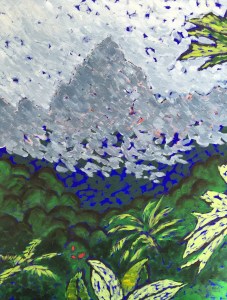
Early in the morning, I meditated on the Kalalea Mountains while swimming in the waters of Kauai. Floating in the warm water, each wave washed through me, its action filling the emptiness in my soul. The sun shone on the mountaintop above me, but as quickly as the golden ridge appeared, it was gone. The Kalaleas were obscured, disappeared, in fact vanished. Had you just arrived you would never know the mountains existed. A cloudburst, a downpour, and then a waterfall tumbled down the mountains to the sea. Momentarily, the tempest ceased, the clouds parted and the sun returned to reign down upon the peak. And just as quickly the clouds returned, the mountains departed, and the waves again washed through me. I grasped the Buddhist understanding of faith.
Created by Tibetan monks, the great sand mandalas, objects of beauty, are readily swept away. By their impermanence, these objects teach us about truth. Their creation and their dissolution is an act of faith, revealing the beauty and truth of impermanence.
A haiku from Matsuo Basho captures this idea of impermanence well; beauty cannot be held captive. Beauty must be free, so it can return.
“The bee emerging
from deep within the peony
departs reluctantly”

The floating wreckage of a ship’s cargo, flotsam skims the surface of the sea, readily found and easily rescued. Perhaps jettisoned, with the hope of saving the ship, in time, the flotsam becomes derelict, sinking beneath the waves to the bottom of the sea, with little hope of reclaim.
In Herman Melville’s Moby Dick, Father Mapple preaches his sermon at the Whaleman’s Chapel in New Bedford about Jonah and the Whale:
”A dreadful storm comes on, the ship is like to break. But now the boatswain calls all hands to lighten her; when boxes, bales and jars are clattering overboard…for when Jonah not yet supplicating God for mercy, since he but too well knew the darkness of his deserts – when wretched Jonah cries out to them to take him and cast him forth into the sea, for he knew that for his sake the great tempest was upon them; they mercifully turn from him, and seek by other means to save the ship. But all is in vain; the indignant gale howls louder…and now behold Jonah taken up as an anchor and dropped into the sea; when instantly an oily calmness floats out from the east and the sea is still, as Jonah carries the gale with him, leaving smooth water behind…he drops seething into the yawning jaws awaiting him.”
Delve to the depths of the sea, in the belly of the whale, Jonah does not cry and wail, he keeps his faith, continuing to strive, to stay committed to the path, even when all around seemed dark and in shadows. By his continual striving, he will be reclaimed.
On his recent bluegrass album, The Happy Prisoner, Robert Earl Keen recorded the Wayfaring Stranger with Natalie Maines. The plaintive lyrics haunt me:
“I am a poor wayfaring stranger, while travelling through this world of woe.
Yet there’s no sickness, toil or danger. In that bright world to which I go.
I’m going there to see my mother. She said she’d meet me when I come.
I’m only going over Jordan. I’m only going over home.”
A classic American folk and gospel song, it resonates with one of Buddhism’s four Noble Truths that all is suffering, all is woe, and impermanence is one of the great causes of suffering. But a bright world exists to which we can go.
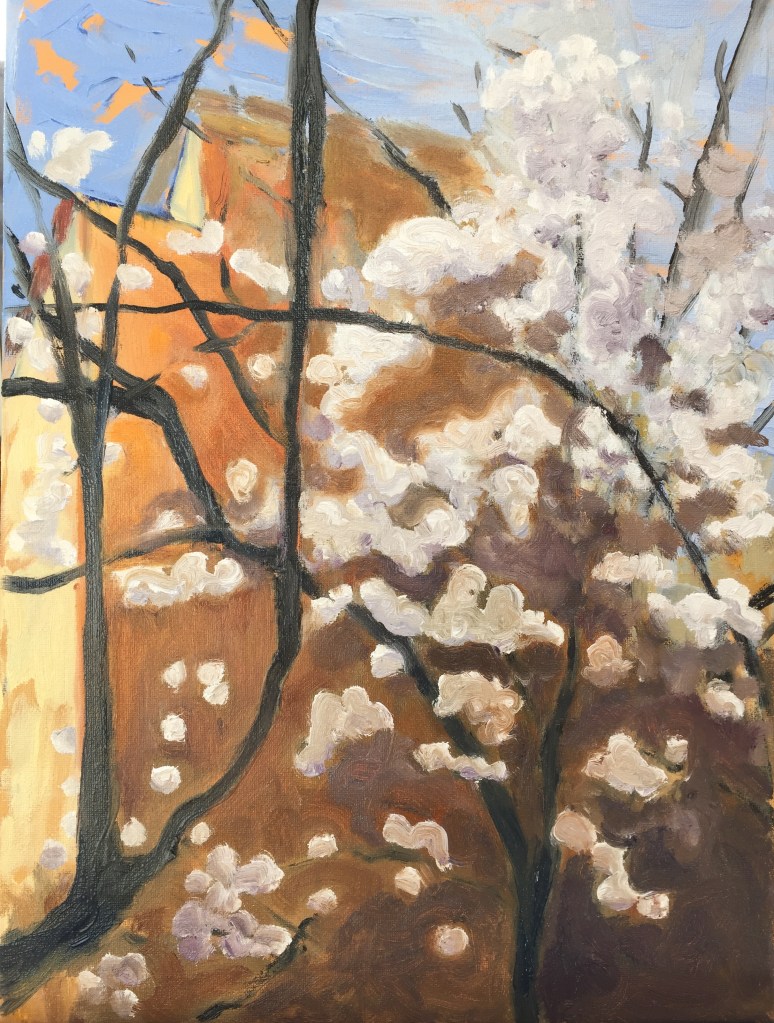
Last week the rains stopped and the fruit trees blossomed, a month before expected, but nonetheless spectacular for their early arrival. The plum trees in my yard shimmered in the February sunset, still winter by the calendar. The blossoms will not remain long. But long enough to tarry in my dreams, haunt my imagination, and find their way from brush to canvas to capture the beauty of impermanence.
This weekend we will say goodbye to a good friend, my second mother, who has gone over Jordan. There is no sickness, toil or danger, in that bright world to which she goes. Someday we’ll join her, going there, no more to roam. She said she’d meet us when we come. She said she’s only going home.
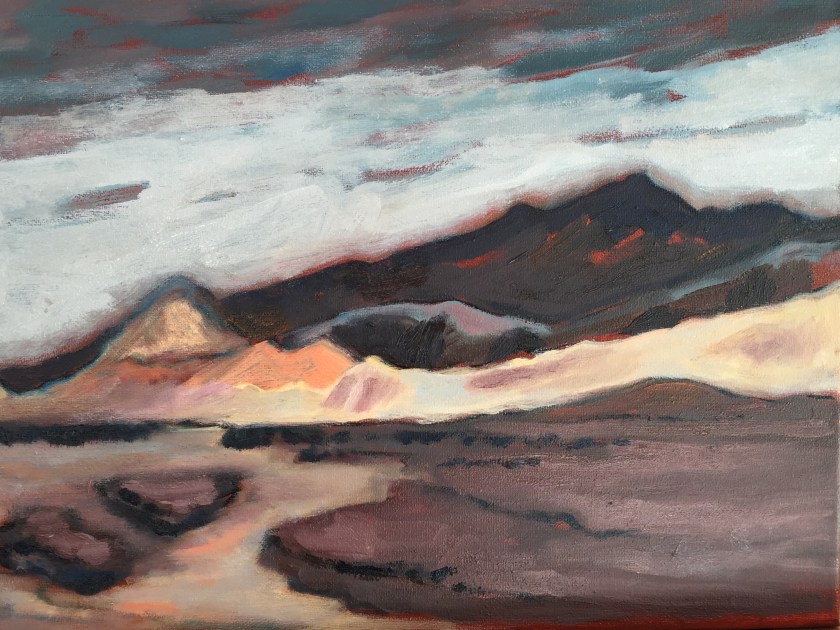
The Sanskrit word samsara means to wander, and in the context of Buddhism it means to return, confined to rebirth, locked in an endless cycle of ignorance and suffering, until after dedicated work following the path to end suffering, enlightenment is reached, and the eyes are opened. According to Donald Lopez Jr. in The Story of Buddhism, “wisdom is the insight that everything is of the nature of consciousness and the product of one’s own projections.” To become a buddha, it is necessary to be empty, as the sutras repeatedly teach “not to see anything, is to see everything…..in Zen, there is the saying ‘mountains are mountains,’ referring to the dictum that before one begins the practice of Zen, mountains are mountains; during the practice of Zen, mountains are not mountains; after the practice of Zen, mountains are mountains.”
At the edge of the void, one can see the emptiness from which all matter comes into being, and from which all things evaporate. Form gives us a means to learn and build confidence; form provides a path to experience the teachings and verify the teacher. Like an elephant’s footprint, form is a sign, here today, but gone tomorrow. Objects are material, ever changing in state; the spirit alone is precious. Tibetan Buddhist Monks create beautiful sand mandalas only to sweep them away to symbolize the transitory nature of material life. Their creation and their dissolution is an act of faith, revealing the beauty and truth of impermanence. At the edge of the void, one finds the beginning of the possible.

We sat by the bedside of our departed loved one. Moments before dawn, quiet stillness all around, we listened for the spirit’s touch before it crossed the river.
Hours later in the granite cathedral of the spirit that is Yosemite, I sat before the falls along the Merced River and listened. The recent rains brought needed snow to the mountains, birthplace of the watershed, singing a welcome song of falling water to the Valley. In Siddhartha, Herman Hesse wrote “the river taught me how to listen…..the river knows everything; everything can be learned from it…..how to listen with a still heart, with an expectant, open soul, without passion, without desire, without judgment, without opinion.” Along the river, I heard the touch of farewell.
Cycling in the rain, while a bit hairy has great rewards. Riding the bike path on the Bay Bridge approach from Oakland to Yerba Buena Island suspends one in time and space. Rushing past, the wind filling my ears, I swear that was a glimpse of the great void in the corner of my eye. Perhaps, because of the recent deaths of cherished artists Alan Rickman and David Bowie, and the impending departure of a loved one, time and the measurement of our impact here on earth has been much on my mind. Western Civilization has bequeathed paradoxes to ponder and motivate us: reverence for eternity and a fascination with yesterday and yonder. Measuring, measuring, measuring, always measuring; how will we be judged by our peers or by heaven? Ungrounded measuring can mean endless suffering.
Lewis Mumford compared these paradoxes in The Golden Day. Describing the Middle Ages, Mumford wrote “medieval culture lived in the dreams of eternity: within that dream the visible world of cities and castles and caravans was little more than a forestage on which the prologue was spoken.” Characterizing the Renaissance, Mumford wrote “the first hint of change came in the Thirteenth Century, with the ringing of the bells…..as soon as the mariner could calculate his position in time and space, the whole ocean was open to him…..time and space took possession of the European’s mind. Why dream of heaven or eternity?…..outside the tight little world of Here and Eternity, they were interested in Yonder and Yesterday…..”
Reaching the end of the bike path, I dismounted and looked at the southwest vista. Thanks to Descartes‘ Cartesian coordinates, my position in time and space could be plotted, but where was I? Late afternoon, hundreds of cars rushed by, racing time, creating a thunderous enveloping sound. The grey twilight descended. Mortality, ageing and death are inescapable. All is impermanence, but acknowledgement is the first step on the Middle Way.

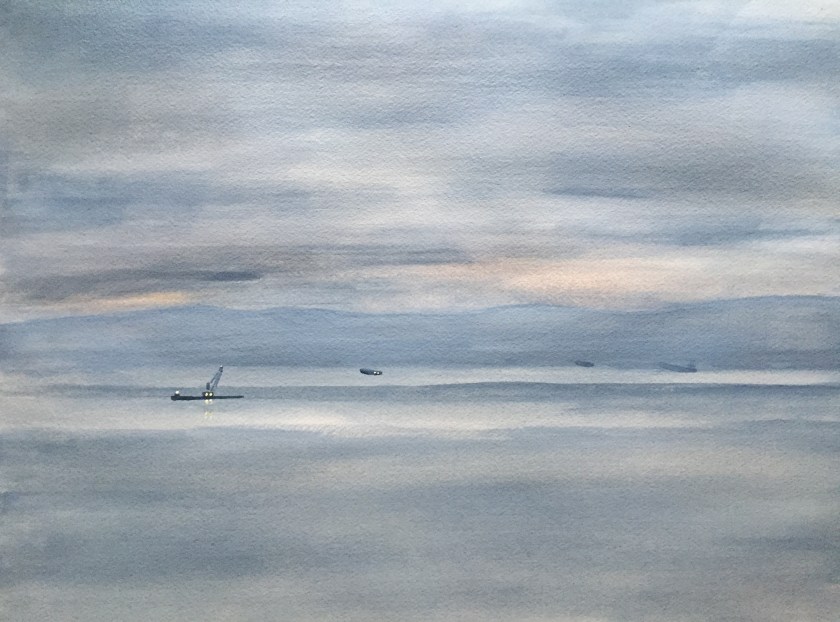
Dark, cold and grey comes the day as the sun protests for better working hours. The whiff of coffee wafting through the house persuades me to leave my blanket comfort. Jets flying 5,000 feet above, on landing approach, mean rain is coming. Finally.
“A wanderer,
so let that be my name –
the first winter rain.
Tabibito to
waga na yobare’n
hatsushigure.”
by Matsuo Basho

