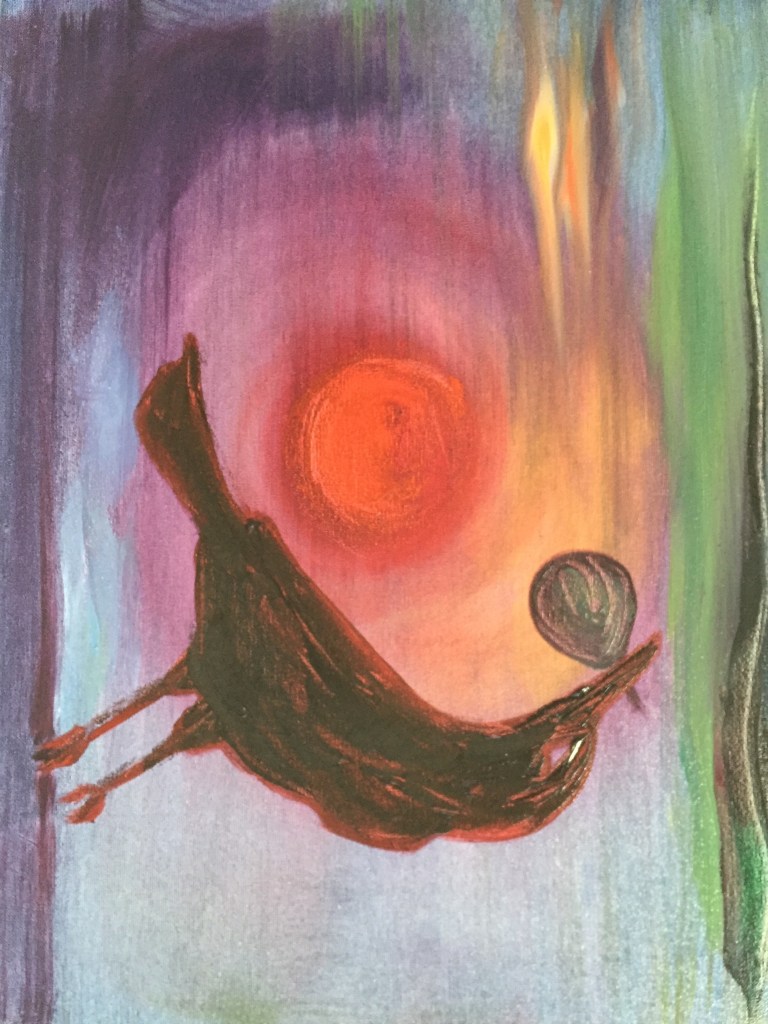
Mending. Helen Keller once wrote “although the world is full of suffering, it is also full of the overcoming of it.” Our garden is blessed with fruit trees and in the fall we harvest pears, persimmons and figs. Generously, we share the bounty with other inhabitants of our neighborhood, our neighbors, the scrub jays, the squirrels and the occasional raccoon. But today I saw my first crow choosing a fig. It reminded me of a story in the BBC news about a little girl named Gabi Mann who made friends with a flock of crows. About five years ago, part of Gabi’s lunch unexpectedly became a feast for the crows, but then something special happened. Gabi started purposefully sharing her lunch with the crows, and as if to mend the relationship – strained by the stolen lunch – the crows returned, bearing gifts. Four years later, Gabi ritually feeds the birds, and the crows continue to express their thanks with gifts. Gabi saves and savors the gifts including beach glass, beads, lego pieces, and her favorite, a pearl colored heart. Mending.
A Buddhist seeks refuge in the Three Jewels: Buddha (the enlightened one), the Dharma, (the Buddha’s teachings of the four noble truths and the eightfold path), and the Sangha (the community of Buddha’s followers seeking enlightenment). The Sangha can be a formal community of monks living in a monastery or a community of laypeople who gather together.
Enlightenment is nearly impossible to achieve alone. A person must understand that we suffer as do all those around us; suffering comes from a cause; suffering can end; and the path to end suffering and achieve enlightenment is the middle way. A central aspect of Sangha is to gather with others who can mentor, as we in turn mentor others. As members of a Sangha we help each other on the eightfold path to right understanding; right intention; right communication; right engagement; right service; right energy; right mindfulness; and right concentration.
September brings cooler nights and turning leaves. The fruit trees are bringing forth figs, pears and persimmons and our thoughts turn to the harvest holidays. Morning skies are gray and foggy and afternoons are blessed with golden sunshine from a southern exposure. A melancholy rests lightly on my shoulders, realizing we’ve nearly completed the ritual cycle round the solar system, another year gone, mourning lost loves, preciously cradling what we hold dear, the future a mystery.
The song’s roots lay in Depression riddled Georgia, written and first performed in 1933 by Oliver Hood, a poem to lost love. A local bard, Hood’s authorship remained anonymous for many years, a man who loved music and making music every Sunday after church and dinner, sitting on his front porch with his friends and neighbors sharing songs and tunes. As Alan Lomax writes in The Folk Songs of North America describing the white ballad singer of roots music “carefully tune [s] his voice…his latent emotions must be kept under control…his solo…an act of memory, almost ritualistic.” A sharer of songs, Hood was not concerned about copyright in the early years of his music writing. Governor Jimmie Davis, bought the rights from the Rice Brothers, who recorded the song in 1939 claiming authorship.
The other night dear, as I lay sleeping I dreamed I held you in my arms But when I awoke, dear, I was mistaken So I hung my head and I cried.
You are my sunshine, my only sunshine You make me happy when skies are gray You’ll never know dear, how much I love you Please don’t take my sunshine away
I’ll always love you and make you happy, If you will only say the same. But if you leave me and love another, You’ll regret it all some day
You are my sunshine, my only sunshine You make me happy when skies are gray You’ll never know dear, how much I love you Please don’t take my sunshine away
You told me once, dear, you really loved me And no one else could come between. But now you’ve left me and love another; You have shattered all of my dreams
You are my sunshine, my only sunshine You make me happy when skies are gray You’ll never know dear, how much I love you Please don’t take my sunshine away
In all my dreams, dear, you seem to leave me When I awake my poor heart pains. So when you come back and make me happy I’ll forgive you dear, I’ll take all the blame.
You are my sunshine, my only sunshine You make me happy when skies are gray You’ll never know dear, how much I love you Please don’t take my sunshine away
Meander and mindful. Robin L. Chandler Copyright 2016.
Sitting quietly, I concentrate on my breathing. My thoughts float by like clouds and I meander among them until. I remember. Stop meandering. Remember. Concentrate on each breath. Mindfulness.
Bristlecone Pine in the White Mountains. Robin L. Chandler Copyright 2016.
The White Mountains are a high desert range situated between the Sierra Nevada Mountains and the Great Basin Desert and overlooking Death Valley to the South and the Owens Valley to the West. White Mountain Peak at 14,252 feet is third highest mountain in California following Mt. Whitney and Mt. Williamson. A big, empty, solitary place, created by dynamic geologic forces; it is a place where, Ancient Bristlecone Pines teach pilgrims about a higher consciousness. Time stands still, and peering down in the valley, pilgrims can see life’s journey, the forks in-the-road ahead, and path choices, guided by the wisdom discovered amongst trees – like the Bodhi Tree – over four thousand years old.
In the late 1930s, the ethnomusicologist Alan Lomax preserved for the Library of Congress Archive of Folk Song Down in the Valley. Captured in the Great Smokey Mountains of North Carolina, the song is written from the perspective of an empty, solitary, place – prison – where time also stands still. Peering into space, cut off from the earth and sky, the prisoner sees deep into life’s chasm, the forks in the road behind, and reflects sadly on choices made.
Down in the valley valley so low Hang your head over hear the wind blow Hear the wind blow dear hear the wind blow Hang your head over hear the wind blow.
Roses love sunshine violets love dew Angels in heaven know I love you Know I love you dear know I love you Angels in heaven know I love you.
If you don’t love me love whom you please Throw your arms ’round me give my heart ease Give my heart ease love give my heart ease Throw your arms round me give my heart ease.
Build me a castle forty feet high So I can see him as he rides by As he rides by love as he rides by So I can see him as he rides by.
Write me a letter send it by mail Send it in care of Birmingham jail Birmingham jail love Birmingham jail Send it in care of Birmingham jail.
Going fishing with Dad was fun. Hot & humid Saturday mornings, piling into the station wagon with our poles, thermos or two, and bologna sandwiches. I had a spincast, pretty basic, the kind you had to bait yourself; the worms squirming in a Styrofoam cup filled with a bit of dirt and old coffee grounds. Dad was a fly fisherman; I was fascinated by the hours he spent tying his own flies in his basement workshop; I was also captivated by the ballet of the line striking the water. What an elegant and enigmatic ritual of rod and line dancing on the surface, breaking the serene plane. We fished in lakes and rivers of our Southern homeland, first Texas and later Virginia. I never caught many, and I know he spent hours helping me when he could have been fishing. But I remember the early mornings, alone together adrift in time, the sound of still water and rich dirt, the smell of dawn, before the fish bit.
Driving home, my father always sang to me, and I loved his tenor, cigarette scratchy. Sometimes, he made me laugh with a song from his days in the Air Force; “Old King Cole was a merry old soul, and a merry old soul was he, and he called for his pipe and he called for his bowl and he called for his privates three,” laughing and singing our way through the ranks to the general.
But more often than naught he sang Johnny Mercer and Harold Arlen’s The Blues in the Night. For me it was a song of mystery, filled with exotic places, the sound of whistlin’ trains, of pain, darkness and loneliness beyond my age of understanding. But I felt the sadness, the melancholy, and the blues in his voice. It touched me deeply. He explained to me that Natchez and Mobile, Memphis and St. Joe were all cities on the deep and long Mississippi River with headwaters near St. Paul, Minnesota rolling all the way to New Orleans and the Gulf, the land of dreams. Our river, became the river of song. Magic. Later, when I was able, I purchased a recording of Louis Armstrong singing and playing his trumpet with Oscar Peterson on piano. Listening now, I bring my own archaeology of understanding to this song and what it says about the space and time from which it sprang…a place limiting relationships between genders and races. But Louis’ deep growly voice always takes me back to the riverside where song began for me.
My mama done tol’ me, when I was in knee pants My mama done tol’ me…
“son, a woman’ll sweet talk,
And she’ll give ya the big eye, but when the sweet talkin’s done
A woman’s a two-face, a worrisome thing who’ll leave ya to sing
the blues in the night”
Now the rain’s a-fallin’, hear the train’s a-callin, “whooee!” (my mama done tol’ me) hear dat lonesome whistle blowin’ ‘cross the trestle, “whooee!” (my mama done tol’ me) a-whooee-ah-whooee ol’ clickety-clack’s a-echoin’ back the blues in the night The evenin’ breeze will start the trees to cryin’ and the moon will hide it’s light when you get the blues in the night Take my word, the mockingbird’ll sing the saddest kind o’ song, he knows things are wrong, and he’s right
From natchez to mobile, from memphis to st. joe, wherever the four winds blow I been in some big towns an’ heard me some big talk, but there is one thing I know A woman’s a two-face, a worrisome thing who’ll leave ya to sing the blues in the night
So, let me give ya fair warnin’ You may feel fine in the mornin’ But look out for those blues in the night
Kalalea revealed. Robin L. Chandler Copyright 2016.Kalalea obscured. Robin L. Chandler 2016.Kalalea in faith. Robin L. Chandler Copyright 2016.
Early in the morning, I meditated on the Kalalea Mountains while swimming in the waters of Kauai. Floating in the warm water, each wave washed through me, its action filling the emptiness in my soul. The sun shone on the mountaintop above me, but as quickly as the golden ridge appeared, it was gone. The Kalaleas were obscured, disappeared, in fact vanished. Had you just arrived you would never know the mountains existed. A cloudburst, a downpour, and then a waterfall tumbled down the mountains to the sea. Momentarily, the tempest ceased, the clouds parted and the sun returned to reign down upon the peak. And just as quickly the clouds returned, the mountains departed, and the waves again washed through me. I grasped the Buddhist understanding of faith.
Created by Tibetan monks, the great sand mandalas, objects of beauty, are readily swept away. By their impermanence, these objects teach us about truth. Their creation and their dissolution is an act of faith, revealing the beauty and truth of impermanence.
A haiku from Matsuo Basho captures this idea of impermanence well; beauty cannot be held captive. Beauty must be free, so it can return.
The salty taste of a brisk wind and the bright midday sun welcomed we plein air painters fleeing the sweltering inland heat. Time suspended, we set-up our easels and laid out our paints and brushes intent on capturing the moment. Painting the seascape, onsite, is a meditation, a chance to lose self, and by the act, find self again. The sea, sky and land fill the gaps, and the renewed soul sees the wonder of life everywhere.
Driving to the coast, the radio waves burst with information about the sea change in Britain, Brexit. A campaign of fear coaxed many to mortgage their future to recapture a time past. Examine wisely the evidence of history; think critically of the stories told by those who seek power. Myths are one interpretation of the past. Identify the evidential source, and ask for what purpose was it created, and for what goal it is used now. William Carlos Williams wrote In the American Grain “to try to find out for myself what the land of my more or less accidental birth might signify.” It is a very good book, a poet’s interpretation of my country’s history. William writes “History, history! We fools, what do we know or care? History begins for us with murder and enslavement, not with discovery.”
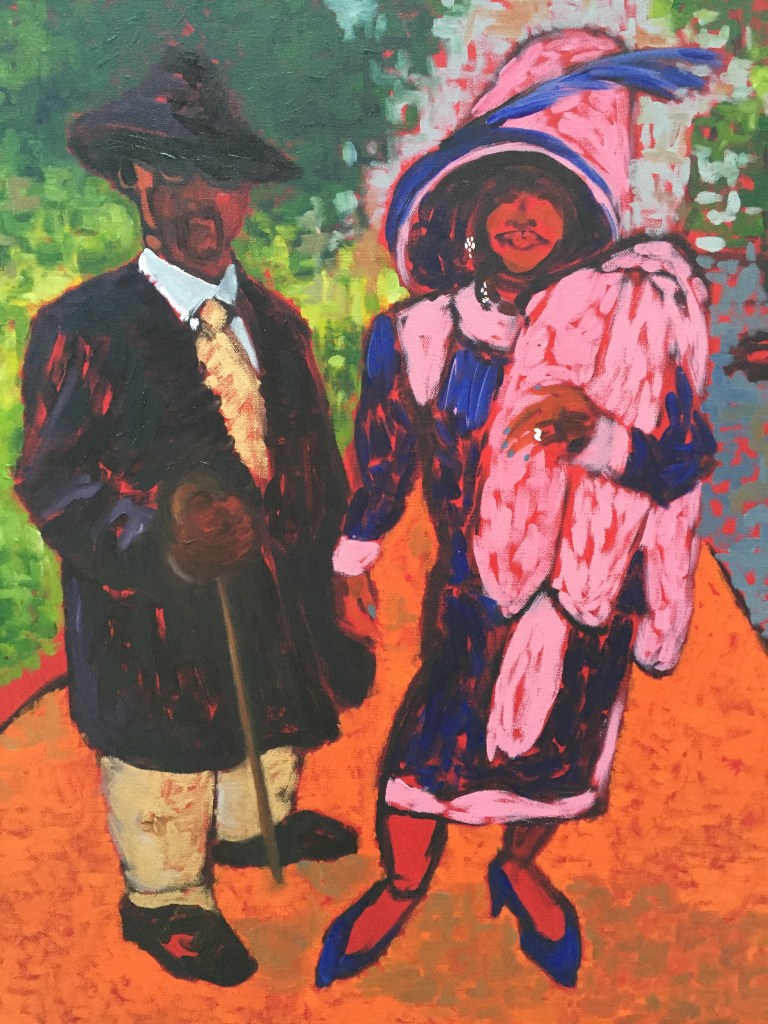
Oakland, California is my home. A politician once called my city one of the most dangerous place in the world. Biking Oakland’s streets or walking the sidewalks does not feel particularly scary to me. Of course one should always be aware and sensible of your surroundings while moving through the urban scape. But there is so much good at work and at play in this city, designating it simply as dangerous, dismisses it unfairly. Engaging with my fellow city dwellers at the farmer’s market, the YMCA, the coffee shop, or at Cato’s watching the Warriors, I become part of the city’s story. And it is wonderful to talk, walk and work with these diverse and special people and hear what makes us Oaklandish.
Oakland is a vital city undergoing change. San Francisco’s high cost-of-living has brought a wave of immigrants to Oaktown who live and work amongst longtime residents. New buildings are under construction and old buildings are being renovated. Change brings a new skyline, new traffic patterns, and new conversations and exchanges between people of differing genders, colors, sexual preferences, and creeds. And like many cities, experiencing a rebounding economy, crime, poverty, injustice and pain exist alongside the rebirth.
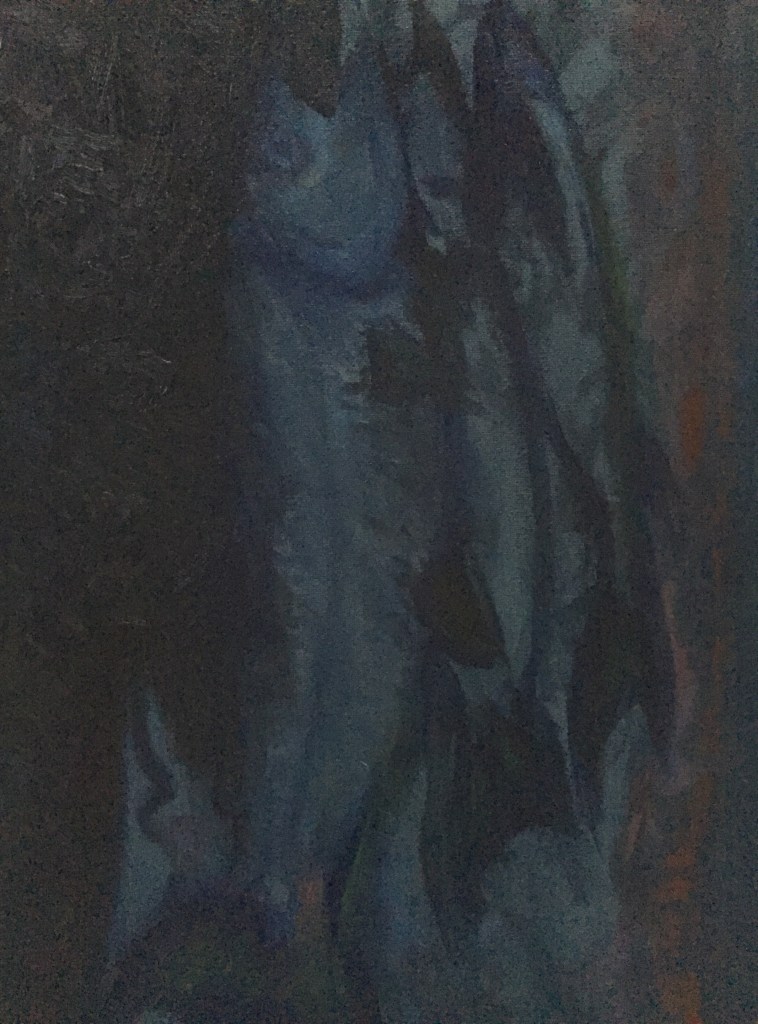
Lazarus was here. Robin L. Chandler Copyright 2016.
There are many stories to be told about Oakland: stories of success; stories of despair; stories of challenge; and stories of recovery. These are the stories that we who love Oakland want to tell and hear told. Irresponsible politicians write a city off when they label it dangerous without understanding the community, with little knowledge of individual stories, without context or perspective. It is criminal to disparage a town, without having a clear understanding of who lives there, their dreams and their capacity to achieve those dreams. It is criminal to dismiss a city without knowledge of the problems it faces, without a sincere concern for it’s people and without suggesting sustainable strategies to help resolve the challenges it faces. Stories, of poverty and pain, are rewritten by building faith in community, and keeping hope in individuals alive. Stories, of poverty and pain, are resolved with better access to education, a decent minimum wage, affordable housing, and health benefits funded by raising the taxes of the wealthiest 1%.
There are many ways to tell stories, and artistic works are usually at the forefront of engagement making the human connection, building awareness, and starting a dialogue. Thirty-second sound bites and 140 character tweets by grandstanding politicians can end a story before it has a chance to begin. The book arts, the dramatic arts, the performing arts, and the visual arts create spaces that reveal our experiences, open hearts and initiate listening. The great soul is in everyone and their stories should be told.