ash and bone

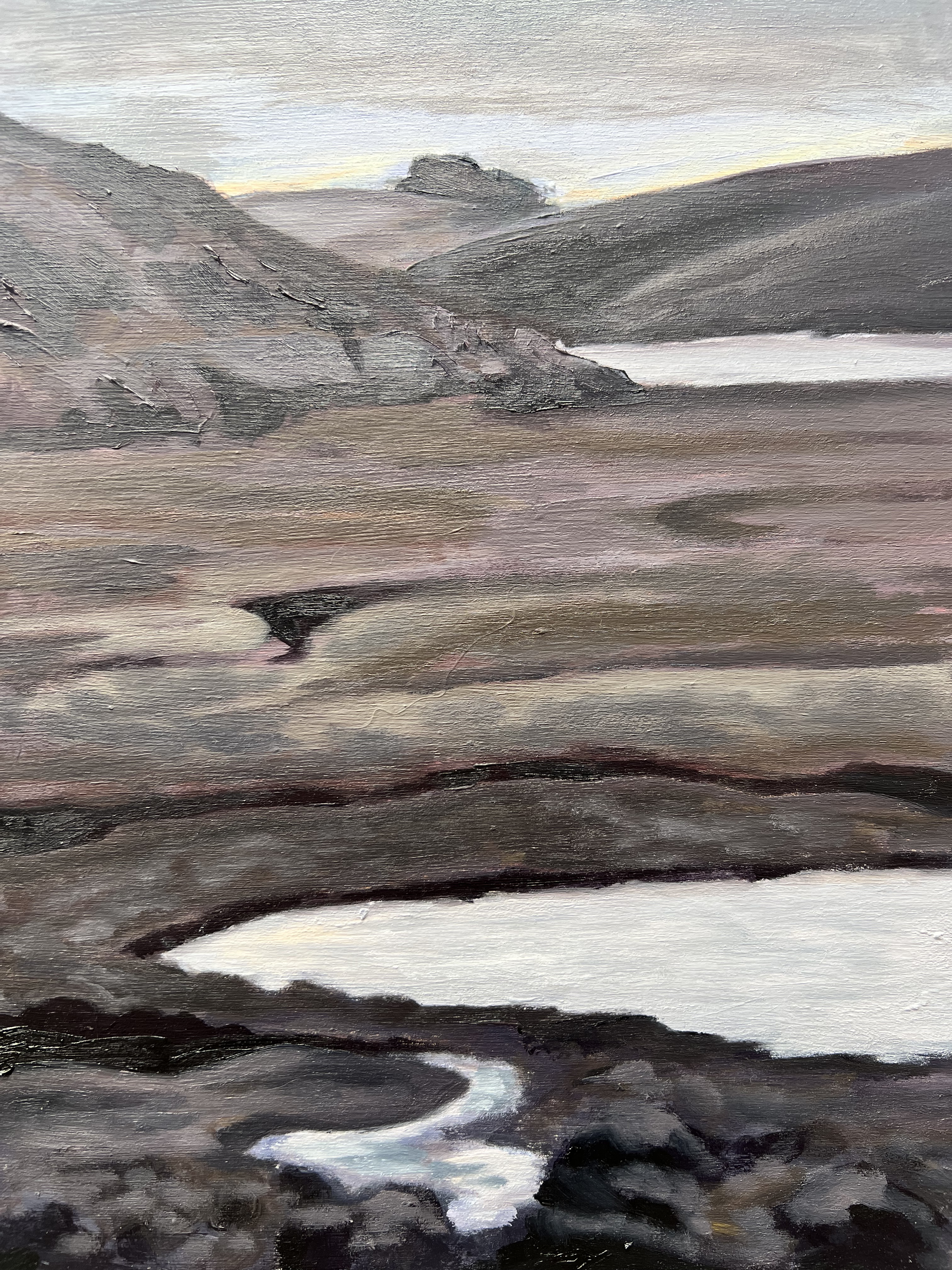
Walking along Inverness Ridge among the new growth of bishop pines after the Vision Fire (1995); in the distance are douglas firs burned in the Woodward Fire (2020). Robin L. Chandler, 2025.

We were afraid to go back

afraid to listen to the stories

ash and bone might tell

We wanted to believe our lives were immutable

untouchable by nature, fate or disaster

At twilight we skirted the base of the first burned hill

reclaimed her scorched shoulder

her ruined slope

The ground beneath our feet released puffs of smoke

like ancient ghosts they rose up around us

to disappear into wind…..

Excerpt from the poem “After the Fires” by Devereaux Baker published in California Fire & Water: A Climate Crisis Anthology edited by Molly Fisk (p.15)

“When Sir Francis Drake spent a month in 1579 repairing his ship in the bay that now bears his name, the hills and ridges to the east would have been mostly open grassland or coastal scrub because of the Miwok’s liberal use of fire as a key tool of their ecological management and because of grazing by herds of elk, which benefited from the anthropogenic burning. The same was true when Sebastian Ceremeno, a Portuguese navigator and explorer sailing on the Manilla galleon route, was shipwrecked in Drakes Bay in 1595. Richard Henry Dana, visiting San Francisco Bay in 1840 described the herds of elk he could see on the open headlands.” (p.84)

“The [Mt.] Vision Fire started on October 3, 1995, and burned for about a week in an area mostly designated as park wilderness, eventually burning almost twelve thousand acres. Some local boys apparently thought they had drowned their campfire, but they hadn’t. It’s a story that reminds me of Henry David Thoreau; on a camping trip with a friend in April 1844, their campfire got out of control and almost burned down their hometown of Concord, Massachusetts. Many years later, that experience led Thoreau to investigate the fire ecology of his local ecosystem. He recognized the influence of past Native American burning on the landscape and became essentially the first published fire ecologist through his writing on the subject. The Vision Fire burned an area partly dominated by bishop pine, Pinus muricata. Bishop pine became so familiar with fire that it evolved a relationship that could be called “friends with fire.”  (p.86-87)

Excerpt from the chapter “Making Friends with Fire” published in Bruce Byer’s book titled Nature on the Edge: Lessons for the Biosphere from the California Coast.

the tangle of human failures

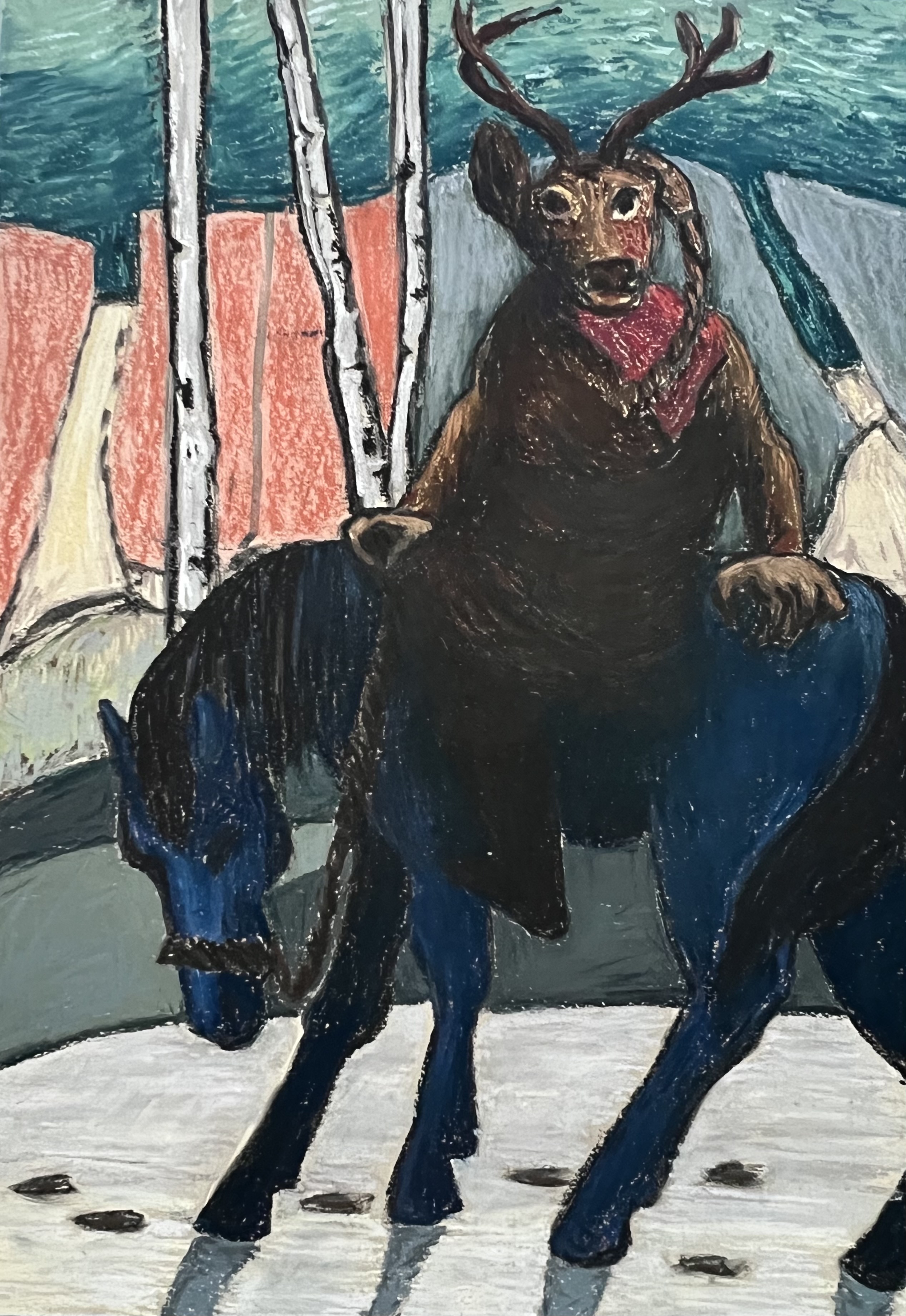
Reinman. Robin L. Chandler, 2024

“After dancing all night in a circle we realize that we are a

                  part of a larger sense of stars and planets dancing with us

                  overhead.

When the sun rises at the apex of the ceremony, we are

                  renewed.

There is no mistaking this connection, though Walmart

                  might be just down the road.

Humans are vulnerable and rely on the kindness of the 

                  earth and sun; we exist together in a sacred field of

                  meaning.”

Excerpt from Joy Harjo’s poem Talking with the Sun published in her book titled Conflict Resolution for Holy Beings: Poems (2015) (p.31)

ode to Gloucester

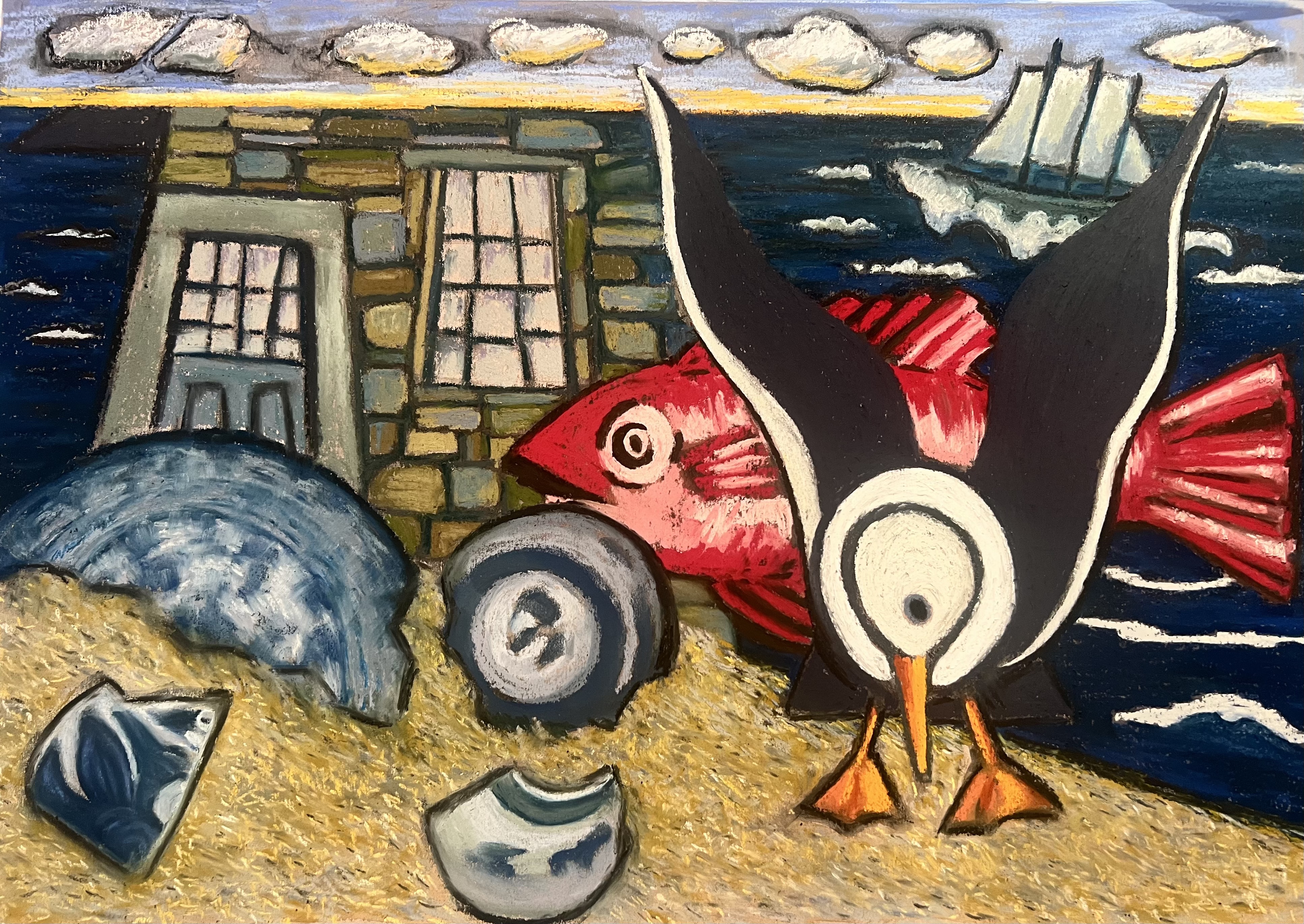
ode to Gloucester. Robin L. Chandler, 2024

Liberty for the few

Equality for the many

The criminal copies the oligarchy

Which is an international fold of moneys

The gulls of New England

Close their bills against the oil

Spills. At night pleasure rocks

In chairs and harbors

Wine colors contort on the goblets

From Selected Poems (2000) by Fanny Howe (p.105)

*****

“With [Charles] Olson his identity with the place, with Gloucester, give his major work, The Maximus Letters, a deep emotional center. The only other American writer who gives me the same sense of responding to a place, in both an historical and philosophic sense is Thoreau in his first book, A Week On the Concord And Merrimack Rivers.

“Olson, in one of the Letters’ most persistent themes, uses Gloucester as a poetic expression of the realities of history…..the sense of place in the letters is – in a final sense – so compelling because what Olsen is trying to hold on to is the sense of place in time, as well as the sense of the immediate place of Gloucester.”

“The Letters become less of the poet’s expression and more the historian’s as they go on, even though the history is handled as poetic material. In any of the single Letters the history is almost without meaning – odd facts, lists of provisions, inserted paragraphs on the fishing industry – but with the growth of the poem as a whole it is clear that something else is involved.”

“Sometimes I find myself thinking of Olson as an artisan, a worker with his hands, a carpenter, New England journeyman…..It is difficult to be both a historian and a poet, but by using some of his materials as an artisan he is usually able to keep the two together within the poem.”

“The fullest aspect of the poem is still its involvement with Gloucester, but it is also about the painter Marsden Hartley – the period of his work in Gloucester, the powerful, mythic, almost folk paintings of the 1930s. The emphasis of the Letter is still circular – within, from, and to Gloucester – but Olson has separated out a part of this experience, and given it a distinct, separate identity outside of the main currents of the rest of the Letters.”

“I’ve never decided whether or not Olson considers his poems difficult to follow or if he cares, but he is difficult, one of the most difficult of the modern poets to follow…sometimes as in the inner references of Letter 7 its because he doesn’t give enough away – at other times, as in the overall structure of the Letters, because he includes a maze of only distantly related material.

“The glimpse that Olson gives of Hartley does have its inner intensity. Is it only for someone who knows the paintings? Who is already familiar with Hartley’s life? It could be. The response to anything in Maximus has to be personal. For someone already deeply familiar with the painter and his work Olson’s poem, with all it’s rambling and discursion, is a sensitive, moving portrait…..whatever someone decides about the poem any American poet beginning to sort out his poetic background will have to find his own place in the Letters – to find his own place in the American vision of Charles Olson’s Gloucester.”

From Young Tom and Charlie: Two American Poets at Home in Gloucester Seven Poems by T.S. Eliot and Charles Olson and Two Commentaries by Amanda Cook and Samuel Charters Selected with an Introduction by Ann Charters (p.72 – 81)

The quotes are from the commentary by Samuel Charters.

Tumanguya: great spirit home

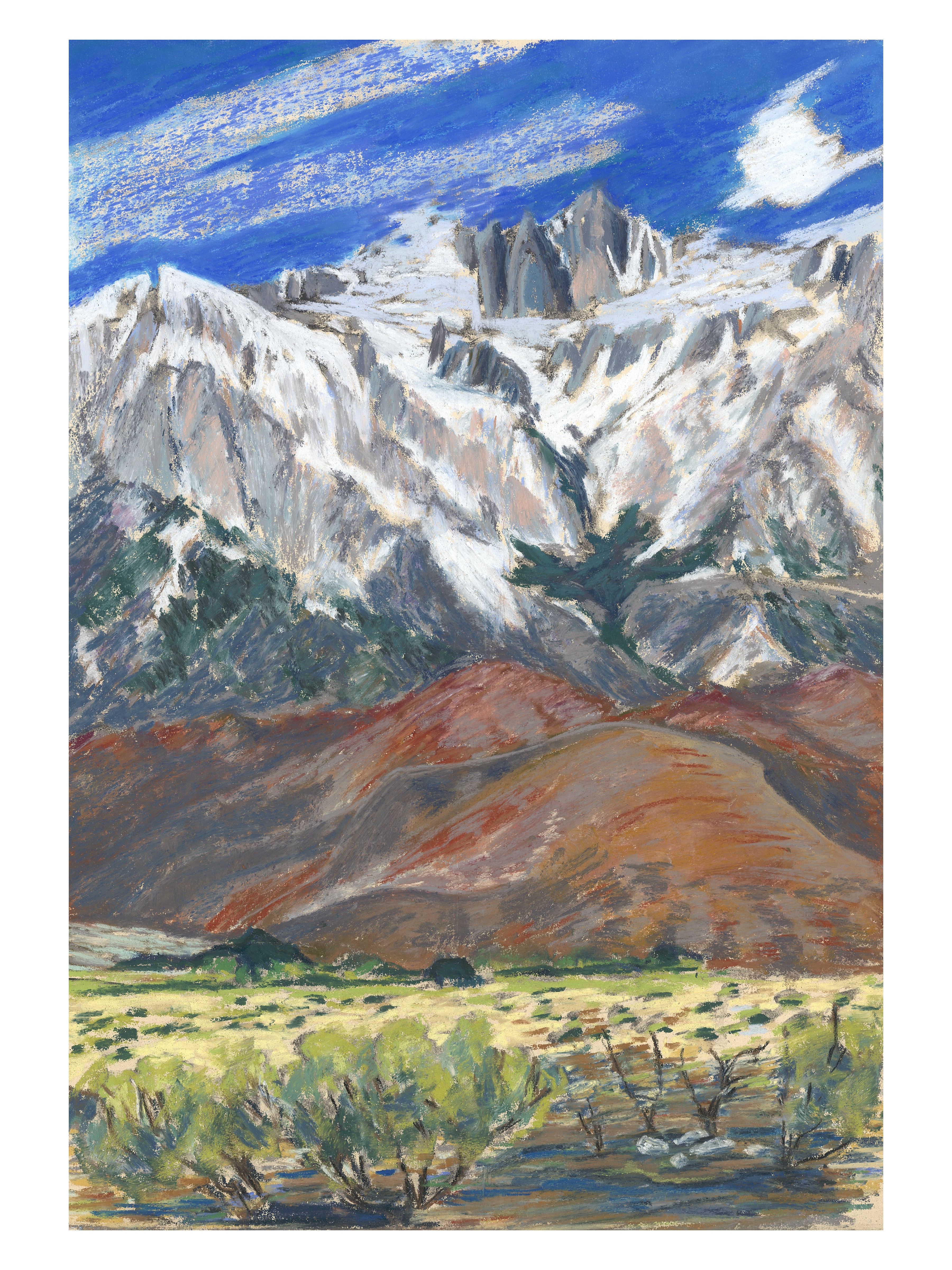
Tumanguya, also known as Mt. Whitney, in Spring. Robin L. Chandler, 2024.

“In 1750, nearly all of the world’s 750 million people, regardless of where they were or what political or economic system they had, lived and died within the biological old regime. The necessities of life – food, clothing, shelter, and fuel for heating and cooking – mostly came from the land, from what could be captured from annual energy flows from the sun to the Earth. Industries too, such as textiles, leather, and construction, depended on products from agriculture or the forest. Even iron and steel making in the biological old regime, for instance, relied upon charcoal made from wood. The biological old regime thus set limits not just on the size of the human population but on the productivity of the economy as well.

These limits would begin to be lifted over the century from 1750 to 1850, when some people increasingly used coal to produce heat and then captured that heat to fuel repetitive motion with steam-powered machines, doing work that previously had been done with muscle. The use of coal-fired steam to power machines was a major breakthrough, launching human society out of the biological old regime and into a new one no longer limited by annual solar energy flows. Coal is stored solar energy, laid down hundreds of millions of years ago. Its use in steam engines freed human society from the limits imposed by the biological old regime, enabling the productive powers and numbers of humans to grow exponentially. The replacement – with steam generated by burning coals – of wind, water, and animals for powering industrial machines constitutes the beginning of the Industrial Revolution and ranks with the much earlier agricultural revolution in importance for the course of history. The use of fossil fuels – first coal and then petroleum – not only transformed economies around the world but also added greenhouse gases to Earth’s atmosphere.”

Excerpt from Robert B. Marks’ The Origins of the Modern World: A Global and Environmental Narrative from the Fifteenth to the Twenty-First Century. Fifth Edition (p. 101 – 102)

The concept of the biological old regime, as discussed by Dr. Marks in great detail in Chapter One of the book, is based upon relationships, such as the rise of civilization and the agricultural revolution, the relationships between towns or cities and the countryside, between elites and peasants (also called agriculturalists or villagers), between civilizations and nomadic pastoralists, and between people and the environment 

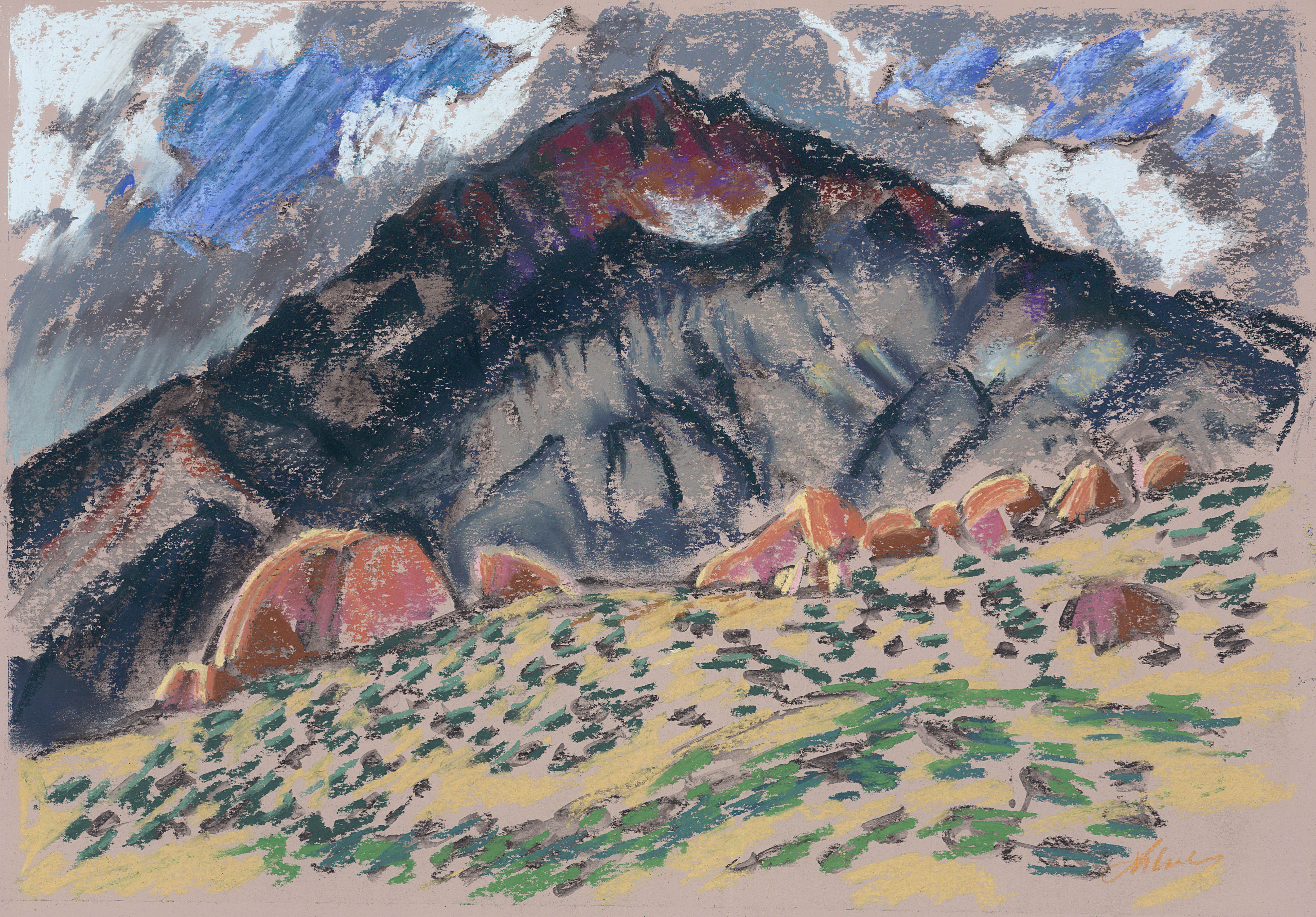
standing tall

Winuba. Robin L. Chandler, 2023

“…..on a September afternoon…..I return to the Buttermilks, walking about six miles roundtrip on the wash-boarded and rutted road up to the monster boulders known as Grandma and Grandpa Peabody, a favorite haunt of rock climbers. It is an amazing hike. I meet and talk with several people who call Payahuunadu their home. I am hooked on the Buttermilks! Storms linger in the valley and the day is a patchwork of blue skies, rainbows, and occasional downpours, but mostly a sensational cloud cover frames the mountain the Numu Paiute called Winuba (“Standing Tall”). Winuba is known to many as Mount Tom, and at 13,658 feet is the commanding peak of the Upper Owens Valley. I scramble amongst the granite boulders and marvel at their size. Grandpa Peabody is 50 feet high and 65 feet in diameter. Based on analysis of the boulders’ composition, geologists conclude that earthquakes shook these boulders loose from the ridgecrest and they rolled downslope, coming to rest in this field. I made this pastel in the studio from a photograph I took that day; the large pink boulder on the left is Grandpa Peabody.”

Excerpt from my book Awakened in the Range of Light: Art, Pilgrimage, and Friendship in the Sierra Nevada (p.42)

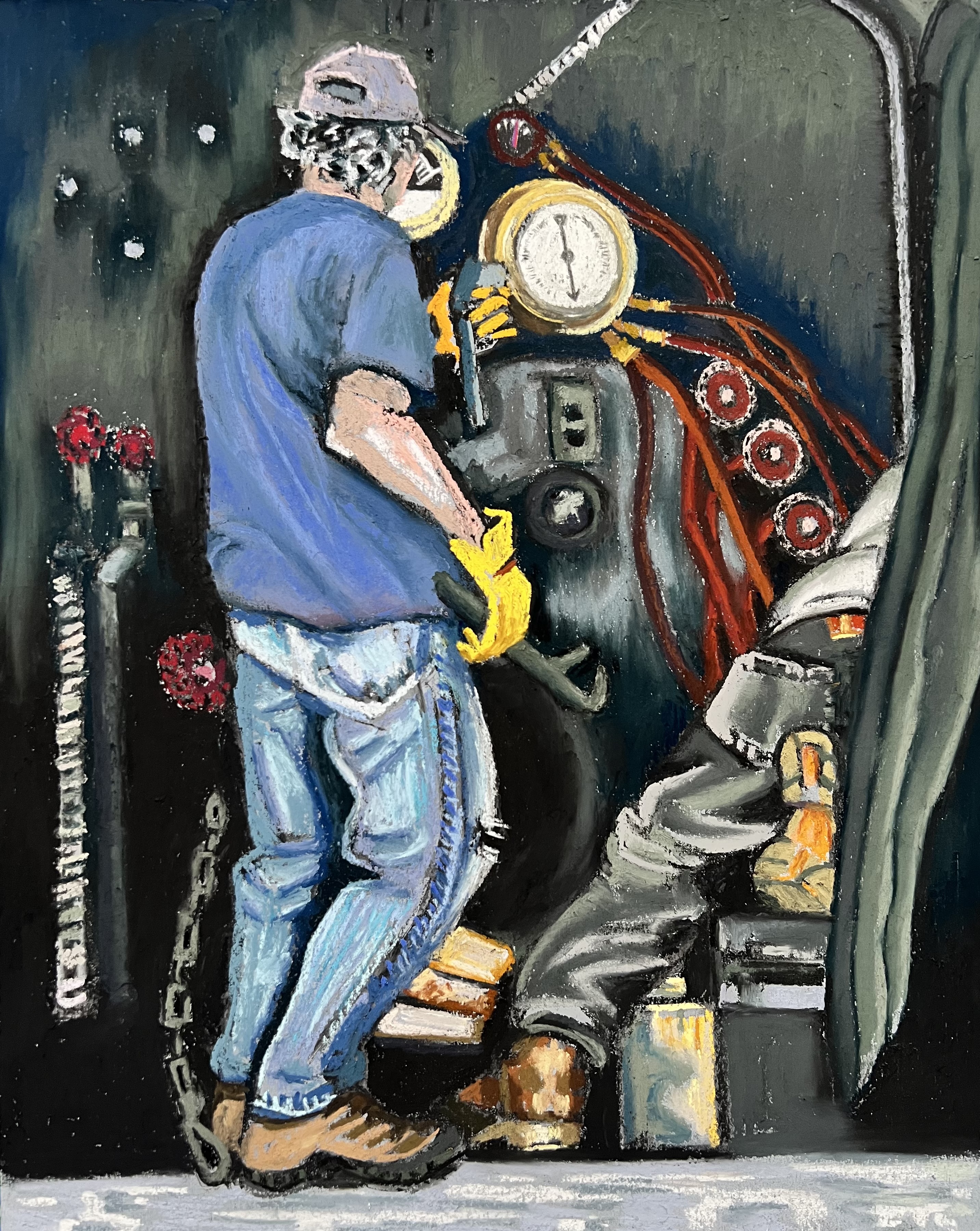
The Slim Princess

Cab compartment of Southern Pacific no. 18, the “Slim Princess.” Robin L. Chandler, 2024

The Slim Princess is an oil fire 4-6-0 “Ten Wheeler” type narrow-gauge steam locomotive built in 1911 by the Baldwin Locomotive Works of Philadelphia, Pennsylvania. This incredible machine is preserved by the Eastern California Museum (in the Larry Peckham Engine House) and has been lovingly restored and maintained in operable condition by a devoted cadre of volunteers who I recently watched laboring on the engine. Working from a photograph I made onsite, I painted this pastel.

“…..the Slim Princess worked the Nevada California Oregon line for 15 years, eventually sold to the Southern Pacific narrow gauge line. Mining and timber and farming in east California, Nevada and points west kept railroad companies going since the 1880s. The Carson and Colorado Railroad Company was incorporated in 1880 running on the narrow-gauge lines.” 

Excerpt from Sierra Wave Media, March 30, 2021 

“…..a little more than ten years later the Southern Pacific took over the Carson and Colorado. The ever-present hope of a southern railroad was encouraged. Collis P. Huntington, head of the greater company, decided to complete the line through the valley, connecting the transcontinental systems to the south and the north. Before he proceeded with that plan, death claimed him, and his successors held a different view. When the Los Angeles aqueduct required large quantities of freight, the long-wanted [rail]road was built, and its last spike was driven at Owenyo October 18, 1910. It gave the valley a southern rail connection, though the narrow-gauge traversing Owens Valley as far as Owenyo has never been standardized…..the ‘Slim Princess,’ as the narrow-gauge was locally dubbed, would be made a part of a through north-and-south interior system. But those improvements have been completed, and there still remains 134 miles of the narrow-gauge which Mills said had been ‘built 300 miles too long and 300 years too soon.’ “

Excerpt from W.A. Chalfant’s The Story of Inyo (revised edition 1933), p. 313-314

the road to Bodie

Dunderberg Peak from the road to Bodie. Robin L. Chandler, 2024

“…there in the empty desert; there are the arid mountains; they shimmer in the ashen heart of noon, or swim in the far elusive colors of evening – a reality that appears unreal, challenging the imagination…you cannot argue with the silence. It returns your questionings to you, to your own inner silence which becomes aware – a mystical something that is neither reason nor intelligence nor intuition, a recognition of some nameless truth that may not be denied.” (p.234)

Quote from a letter written by the artist Maynard Dixon on the occasion of a retrospective exhibit of his work held in November 1945 at the Scripps College art gallery. This is an excerpt from The Life of Maynard Dixon by Donald J. Hagerty

believe in our experience

Inspired by Mule Days in Bishop. Robin L. Chandler, 2024

“The reality bequeathed us by centuries of pioneering and its industrial sequel made our great need the creation of a new reality. But only spiritual force can create. Reason directs and conserves. Reason, it follows, was an ideal guide for the progress westward: and remains an ideal preservative for the traditional moods. Pragmatism, in its servility to Reason, is supine before the pioneer reality whose decadent child it is. As a recreative  agent of American life – which it claimed to be – it was destined to be sterile: destined to rationalize and fix whatever world was already in existence. The legs of the pioneer had simply become the brains of the philosopher.” (28 – 29)

“America was builded on a dream of fair lands…..in the infinitely harder problems of social and psychic  health, the dream persists.  We believe in our Star. And we do not believe in our experience. America is filled with poverty, with social disease, with oppression and with physical degeneration. But we do not wish to believe that this is so. We bask in the benign delusion of our perfect freedom. In the same way, the pioneer…..believed only in pressing on. There is this great difference, however. Physical prowess throve best unconsciously and fostered by a dream. Spiritual growth without the facing of the world is an impossible conception.” (31 – 32)

Excerpts from Our America by Waldo Frank published in 1919

a land apart

Foxtail Pine along the Cottonwood Lakes Trail. Robin L. Chandler, 2024

“Over that [1929] summer, [Georgia] O’Keefe worked her way through the standard paintings of santos, Ranchos de Taos church, and Taos Pueblo itself, but hints of her later work appeared as well. Particularly in a series of paintings of penitence crosses against a backdrop of a southwestern night sky, O’Keefe illustrated the spiritual inspiration she found in the New Mexico landscape. Perhaps the best-known painting from the summer, however, is The Lawrence Tree…..O’Keefe described the painting…..’I had one particular painting, that tree in Lawrence’s front yard as you see when you lie under it on the table with the stars it looks as tho it is standing on its head.’…..the work shows O’Keefe’s sensual appreciation of New Mexico as well as her engagement with [D. H.] Lawrence‘s writing. Lawrence had described the tree himself in St. Mawr, and Lawrence’s work remained in O’Keefe’s library throughout her life. Although Lawrence typically saw the tree with some ambivalence, O’Keefe made it entirely her own. In the painting, the tree reaches up and seems to kiss the sky, much as O’Keefe herself once said she wanted to do.” (177)

Excerpt from Flannery Burke‘s From Greenwich Village to Taos: Primitivism and Place at Mabel Dodge Luhan’s (Lawrence, Kansas: University of Kansas Press, 2008)

“The rivers of fluid fire that suddenly fell out of the sky and exploded on the earth near by, as if the whole earth had burst like a bomb, frightened her from the very core of her, and made her know secretly and with cynical certainty, that there was no merciful God in the heavens. A very tall, elegant pine-tree just above her cabin took the lightning, and stood tall and elegant as before, but with a white seam spiraling from its crest, all down its tall trunk, to earth. The perfect scar, white and long as lightning itself. And every time she looked at it, she said to herself, in spite of herself: There is no Almighty loving God. The God there is shaggy as the pine-trees, and horrible as the lightning. Outwardly, she never confessed this. Openly, she thought of her dear New England Church as usual. But in the violent undercurrent of her woman’s soul, after the storms, she would look at that living seamed tree, and the voice would say in her, almost savagely: What nonsense about Jesus and God of Love, in a place like this! This is more awful and more splendid. I like it better. The very chipmunks, in their jerky helter-skelter, the blue jays wrangling in the pine-tree in the dawn, the grey squirrel undulating to the tree-trunk, then pausing to chatter at her and scold her, with a show of fearlessness, as if she were the alien, the outsider, the creature that should not be permitted among the trees, all destroyed the illusion she cherished, of love, universal love. There was no love on this ranch. There was life, intense, bristling life, full of energy, but also, with an undertone of savage sordidness.” (167-168)

Excerpt D. H. Lawrence‘s St. Mawr (New York, New York: Penguin Books, 1997)

directness and certainty

Lodgepole Pines along the Little Lakes Trailhead. Robin L. Chandler, 2024

“In the beginning there were stories and the stories were made of Earth. Rocks and rivers, mountains and sea, these were the gods and the gods moved within them.” (p.225)

In 2013, the entirety of the novel Moby Dick was translated into emojis, those little ideograms of smiling faces and pets and objects that populate our phones and number around 1000…their appeal seems to be based on the strange and paradoxical combination of specificity and obscurity that they embody…they purport to transcend cultural difference and cut a line of sincerity and clarity straight to the nebulous heart of what we mean to say. Yet for all that, emojis, particularly in combination, open wormholes of ambiguity.” (p.228)

“Yet directness and certainty remain a dream despite our words, despite our codes, despite our cyphers. Who can state for sure the meaning of Moby Dick? ‘Of whales in paint; in teeth; in wood; in sheet-iron; in stone; in mountains; in stars’: Ishmael, its narrator, could find them everywhere. Yet the whale itself, the white whale, the named whale, is elusive. What did it mean to Ahab? Why the obsession, the desire, the pursuit? Everything can mean something else, if only we could agree what. Augustine wondered whether we could decide simply by pointing and naming. Remember that Moby Dick, whose title names its prey, itself begins with an act of naming: ‘Call me Ishmael.’ Yet in saying that, it is clear, too, that any name would have sufficed. The willow is also ‘sallow,’ is also ‘osier.’ In such simple acts lie a world of ambiguity, and a history concealed from the eyes of the everyday. Nothing is steady. Meaning sways like the hull of a ship. Ahab, with leg of wood, and scars on his body like the ‘seam sometimes made in the straight, lofty trunk of a great tree,’ hunts over ocean and sea in a vessel of timber from which a mast extends like a great oak into the sky above. Nailed to it is a gold doubloon and at its top a man sits, in the masthead, watching the horizon, searching.” (p.228-229)

Excerpts from Aengus Woods’ Of Trees in Paint; In Teeth; In Wood; In Sheet-Iron; In Stone; In Mountains; In Stars published in Katie Holten’s The Language of Trees: A Rewilding of Literature and Landscape