Big Pink

House. Copyright 2012 Robin L. Chandler

My neighbor’s house was an Oakland community landmark on Google Earth with its magenta walls and chartreuse trim.  It was so pink I always hummed something by The Band, which makes me think about the passing of the great Levon Helm, but that’s another story.  All colors fade in the sunshine, even the bright ones, and so the day came when a new coat of paint was required.   While most mortals choose the security of pale pastels for their homes, my wonderful neighbors boldly embrace intense, vibrant, juicy color.  The two-story domicile now dresses in an azure gown with lime accessories.   The transition was a delight.  For several days the house was a canvas where a team of painters painted layer upon layer diligently bringing blue to the forefront and quietly pushing the reddish-pink to the background. Daily life was being re-framed through the window. Within borderlines created by ledges and transoms, the colors and shapes were pushing and pulling within a geometric grid recalling one of my favorite painters Richard Diebenkorn.  Just a few weeks ago, we saw the Diebenkorn Ocean Park Series exhibit at the Orange County Museum of Art.  Initially inspired by the “view” from his studio window, Diebenkorn captured the geography, topography and hazy light inspired by the marine/desert environment of Los Angeles.  My love affair with Diebenkorn began over thirty years ago in a course taught by the painter Cornelia Schulz.  Captivated and spiritually centered by Diebenkorn’s strong horizontal and vertical bands of color I was inspired to see the world through his framework. Diebenkorn’s painting made me feel it was possible to realize something as close to oneness as can be known.  Critiquing my work, Schulz noted my clear interest in the Ocean Park Series and suggested that I seek out Diebenkorn’s inspiration: the abstractions created by Matisse of the “view” from his window during his stay in Morocco and Tangiers.  And I did.  Last summer San Francisco MOMA hosted the exhibit The Steins Collect which delved deeply into the art collections formed by  Gertrude, Michael, Sarah and Leo Stein.  Michael and Sarah Stein became great friends with Henri Matisse purchasing many of his paintings.    Leaving Paris before the Nazi invasion of Europe, Michael and Sarah Stein settled in Palo Alto, California.  After World War II, Richard Diebenkorn, an Art Student at Stanford University, regularly attended the salon’s held by Sarah Stein, where he was first exposed to Matisse’s paintings.  In 1964 and 1966 Diebenkorn had the opportunity to see many of the paintings Matisse created in Morocco and Tangiers at the Hermitage in Leningrad and the UCLA Art Gallery Matisse retrospective. In 1967, Diebenkorn moved to Los Angeles and the Ocean Park Series was born.

Tell me a story Siri

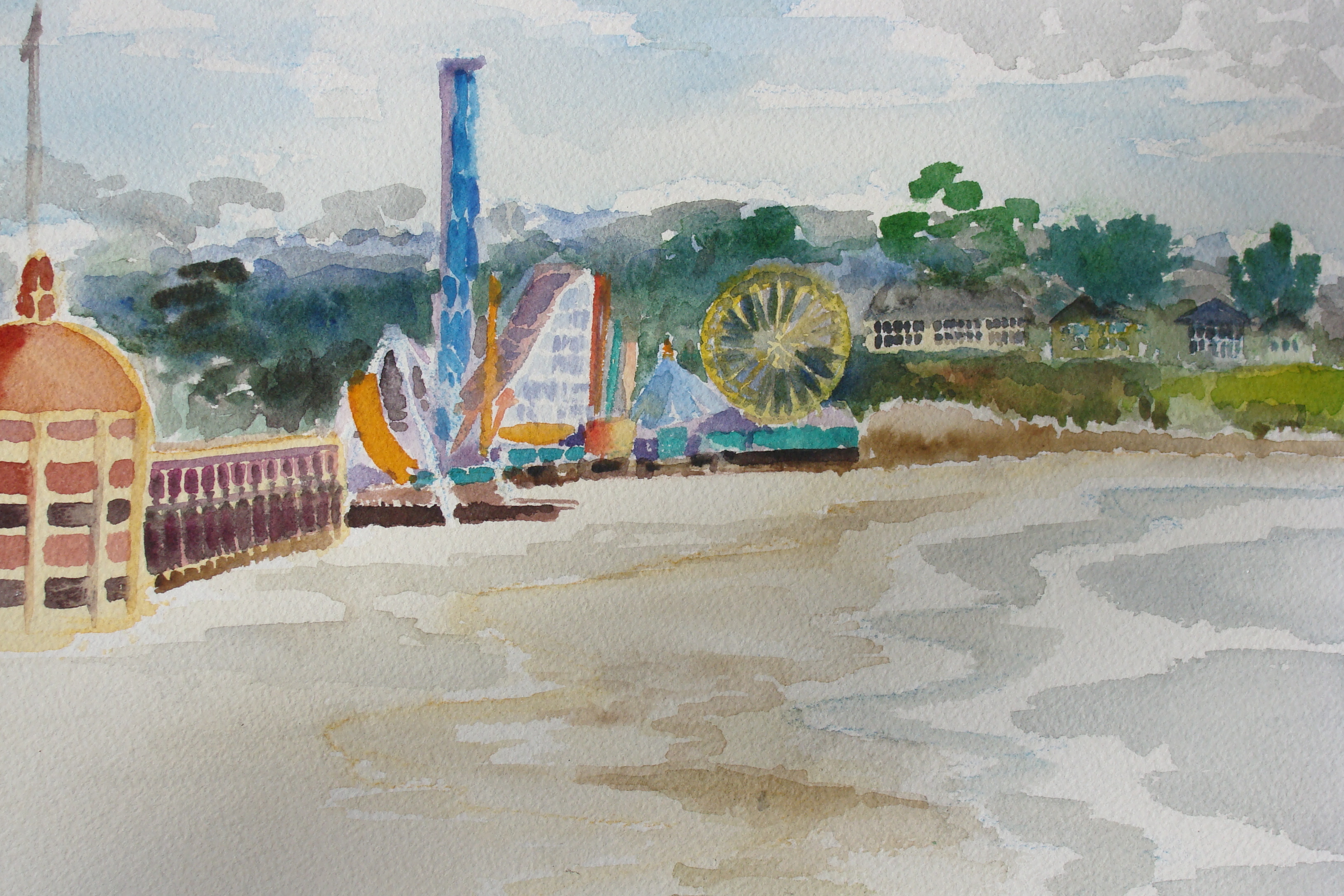
Santa Cruz Boardwalk Copyright 2012 Robin L. Chandler

Nearly every morning I meet my good friend at Java Junction and we bike to work at UC Santa Cruz along the boardwalk and finally up the hill and through the great meadow and the redwood trees. It’s a special way to spend the early morning: connecting with a great friend while cycling in such a beautiful place.  The eight miles pass quickly always made fun by the stories we tell each other.  My friend says “its all about the conversation,” and she is so right; life is all about sharing our stories.

In this age –  our moment in time – it’s all about sharing our stories of the past, present and future and staying connected.  Facebook, Google+, Linkedin, Twitter, WordPress, Yelp and YouTube make this possible. Its also about having the tools to make sense of all this information – to gather, organize, comment, enhance and recommend this information using tools like Digg, Reddit, RSS feeds, Storify, Tumblr, TweetDeck and Unilyzer to name but a few.  My life in archives and libraries is all about collecting, preserving and making accessible our culture’s stories – and it is a broad range of stories – published and unpublished, formal and casual, analytical and subjective.

At the recent WebWise 2012 conference we learned about many exciting projects funded by the Institute of Museum and Library Services (IMLS) to help individuals and groups create, share and preserve “stories” and build tools to make sense of and use this information. Simply put its about making it easier to make connections.  Dave Isay founder of StoryCorps spoke passionately about his belief in the power of the microphone.  A simple, straightforward format places two people in front of a microphone for forty minutes and their stories are recorded.  While it does not take the place of formal oral history, StoryCorps capture an important snapshot of people’s lives in space and time.  In over eight years, StoryCorps has captured over 40,000 interviews with over 70,000 people that are now archived in the Library of Congress.   David Klevan of the US Holocaust Museum described the sobering but important work of the Remember Me? Project which uses Facebook and Twitter to release photographs of children (now adults) orphaned by the Holocaust and World War II with the goal of reuniting them with surviving family members worldwide.  Eileen McAdam of the Hudson Valley Sound and Story Project described her project’s work to share sections of formal oral histories using new technologies synchronizing oral history snippets with GPS enabled mobile apps.  Doug Boyd of the University of Kentucky Digital Library Project to create the Oral History Metadata Synchronizer to dynamically index audio and video digital files creating access points to collections of oral histories.

Today’s technology is increasingly about sharing and staying connected.  We have a world of knowledge at our fingertips and a world populated with individuals we can tap into <and they to us> in an instant 24/7.  As in past revolutions, our emerging technologies provide new opportunities to share and learn about each other.  Creating new opportunities to build tolerance and patience, and perhaps empathy for one another. To make a connection.  It is a promising story with promise to fulfill.

Feliz ano Nuevo

Early morning and first day of the New Year, dinner was already in the bag.  The black-eyed peas were cooked and we still had a little smoked turkey from “Tejas”  – my Dad’s annual holiday gift.  We were ready for our traditional new years pilgrimage to the ocean.  The truck easily covered the fifty-mile distance seamlessly crossing the once Spanish and Mexican ranchos — remembered now mostly as streets, colleges, landmarks or towns named for land grants – Peralta, San Pedro, Nicasio, Tomales and de Los Reyes.  Sir Francis Drake Boulevard holds some thirty years of memories: the old white horse in the corral just west of Lagunitas (a toy horse perched on the fence has sadly replaced the original); seeing my first Steelhead with Jane in Lagunitas Creek on our bike-camping trip from Santa Rosa to San Francisco; watching the Salmon with Wave as they lay their eggs in redds just below Kent Lake; and the journey to Bolinas in the old VW bug for my first kayaking adventure with Glo, John and Carol.

Before reaching the beach, two mandatory stops are necessary.  Ginger & Chocolate-Chocolate-Cherry cookies from the Bovine Bakery are a must: necessary fuel for the hike ahead.   Stocking up on our reading materials was another must at the Point Reyes Books.  We are members of their Community Supported Bookstore Program a cool new idea inspired by community supported agriculture to help sustain independent book sellers.  Supporters make a deposit with the bookstore and draw upon that amount for future purchases.  Brilliant! I hope other bookstores start this program!  A lover of browsing, I bought my first book of 2012, a volume by the roots music guitarist Ry Cooder: Los Angeles Stories.  Looks like my kind of book.  Fiction, but the kind of stories you might gather by sitting down with the everyday folks in your community over a cup of coffee and listening to their life; learning about their part in our shared history.  Revived both gastronomically and intellectually, we headed on down the road to Limantour Beach to let the ocean ions do their purifying thang.  We walked the beach length in the bright sunshine, the waves gently lapping at our feet and the sweet ocean air wafting through us.  Later, alone in the truck for a few minutes while Wave lingered to capture a last image of a beautiful day, I queued Mary Gautier’s Mercy Now.  As I look to the year ahead may everyone have “ a little mercy now.”

Auld Lang Syne

Farmer’s Market, Splashpad Park, Oakland. Copyright 2011 Robin L. Chandler

“How do you do that?” said Terrell.  About six years old, my admirer sat beside me on the concrete wall.  “I like to paint too…Santa brought me some paints, brushes and paper.”  While his grandmother watched, I loaned my new friend some paper and a brush and, we painted together in the brilliant sunshine of this last day of 2011.  The Saturday Farmer’s Market is a worthy subject: a unique cityscape with the mixing and mingling of so many kinds of people engaged in reaping the fruits of farmer’s labor.  As I walk through the market and see the bounty of the harvest, I recall the stories from a wonderful book  Cultivating a Movement. Edited by Irene Reti and Sarah Rabkin, the book draws from oral histories documenting the lives of individuals engaged in organic farming and sustainable agriculture on California’s Central Coast. The interviews dig deep into the social, cultural and environmental history of California on a range of topics concerning organic / sustainable agriculture including the influence of the hippie movement of the 1960s and 1970s; the influence of Alan Chadwick on farming; the organizing of Mexican-American farm workers resulting in the formation of the United Farm Workers (UFW) union; the publication of Rachel Carson’s Silent Spring; the creation of the California Certified Organic Farmers (CCOF); and the influence of the UC Santa Cruz Center for Agroecology and Sustainable Food Systems. Recommended reading!

Our urban life blossoms in this space called Splashpad Park; an island of trees, shrub and grass floating between a major freeway and busy city streets.  Cars rush by; children and their parents line-up to see movies at the Grand Lake Theater; activists pass-out buttons and leaflets for Occupy Oakland while others gather signatures for a referendum against the death penalty; musicians play folk songs and Grateful Dead tunes; and shoppers visit the bakery, dry cleaners and other specialty shops as well as the Farmer’s Market.   Oakland’s community awakens on Saturday mornings, re-energized after the busy workweek, engaging in the timeless ritual of gathering those items necessary for sustenance.    Not sure if his little self will grasp all I wish him to know, but I pass on to Terrell the wise words of my drawing teacher Rob Anderson “draw what you know, what you see, what you feel, continue on until it is what you are.”  Grandmother gently urges Terrell that its time to leave; she rattles off the items they still need to buy: navel oranges, beets, radichio and arugula.

Turning back to my painting, I modestly attempt to capture on paper something reminiscent of the grand American Experiment performed by the Ashcan Painters – including Robert Henri, John Sloan, George Luks, William Glackens and Everett Shinn – a vivid description of America’s bustling cities and her people. My favorite painter of this Group – George Bellows – created some of the most moving depictions of the urban landscape: “The Lone Tenement”  and “Blue Morning.”  So, on this December 31, 2011 I raise my brush in celebration of painters old long ago, always brought to mind.

journey to the mountaintop

Mt. Whitney at sunrise. Copyright 2011 Robin L. Chandler

Life is all about the journey; it’s never about the destination.  Over the years, I have made many pilgrimages to Mount Whitney, a mountain that has “tattooed” my body and still lingers in my dreams. Many years ago, I began a dialogue with my “friend,” the tallest summit in the continental United States, and I am grateful that the conversation continues.  On September 15, 2001  – a mere four days after 9/11 – I walked the pathway to the summit (14,497 ft.) for the first time with six friends. On that journey, the mountain helped me believe in my ability to prepare, plan and confront my fears and doubts. Unexpectedly, the mountain helped me grapple with the tragic events in New York City. In 2001, I reached the mountaintop, looked eastward and was gifted with a glorious view of my country; I saw strength, determination and resilience. Looking to the valley below, I saw the result of similar challenging times beset by fear and prejudice, as realized by the internment of Japanese-American Citizens at Manzanar.

Now, ten years later, I returned to visit my old friend the mountain and see what stories the mountain might share. Seven of us started the walk up Mount Whitney on September 17, 2011 at 3:00AM: Connie, David, Doug, Kim, Margaret, Matt and me. In 2001, it had taken me eighteen hours to reach the summit and return to camp at Whitney Portal. Hoisting my pack on my back, I imagined myself back at the campfire around 9 PM with a well-earned celebratory brew in my hand. My dear friend Pam was coming all the way from Sonora to make sure we had a warm fire, pizza and beer at the end of our hike. But before fast-forwarding, I rewound thinking about when this journey really began.  It began months earlier with hours of hiking. April 2011, I hiked to Sill Hill waterfall in San Diego County with David and Margaret.  May 2011, I circumnavigated Monterey Bay with my friends Irene and Sara.  July 2011, Connie and I hiked Big Basin in Santa Cruz.  August 2011, Irene and I hiked in the Sierras surrounding Convict Lake and summited Mt. Dana in Yosemite.  August 2011, David, Margaret, Doug and I hiked Mt. San Jacinto near Palm Springs.  September 2011, I hiked in the Hurricaine Ridge in the Olympics in Washington with Umberto and Giovanni.  All lovely hikes with friends whose companionship I treasure.

Range of Light. Copyright 2008 Robin L. Chandler

Three of the seven argonauts made it to the summit this year; and I toast my compatriots David, Doug and Margaret for their accomplishment! Cheers! For me, this hike ended at nearly 13,400 feet somewhere amidst the 98 switchbacks between Consultation Lake and Trail Crest. More importantly, the journey to the mountaintop has never ended and I hope it never does.  This time, my friend the mountain shared with me long-lasting stories: the joy helping others accomplish great things, the grace in humility, the sweetness of friendship during hardship and pain, and the wisdom in understanding “its never over ‘til its over.”  I look forward to my next pilgrimage to the mountain.

Just off the beaten path….our precious California State Parks

New Brighton State Beach. Copyright 2011 Robin L. Chandler

On May 21st we started our journey at the Salinas River National Wildlife Refuge and ended some eight hours later at the wharf in Monterey.  On three sequential Saturdays some fifty adventurers hiked thirty miles in the distinguished company of Sandy Lydon, Historian and Cabrillo College faculty, and Gary Griggs, Director of UC Santa Cruz Institute of Marine Science. Today would be the final ten-mile leg of  Monterey Bay Walk 3. May 7th we hiked from New Brighton State Beach in Capitola to just north of the Pajaro Dunes.  May 14th we ambled from Zmudowski State Beach to the Salinas River.  This morning a flock of Caspian Terns greeted us by the riverbank as we walked through the refuge to the beach. All was beautiful: endless sky, sea and sand.  My day’s walk would be measured by miles of words and punctuated by meters of awed silence –  awe inspired by the magnificent Monterey Bay. My companions on this adventure included my amazing friends Irene Reti and Sarah Rabkin.  Both passionate environmentalists, they have shared their love of nature, understanding of human frailty and hopes for the future in their recent books: Reti’s Kabbalah of Stone and Rabkin’s What I Learned at Bug Camp: Essays on Finding a Home in the World.   I am grateful for all the knowledge they shared with me about the human and natural history of lands between Santa Cruz and Monterey on these special  Saturdays in May.

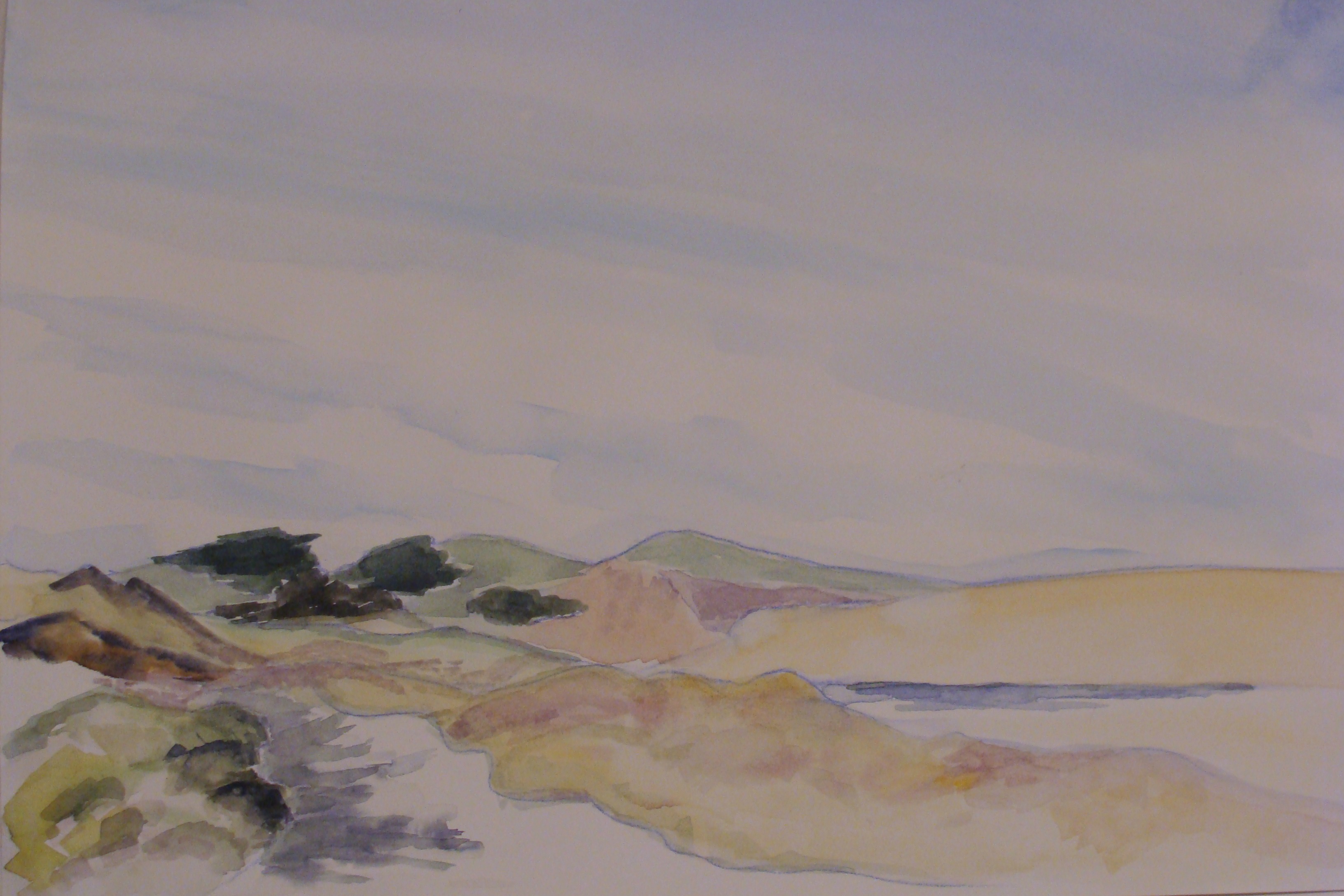
Sandholdt State Park. Copyright 2011 Robin L. Chandler

Reflecting on the walks, many images delight my mind — images conjured by the stories of Sandy and Gary, the two  trip leaders: the realization that Monterey Bay is not a pristine environment, no location on the Bay has been spared the impact of humankind; the image of Chinese fishing sampans on the beach now known as New Brighton; the impact of earthquakes, erosion and tidal forces on the coastline; the story of Gaspar de Portola and his Spanish troops walking what would become the El Camino Reale as he searched in vain for Monterey Bay; developers’ insistence on building at the ocean’s edge, imperiously disregarding the cycle of el nino and la nina climate patterns on urban planning; the mother gray whale and her baby breaking the surface with their spouts; the enormous American bullfrog, an invasive species found on the shore of the Salinas River; the bachelor otter pod at Moss Landing; the snowy plovers guarding their nests and chicks on the beaches near to Monterey; and the clouds: light fogs at a far distance resting lightly on the water — quickly burning back leaving a brilliantly bright day where sunlight danced crisply on the waves, or the dramatic bands of clouds moving fast north to south, precursors of the front that would bring unseasonal rain from Santa Cruz to San Diego.

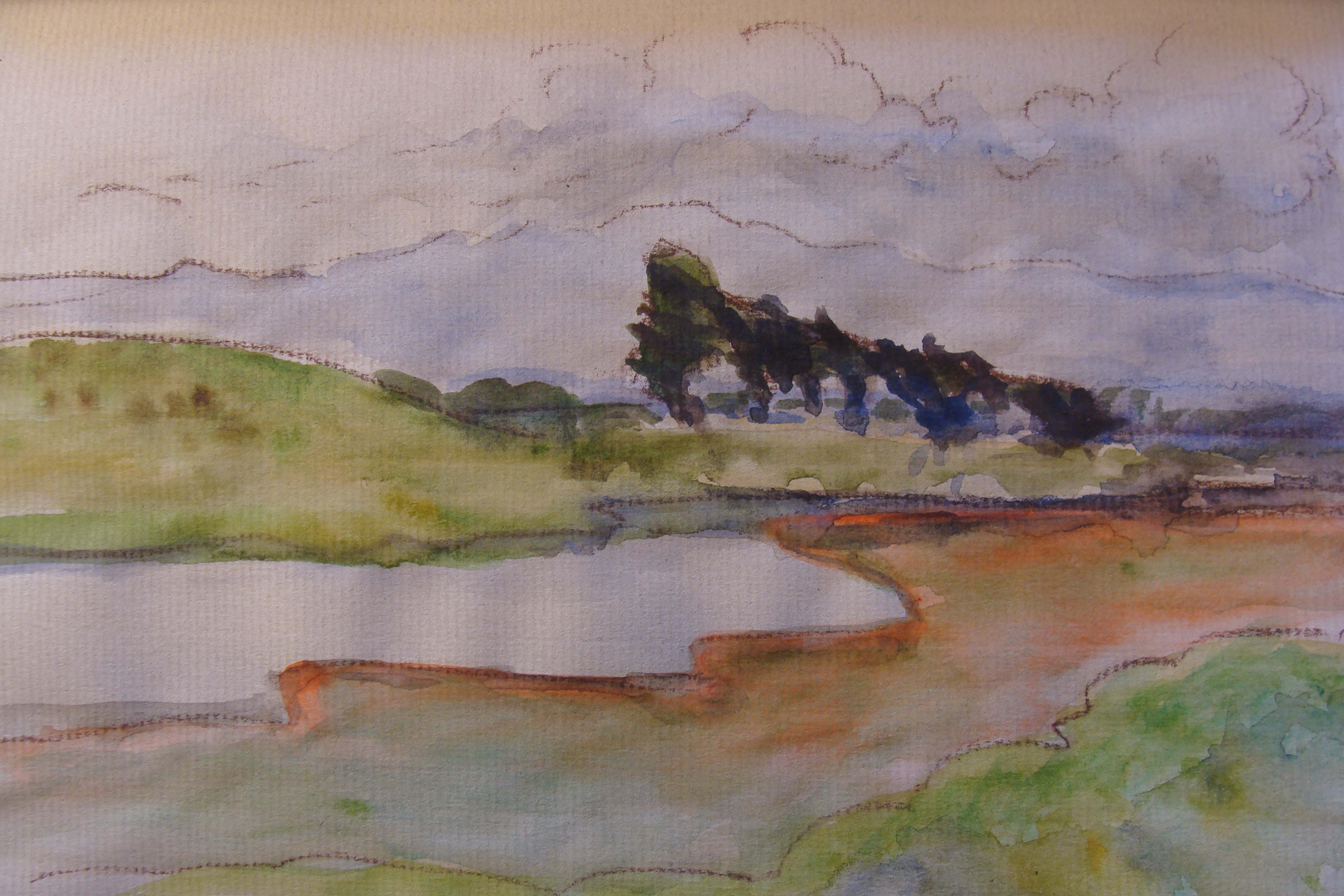
Fort Ord State Park. Copyright 2011 Robin L. Chandler

For thirty miles from Santa Cruz to Monterey we walked on the beach  – a pathway formed from a patchwork of California State Parks and Federal Wildlife Refuges  — a ring of bright white sand circling the Monterey Bay Marine Sanctuary.  Seventy California State Parks will be closed because of our state budget crisis.  Four of these parks are beach parks found along the shores of Monterey Bay, and two of them we crossed during our bayside journey: Zmudowski State Beach and Moss Landing State Beach.  In November 2010, the majority of California’s citizens elected NOT to  pass Proposition 21, a referendum proposing an annual $18.00 vehicle license fee.  Such a small price to pay for so much beauty….. just off the beaten path…..our precious California State Parks.

Ghosts of Aprils Past

Cotton. Copyright 2011 Robin L. Chandler

Guarded by the monuments honoring the defenders from the northern aggression

A town square, now sits quiet

Bypassed

The highway  leads to the WalMart suburbs, spaces filled with fast food and fast fun, a drive through espresso and a MySpace page

The rhythms of cicadas, drowned by the roar of air conditioners

In the shade of live oaks, by the County Courthouse, I sit with my father and uncle

They speak of my grandfather – Eph – Manager of the cotton gin in Thorndale, Texas

With their voices the past comes alive:

The wagons creaking under their load

Bales of cotton

Products of hours of picking under a hot sun

Sweat streaming

Backs bent with pain

Bloody hands

Callused hands scarred by the thorns of the south’s cash crop

White hands and black hands made equal

By the pain and the heat

Sunlight streams through the cracks

Revealing cotton dust rising

Filling the spaces between breaths

The cotton enters the gin

Separating fibers from seeds

Long white fibers

To form the clothes on our backs

Dark seeds pressed

Oil for margarine, meal to feed cattle

They say the cotton gin killed Eph

Years of dust caused the cancer in his brain

A working man

A hard man

No time for tenderness

Love meant food on the table and a roof over their heads

My father’s sense of duty and responsibility flow from him

Father buried Eph in Taylor – as he asked — with a good view of the  road to Thorndale

Later that evening, we watch a little league game, April brings the nation’s pastime

A hot wind blows across the field

A reminder of the scorching Texas day

Grasshoppers by the hundreds fly towards the electric lights.

A black child walks by

Interrupting the serenity of our colorless existence

Watch him, a stranger says, he may have a knife

Shaken, I am horrified: the cotton gin cranks on, separating the light from the dark

Suburban streets cannot mask

Centuries of hurt, neglect and segregation

Revisiting our country’s Civil War, April resonates: Sumter, Appomattox, Lincoln’s Assassination

Bypass not these one-hundred and fifty years

Bypass not these struggles for justice

Mold not history to political need

Pick not the path of easy memory and least resistance

Sift the evidence, seek the truths

For we hold these truths to be self-evident

That “all” are created equal

Long before his death in Memphis in April 1968

Dr. King dreamed on the 100th Anniversary of the Emancipation Proclamation at the  steps of the Lincoln Memorial:

“…..we will be able to transform the jangly discords of our nation into a beautiful symphony of brother hood.”

Dark, salt, clear, moving, utterly free*

Marin Headlands on the Pacific Ocean. Created by Robin L. Chandler. Copyright 2010 National Park Service.

In Moby Dick, Herman Melville described the Pacific Ocean as the “tide-beating heart of the earth that makes all coasts a bay in it.”   Describing the interconnectedness of the lands ringing the Pacific Rim he wrote “the same waves wash the moles of the new-built Californian towns, but yesterday…..lave the faded but still gorgeous skirts of the Asiatic lands, older than Abraham; while all between float milky-ways of coral isles, and low-lying, endless, unknown Archipelagoes, and impenetrable Japans.”  On Friday March 11, 2011, mankind was humbled by a 9.0 magnitude quake striking the northeastern coast of Japan and triggering a Tsunami whose force quickly silenced thousands of voices near Sendai and damaged harbors – including Crescent City and Santa Cruz –  5,000 miles to the east along the North American coastline.  Nature will always bind what man’s competitive psyche seeks to distance.  Hokusai’s woodblock print “The Great Wave” part of his  series Thirty-six Views of Mt. Fuji has long been a favorite of mine; mesmerized by the beauty of the wave, it is only now, newly humbled, that I truly grasp the precarious position of the fishing boats depicted in the print.

Last weekend I attended the Point Reyes Book’s third Geography of Hope conference bringing together people, place and literature to discuss water as both a life-giving and a life-taking force.  As rain poured outside in biblical proportions, the Japanese people were never far from our consciousness in this community located on the San Andreas Fault so near the Pacific Ocean.   An inspiring  gathering, we listened rapturously to poets, writers and scientists – including Robert Hass, Brenda Hillman, William Least Heat Moon, Tim Palmer, Philip Fradkin, Eddy Harris, Peter Gleick, Evelyn Reilly and Julia Whitty —  speak about rivers, lakes and oceans and their hopes and fears for the health of our planet.  The desire to teach children  – through art, literature and science – about the connections between humans and nature was a major theme, but concerns about the potential of social media and hand-held technology to disconnect society from the natural world was an undercurrent of the gathering.

My work as a digital archivist working in academic libraries fosters my belief that social media can be leveraged to enhance our connections with and understanding of the natural world.  If any good can be drawn from the tragedy of the Japanese earthquake and Tsunami, it is the knowledge that this is  likely the best documented disaster in recent history, and this information will be repurposed for constructive use. Numerous digital images and video recordings of the Tsunami’s destructive power were captured by survivors of these events and uploaded for sharing on social media sites. This week a BBC article published on March 21, 2011 “Japan Tsunami to Help Predict Future Waves” reported  how scientists will use this data to study Tsunamis. At the 2011 Institute for Museum and Library Services (IMLS) Webwise conference, Dr. Francine Berman, Vice President for Research at the Rennslaer Polytechnic and Dr. Joshua Greenberg, Director of Digital Information Technology and Dissemination of Knowledge Program at the Sloan Foundation delivered keynote addresses making several complimentary points: the role of the “crowd and the social network” in the generation of observational research data; the need for a macroscopic approach to gather comprehensive data sets and analyze and visualize data at scale; and the need for archivists, librarians and museum professionals to be central players in data curation workflows to appraise, manage, preserve and provide access to data supporting ongoing research.  Its important to note that this kind of work is underway.  The National Science Foundation (NSF) funded DataONE a multi-institutional and cross-discipline collaboration of universities and organizations including the California Digital Library to lay the foundation for a distributed framework and sustainable cyberinfrastructure that meets the needs of science and society for open, persistent, robust, and secure access to well-described and easily discovered Earth observational data.

Webwise also featured workshops and sessions on Libraries and Museums engaged in STEM (Science, Technology, Engineering and Mathematics) Learning.  STEM is part of President Obama’s program “Educate to Innovate,” a campaign to improve the participation and performance of America’s students in these disciplines.  Teachers, librarians and museum staff are developing many fun and engaging learning modules using social media and technology.  One particular module — Habit Tracker – caught my eye; I saw a demo of the prototype at the conference.  Using the Apps developed for iPhone and iPad2 technology, Habitat Tracker will help students learn about the nature of science by learning to ask their own questions about the natural world, recording observations, performing analysis and participating in peer review with fellow students.

A humble respect, enjoyment and love of the natural world and a belief in the utility of social media technology and services are not mutually exclusive.  They can be symbiotic and when so joined the resulting analysis can support greater understanding of the natural world and our place in the cycle of life.  It is my hope that technology advancements – like social media –  will bring individuals greater engagement with nature and help humankind shoulder the stewardship responsibilities required to ensure the natural world survives for future generations.

*From the poem At the Fish Houses by Elizabeth Bishop read by Eric Karpeles at the Geography of Hope Conference

Field notes: rain and the coming of spring

The promise of spring. Copyright 2010 Robin L. Chandler.

Three times in the night I woke to the sound of driving rain: hard and loud on the rooftop. Now with the first light of morning I see the dark gray clouds of the cold front streak across the sky moving southeast.  Some of the apple-blossoms on the tree outside my window did not survive the night, but most held on, somehow. I was worried. January has been glorious in Santa Cruz, teasing us with warm days, glorious sunlight and little rain; gone were the drenching storms that defined California’s December.

The fruit trees have responded to the spring-like days, colors of white and pink delicately dancing in the breeze; there is always that fear that blossoms will open too early and a hard rain will end their story before it begins. Difficult to imagine a spring without ripening fruit and the canning that gives us apricot, peach and plum preserves – the taste of summer in winter. We are approaching Imbolc, the cross-quarter days when the sun in its celestial travels is midway between the winter solstice and the spring equinox; in the Northern Hemisphere the sun in its journey has reached the precise point of fifteen degrees in the constellation of Aquarius. Occurring between February 2 – 7 on our Gregorian calendar, it is the middle of astronomical winter, and the beginning of spring.  It is a celebration of the lengthening days and the early signs of spring; known as the Festival of St. Brigid in Ireland, we know it as Groundhog Day, the day the groundhog emerges from its burrow to signify that winter will soon end.  But thankfully winter seeks to stay awhile yet, and truthfully we are not ready to say goodbye to the rain and snow either. If we are lucky our fruit trees will sleep a little longer before awakening to their life purpose. Pacific storms – bringing rain to the coast and Central Valley and the resulting snowpack and snowmelt in the Sierra-Nevada mountains – bring life to all of the inhabitants of California: you, me, fruit trees and Salmon.

In the late 17th century, the Japanese poet Matsuo Basho – the great haiku master – wrote “each day is a journey, and the journey itself home.”  During his life Basho made many pilgrimages throughout Japan with only a knapsack and writing implements, determined to become a hyohaksua “one who moves without direction.” On his last pilgrimage in 1689, Basho travelled through the villages and mountains north of Edo (today’s Tokyo) and along the shores of the Sea of Japan.  During his journey he wrote his masterpiece the Narrow Road to the Interior which features verse and haiku including this one describing the first signs of spring:

Kesa no yuki

nebuka o sono no

shiori kana

translated:

After morning snow

onion shoots rise in the garden

like little signposts

Field notes: rain and watersheds

Salmon returning to Redwood Creek. Created by Robin L. Chandler. Copyright 2010 National Park Service.

In early January 2011, we participated in what is becoming a beloved annual ritual: naturalist guided creek walks in the Lagunitas watershed seeking glimpses of Coho Salmon and Steelhead Trout who have come home to spawn.  The Marin County based Salmon Protection and Watershed Network (SPAWN) is committed to restoring habitat, building community partnerships, and passing legislation supporting the survival of endangered Coho Salmon and Steelhead Trout in California and the Pacific Basin. Thankfully SPAWN is not alone; all along the Northern California coast educational, research and non-profit organizations are engaged in activities to save endangered fish species. In Marin county, the Golden Gate National Parks Conservancy is engaged in restoring salmon habitat along Redwood Creek and the river’s mouth at Muir Beach. While in Santa Cruz, increasing numbers of steelhead smolts are making their way along the San Lorenzo River back to the sea. Scientists attribute these rising numbers of Steelhead to increased rainfall and the efforts of citizens to reduce urban runoff and improve habitat.  These inroads are so important because some efforts in Southern California are foundering; recently the California Coastal Conservancy’s was forced to abandon’s its work to restore the Steelhead to San Mateo Creek in San Diego County.

For the past few years, we have been blessed with observing a pair or two of Salmon – their bodies touched with crimson – swimming upstream and building nests — called Redds – in preparation for laying eggs. But seeing these beautiful creatures is a rarity. Typically annual counts on the Lagunitas and San Geronimo creeks number only in the 60s.  Writing about Steelhead in The Sespe Wild, Bradley John Monsma described California a few centuries ago when “thousands of fish, fattened from the ocean, pool near the mouths of rivers…before dashing upstream to gravel spawning beds in the mountains.” Rain and healthy watersheds are essential for the survival of Salmon and Steelhead; rain provides easy passage for the journey upstream to lay eggs, and give birth to fry. Rain emboldens rivers and creeks to break the sand barriers to the sea permitting smolt to begin the ocean phase of their life.

People make a huge difference in building healthy watersheds. We need to care, we need to understand that our lives are better because these animals are part of our world. We need to grasp that we are living in a biodiversity crisis that can only be resolved by our understanding the power of our different interdependent lives.  Monsma quoting the human ecologist Paul Shepard writes “with the loss of species, we may be losing something essential to our humanity. It may be that we can approach the depth of ourselves only in relation to a diverse and healthy ecosystem” suggesting that mature societies are those that are “characterized by a view broad and forgiving involving a sense of the larger gift of life, a realistic sense of the self and other, a sense of the talents of generosity and circumspection.”