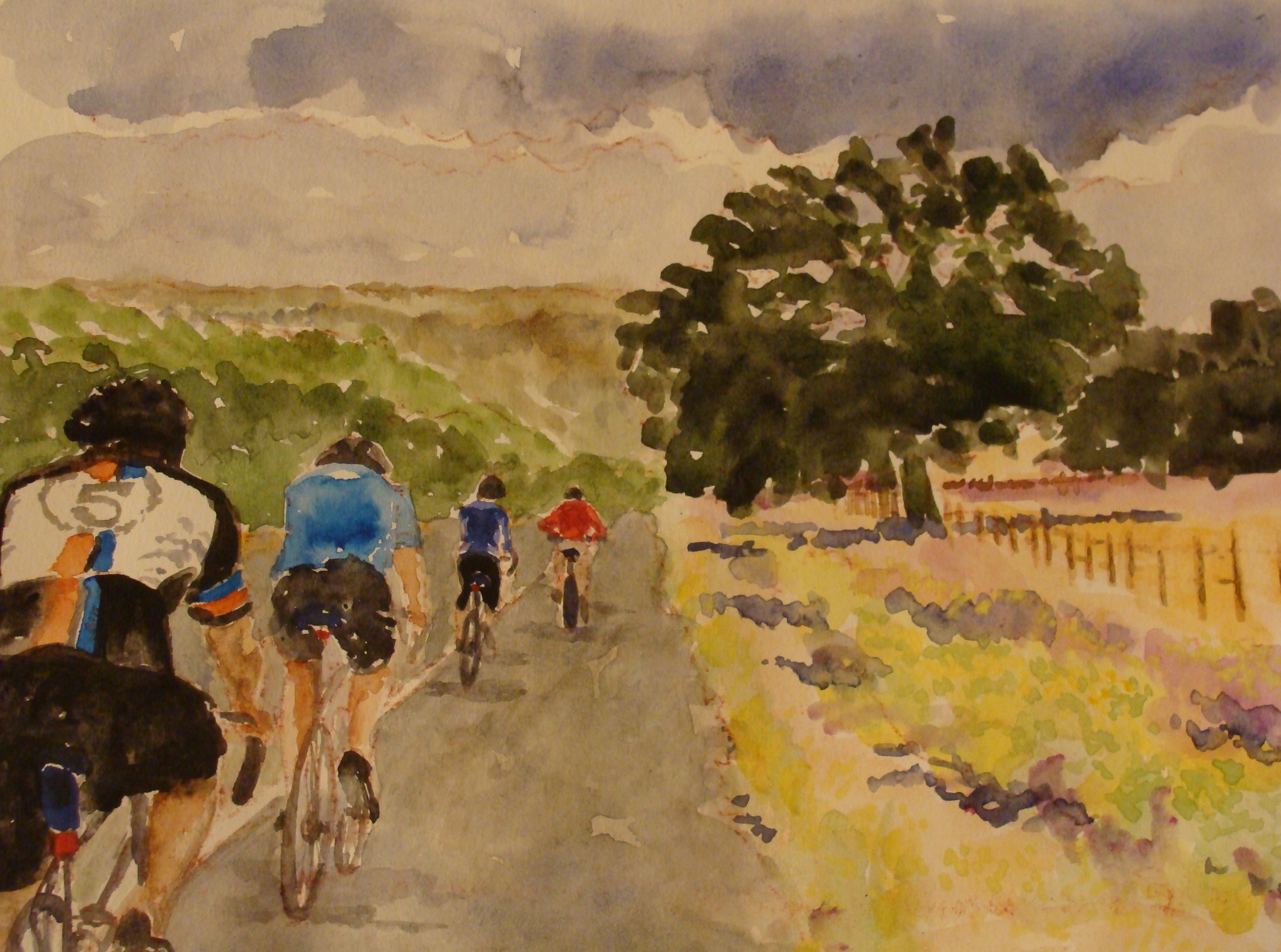
Day 3: King City to Paso Robles; starting up Quadbuster. Copyright Robin L. Chandler 2014
In Shambhala: The Sacred Path of the Warrior Chogyam Trungpa wrote “the essence of human bravery, is refusing to give up on anyone or anything….and the master warrior is extremely humble….humbleness comes from working with others…to give space and time to others to develop their own understanding of goodness and of warriorship…patience is extending gentleness and faith to others all the time.” The warrior possesses faith in the basic goodness of others, a fearless expression of gentleness and genuineness on behalf of all sentient beings, and understands that tenderness comes from strength…stable, solid and true. Yesterday, I reconnected with friends and fellow travelers riding in the AIDS LifeCycle 2014 contingent of the San Francisco Pride parade. The Ferry Building behind us, we cyclists, some two hundred strong, rolled out on to Market Street just behind the roaring engines of our beloved Dykes on Bikes. Peddling through the cheering crowd lining the route, my tears and laughter surfaced. On our helmets and bikes we all wore the number 1371 for Edna Flores-Lagunte, ALC rider, fundraiser, training ride leader and roadie, who sadly passed away this year on this her 13th LifeCycle. Edna was a warrior on the sacred path; she was loving, generous, joyous and so committed to helping others. Edna changed lives making them better. During the seven days riding from San Francisco to LA, I kept hearing the mantra “this ride will change your life.” By the time we left San Francisco on June 1, it already had. Physically stronger and mentally more disciplined than a year earlier, I had also deepened friendships through honest conversations that happen during a long-distance training ride. But my most important life insight was yet to be revealed. Cycling 545 miles opens your eyes and your heart to yourself and to others. During the ride, I learned that tenderness grows from strength. With strength, I changed a rider’s flat tire when I worried I’d be sagged. With strength, I helped a tired rider set-up their tent when I was hungry. With strength, I let a weary rider take a hot shower before me when I was cold. And perhaps most importantly, with strength, I aspire to be as loving, generous, joyous and committed a person as Edna.
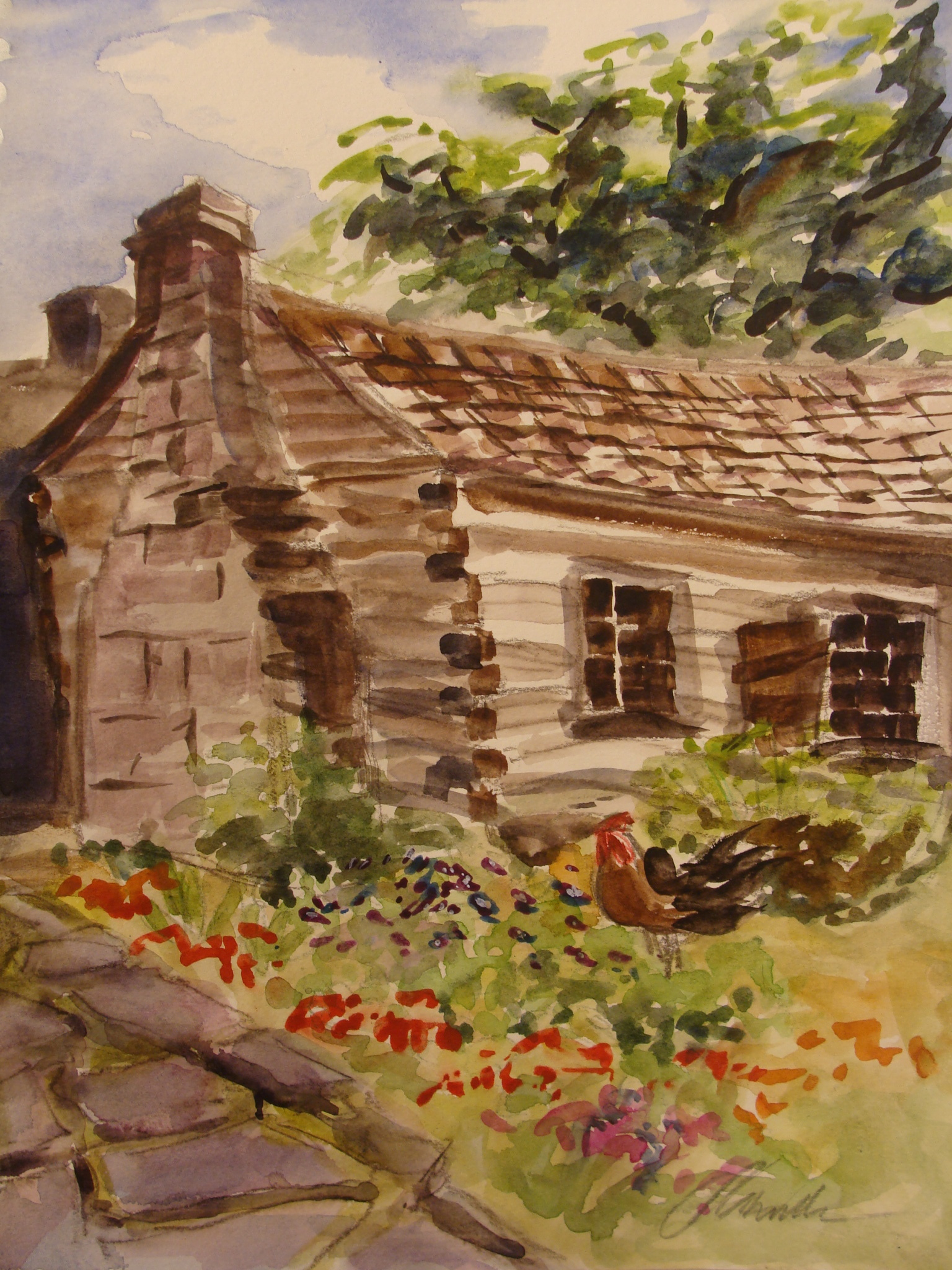
Moore-Hancock Farmstead log cabin Austin, Texas. Copyright Robin L. Chandler 2014.
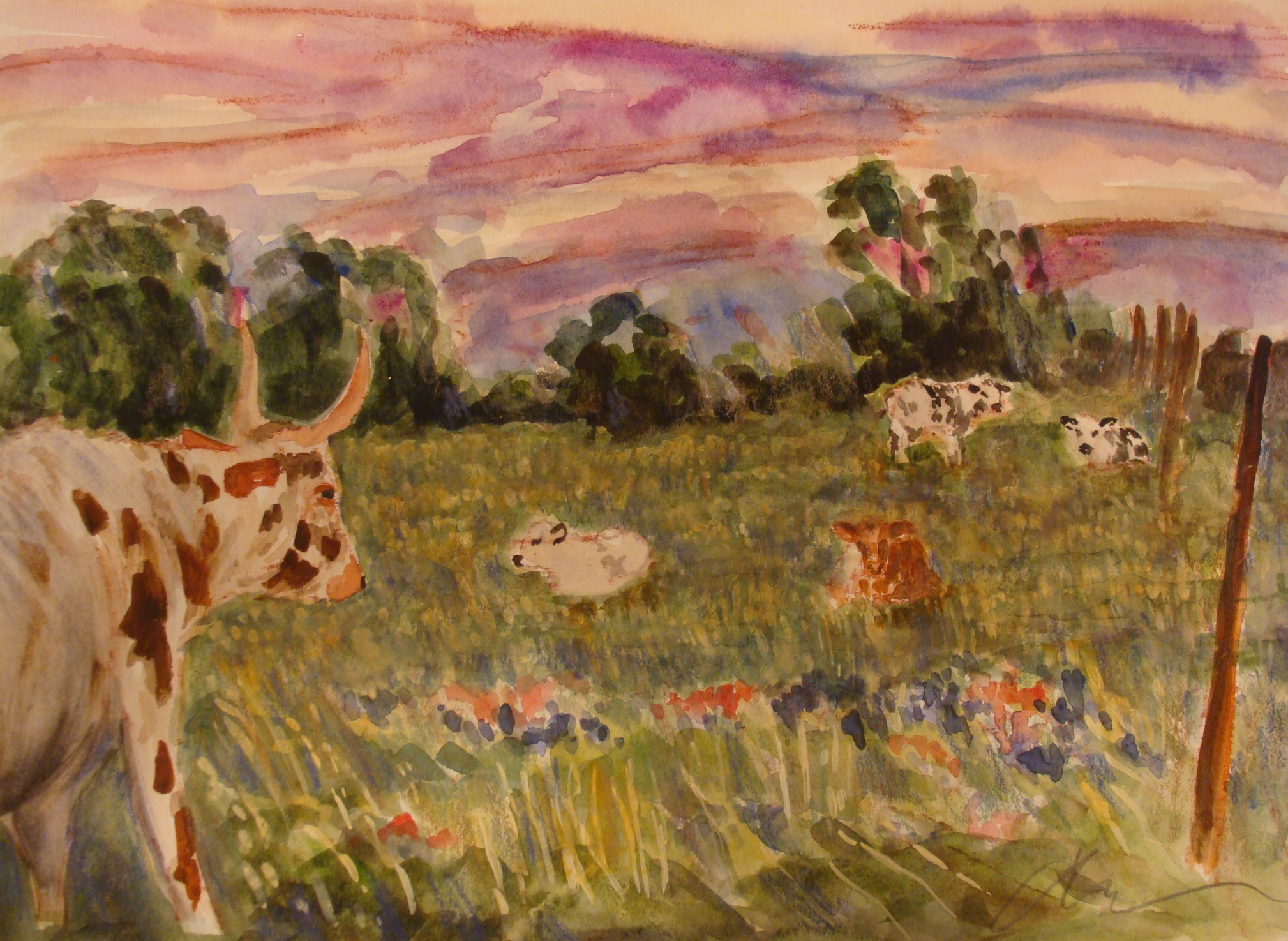
In just under thirty-three days, the AIDS LifeCycle begins and we ride from San Francisco to Los Angeles. Cranking up the training, I’ve been riding some classic climbs in the Bay Area: Pinehurst to Skyline, the Three Bears and the Hicks Valley Wilson Hill Road. But recently I took a break to visit Austin, Texas the home of former Governor Ann Richards[1]. Austin hosted the Society of Architectural Historians (SAH) annual meeting. It doesn’t take much arm twisting to visit the queen city of Central Texas. Because in Austin you can easily find great music (we saw Squeeze Box Mania at Threadgills which featured the great conjunto tejano accordianist Joel Guzman and songwriter / vocalist Sarah Fox), local brews (Thirsty Planet’s Yellow Armadillo Wheat) and Southern comfort food (fried pickles)! And April is a beautiful time to visit Texas. Bluebonnets and Indian Paintbrush nonchalantly grace street corners and boulevard median strips. And a quick drive outside the city limits brings sights of mother Longhorns doting on their calves frolicking in pastures among the spring wildflowers. A meeting like SAH provides the opportunity to dig deeper into the urban landscape and we participated in the post-conference tour Transition, Gentrification and Hidden History in Austin’s Black Neighborhoods. When the Civil War ended in 1865, many freed slaves migrated to the nearest town where they settled and established neighborhoods such as Austin’s Clarksville and Wheatville. Some freedman like Orange Hancock settled on land formerly
Longhorns, Bluebonnets, and Indian Paintbrush. Copyright Robin L. Chandler 2014.
owned by their masters such as the Moore-Hancock Farmstead. Built in 1849, the Moore- Hancock home is the oldest Austin log cabin on it’s original site and a tangible link to 19th century African-American history in north-central Austin. The Freedmen communities thrived until 1928 when the Austin City Master Plan achieved segregation by zoning East Austin as a district where services and amenities such as plumbing and paved roads would be provided to African-Americans. With this zoning plan, Austin sought to draw African-Americans to the East side of town and extinguish black neighborhoods encroaching on expanding white Austin. Some eighty-years later, East Austin is gentrifying as popular food venues such as Franklin Barbecue have opened (just down the street from the historic Chitlin’ Circuit nightclub the Victory Grill where one of my favorite blues players W.C. Clark got his professional start) and the Rosewood Courts Housing Authority seeks a listing on the National Register of Historic Places. To learn more about these neighborhoods, read Michelle Mears book And Grace Will Lead Me Home: African-American Freedman Communities of Austin, Texas 1865-1928.
Strawberry fields along San Andreas Road. Copyright Robin L. Chandler 2014Egret on Elkhorn Slough. Copyright Robin L. Chandler 2014Crossing the Pajaro River. Copyright Robin L. Chandler 2014Monterey Bay from Fort Ord State Park. Copyright Robin L. Chandler 2014
My training for the 2014 AIDS Life Cycle continues! It is the end of March, and just last week I achieved this month’s goal to cycle more than ninety miles in one day. It was an amazing day beginning in heavy fog and ending in bright sunshine and strong winds blowing in from the Pacific; a beautiful ride, the kind of ride that clears your head and helps put everything in perspective, well at least for a few moments! My journey took me from Santa Cruz where I cycled past surfers at Pleasure Point, through redwood trees in Aptos, along the nature reserve at Elkhorn Slough, and through Fort Ord Dunes State Park and on to fisherman’s wharf at Monterey. My good friend Connie joined me for the Castroville to Monterey loop; it was wonderful to have the company and conversation. After lunch, I got back on my bike and rode the fifty miles home to Santa Cruz. It can be done!
Cycling gives you time to think about what you see as you ride. North of the Pajaro River I travelled through strawberry fields; north of the Salinas River through rows of artichokes, all crops being irrigated and tended by hard working Mexican-American farm workers. Every March 31st in California we celebrate the birthday of Cesar Chavez as an official state holiday. It was nearly fifty years ago when Cesar Chavez came to Delano, California to begin the dangerous but desperately important work of organizing farm workers. In 1935 the Wagner Act establishing the National Labor Relations Board (NLRB) was passed by the U.S. Congress and signed into law by President Franklin Roosevelt. The NLRB ensures that workers can join unions and engage in collective bargaining without management reprisal. But unfortunately, agricultural workers were not included in the Wagner Act legislation, an omission that took another thirty years and Cesar and his wife Helen Chavez and Delores Huerta, labor leader, civil rights activist and co-founder with Chavez of the United Farm Workers (UFW) devoting themselves to the cause of organizing farm workers to rectify. The multi-ethnic movement Si se puede began in 1965. On Friday March 28, 2014, Diego Luna’s motion picture Cesar Chavez was released nationally. With great excitement, Wave and I attend the film; it was wonderful to be in the theater with so many young people clearly moved by their heroic story on screen. The film was inspiring; the hard work of farming becomes a tragedy when workers responsible for putting the food we eat on the table are not given respect, consideration, a reasonable wage, and protection from agricultural pesticides. The film primarily documents the events surrounding the Delano Grape Strike (la huelga) including the three hundred mile pilgrimage from Delano to the state capital in Sacramento and Chavez’s moving hunger strike to end violence against striking workers. The twenty-five day hunger strike ended in March 1968 some forty-six years ago this month. Senator Robert Kennedy brought national prominence to the movement when he joined Cesar Chavez to end his hunger strike with a celebration of the Eucharist. In my mind, Kennedy’s presence was a recognition of Chavez as an American hero. Chavez’s heroic work is detailed in two University of California Press books: Delano – The Story of the California Grape Strike by the journalist John Gregory Dunne and in Peter Mathiessen’sSal si Puedes: Cesar Chavez and the New American Revolution
A traveller walking the Monterey coastline. Copyright Robin L. Chandler 2014.
Santa Cruz ahead and Monterey behind, we cycled through coastal farmland on yet another rainless winter day a couple of weekends ago. Here in drought stricken California, the Monterey Bay shimmers beside us and the air is sweet, replenishing my body with every breath. It is nearing the end of a sunny day, high clouds above us, but distant hills are taking on a hazy quality and we are glad it’s only a few more miles to retrieve our cars. I feel a strange guilt and paradox. It is beautiful, but it should be raining. We are training for the Strawberry Fields Forever ride, a fundraising event sponsored by Cyclists for Cultural Exchange dedicated to the “express purpose of furthering peace and international understanding through exchanges between people with a common interest in cycling.” An unusual and wonderful goal! As happy as riding makes me, I am nagged by the lack of rain. We need a strong steady downpour to quench this parched land. My mind jumps months on the calendar knowing I’ll be cycling some of these same roads in June when more than two thousand of us ride in the AIDS/Lifecycle from San Francisco to Los Angeles. Excited about the long journey in June and that my fundraising is helping people with HIV/AIDS, I know the route to Los Angeles will take me through my beloved golden brown California landscape. Oh, but how I hope we get more rain and soon.
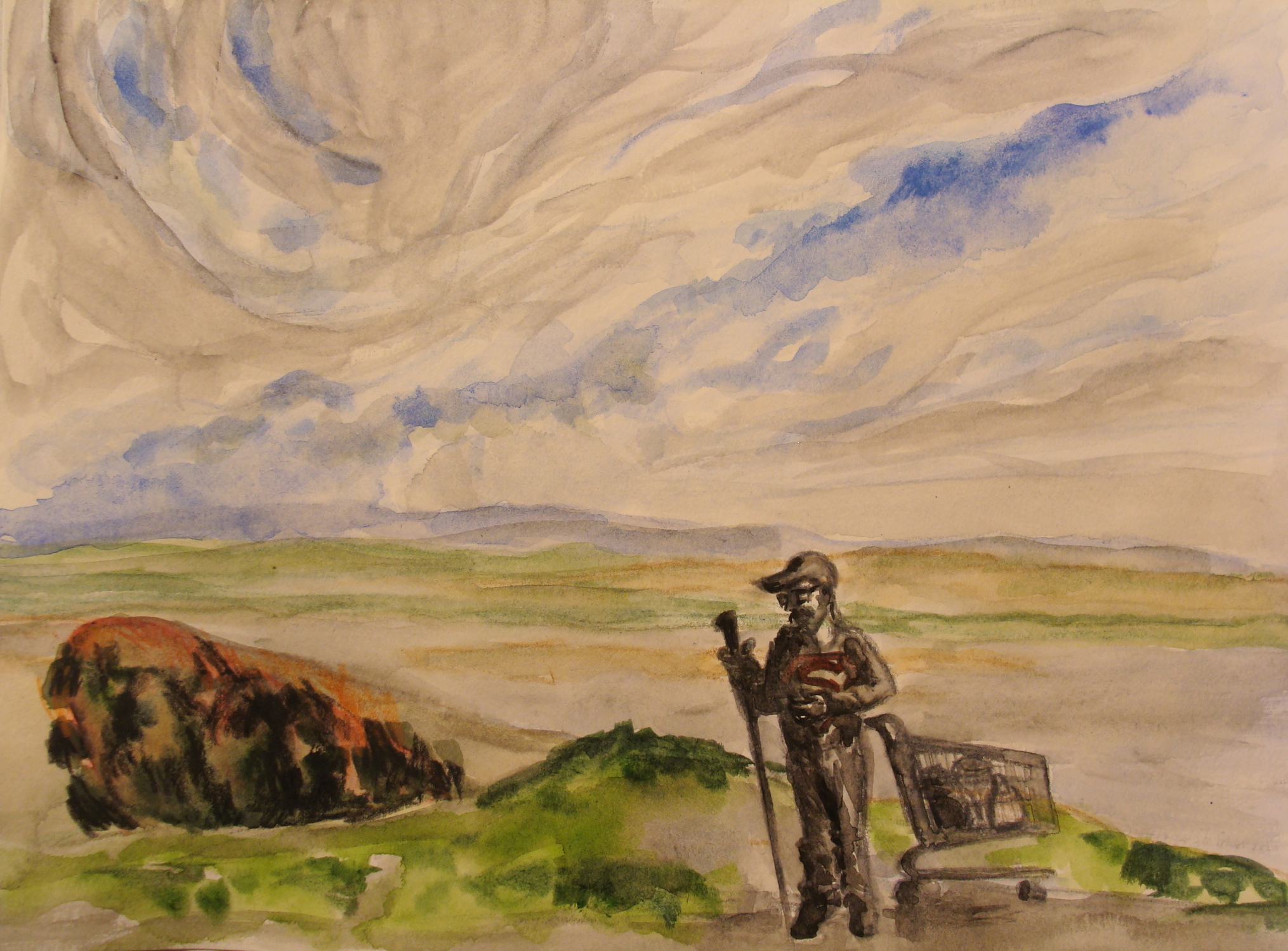
Putting those thoughts aside, I reach the crest of a small hill. About a mile ahead, a man, dressed in black, is pulling a shopping cart; a mystery considering there is no grocery store in sight for miles…no strip malls, box stores, houses or anything of the kind remotely close. The rich farming fields of Monterey County envelope us, a land where artichokes, broccoli, cauliflower, spinach, and strawberries grow readily. Reaching his side, I note his tiredness and resignation, but I grasp this young man in his dirty Superman t-shirt is on an epic journey. He is not homeless, he is without home. Hoping my last Clif Bar will ease some of his sadness, he tells me his name is Lawrence. He describes leaving San Diego some weeks ago, “Life got messed up. It was time to walk…walk a long time…leave it all behind me…I’m going to Washington State. The walk will make it better. But Big Sur was rough. I barely survived.” Reaching into my pocket, I pull out a twenty, giving it to him as I shake his hand hoping the gesture will get him a little farther down the road and a few steps closer to finding home. I wish you well Lawrence wherever the road takes you.
It was time to return to my own odyssey. As my bike put space between us, I began to sing Bob Dylan’s Farewell, a tune lingering with me since seeing the Coen brother’s Inside Llewelyn Davis.I hope Lawrence strikes it lucky on the highway goin’ west.
“Oh it’s fare thee well my darlin’ true,
I’m leavin’ in the first hour of the morn.
I’m bound off for the bay of Mexico
Or maybe the coast of Californ.
So it’s fare thee well my own true love,
We’ll meet another day, another time.
It ain’t the leavin’
That’s a-grievin’ me
But my darlin’ who’s bound to stay behind.
Oh the weather is against me and the wind blows hard
And the rain she’s a-turnin’ into hail.
I still might strike it lucky on a highway goin’ west,
Though I’m travelin’ on a path beaten trail.
So it’s fare thee well my own true love,
We’ll meet another day, another time.
It ain’t the leavin’
That’s a-grievin’ me
But my darlin’ who’s bound to stay behind.
Sunrise at Montserrat Abbey. Copyright Robin L. Chandler 2014.
No matter where you find yourself, walking or cycling connect you to place. On foot or on a bike, life slows down and ceases to rush by in a blur. The smells, tastes, sounds, and sights of a landscape can be discovered, lingered over, and remembered. This rings true in both urban settings and the countryside where the aroma of paella cooking, the taste of locally made vermouth, the sound of church bells ringing, or the sight of the remaining fall leaves colorful against a winter sky are savored and stored like Proust’s memories of things past. Or as the landscape writer and teacher, J.B. Jackson wrote in his essay Sense of Place, Sense of Time the atmosphere…the quality of the environment…have an attraction…we want to return to, time and again.” So, after days of walking and gathering our own observational data about Barcelona, we set out to walk in some of Catalonia’s regions known as comarcas.
In the comarca of Pla de Barges, home to cava grapes, we arrived at Catalonia’s iconic mountain Montserrat to visit the Benedictine abbey Santa Maria de Montserrat in which the Mare de Deu de Montserrat – the black Madonna known as La Moreneta – greets pilgrim’s seeking to touch her hand to receive her blessing. The Montserrat range is Spain’s first national park and features formations composed of pink conglomerate and limestone rock visible from a distance as serrated ridges. The park draws hikers, rock climbers, nature lovers, tourists, and pilgrims to traverse the park’s miles of trails. On clear days visitors can see Mallorca one of Spain’s Balearic Islands in the Mediterranean; unfortunately for us, it was hazy. At sunrise the rocks and abbey are bathed in pinks and oranges and the Llobregat river valley below the mountain is covered with a blanket of fog. The Llobregat river flows from the Pyranees to enter the Mediterranean at Tarragona, the Roman imperial city of Iberia. The mountains above the abbey host chapels and the ruins of hermitages dating back over ten centuries. We walked the Cami de Sant Miquel through a Mediterranean Oak forest to Sant Joan’s chapel, the hermitage of Sant Onofre and the Stairway of the Poor. On the trail to the hermitage, I was moved by the stones worn smooth by centuries of pilgrims climbing the trail. My thoughts travelled to the Zen Buddhist, Matsuo Basho, the great master of haiku who wandered Japan writing poetry during the 17th century. Bashho drew inspiration from his environment, capturing his experience beautifully in a few short lines. Reaching the summit, I heard the abbey’s bells ring the quarter hour hundreds of meters below.
Sunset at La Rectoria de Sant Miquel de Pineda. Copyright Robin L. Chandler 2014.
Later in the trip, we visited the volcanic comarca of La Garrotxa, staying at the lovely bed and breakfast La Rectoria Sant Miquel de Pineda beside a restored 12th century chapel situated on the Ruta del Carrilet part of the itinerannia, a network of historical paths connecting three comarcs: El Ripolies (Pyranees mountains), La Garrotxa (the volcanic park) and L’Alt Emporda (rolling hills teased by the offshore dry, cold Tramuntana wind ). This network of trails is ideal for avid hikers and mountain bikers who enjoy exploring nature, touring farms, and sampling local cheeses, hazelnuts, pinenuts, honeys and breads, as well as learning about the history of the area. We walked the path leading to La Rectoria once the bed of the narrow gauge railroad connecting the ancient cities of Girona and Olot. We also explored the cobblestone alleys of the medieval towns of Besalu and Sant Pau discovering the traces of Jewish communities tragically expelled by their majesties Ferdinand and Isabella’s Alhambra Decree in 1492 after the Reqonquista of Muslim Iberia in 1491. We visited these towns on the celebration of Treis Reis (Three Kings day) or the Epiphany, when the Magi visited the infant Jesus celebrating the revelation of the Son of God as a human being. Parades arrived at the main town plaça where the Kings presented gifts to eager children and on January 6 we ate the Tortell de Reis. Each night at dinner our host Roy Lawson and his wife Garrotti created delicious meals featuring fare from local farms including haricot beans, truffles, goat cheese soufflé, and buckwheat pancakes. Roy and Garrotti’s hospitality, comfortable and welcoming accommodations, fabulous food are a must if you are travelling in Catalonia; and the people you meet at their B & B are great! Roy and Garrotti also have a blog for La Rectoria.
And then we came home and began thumbing our new Catalan cookbook!
Sketch of Salvadore Dali statue in surreal Cadaques, Catalonia. Copyright Robin L. Chandler 2013.
Maybe it’s gravity, centrifugal force, or just the force of my own nature, but I always find a comfortable place to anchor, while traveling amongst the new. No surprise confession here, but I love comfortable places where friends talk over wine and beer, and in Barcelona, I will add Els Quatre Gats to my list. Of course given my current obsessions with cycling, it helps a lot that the café features a mural size art nouveau style painting of two cyclists on a tandem by Ramon Casas. Opened in 1897, Els Quatre Gats was a home to the artists and intellectuals participating in Barcelona’s Modernisme movement. It was a favorite place of Picasso, who came to Barcelona to study painting, laying the foundation for his Blue Period. Picasso had strong connections to this region, personally requesting that the Museo Picasso be built in Barcelona. Over glasses of cava and grilled calamari, we talked about our day visiting the northern Catalonia towns of Figures, Cadaques and Port Lligat on the “Salvadore Dali Trail,” and mused about the two artists and their context within the Spanish Civil War.
Painted in 1937, Picasso created Guernica in response to the then recent bombing and destruction of the Basque village by German and Italian warplanes allied with Franco’s forces fighting the Spanish Republic’s Popular Front. Guernica was first exhibited in June 1937 at the Paris International Exposition by the Spanish Republican Government and then travelled to England and the United States with the hope of raising awareness and sympathy for the elected government of the Spanish people. Picasso, who died in 1973, never returned to Spain while Franco was dictator.
Sketch of harbor near Dali’s home in Port Lligat, Catalonia. Copyright Robin L. Chandler 2013.
In 1936, Salvador Dali painted Soft Construction with Boiled Beans(Premonition of Civil War). Known as a Surrealist, Dali worked in what he described as the paranoiac critical method to access the subconscious for greater artistic creativity. While sketches for the painting are dated to 1934, Dali felt the painting described the many hardships endured by Spaniards during the Spanish Civil War. In 1934, Dali was expelled from Surrealism by Andre Breton and the other Surrealists allegedly because of his ambiguous position on the relationship between politics and art. Dali returned to Spain in 1949, living in Port Lligat until his death in 1989 fully embracing Franco’s dictatorship.
Sunset on Monterey Bay from the UC Santa Cruz bike path. Inspired by the artist Doug Ross. Copyright Robin L. Chandler 2013.
Lately, cycling has taken a prominent place in my life; it obsesses my thoughts and it floats through my dreams. I continually cruise peoples’ bikes comparing brands and components; I obsessively monitor my tire pressure; free moments catch me surfing the internet planning road rides; and sometimes in sleep I am climbing the Col du Tourmalet in the Pyrenees and see myself flying downhill, joyously singing, alive, transcendent. Cycling is my primary transportation to work in Santa Cruz and I love everything about it: my breath hanging in the cold morning air; the golden sunrise dancing on the waves; the smell of sardines in the harbor; the cormorants drying their wings at the mouth of the San Lorenzo; the sight of the Big Dipper at the Boardwalk; the red-shouldered hawk’s cry piercing the still meadow; and the steady rhythm of my heart. I’ve even come to humor the stiffness in my cranky knees. But lately, cycling has also become poignant. Riding has become a ritual of honor, an epic poem of remembrance, my song of mourning.
Every year the AIDS Lifecycle, the 545-mile weeklong bike ride from San Francisco to Los Angeles begins with a ceremony featuring the poignant entry of the riderless bike. The entourage escorting the bike includes self-identified HIV positive cyclists calling themselves the Positive Peddlers; the ritual honors those who have passed and those who are so ill they cannot ride. In the 1990s, I worked with a wonderful man and archivist named Willie Walker. A nurse on the SF General Hospital AIDS Ward, Walker, when he realized gay history was becoming a victim of the AIDS epidemic, founded the Gay, Lesbian, Bisexual and Transgender (GLBT) Historical Society of San Francisco, along with Alan Berube, Estelle Freedman, and several others. Walker was also the project archivist for the UC San Francisco (UCSF) Library AIDS History Project. During the 1990s, Walker was my colleague and friend when we collaborated at GLBT and UCSF. In June 2002, I did my first AIDS cycling event, the European AIDS Vaccine ride. This month, I registered to make this epic journey again. In June 2014, I will ride in the AIDS Lifecycle to raise money to help persons living with AIDS and HIV and to honor friends I have lost. We lost the generous, loving, and dedicated Walker several years ago, not to AIDS, but to other natural causes. But on the road to Los Angeles, I will honor and remember Walker and how he fought AIDS by keeping history alive.
A ghost bike is a bicycle painted white, serving as a roadside memorial when a cyclist has been injured or killed by a motorist. It is hoped that the memorial will remind drivers to slow down, share the road, and fully grasp the potential destructive capacity of the vehicles they drive. In early November, we lost Josh Alper while he was cycling north of Santa Cruz on Highway One. Josh was beloved by so many; he brought us music, humor and such sweetness. He was also so earnest about helping students and faculty at the UCSC Library. When shopping for a new bike, I purchased my new wheels at Santa Cruz’s Spokesman on Josh’s recommendation. Josh was a gearhead about bikes and Spokesman is a bike shop with a tip-top crew of gearheads; they, like Josh, know their stuff. From talking to Josh, it was clear he loved riding, building and maintaining his bike. He was also devoted to the history of the sport. Waiting in line for coffee, he often spoke to me about his deep respect for Greg LeMond, three-time winner of the Tour de France and the only American to win this epic contest. He urged me to read Slaying the Badger: Greg LeMond, Bernard Hinault, and the Greatest Tour de France; he loaned me his copy so I could understand the now mythologized rivalry between teammates LeMond and Hinault. In honor of Josh, the Spokesman bike crew assembled the ghost bike, one of many memorials to this young man. You are greatly missed Josh, and always will be. In early 2014, I will ride with other cyclists to honor, remember and mourn Josh as we escort his ghost bike to its final resting place.
Homer’s poetic narrative of the Trojan War, The Iliad ensures immortality for Achilles and his fellow warriors. Inscribing their glory in battle, their deeds live on, honored in perpetuity. In Ancient Greece, the recitation of the epic poem was an act of remembrance, honoring the glory of warriors. In 21st century California, with the act of cycling, I will honor, remember, and mourn the glory of lost comrades.
Quaking Aspens on Rock Creek in the Eastern Sierra. Copyright Robin L. Chandler 2013
October’s government shutdown locked us out of our national parks. Fortunately, national forests are nearly impossible to fence in. Forest rangers closed visitor centers, but they could not padlock our public lands. The indifference, lack of connection, and abstract selfishness of a political minority – disregarding communities beyond their voting district – blocked passage of a federal budget, keeping government workers from their jobs – in this case stewardship of our natural resources – and held our country hostage, reeking havoc with local economies, such as businesses dependent on tourists to our national parks. Flouting our temerity, we voted with our feet gaining access to our birthright, our public lands. Entering Inyo National Forest, we found welcome amongst the wilderness of trees in the Eastern Sierra and Great Basin Desert, trees, blessed by their ignorance of Washington, D.C.’s theater of the absurd. I photographed our journey in addition to the watercolors in this blog entry.
Ancient Bristlecone Pines on the White Mountains. Copyright Robin L. Chandler 2013
When its fall in the Eastern Sierra, trees dress in dramatic and painterly yellows and gold accented now and then with a touch of red and orange. Near sagebrush scrub in the yellow pine belt bioregion found at approximately 7,000 feet above the sea, the yellowing leaves of black cottonwoods are jewel-like on the landscape. Thriving on moisture, the cottonwoods grow where their roots find water near lakes, meadows, springs, and mountain streams. Higher in the Sierras, in the 9,000 – 11,000 foot elevation range, forests of jeffrey and lodgepole pines, red fir and western junipers are found, as well as stretches of quaking aspens, simply breathtaking to behold. Finding water amongst rocks at cliff bases, these trees sparkle in the sunlight, and the wind reveals their white trunks and stirs leaves in a continual flutter. Farther East in the Great Basin Desert, the White Mountains host magnificent ancient bristlecone pine forests. Methuselah, the oldest tree on earth, estimated at over 4,750 years in age, thrives in this arid, exposed landscape, requiring minimal water and finding just enough nutrients in the dolomitic and alkaline soils where few other trees can flourish. Keeping only essential parts alive during times of stress, the living tree is dressed in dead branches, made smooth over time by the forces of wind, ice and fire. The sculptural bristlecone pines seem to form a community of dancers moving nominally in a minimalist ballet for the ages. The beauty is sublime; this place opens our living souls and we are filled with affection.
For this trip, my book of choice was AGreat Unrecorded History a biography of one of my favorite writers, E. M. Forster, written by Wendy Moffat. In 1909, just days after reading Walt Whitman’sLeaves of Grass, an inspired Forster sketched out the entire concept of one of his finest works, Howard’s End. Published in 1910, Forster explored several themes including developing urban industrial spaces juxtaposed with a rapidly eroding English countryside, and the human need toconnect. A century later, Wendell Berry, who like Forster appreciated the value of community and place, was honored to give the 2012 Jefferson Lecture in the Humanities, which he titled It All Turns on Affection. Informed by Forster’s Howard’s End, Berry described the need for integrated local economies connecting cities with their surrounding rural landscapes “to bring producers and consumers…back within the bounds of the neighborhood…[within] effective reach of imagination, sympathy, affection…[gaining] a measure of security that cannot derive from a national or global economy controlled by people who, by principle have no local commitment.” In his talk, Berry described Forster’s foresight: “the existence of small farms were limited and that an industrial ugliness, was creeping out of the cities and into the countryside, and that this ugliness was characterized by the withdrawal of affection from places.” In Howard’s End climactic scene Margaret Schlegel talks to her husband Henry Wilcox, “a plain man of business who sees life realistically with a hardness of mind and heart only because it is expedient and because it subtracts from reality the life of imagination and affection, of living souls.” Margaret tells Henry “it all turns on affection now…affection. Don’t you see?”
In Song of Myself a poem from Leaves of Grass, Walt Whitman penned the line “the press of my foot to the earth springs a hundred affections.” May our political leaders in Washington remember their actions impact places and persons across our nation and the world. As they do their work, may they walk with affection, understand their commitments, and not trample – drunk with power – the places and communities – in the lands just beyond their own.
Young deer in the Santa Cruz meadow. Copyright 2013 Robin L. Chandler.
UC Santa Cruz is a special place; where else would you find a traffic sign flashing bright orange “be alert…deer crossing the roadway.” Cycling into work, I laughed lovingly acknowledging both the practical advice and the deeper meaning of mindfulness. Situated on a mountain overlooking the Pacific, the campus is replete with rolling meadows and coastal forests of tanoak, bay laurel, Pacific madrone and the regal Redwoods. An ecosystem intimately shared by animals, plants and people. After a quiet summer, September signals major events in certain campus populations: the academic cycle migration of homo sapiens and the advent of the breeding season for California mule deer. The traffic signal brings some needed intervention to manage the humans and deer inhabiting this space. All summer the bucks have roamed the meadows as a herd while their antlers grew big and strong preparing to compete for a mate. Next spring, fawns begin the cycle anew. Riding up the bike path through the thirsty meadow, I wonder from where the mountain lion watches these migrations and lifecycles. Will I ever see one?
Right mindfulness, an element of the Buddhist eight-fold path, teaches adherents to be alert, present, building awareness of the moment…the path to enlightenment. Earlier this year, I received a gift from the wife of a landscape painter whose work I greatly admire; she connected me to the work of Peter Matthiessen, Buddhist and writer of fiction and many well-respected books about the environment including the National Book Award winner The Snow Leopard. Trekking through Nepal with the ancient Buddhist shrine Shey Gompa on Crystal Mountain as their destination, Matthiessen and the field biologist George Schaller were seeking research data on the Blue Sheep and the Snow Leopard. Truly a book about his spiritual journey, Matthiessen finds the revered Lama of Shey who blesses him with a koan “Have you seen the snow leopard? No. Isn’t that wonderful!” Matthiessen writes “I feel great gratitude for being here, for being, rather for there is no need to hike oneself to the snow mountains in order to feel free. I am not here to seek the “crazy wisdom;” if I am, I shall never find it. I am here to be here, like these rocks and sky and snow, like this hail that is falling down out of the sun…the absurdity of a life that may well end before one understands it does not relieve one of the duty (to that self which is inseparable from others) to live it as bravely and generously as possible.”
It is the season when deer are on the minds of many. Last weekend we attended the fundraiser for the journal West Marin Review held by Point Reyes Books. Two great women poets read from their work: Kay Ryan and Jane Hirshfield and ironically among the many poems they read, they both chose to read works about deer. Selecting a poem from her book The Best of It, Ryan read “a buck looks up: the touch of his rack against wet bark whispers a syllable singular to deer; the next one hears and shifts; the next head stops and lifts; deeper and deeper into the park.” Hirschfeld choose a poem from The Lives of the Heart and read “a root seeks water. Tenderness only breaks open the earth. This morning, out the window, the deer stood like a blessing, then vanished.”
Swanton Pacific Ranch. Copyright 2013 Robin L. Chandler
June and we are blessed again with strawberries. It’s after 5:30PM when I leave work, but the summer sun remains sky high moving towards the solstice. Driving north from Santa Cruz towards Davenport, the Pacific flashes brilliantly on this clear and hot day; along the coast farmers are irrigating their crops. The infinite horizontality brings mindfulness; the day falls away and clarity about the scheme of things returns. Listening to the Blessed Are album, and I find the Woody Guthrie track Deporteeand I softly sing with Joan Baez:
Is this the best way we can grow our big orchards? Is this the best way we can grow our good fruit? To fall like dry leaves to rot on my topsoil. And be called by no name except “deportees.”
Swanton Berry Farm is my destination. Founded in 1989 by UC Santa Cruz graduate Jim Cochran, Swanton’s is the first commercial organic strawberry farm in California; it is also the first certified organic farm in the United States to sign a labor contract with the United Farm Workers (UFW). The farm stand, where I purchase my two pints of bright red strawberries, proudly displays the UFW flag bearing the black eagle on a field of red. The UFW was formed as a result of Cesar Chavez’s organizing of Mexican-American and Fillipino American farmworkers to engage in boycotts, hunger strikes and strikes (all based on pacifism) to gain their rights. The successful 1965 Delano grape strike is the most famous effort. The strawberries are amazing; a delight to see, smell, and taste the sweet and tart delight grown in the sandy soils of the coastline routinely kissed by the sea air. Last year, when Irene Reti’s & Sarah Rabkin’s oral history Cultivating a Movement was published, I read about Jim Cochran’s sustainable practices. Jim described using the Brassica family of plants— broccoli, cauliflower and mustard greens— in crop rotation to improve soil health instead of traditional strawberry farming practices using methyl bromide and Chloropicrin to kill soil disease. At Swanton’s you will never see the plastic covering the fields of commercial growers, indicating chemical fumigation is underway.
This month is also the 38th anniversary of the California Agricultural Labor Relations Act that became law on June 5, 1975 giving farm workers the right to collective bargaining and ensuring “peace in the agricultural fields by guaranteeing justice for all agricultural workers and stability in labor relations.” The act allowed union organizers to meet with farm workers in the fields and for farm workers to select representation by unions such as the UFW to engage in collective bargaining to negotiate conditions of employment.
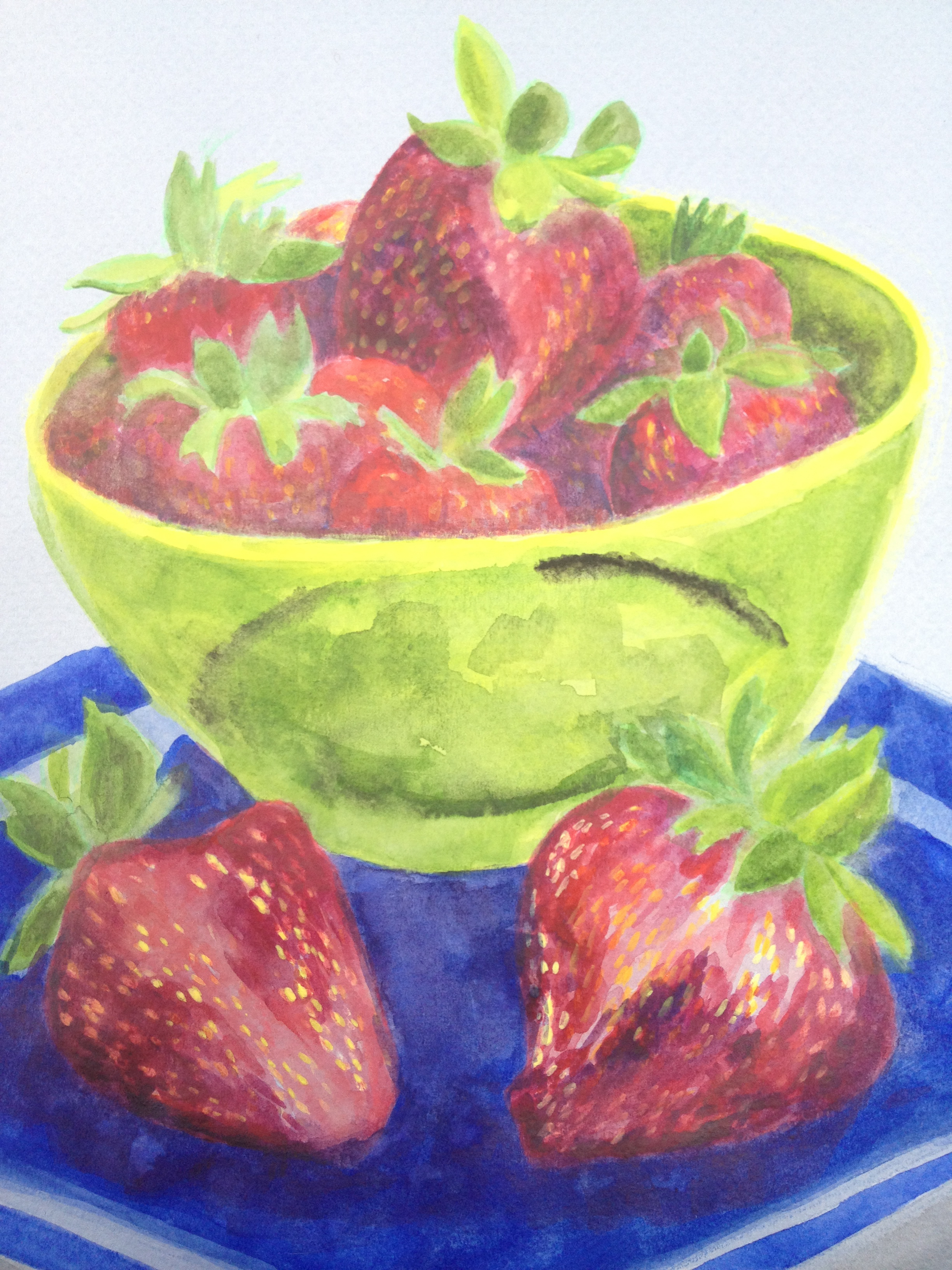
Strawberries. Copyright 2013 Robin L. Chandler
After purchasing my strawberries, I drive out Swanton Road a beautiful loop curving through the Swanton Pacific Ranch, crossing Scott Creek a riparian corridor for Coho Salmon and Steelhead Trout, and winding through forests of Redwoods, Douglas Fir, and Monterey Pine. Surfers say the waves where Scott Creek estuary greets the ocean are the same as Swami’s Beach in San Diego County. The Ranch is beautiful. The furrows nestled amongst the coastal ecosystem; mankind’s geometric abstractions seeking to tame the wilderness topography. Recently I learned about the plein-air painter Sheridan Lord whose inspiring works are with us in the book Things in Place. Sheridan’s farm paintings are pictures “of breathtaking simplicity: the whole surface is occupied by the towering sky and broad fields, which are separated by a mere strip of trees.” Lord’s paintings evoke the environmental writer Peter Matthiessen who quotes the Ojibwa people in his book Nine-Headed Dragon River writing “sometimes I go about in pity for myself, and all the while a great wind is bearing me across the sky.” Mindfulness is found in many ways: in a song, in a vista, in a painting, in a koan, or in a strawberry.






 alive in the sea of information