a land apart

Foxtail Pine along the Cottonwood Lakes Trail. Robin L. Chandler, 2024

“Over that [1929] summer, [Georgia] O’Keefe worked her way through the standard paintings of santos, Ranchos de Taos church, and Taos Pueblo itself, but hints of her later work appeared as well. Particularly in a series of paintings of penitence crosses against a backdrop of a southwestern night sky, O’Keefe illustrated the spiritual inspiration she found in the New Mexico landscape. Perhaps the best-known painting from the summer, however, is The Lawrence Tree…..O’Keefe described the painting…..’I had one particular painting, that tree in Lawrence’s front yard as you see when you lie under it on the table with the stars it looks as tho it is standing on its head.’…..the work shows O’Keefe’s sensual appreciation of New Mexico as well as her engagement with [D. H.] Lawrence‘s writing. Lawrence had described the tree himself in St. Mawr, and Lawrence’s work remained in O’Keefe’s library throughout her life. Although Lawrence typically saw the tree with some ambivalence, O’Keefe made it entirely her own. In the painting, the tree reaches up and seems to kiss the sky, much as O’Keefe herself once said she wanted to do.” (177)

Excerpt from Flannery Burke‘s From Greenwich Village to Taos: Primitivism and Place at Mabel Dodge Luhan’s (Lawrence, Kansas: University of Kansas Press, 2008)

“The rivers of fluid fire that suddenly fell out of the sky and exploded on the earth near by, as if the whole earth had burst like a bomb, frightened her from the very core of her, and made her know secretly and with cynical certainty, that there was no merciful God in the heavens. A very tall, elegant pine-tree just above her cabin took the lightning, and stood tall and elegant as before, but with a white seam spiraling from its crest, all down its tall trunk, to earth. The perfect scar, white and long as lightning itself. And every time she looked at it, she said to herself, in spite of herself: There is no Almighty loving God. The God there is shaggy as the pine-trees, and horrible as the lightning. Outwardly, she never confessed this. Openly, she thought of her dear New England Church as usual. But in the violent undercurrent of her woman’s soul, after the storms, she would look at that living seamed tree, and the voice would say in her, almost savagely: What nonsense about Jesus and God of Love, in a place like this! This is more awful and more splendid. I like it better. The very chipmunks, in their jerky helter-skelter, the blue jays wrangling in the pine-tree in the dawn, the grey squirrel undulating to the tree-trunk, then pausing to chatter at her and scold her, with a show of fearlessness, as if she were the alien, the outsider, the creature that should not be permitted among the trees, all destroyed the illusion she cherished, of love, universal love. There was no love on this ranch. There was life, intense, bristling life, full of energy, but also, with an undertone of savage sordidness.” (167-168)

Excerpt D. H. Lawrence‘s St. Mawr (New York, New York: Penguin Books, 1997)

“it’s not what you look at, but what you see”

Wit-Sa-Nap Creek Winter Sunset. Robin L. Chandler, 2024

“[According to the Avatamsaka Sutra,] Indra’s net is pictured as stretching indefinitely in all directions, and at each of the knots of the net is a glittering jewel. All the other jewels in the net are reflected in each individual jewel, and each jewel reflected is also reflecting all the other jewels. This metaphor describes what was called, in Pali (the original language of the Buddhist canon), paticca samupadda, “dependent co-arising.” Modern Buddhist teachers have called it “interbeing,” or “the harmony of universal symbiosis.” This is a theory of mutual intercausality, interconnectedness, and interdependence. It is a worldview from the same ecophilosophical galaxy as Alexander von Humboldt’s “kosmos,” the Nuu-chah-nulth First Nation’s principle of hisuknis cawaak, and the “everything is connected” view at the heart of ecology. When Thoreau wrote that humans need to “realize where we are and the infinite extent of our relations,” he had this kind of idea in mind.

We think in metaphors, often — and even scientists do. Metaphors are the templates of pattern, and having those templates helps scientists — and everyone — “see” the patterns and relationships underlying the superficial “data” of experience, which often appear chaotic. Thoreau wrote in his journal on August 5, 1851, “The question is not what you look at, but what you see.” Seeing deep patterns needs a metaphoric, poetic mind.” (p.166)

The Sierra Nevada Red Fox pictured in my painting is endangered; there are less than forty of these beautiful creatures remaining in the California counties of Alpine, Fresno, Inyo, Madera, Mono and Tuolumne. As an artist, I choose to make art that fosters kinship with the earth by capturing glimpses of the world’s beauty. I hope that inspiring others to understand our interconnectedness with nature will help preserve the earth- and in this case, the Sierra Nevada Red Fox – for future generations. 

Excerpts from Bruce ByersThe View From Cascade Head: Lessons for the Biosphere from the Oregon Coast

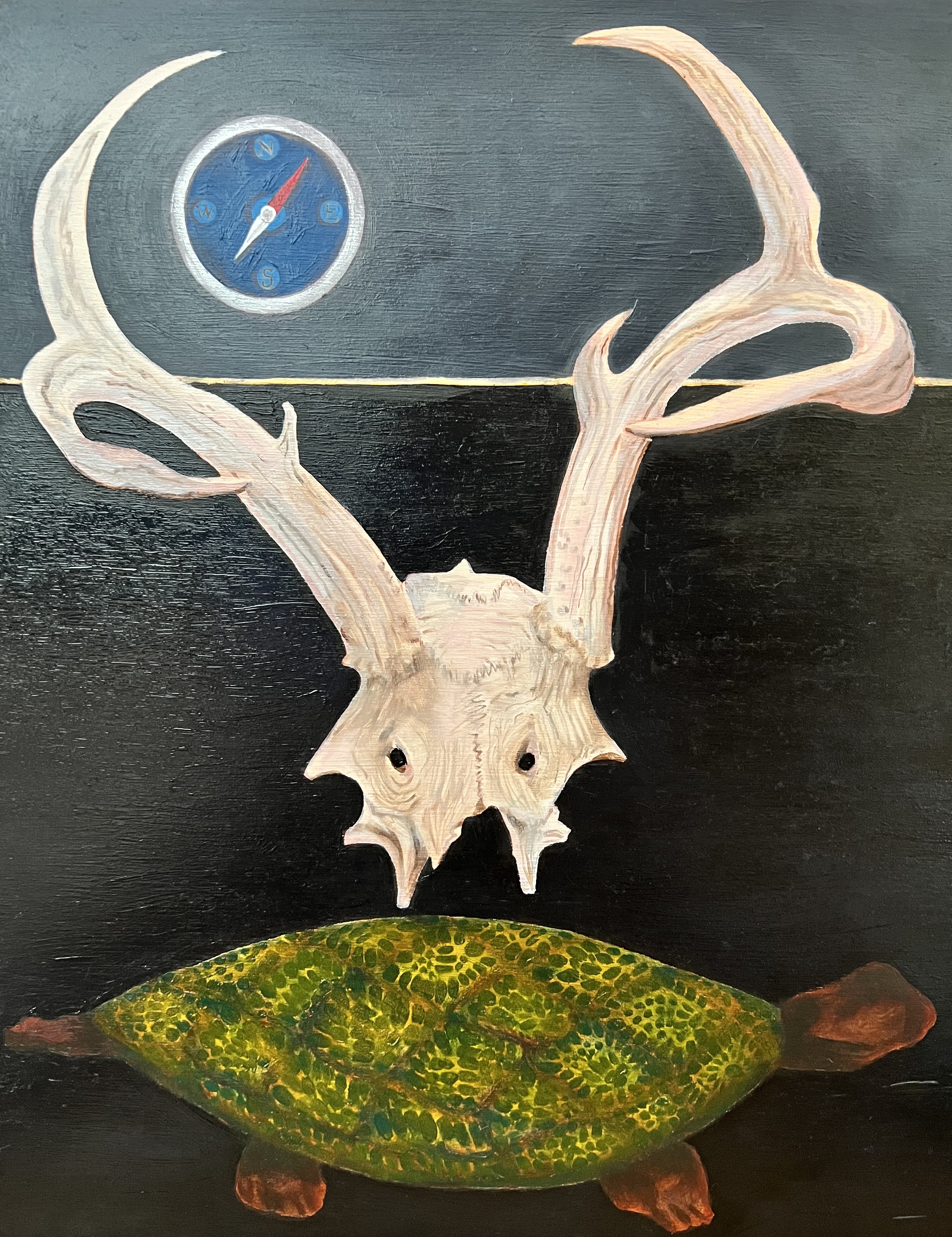
“the turning point at which modern history failed to turn”

Mt. Conness. Robin L. Chandler, 2023.

“Over Constable‘s canvas [The Hay Wain] the Just Stop Oil activists taped an updated version, in which the winding river Stour, in the artist’s native Suffolk, is replaced by an asphalt highway. Fossil-fuel consuming jets festoon the sky, and smokestacks line the horizon. ‘You can forget your green and pleasant land,’ one of the protestors, the twenty-three-year-old Hannah Hunt, proclaimed, ‘when further oil extraction will lead to widespread crop failures. So yes,’ she added defiantly, ‘there is glue on the frame of this painting but there is blood on the hands of our government.’ Hunt was quoting from ‘Jerusalem,’ the short poem in which William Blake (an admirer of Constable) warned that the ‘dark Satanic Mills’ of the Industrial Revolution posed a threat to ‘England’s green & pleasant Land.”*

*This excerpt is from Christopher Benfey‘s essay Constable’s Quiet Tumult published in The New York Review of Books, Volume LXX, Number 15, October 5, 2023.

*****

The title of the blog is taken from the quote “the year 1848 was the turning point at which modern history failed to turn,” by George Macaulay Trevelyan in his 1922 book British History in the Nineteenth Century (1782 – 1901).

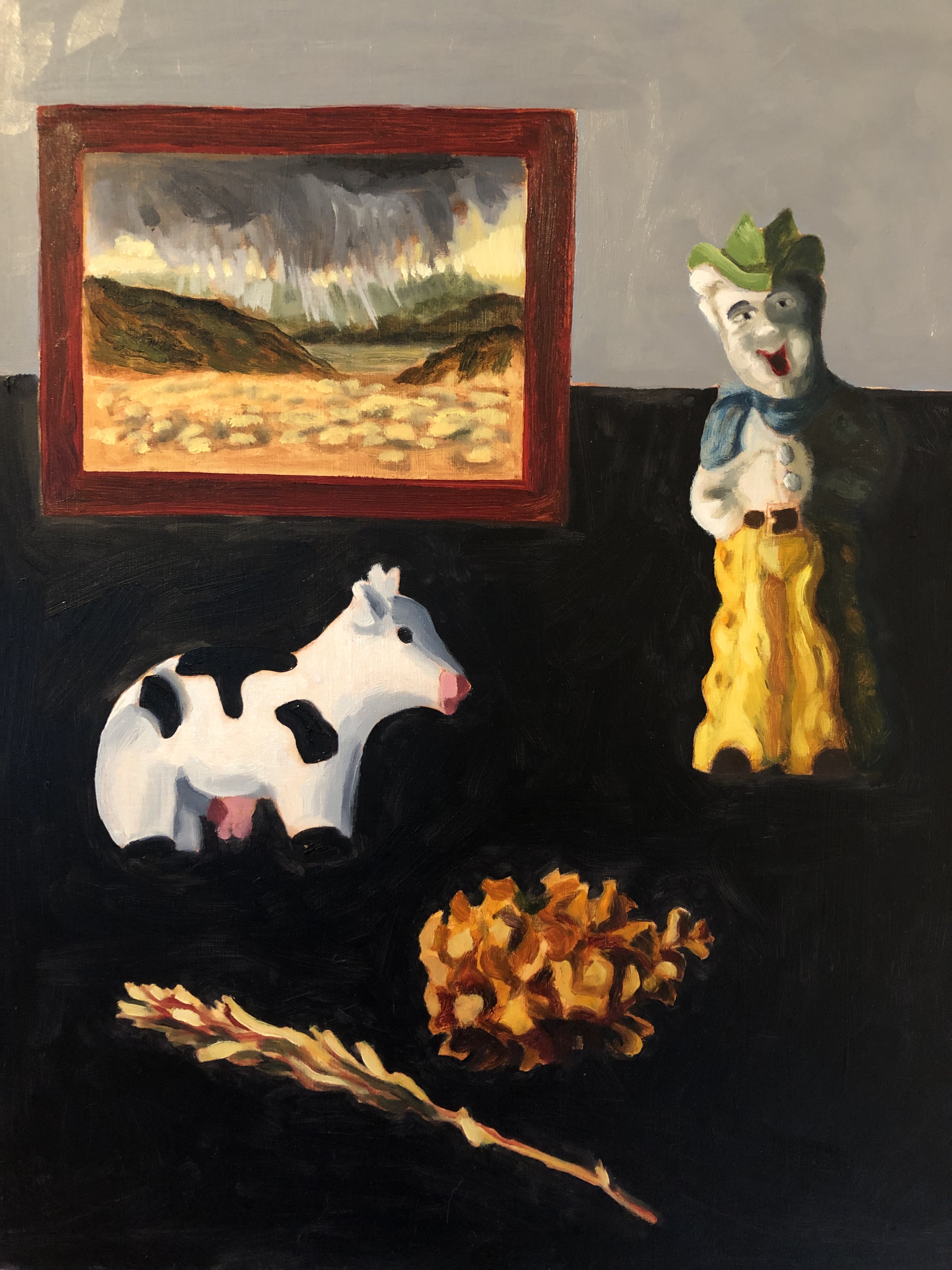
home…home on the range

Where the Deer and the Antelope Play. Robin L. Chandler, 2022.

“…..as is well argued by Bruce Pascoe in his book Dark Emu, the Europeans had a terrible track record for arriving in a new world (Australia in the case of Dark Emu) and, as we all know, devastating the Native tribes by varying methods of genocide, or at least brutal displacement. In order to treat other human souls so viciously, this behavior on “our” part required a certain degree of denial. This was achieved by treating the American Natives, or the Aboriginal tribes in Australia as less than human – vermin, really – that required extermination, so that the proper “civilized” humans could set-up house. Pascoe succinctly points out that when the English made their reports detailing the progress of their settlements Down Under, they therefore had to necessarily ignore the complex civilizations of the local tribes entirely, despite their methods of surviving amicably in concert with nature that had been developed over millennia. Housing, farming, fishing complete economies: eradicated. Wiped off the face of Australia. “Nothing to see here, your highness, except some random savages!” Next, of course, the English heroically shipped in herds of grazing sheep and cows and attempted to plant their wheat and other continental grains, and then looked on stupidly as they all faltered and died in inhospitable soil, within an ecosystem that was entirely alien to the biology of their plants and animals. They exhibited all the common sense of hijacking a plane for its cargo of riches and then killing the pilots without gleaning any of their imperative knowledge. We’re all in so much of a hurry, then and now, to make money, that we never bother learning to land the son-of-a-bitching plane.”

Excerpt from Nick Offerman‘s book Where the Deer and the Antelope Play: The Pastoral Observations of One Ignorant American Who Loves to Walk Outside.

for Kyiv

Robin L. Chandler, 2022.

Bees build around the honeycomb of lungs,

Ants build around white bone.

Torn is paper, rubber, linen, leather, flax,

Fiber, fabrics, cellulose, snakeskin, wire.

The roof and the wall collapse in flame and heat seizes the foundations.

Now there is only the earth, sandy, trodden down,

With one leafless tree.

Excerpt from the poem A Poor Christian Looks At The Ghetto by Czeslaw Milosz

we do not know

Robin L. Chandler, 2021.

WE DO NOT KNOW THE FUTURE. We do not know when the next war will start. We do not know when the last glacier will melt. We do not know when the last coral reef will bleach. We do not know how much oil we might still burn. We do not know when the last Javan rhinoceros will die. We do not know how nation-states will cope with millions of climate refugees. We do not know what policies economic crisis will be used to justify. We do not know when the Amazonia will collapse. We do not know how many more concentration camps will be built. We do not know when the Colorado River will go dry. We do not know toward what insidious ends the righteous hate of the downtrodden will be turned. We do not know when the Arctic Ocean will be ice free. We do not know what politics looks like in a world of catastrophic ecological collapse. We do not know when the Gulf Stream will slow to a stop. We do not know what we are capable of getting used to.

From Beginning with the End by Roy Scranton in Emergence Magazine

land of little rain

the east side. Robin L. Chandler, 2021.

It is thus that the novel takes its modern form, through “the relocation of the unheard-of toward the background…while the everyday moves into the foreground.” There is, however, an important difference between the weather events that we are now experiencing and those that occur in surrealist and magical realist novels: improbable though they might be, these events are neither surreal nor magical. To the contrary, these highly improbable occurrences are overwhelmingly, urgently, astoundingly real.

Amitav Ghosh The Great Derangement: Climate Change and the Unthinkable

“the most basic tenet…”

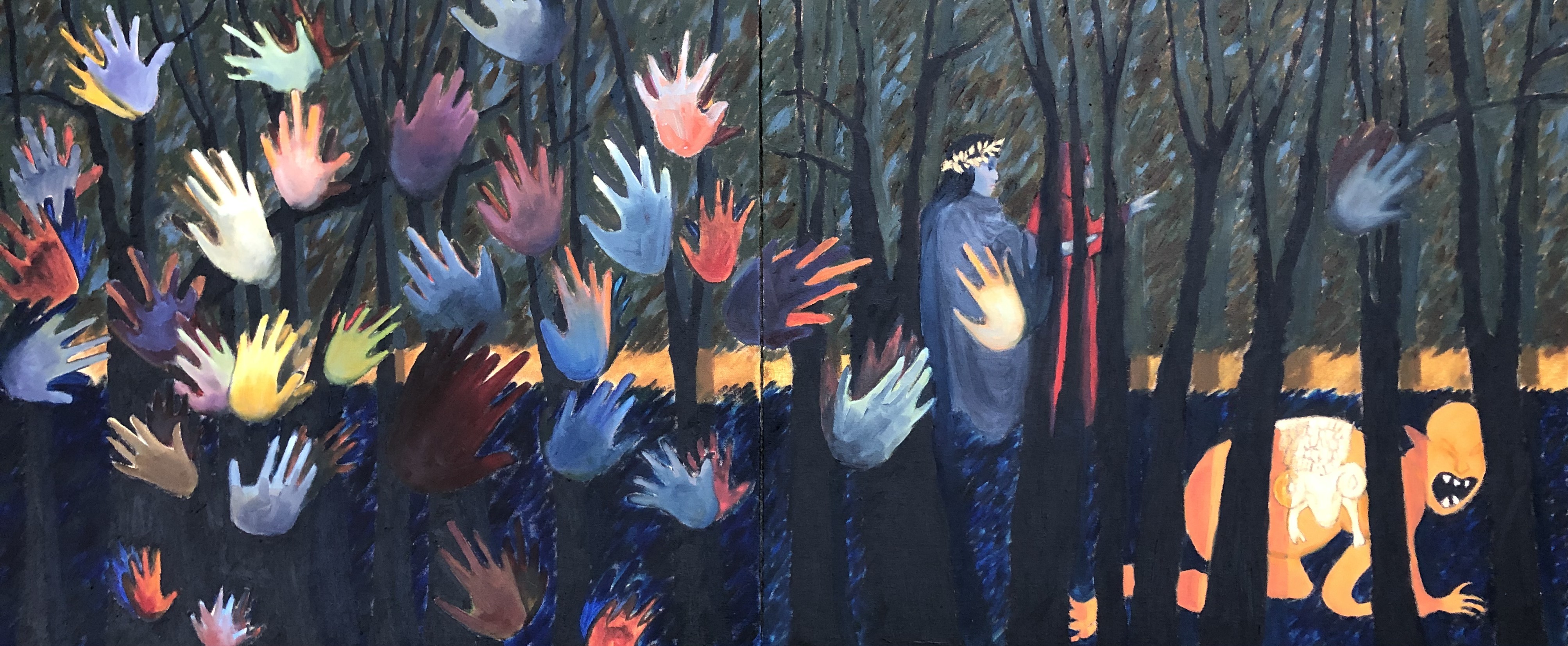
Awake, Arise, and Vote!
Robin L. Chandler, 2021.

The Right to Vote is ephemeral.

It is as fragile as a butterfly.

It must be protected, or it becomes extinct.

Democracy, like nature, must be nurtured.

It is fragile and easily destroyed.

And it is difficult to restore what has been lost.

Dante and Virgil divine this “comedy,”

And point the beast to the gates of hell.

Raise your hands and be counted.

Awake, arise, and vote!

ex voto

Souls of Birds. Robin L. Chandler, 2020.

Thank you for the hummingbirds…a glimmer of hope we cherish in our gardens.

Hear our votive prayer for the bird souls, thousands dead in New Mexico, victims of the wildfires fueled by climate change:

“And when bird song is gone will earth be the only witness?

Will only rocks grieve the absence?”

Do we pray for a miracle

or…

awake from the dream that our world consists of disconnected beings?