Farallon Islands from Point Reyes on a winter day. Copyright 2012 Robin L. Chandler.
It’s late afternoon on the last day of December 2012 and the annual Pacific migration of the gray whales from the Arctic to Baja is underway. On a spectacular day the air is clear and crisp, the sea is still – little movement on the waves, a cold rainy front moves south towards Southern California just skirting the Bay Area. Miles-at-sea, there is a flash of lightening. From the cliffs at Point Reyes National Seashore we look south towards the Farallon Islands. Wave gazes out at the infinite horizon and happily finds a small pod of whales. One fluke breaks the plane, and a bushy kind of heart shaped blow emerges nearby. “A whale spout is like catching a glimpse of a shooting star,” she says.
Antoine de Saint-Exupery’s 1943 novel The Little Princecomes to mind:
“All men have the stars,” he answered, “but they are not the same things for different people. For some, who are travellers, the stars are guides. For others they are no more than little lights in the sky. For others, who are scholars, they are problems. For my businessman they were wealth. But all the stars are silent. You–you alone–will have the stars as no one else has them–”
Otters at Elkhorn Slough. Copyright 2012 Robin L. Chandler
The thirty-eight miles from Santa Cruz to Monterey can be a very busy road to navigate. Route One is a major corridor with trucks carrying produce from the fields, and cars transporting farm workers, fishermen, tourists, recreation seekers of every stripe, and people like me who live and work at least part of their lives in this region. Hurtling through space, my eye catches glimpses of life’s daily epic poem acted-out by the inhabitants – people, plants and animals – of this region.
Our Elkhorn Slough epic begins near Moss Landing, now a man-made harbor, but once an estuary, part of the Pajaro-Salinas river system that historically shared a common entrance to the Pacific Ocean. Launching kayaks recently on a cold gray Sunday morning, we were treated to a new chapter in this epic story. An important component of the Pacific Flyway for migratory birds, the harbor and slough are populated with many species. This day we spotted Bandt’s, Double-crested, and Pelagic Cormorants; Brown and White Pelicans; Common Loons; Clark’s, Western and Horned Grebes; Forester’s Terns, and shorebirds including Curlews, Dowitchers and Godwits. Elkhorn is also home to many marine mammals. Hauled out on the beaches and mud banks, harbor seals and pups nap after a busy night seeking nourishment in the waters of the Pacific. Sea Lions rest comfortably piled-up on man-made docks. At low-tide, we spot Sea Anenome’s anchored to pilings and there secure amongst the now visible Eel Grass and occasional wayward kelp strand, we find mother Otters and their pups. The epic story of one such Otter pup is told in the movie Otter 501, a visual poem to stewardship. Paradoxically, Elkhorn Slough – a safety net to many animals and plants – is situated amongst a complex and encroaching human ecosystem including a vibrant agricultural economy, a regional power plant, an active fisherman’s harbor, recreational area for birders, hikers and kayakers, and a major north-south highway transporting people and goods. It is through tireless stewardship that these animals and plants survive in this amazing place.
To the uninitiated speeding by in their cars, Elkhorn Slough is just a flash of light reflecting off water, punctuated mostly by the two power-plant towers dominating the skyline. But for the animals and plants it is a sanctuary part of the Monterey Bay National Marine Sanctuary (MBNMS). In 1992, MBNMS became a Federally protected marine area offshore California’s Central Coast. Stretching from Marin County to Cambria near Hearst’s Castle San Simeon, the sanctuary encompasses some 276 miles of shoreline and over 6,000 square miles of ocean. MBNMS is the home to one of the most diverse ecosystems in the world with more than 33 species of marine mammals, 94 species of birds and 345 species of fish. MBNMS partners with organizations and institutions such as the Elkhorn Slough Foundation, the Monterey Bay Aquarium and research universities including the University of California and Stanford to preserve, perform research, and educate citizens about co-existing as members of this ecosystem on the central coast.
Elkhorn Slough is a fragile marine ecosystem. Most of us quickly drive by the Slough, preoccupied with getting to our next destination. Most of us don’t grasp the Slough’s role as a sanctuary in an epic poem, and fewer grasp that we are actors in the story and that have responsibilities to co-exist with the animals and plants as members of this ecosystem. We can actively choose to act as stewards; we can choose to oversee and protect places like Elkhorn Slough, places worth caring for and preserving because they provide sanctuary to living creatures that enrich our lives and ensure our survival both spiritually and physically. Anyone can be a steward; it can be as simple as recycling plastic bottles and composting vegetable waste or casting a vote to raise tax revenue to keep California State Parks open and education affordable for students at the University of California. Stewardship is becoming a member of the Elkhorn Slough Foundation to help create conservation easements or becoming a volunteer naturalist with the MBNMS or taking a child to the Monterey Bay Aquarium to teach them about the wonders of the ocean.
Stewardship is a story that must be shared with others, repeatedly. Saddened, I fear that for every story told, there are thousands of people who will never hear the story, therefore never be educated to learn about and understand their role as stewards. With education, we build empowerment, foster discussion, enable understanding, and realize just actions through compromise. These are noble aspirations, and evidence abounds that it is always an uphill battle. However, as the church of baseball teaches and Yogi Berra preaches, “it ain’t over till its over.” At the bottom of the ninth with two outs and down by five runs, the Sisyphus at the plate knows heaven is found in the uphill struggle (described in the The Great Wave blog entry). And so we must continue the hard work to learn and to teach each other about our responsibilities as stewards of ecosystems, no matter how great the odds. As Rachel Carson wrote in her 1958 article Our Ever Changing Shore republished the book Lost Woods: The Discovered Writing of Rachel Carson, “in every out thrust headland, in every curving beach, in every grain of sand there is the story of the earth.”
Early morning and first day of the New Year, dinner was already in the bag. The black-eyed peas were cooked and we still had a little smoked turkey from “Tejas” – my Dad’s annual holiday gift. We were ready for our traditional new years pilgrimage to the ocean. The truck easily covered the fifty-mile distance seamlessly crossing the once Spanish and Mexican ranchos — remembered now mostly as streets, colleges, landmarks or towns named for land grants – Peralta, San Pedro, Nicasio, Tomales and de Los Reyes. Sir Francis Drake Boulevard holds some thirty years of memories: the old white horse in the corral just west of Lagunitas (a toy horse perched on the fence has sadly replaced the original); seeing my first Steelhead with Jane in Lagunitas Creek on our bike-camping trip from Santa Rosa to San Francisco; watching the Salmon with Wave as they lay their eggs in redds just below Kent Lake; and the journey to Bolinas in the old VW bug for my first kayaking adventure with Glo, John and Carol.
Before reaching the beach, two mandatory stops are necessary. Ginger & Chocolate-Chocolate-Cherry cookies from the Bovine Bakery are a must: necessary fuel for the hike ahead. Stocking up on our reading materials was another must at the Point Reyes Books. We are members of their Community Supported Bookstore Program a cool new idea inspired by community supported agriculture to help sustain independent book sellers. Supporters make a deposit with the bookstore and draw upon that amount for future purchases. Brilliant! I hope other bookstores start this program! A lover of browsing, I bought my first book of 2012, a volume by the roots music guitarist Ry Cooder: Los Angeles Stories. Looks like my kind of book. Fiction, but the kind of stories you might gather by sitting down with the everyday folks in your community over a cup of coffee and listening to their life; learning about their part in our shared history. Revived both gastronomically and intellectually, we headed on down the road to Limantour Beach to let the ocean ions do their purifying thang. We walked the beach length in the bright sunshine, the waves gently lapping at our feet and the sweet ocean air wafting through us. Later, alone in the truck for a few minutes while Wave lingered to capture a last image of a beautiful day, I queued Mary Gautier’s Mercy Now. As I look to the year ahead may everyone have “ a little mercy now.”
New Brighton State Beach. Copyright 2011 Robin L. Chandler
On May 21st we started our journey at the Salinas River National Wildlife Refuge and ended some eight hours later at the wharf in Monterey. On three sequential Saturdays some fifty adventurers hiked thirty miles in the distinguished company of Sandy Lydon, Historian and Cabrillo College faculty, and Gary Griggs, Director of UC Santa Cruz Institute of Marine Science. Today would be the final ten-mile leg of Monterey Bay Walk 3. May 7th we hiked from New Brighton State Beach in Capitola to just north of the Pajaro Dunes. May 14th we ambled from Zmudowski State Beach to the Salinas River. This morning a flock of Caspian Terns greeted us by the riverbank as we walked through the refuge to the beach. All was beautiful: endless sky, sea and sand. My day’s walk would be measured by miles of words and punctuated by meters of awed silence – awe inspired by the magnificent Monterey Bay. My companions on this adventure included my amazing friends Irene Reti and Sarah Rabkin. Both passionate environmentalists, they have shared their love of nature, understanding of human frailty and hopes for the future in their recent books: Reti’s Kabbalah of Stone and Rabkin’s What I Learned at Bug Camp: Essays on Finding a Home in the World. I am grateful for all the knowledge they shared with me about the human and natural history of lands between Santa Cruz and Monterey on these special Saturdays in May.
Sandholdt State Park. Copyright 2011 Robin L. Chandler
Reflecting on the walks, many images delight my mind — images conjured by the stories of Sandy and Gary, the two trip leaders: the realization that Monterey Bay is not a pristine environment, no location on the Bay has been spared the impact of humankind; the image of Chinese fishing sampans on the beach now known as New Brighton; the impact of earthquakes, erosion and tidal forces on the coastline; the story of Gaspar de Portola and his Spanish troops walking what would become the El Camino Reale as he searched in vain for Monterey Bay; developers’ insistence on building at the ocean’s edge, imperiously disregarding the cycle of el nino and la nina climate patterns on urban planning; the mother gray whale and her baby breaking the surface with their spouts; the enormous American bullfrog, an invasive species found on the shore of the Salinas River; the bachelor otter pod at Moss Landing; the snowy plovers guarding their nests and chicks on the beaches near to Monterey; and the clouds: light fogs at a far distance resting lightly on the water — quickly burning back leaving a brilliantly bright day where sunlight danced crisply on the waves, or the dramatic bands of clouds moving fast north to south, precursors of the front that would bring unseasonal rain from Santa Cruz to San Diego.
Fort Ord State Park. Copyright 2011 Robin L. Chandler
For thirty miles from Santa Cruz to Monterey we walked on the beach – a pathway formed from a patchwork of California State Parks and Federal Wildlife Refuges — a ring of bright white sand circling the Monterey Bay Marine Sanctuary. Seventy California State Parks will be closed because of our state budget crisis. Four of these parks are beach parks found along the shores of Monterey Bay, and two of them we crossed during our bayside journey: Zmudowski State Beach and Moss Landing State Beach. In November 2010, the majority of California’s citizens elected NOT to pass Proposition 21, a referendum proposing an annual $18.00 vehicle license fee. Such a small price to pay for so much beauty….. just off the beaten path…..our precious California State Parks.
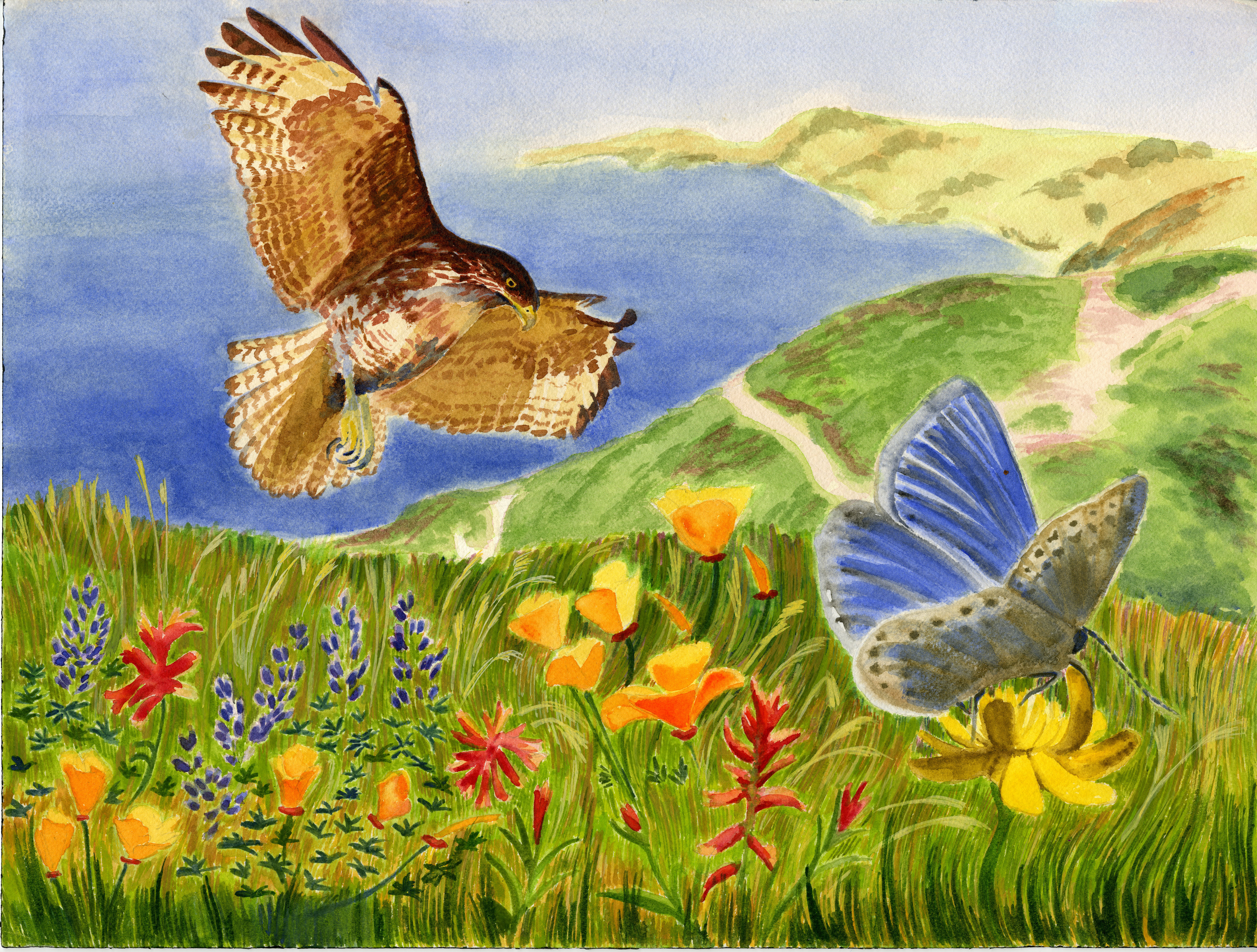
Marin Headlands on the Pacific Ocean. Created by Robin L. Chandler. Copyright 2010 National Park Service.
In Moby Dick, Herman Melville described the Pacific Ocean as the “tide-beating heart of the earth that makes all coasts a bay in it.” Describing the interconnectedness of the lands ringing the Pacific Rim he wrote “the same waves wash the moles of the new-built Californian towns, but yesterday…..lave the faded but still gorgeous skirts of the Asiatic lands, older than Abraham; while all between float milky-ways of coral isles, and low-lying, endless, unknown Archipelagoes, and impenetrable Japans.” On Friday March 11, 2011, mankind was humbled by a 9.0 magnitude quake striking the northeastern coast of Japan and triggering a Tsunami whose force quickly silenced thousands of voices near Sendai and damaged harbors – including Crescent City and Santa Cruz – 5,000 miles to the east along the North American coastline. Nature will always bind what man’s competitive psyche seeks to distance. Hokusai’s woodblock print “The Great Wave” part of his series Thirty-six Views of Mt. Fuji has long been a favorite of mine; mesmerized by the beauty of the wave, it is only now, newly humbled, that I truly grasp the precarious position of the fishing boats depicted in the print.
Last weekend I attended the Point Reyes Book’s third Geography of Hope conference bringing together people, place and literature to discuss water as both a life-giving and a life-taking force. As rain poured outside in biblical proportions, the Japanese people were never far from our consciousness in this community located on the San Andreas Fault so near the Pacific Ocean. An inspiring gathering, we listened rapturously to poets, writers and scientists – including Robert Hass, Brenda Hillman, William Least Heat Moon, Tim Palmer, Philip Fradkin, Eddy Harris, Peter Gleick, Evelyn Reilly and Julia Whitty — speak about rivers, lakes and oceans and their hopes and fears for the health of our planet. The desire to teach children – through art, literature and science – about the connections between humans and nature was a major theme, but concerns about the potential of social media and hand-held technology to disconnect society from the natural world was an undercurrent of the gathering.
My work as a digital archivist working in academic libraries fosters my belief that social media can be leveraged to enhance our connections with and understanding of the natural world. If any good can be drawn from the tragedy of the Japanese earthquake and Tsunami, it is the knowledge that this is likely the best documented disaster in recent history, and this information will be repurposed for constructive use. Numerous digital images and video recordings of the Tsunami’s destructive power were captured by survivors of these events and uploaded for sharing on social media sites. This week a BBC article published on March 21, 2011 “Japan Tsunami to Help Predict Future Waves” reported how scientists will use this data to study Tsunamis. At the 2011 Institute for Museum and Library Services (IMLS) Webwise conference, Dr. Francine Berman, Vice President for Research at the Rennslaer Polytechnic and Dr. Joshua Greenberg, Director of Digital Information Technology and Dissemination of Knowledge Program at the Sloan Foundation delivered keynote addresses making several complimentary points: the role of the “crowd and the social network” in the generation of observational research data; the need for a macroscopic approach to gather comprehensive data sets and analyze and visualize data at scale; and the need for archivists, librarians and museum professionals to be central players in data curation workflows to appraise, manage, preserve and provide access to data supporting ongoing research. Its important to note that this kind of work is underway. The National Science Foundation (NSF) funded DataONE a multi-institutional and cross-discipline collaboration of universities and organizations including the California Digital Library to lay the foundation for a distributed framework and sustainable cyberinfrastructure that meets the needs of science and society for open, persistent, robust, and secure access to well-described and easily discovered Earth observational data.
Webwise also featured workshops and sessions on Libraries and Museums engaged in STEM (Science, Technology, Engineering and Mathematics) Learning. STEM is part of President Obama’s program “Educate to Innovate,” a campaign to improve the participation and performance of America’s students in these disciplines. Teachers, librarians and museum staff are developing many fun and engaging learning modules using social media and technology. One particular module — Habit Tracker – caught my eye; I saw a demo of the prototype at the conference. Using the Apps developed for iPhone and iPad2 technology, Habitat Tracker will help students learn about the nature of science by learning to ask their own questions about the natural world, recording observations, performing analysis and participating in peer review with fellow students.
A humble respect, enjoyment and love of the natural world and a belief in the utility of social media technology and services are not mutually exclusive. They can be symbiotic and when so joined the resulting analysis can support greater understanding of the natural world and our place in the cycle of life. It is my hope that technology advancements – like social media – will bring individuals greater engagement with nature and help humankind shoulder the stewardship responsibilities required to ensure the natural world survives for future generations.
*From the poem At the Fish Houses by Elizabeth Bishop read by Eric Karpeles at the Geography of Hope Conference
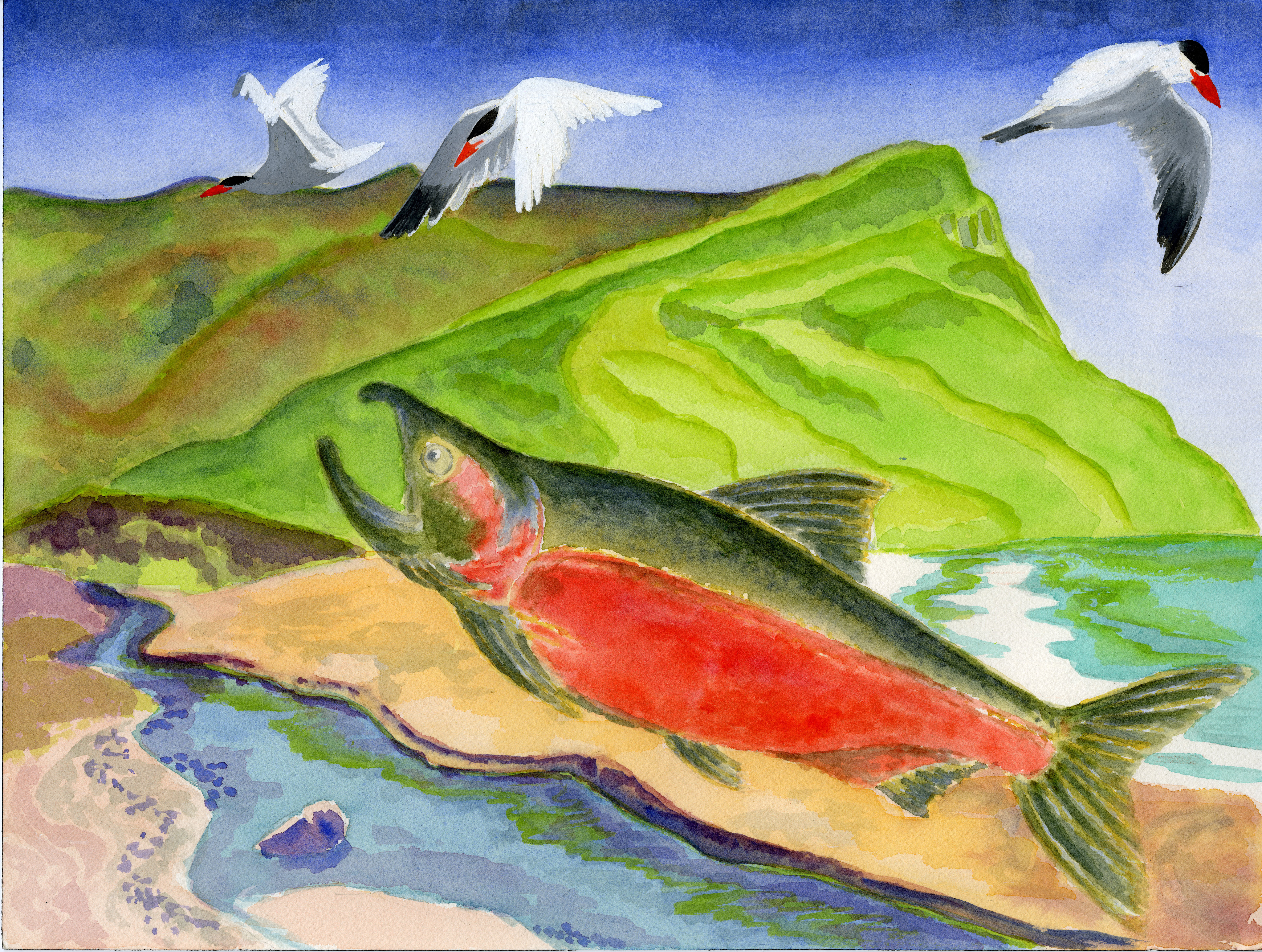
Salmon returning to Redwood Creek. Created by Robin L. Chandler. Copyright 2010 National Park Service.
In early January 2011, we participated in what is becoming a beloved annual ritual: naturalist guided creek walks in the Lagunitas watershed seeking glimpses of Coho Salmon and Steelhead Trout who have come home to spawn. The Marin County based Salmon Protection and Watershed Network (SPAWN) is committed to restoring habitat, building community partnerships, and passing legislation supporting the survival of endangered Coho Salmon and Steelhead Trout in California and the Pacific Basin. Thankfully SPAWN is not alone; all along the Northern California coast educational, research and non-profit organizations are engaged in activities to save endangered fish species. In Marin county, the Golden Gate National Parks Conservancy is engaged in restoring salmon habitat along Redwood Creek and the river’s mouth at Muir Beach. While in Santa Cruz, increasing numbers of steelhead smolts are making their way along the San Lorenzo River back to the sea. Scientists attribute these rising numbers of Steelhead to increased rainfall and the efforts of citizens to reduce urban runoff and improve habitat. These inroads are so important because some efforts in Southern California are foundering; recently the California Coastal Conservancy’s was forced to abandon’s its work to restore the Steelhead to San Mateo Creek in San Diego County.
For the past few years, we have been blessed with observing a pair or two of Salmon – their bodies touched with crimson – swimming upstream and building nests — called Redds – in preparation for laying eggs. But seeing these beautiful creatures is a rarity. Typically annual counts on the Lagunitas and San Geronimo creeks number only in the 60s. Writing about Steelhead in The Sespe Wild, Bradley John Monsma described California a few centuries ago when “thousands of fish, fattened from the ocean, pool near the mouths of rivers…before dashing upstream to gravel spawning beds in the mountains.” Rain and healthy watersheds are essential for the survival of Salmon and Steelhead; rain provides easy passage for the journey upstream to lay eggs, and give birth to fry. Rain emboldens rivers and creeks to break the sand barriers to the sea permitting smolt to begin the ocean phase of their life.
People make a huge difference in building healthy watersheds. We need to care, we need to understand that our lives are better because these animals are part of our world. We need to grasp that we are living in a biodiversity crisis that can only be resolved by our understanding the power of our different interdependent lives. Monsma quoting the human ecologist Paul Shepard writes “with the loss of species, we may be losing something essential to our humanity. It may be that we can approach the depth of ourselves only in relation to a diverse and healthy ecosystem” suggesting that mature societies are those that are “characterized by a view broad and forgiving involving a sense of the larger gift of life, a realistic sense of the self and other, a sense of the talents of generosity and circumspection.”
Fall is here. There is a little chill in the air and the sun’s journey southward gives forth a particular quality of light. This week has found me cycling as much as possible, and I naturally gravitate to the coast to ride the 101 as it meanders through the communities of La Jolla, Del Mar, Cardiff, Encinitas and Leucadia. Every few miles I get a spectacular view of crystalline blue waves peaking and crashing into torrents of white foam and see the surfers catch a wave and joyously ride the crest balanced precariously somewhere between chaos and nirvana. “Clear and sweet is my soul, clear and sweet is all that is not my soul,” wrote Walt Whitman in Leaves of Grass.
Sunset North County San Diego: Swami’s Beach. Copyright 2009 Robin L. Chandler
A few weeks ago, I visited Cape Cod and I was thrilled to see a group of surfers anglin’ on ankle busters, but I think they imagined the waves as a bonsai pipeline.
Near Truro on Cape Cod. Copyright 2009 Robin L. Chandler
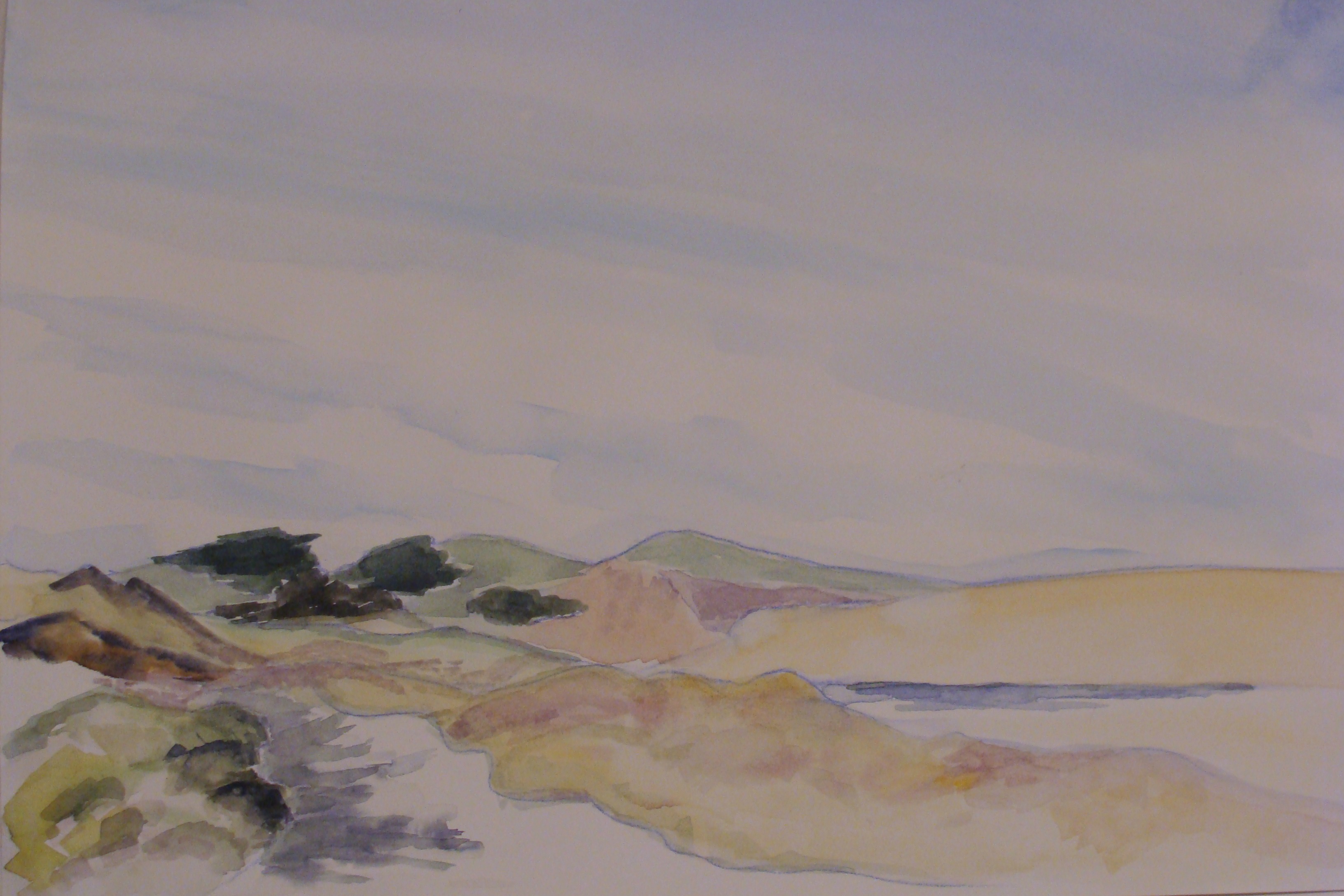
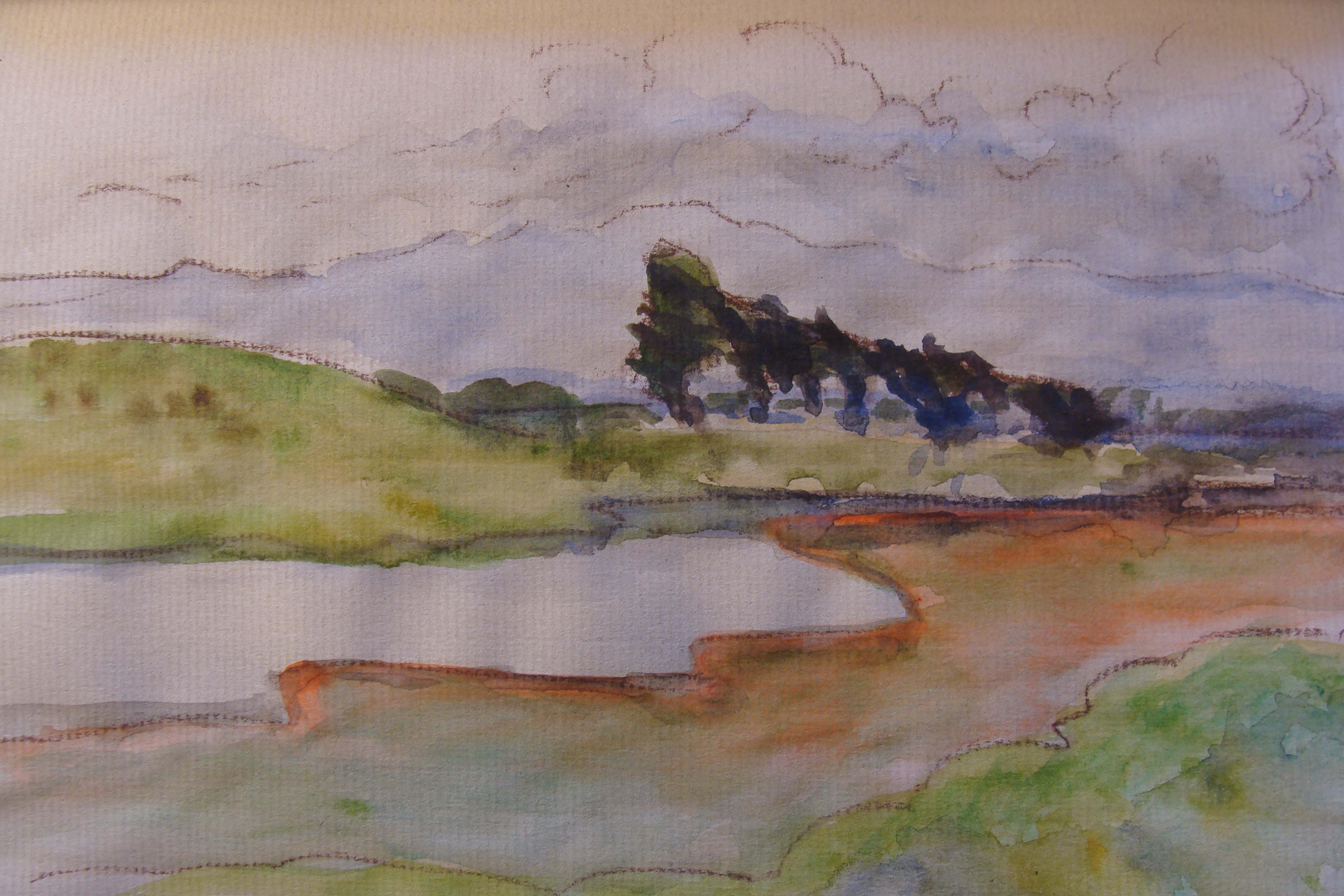
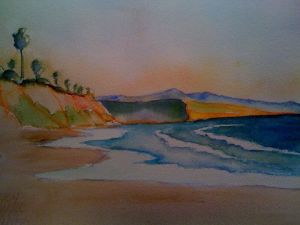
The view of the ocean from the saddle of my bike is where my soul opens up, and my spirit returns to balance. On the bike, I scout out places to paint and observe the world at a pace that allows for interaction, reflection and a laugh or two. Yesterday it was great fun to see Surfrider Foundation members on street corners in Cardiff for their “Hold onto Your Butts” campaign. They were spending their Saturday morning reminding us that cigarette butts do not belong on the beach. It is another of Surfrider Foundation’s good causes part of their beach clean-up efforts and their larger campaigns like “Save Trestles” which kept a toll road out of San Onofre State Park. They do good work. They teach us to be responsible for our beaches and oceans as we should be for any good friend. These are two watercolors that I’ve recently painted of late afternoons in North County San Diego and Truro on Cape Cod. Both pristine and soul redeeming spaces.
On Labor Day I kayaked on Tomales Bay. 2PM and it was high tide when I launched near the town of Marshall and the wind was dancing across the water leaving whitecaps in its wake. It was the first time I would be taking my new single kayak on the water. Wave and I have safely captained a two-person kayack on many trips on Tomales Bay where the center of gravity is low and the craft moves very deliberately through water. In my watercolors, I’ve documented kayackers in singles paddling across this water and now it would be my turn. Wave ably helped me launch the craft, and just after my paddle cut through the water, I heard a voice from the shore asking if I had a plan should I capsize out on the Bay. Well, the truth was, no, I didn’t have a plan. I didn’t think I needed a plan. I felt I had the experience to handle any situation that might come up. I just wanted to get out and enjoy the last few hours of sunshine on a laborless day.
Kayaking near Hog Island, Tomales Bay. Copyright 2009 Robin L. Chandler
I was eager to feel the joy of moving across the water, and have the wind and spray on my face and see the sun dappling the water. I imagined the feel of my arms working hard to create forward movement against the wind blown waves breaking across the bow. I imagined the moment, when one turns and with the wind at your back, experience the joy of being rocked forward momentarily airborne on the back of a breaking wave. But the voice spoke a truth that suggested listening. One of the staff for onsite operations for Blue Water kayaks on Tomales Bay took a few minutes out of her busy life and reviewed with me how to manage the unimaginable. A little later I was on the water and the wind was strong and the waves presented a fun challenge. I was deeply grateful that a person previously unknown to me spontaneously showed concern, and I was able to hear the truth of the concern, put my eagerness in check and gently accept the gift.
Later that day driving home, I thought of learning life lessons aknew. While one gleans much knowledge over the years, one must embrace daily life with the openness of a beginner. Christopher Benfey in his book The Great Wave describes an essay by Shuzo Kuki called “Considerations on Time.” Written in 1928, the essay describes two Japanese responses to the theme “man and time.” These are the Buddhist annihilation of the will, i.e. extinction of desire, and the Samurai’s bushido, i.e. affirmation of the will. Kuki saw the myth of Sisyphus as the very embodiment of the moral ideal of bushido. “Sisyphus rolls a rock almost to the summit of a hill, only to see it tumble back down again. And he is, thus, set to perpetually beginning anew. Is there misfortune, is there punishment in this fact?….Everything depends of the subjective attitude of Sisyphus. His good will, a will firm and sure in ever beginning anew, in ever rolling the rock, finds in this very repetition an entire system of morals and consequently, all is happiness…..he is a man impassioned by moral sentiment…..he is not in hell, he is in heaven.” Camus, describing Sisyphus, would write some years later “the struggle itself toward the heights is enough to fill a man’s heart.”






 alive in the sea of information