near (and far)

Trees burned by fire in the drought stricken Owens Valley. Robin L. Chandler Copyright 2016.

Thanks to an early start, we reached the Owens Valley just before the storm closed Tioga Pass for the winter. Snow had dusted the peaks cradling Tuolumne meadow. There would be no pie today as we passed the Tioga Pass Resort; the diner long since closed, the windows boarded until the spring snowmelt. We were giddy, caught in the romance of the storm; dark thick clouds promised snow and rain to assuage our five-year drought.

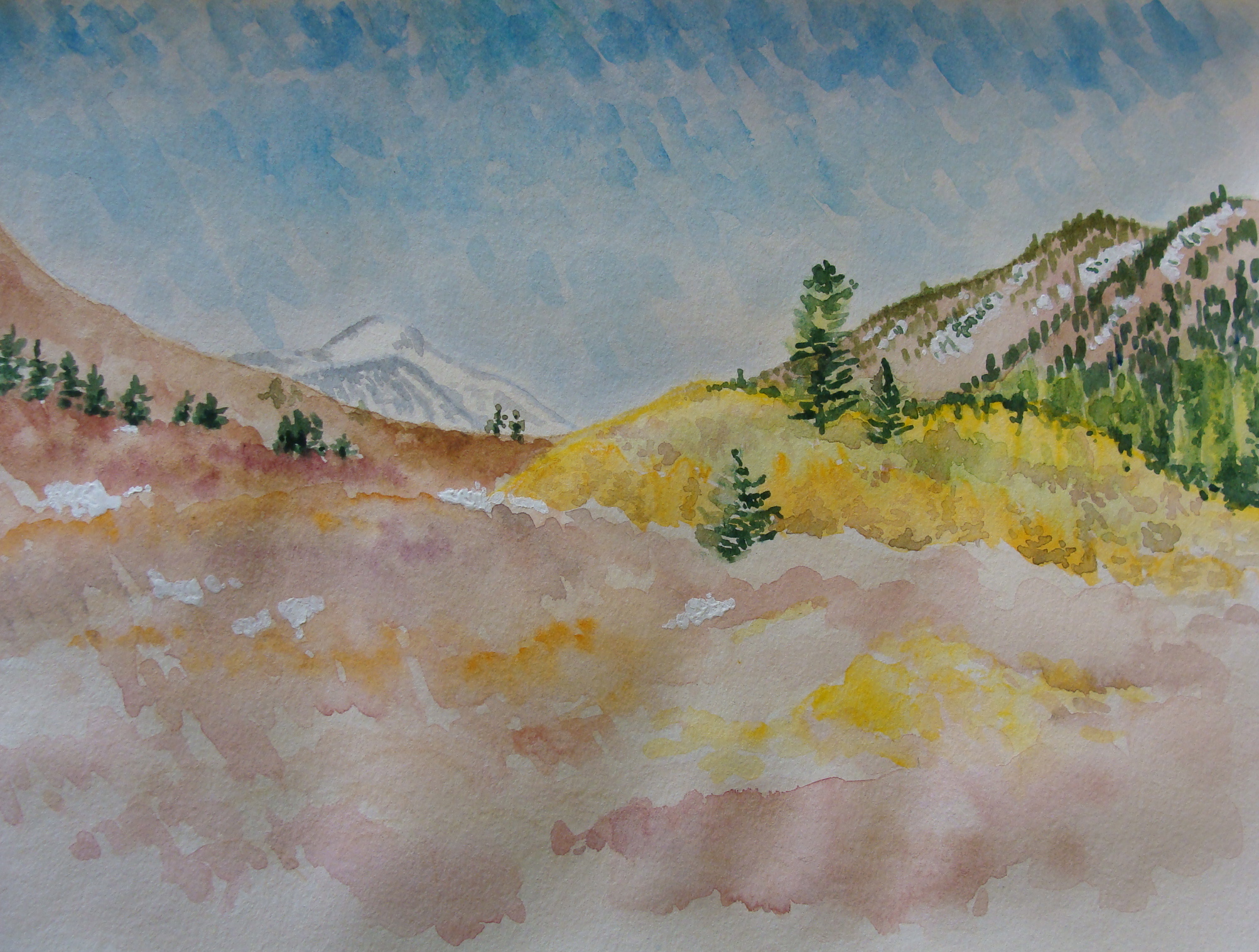
Descending to Mono Lake, we made a right turn onto 395 towards Bishop and the Eastern Sierra Interpretive Association’s (ESIA) inaugural conference on the history of the eastern sierras. This is a desolate land, whose emptiness holds so many stories to be shared. The Owens Valley straddles two counties: Mono and Inyo. Mono County defined by Mono Lake and the volcanic fields at an elevation of 7,000 feet and the Mammoth Lakes ski resort. Inyo County, the table drops sharply, thousands of feet in altitude is lost, as we descend into ranch lands, cottonwoods and the meandering Owens River. We stopped often, capturing with camera and brush the conversation between brooding sky, dark mountains, parched landscape, and autumnal trees. A photographer and a painter, drawn to this sacred place, finding poetry at every compass point.

At the ESIA conference, David Carle spoke about water and the historic choices that shaped California. A long-term California State Park Ranger, Carle now writes full-time about land and water issues facing our state. According to Carle, in 1902 Los Angeles was a small town of 100,000 people, with a promising citrus industry, but desperately seeking water. Led by the engineer William Mulholland, businessmen and city planners set their sights on the Owens Valley, a region of 8,000 residents with a 75,000 acres of farm and pasture land producing 51,000 bushels of wheat annually. The Owens Valley also held lakes and rivers fed by the water stored in the snow covered Sierras. The aqueducts were completed in 1913, but it didn’t take long before Los Angeles was thirsty again. By 1924 Owens Lake was a dry lake bed where dust storms raged. Los Angeles had purchased all the water rights in the valley, but by the mid-1920s they owned all the towns too. Communities had been destroyed and ecological disaster created for the region. The author Mary Austin asked “ is all this worthwhile in order that Los Angeles should be so big?” Today, Los Angeles Department of Water and Power (LADWP) is working hard to implement water reclamation, and to their credit most of Orange County’s water now comes from reclamation. But for some, there will never be enough water, Southern California’s thirst will not be slaked. The proposed Twin Tunnels Project would move water from the Sacramento and San Joaquin Rivers to the southland. Recently, LADWP purchased five islands located in the heart of the river delta, just as LADWP purchased the Owens Valley a century ago. Stop the Tunnels provides information about establishing fair water policies in California.

Looking out across the Owens Valley, at a land so near, so precious, it is scary to know that actions taken by a few powerful people, so far away, change the land and communities forever.

catch a glimpse, overhear a whisper

Mt. Whitney in winter. Robin L. Chandler 2016.
Mt. Whitney in winter. Robin L. Chandler  Copyright 2016.

This winter, we visited the Eastern side of the Sierras. We longed to see the snow covered mountains after so many years of drought. And frankly, I look forward to any chance to gaze upon Mount Whitney, the highest summit in the Sierras and in the contiguous United States at 14,505 feet. Waking early, I drove to the Alabama Hills awaiting the glorious winter light the sunrise would bring to Whitney’s face. Mount Whitney towers above the Alabama Hills, but both ranges are made of granite. The Alabama Hills are composed of two types of rock, an orange metamorphosed volcanic rock, and a type of granite that weathers into potato shaped boulders.

The highest peaks were covered in clouds, it was snowing in the mountains, and Whitney was not visible. I stomped my feet and blew on my fingers to stay warm in the cold, hoping with daylight Whitney would be visible. The sun rose, the clouds , like curtains, drew back and Mount Whitney whispered hello. Countless times, I have come to this place, to stare at this mountain, but I can never get enough. I always return. Joyous, I pondered the magic of what light can do, as Robert Hass wrote in the introduction to his book of the same name “the source of that authority is mysterious to me…but it is that thing in their images [the photography of Ansel and Robert Adams] that, when you look at them, compels you to keep looking.”

forests of Forster

Quaking Aspens on Rock Creek in the Eastern Sierra. Copyright Robin L. Chandler 2013

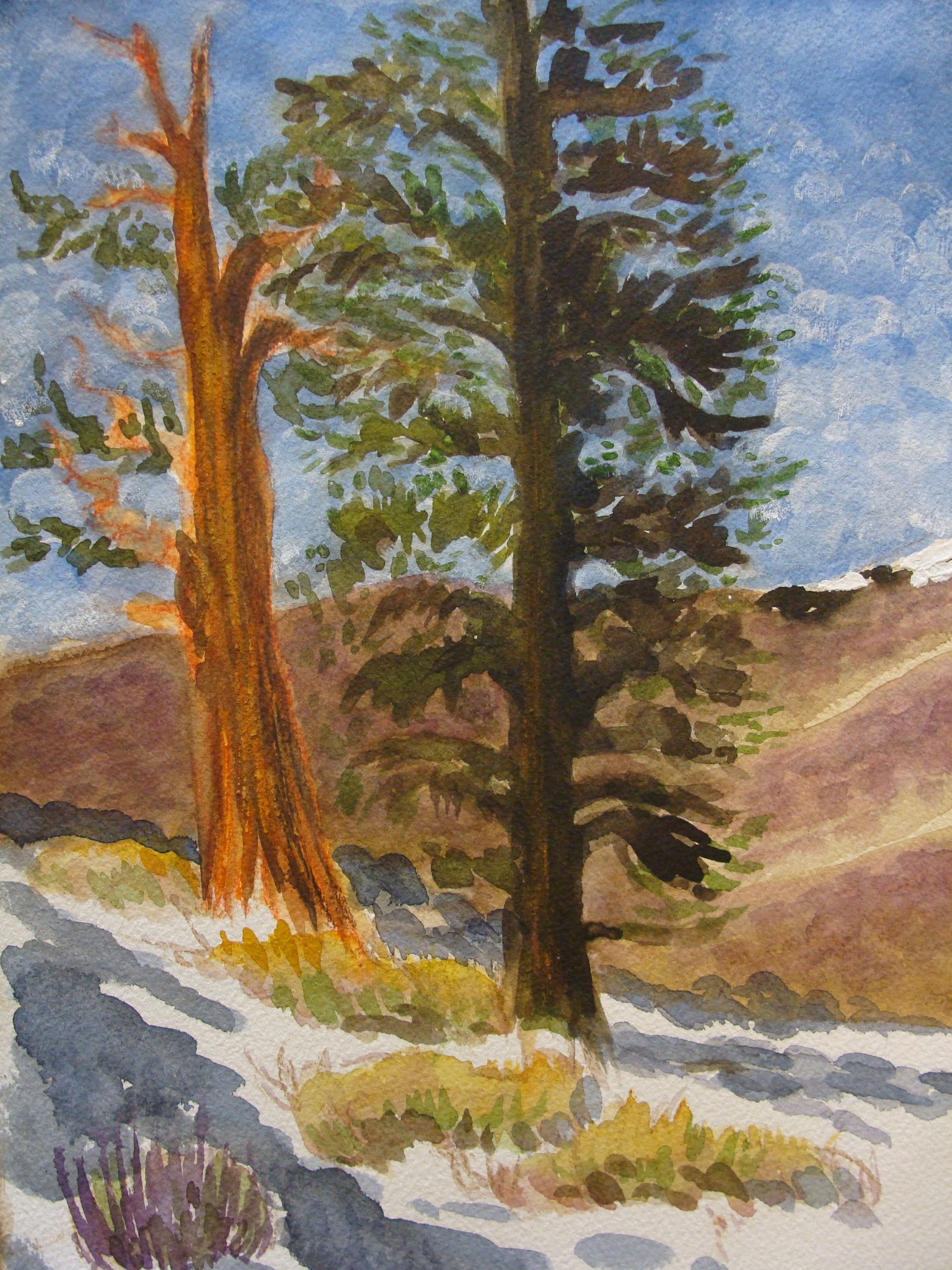
October’s government shutdown locked us out of our national parks. Fortunately, national forests are nearly impossible to fence in. Forest rangers closed visitor centers, but they could not padlock our public lands. The indifference, lack of connection, and abstract selfishness of a political minority – disregarding communities beyond their voting district – blocked passage of a federal budget, keeping government workers from their jobs – in this case stewardship of our natural resources – and held our country hostage, reeking havoc with local economies, such as businesses dependent on tourists to our national parks. Flouting our temerity, we voted with our feet gaining access to our birthright, our public lands. Entering Inyo National Forest, we found welcome amongst the wilderness of trees in the Eastern Sierra and Great Basin Desert, trees, blessed by their ignorance of Washington, D.C.’s theater of the absurd. I photographed our journey in addition to the watercolors in this blog entry.

Ancient Bristlecone Pines on the White Mountains. Copyright Robin L. Chandler 2013

When its fall in the Eastern Sierra, trees dress in dramatic and painterly yellows and gold accented now and then with a touch of red and orange. Near sagebrush scrub in the yellow pine belt bioregion found at approximately 7,000 feet above the sea, the yellowing leaves of black cottonwoods are jewel-like on the landscape. Thriving on moisture, the cottonwoods grow where their roots find water near lakes, meadows, springs, and mountain streams. Higher in the Sierras, in the 9,000 – 11,000 foot elevation range, forests of jeffrey and lodgepole pines, red fir and western junipers are found, as well as stretches of quaking aspens, simply breathtaking to behold. Finding water amongst rocks at cliff bases, these trees sparkle in the sunlight, and the wind reveals their white trunks and stirs leaves in a continual flutter. Farther East in the Great Basin Desert, the White Mountains host magnificent ancient bristlecone pine forests. Methuselah, the oldest tree on earth, estimated at over 4,750 years in age, thrives in this arid, exposed landscape, requiring minimal water and finding just enough nutrients in the dolomitic and alkaline soils where few other trees can flourish. Keeping only essential parts alive during times of stress, the living tree is dressed in dead branches, made smooth over time by the forces of wind, ice and fire. The sculptural bristlecone pines seem to form a community of dancers moving nominally in a minimalist ballet for the ages. The beauty is sublime; this place opens our living souls and we are filled with affection.

For this trip, my book of choice was A Great Unrecorded History a biography of one of my favorite writers, E. M. Forster, written by Wendy Moffat. In 1909, just days after reading Walt Whitman’s Leaves of Grass, an inspired Forster sketched out the entire concept of one of his finest works, Howard’s End. Published in 1910, Forster explored several themes including developing urban industrial spaces juxtaposed with a rapidly eroding English countryside, and the human need to connect. A century later, Wendell Berry, who like Forster appreciated the value of community and place, was honored to give the 2012 Jefferson Lecture in the Humanities, which he titled It All Turns on Affection. Informed by Forster’s Howard’s End, Berry described the need for integrated local economies connecting cities with their surrounding rural landscapes “to bring producers and consumers…back within the bounds of the neighborhood…[within] effective reach of imagination, sympathy, affection…[gaining] a measure of security that cannot derive from a national or global economy controlled by people who, by principle have no local commitment.” In his talk, Berry described Forster’s foresight: “the existence of small farms were limited and that an industrial ugliness, was creeping out of the cities and into the countryside, and that this ugliness was characterized by the withdrawal of affection from places.” In Howard’s End climactic scene Margaret Schlegel talks to her husband Henry Wilcox, “a plain man of business who sees life realistically with a hardness of mind and heart only because it is expedient and because it subtracts from reality the life of imagination and affection, of living souls.”  Margaret tells Henry “it all turns on affection now…affection. Don’t you see?”

In Song of Myself a poem from Leaves of Grass, Walt Whitman penned the line “the press of my foot to the earth springs a hundred affections.” May our political leaders in Washington remember their actions impact places and persons across our nation and the world. As they do their work, may they walk with affection, understand their commitments, and not trample  – drunk with power – the places and communities – in the lands just beyond their own.