Obsidian is so sharp that you can use it to cut your lousy life to pieces, and then when you have the original parts, the real ones, you can put them back together and have a clean assembly of things and see the world as it is and always was, and get to work at last, before it’s too goddam late.
The Coyolxauhqui imperative is to heal and achieve integration. When fragmentations occur, you fall apart and feel as though you’ve been expelled from paradise. Coyolxauhqui is my symbol for the necessary process of dismemberment and fragmentation, of seeing that self or the situations you’re embroiled in differently. Coyolxauhqui is also my symbol for reconstruction and reframing, one that allows for putting the pieces together in a new way. The Coyolxauhqui imperative is an ongoing process of making and unmaking. There is never any resolution, just the process of healing.
It is thus that the novel takes its modern form, through “the relocation of the unheard-of toward the background…while the everyday moves into the foreground.” There is, however, an important difference between the weather events that we are now experiencing and those that occur in surrealist and magical realist novels: improbable though they might be, these events are neither surreal nor magical. To the contrary, these highly improbable occurrences are overwhelmingly, urgently, astoundingly real.
Amitav Ghosh The Great Derangement: Climate Change and the Unthinkable
After a year confined, while Shiva created and destroyed, the open road beckoned. The horizon open, the land infinite, and my mind seemed lotus-like, unbound. And Earth shared: sky, mountains, trees, deserts, meadows, and rivers. My soul replenished: hope glimmers.
Clockwise: Thunderstorm over Wheeler Peak, Taos, NM; waterfall at Whitney Portal, Lone Pine, CA; sentinel trees at Whitney Portal, Lone Pine, CA; monsoon over Mt. Langley, Lone Pine, CA; and the San Francisco Peaks from Bonita Meadow, Flagstaff, AZ. Watercolors by Robin L. Chandler, 2021.
In mid-January, we drove northward on 395 through the Owens Valley from Los Angeles to Mammoth Lakes. Late afternoon, the sun flirted among the storm clouds and the Eastern Sierra mountain peaks creating a dramatic bright yellow light shining on the valley floor turning the White Mountains a mysterious blue. Ahead, a red cinder cone, a volcanic legacy, grew larger as we made our way closer to the sleeping Long Valley Caldera. The cinder cone, a beautiful rich red, still captivates my imagination.
Rebecca Fish Ewan wrote in A Land Between: The Owens Valley“ the landscape…reveals that stability in the West is both precious and fragile; the relationship between people and the land is deep and passionate, yet the balance of this union can be shaken overnight.” When settlers brought cattle to the Owens Valley in the 19thcentury, the new grazing animal destroyed the grasses and marshland environment that had been vital to the lives of the Pauite-Shoshone. When Los Angeles Water and Power Department diverted and transported snow-fed lakes, creeks and rivers of the Owens Valley to the Los Angeles basin, the ecosystem of the region was changed forever.
The Buddha teaches that we must accept that impermanence characterizes existence. But the Buddha’s noble eightfold path also teaches us to have right view, right resolve, right speech, right action, right livelihood, right effort right mindfulness and right concentration. The recent damage to Joshua Tree National Park caused during the Federal government shutdown may last for centuries. It is difficult for me to grasp the consciousness of people who cause such damage. Are they mindful of their actions consequences? Do they lack a relationship with place and community? Do they believe their “life” exists somewhere else in a different time and space? How can I teach that every moment is precious and our actions reflect our consciousness? We must understand our impact on the land and it’s inhabitants; our choices must be guided by sensitivity to the needs of others and not by our desires alone. Stewardship means never having to say your sorry.
In the 1970s, Gary Snyder heard a Crow elder say at a conference in Bozeman, Montana “you know I think if people stay somewhere long enough the spirits will begin to speak to them. It’s the power of the spirits coming up from the land. The spirits and the old powers aren’t lost, they just need people to be around long enough and the spirits will begin to influence them.”[1]
[1]Snyder, Gary. The Practice of the Wild. “The Place, The Region, The Commons.” p.42 San Francisco: North Point Press. 1990.
Aspens, trees of life, sketched at Lundy Canyon. Robin L. Chandler, 2018.
Last Saturday morning – October 27, 2018 – I was standing on the rim of Panum Crater at the edge of Mono Lake looking across the long valley at John Muir’s “range of light” beginning to understand great fullness is found in the emptiness.* My dear companions were scrambling joyously across the rock and ash, relishing the beautiful obsidian and pumice fragments, shattered remains of a past volcanic event. Sadly, a text notified me of the tragedy befalling innocents worshipping at the Tree of Life synagogue in Pittsburgh over 3,000 miles distant. I kept the news to myself desiring my friends feel the joy of discovery, just a little longer. Looking West, I saw before me quaking yellow aspens dancing up the hillside along creeks fed by the alpine lakes Parker and Walker. A single perfect moment – shattered suddenly into a thousand fragments by the destruction at the Tree of Life. At the Eastern Side of the Sierras, we grasp our insignificance within the vastness of eternity, and realize the significance of our actions towards other living beings. May we all find healing, redemption, forgiveness and a mindful constructive path rising from the ashes of our volcano.
* “Before the emanations were emanated and the creations created, a most supreme, simple light filled the whole of existence. There was no vacant place, no aspect of empty space or void, but everything was filled by that simple, infinite light…what is called the light of the Infinite (Eyn Sof).” Luria, Issac. The Tree of Life (Etz Chayyim), Vol. 1. with an introduction by Donald Wilder Menzi and Zwe Padah, and ed. (New York: Arizal, 2008), p. 13.
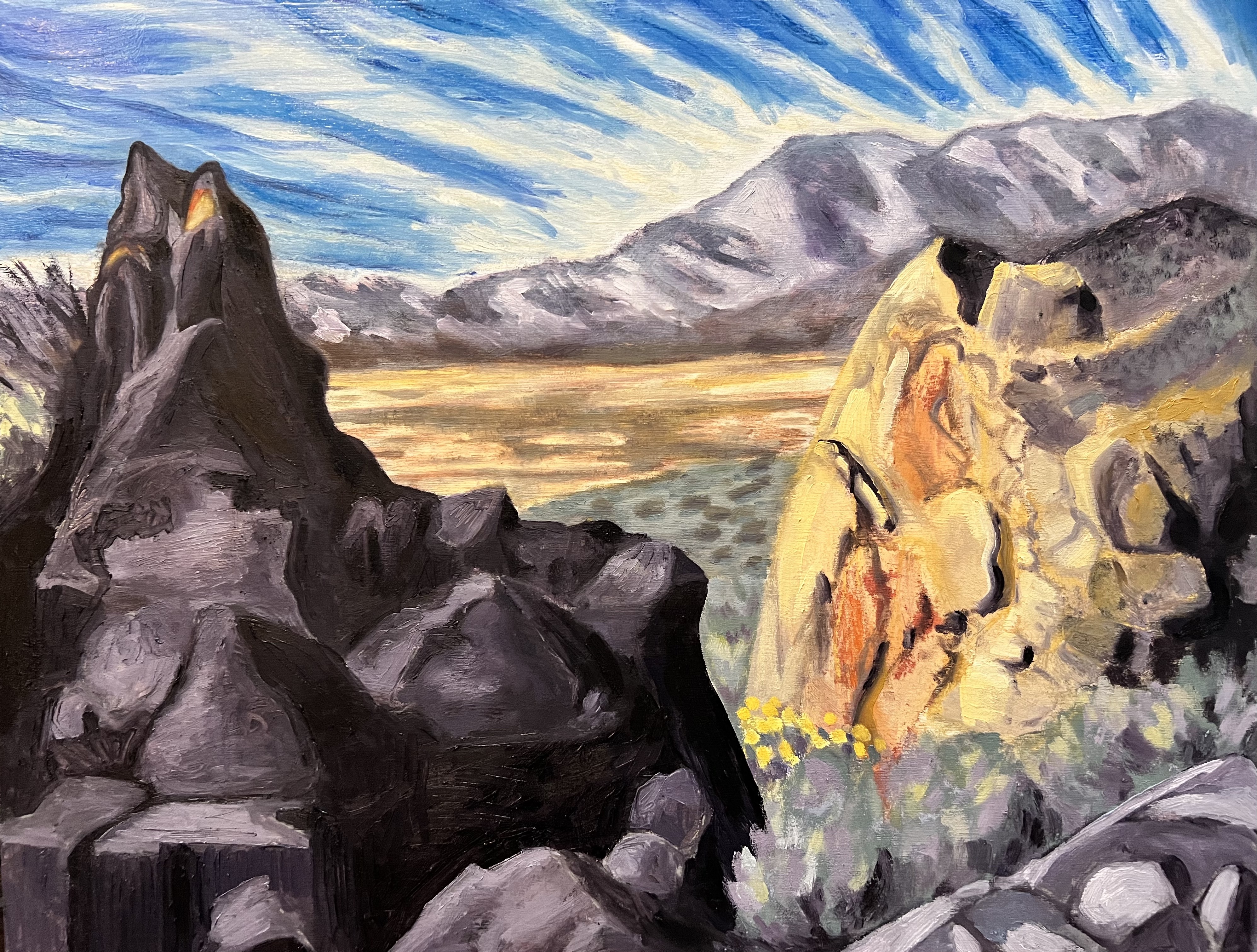
Inyo Mountains from the Alabama Hills. Robin L. Chandler, 2017
Recently, I visited the Owens Valley and gazed upon the vastness of the Sierra Nevada and the Inyo Mountains. Mountains and sky: in that infinite space, their beauty humbled me. In that quiet desert, I opened my soul to their medicine. For two solitary days, I painted Mt. Whitney and the Inyo Mountains from vantage points in the Alabama Hills becoming part of their story. And now, healed by their beauty, now part of their family, I understand how vast humans can be…..when we open our hearts.
Thomas Lowe Fleischner says it best in Nature, Love, Medicine: Essays on Wildness and Wellness, “but each day we start anew and walk out into a world that is full of sorrow and injustice, yes – but that is also heartbreakingly beautiful. Despair must not overrun our appreciation for this world – plant and animal, stone and sky, and human souls – that is immeasurably lovely, more beautiful than it needs to be, in spite of the grief that is embedded within it.”
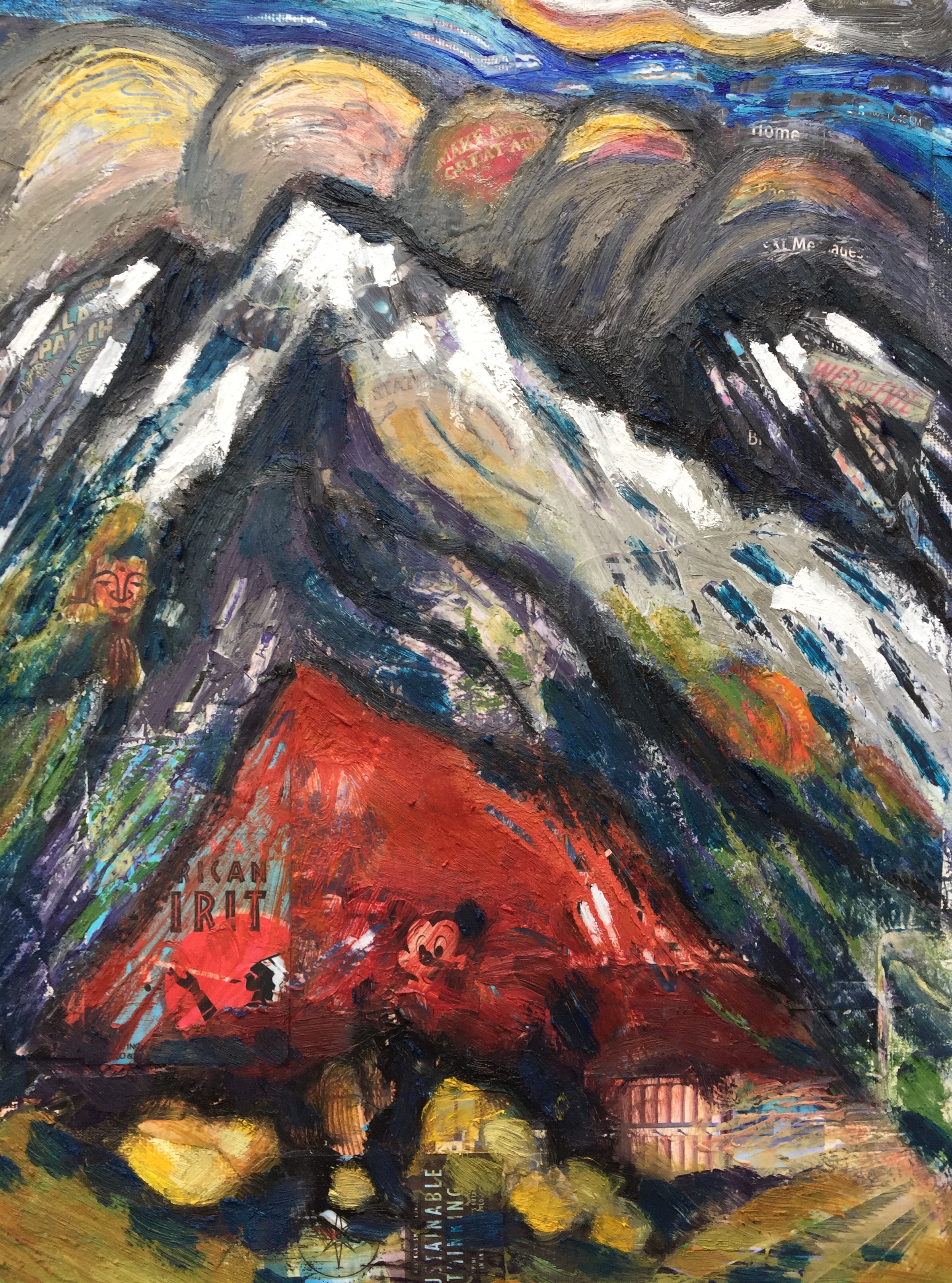
Mammoth Mountain from Minaret Summit. Robin L. Chandler, 2017.
The Tang Dynasty’s Wang Wei is revered in China as a poet, painter, and practitioner of Ch’an (Zen) Buddhism. And for good reason when you read and savor Wang Wei’s work. Wei is considered to be the first Chinese painter to capture the inner spirit of the landscape, originating the mountains-and-rivers tradition beloved by the Buddhist poet Gary Snyder. In his book Mountain Home, David Hinton writes “Wang Wei’s poetry is especially celebrated for the way he could make himself disappear into a landscape, and so dwell as belonging utterly to China’s wilderness cosmology. In Ch’an practice, the self and the constructions of the world dissolve until nothing remains but empty mind or “no-mind.”
A few weeks ago, I travelled with the best companions, reaching the Eastern Sierra and our campground at Convict Lake, after many hours of driving. During our respite, we visited Hot Creek, Long Valley Caldera, Mammoth Mountain, Minaret Summit, and Mono Lake. Walking or sitting amongst the beauty, we were emptied and replenished reaching an awakening, if not the hoped for enlightenment. Wang Wei’s poetry came to mind as I reached for and drank deeply from the cup of friendship and nature. In the Mountains, Sent to Ch’an Brothers and Sisters Wei wrote:
“Anthropocene is the voguish and not yet officially adopted term to describe the first geologic epoch in Earth’s history to be characterized primarily by the impacts of human activity, global warming foremost among them,” writes Glen Martin in the article Hell or High Water: How Will California Adapt to the Anthropocene?
How can I reach others and help them see that for the first time in humankind’s existence – a time now considered the Anthropocene – our actions are raising the temperature of the heavens, the oceans, and the land and thereby changing the fate of all creatures inhabiting these spheres. We must understand the actions we take today impact future generations. And we must understand that human consciousness is formed by our relationship to the sky, the seas and the land: the sky our infinite possibilities, the sea our mystery and the earth our enduring home. What will our consciousness become if the heavens, the oceans and the land are irrevocably changed? What if the air is too dirty to breathe? What if water is a scarce commodity? What if the land is stripped bare and emptied of the creatures with which we currently share this planet? What will it all mean? “We simply need wild country available to us, even if we never do more than drive to it’s edge and look in. For it can be a means of reassuring ourselves, of our sanity as creatures, a part of the geography of hope.”[1]
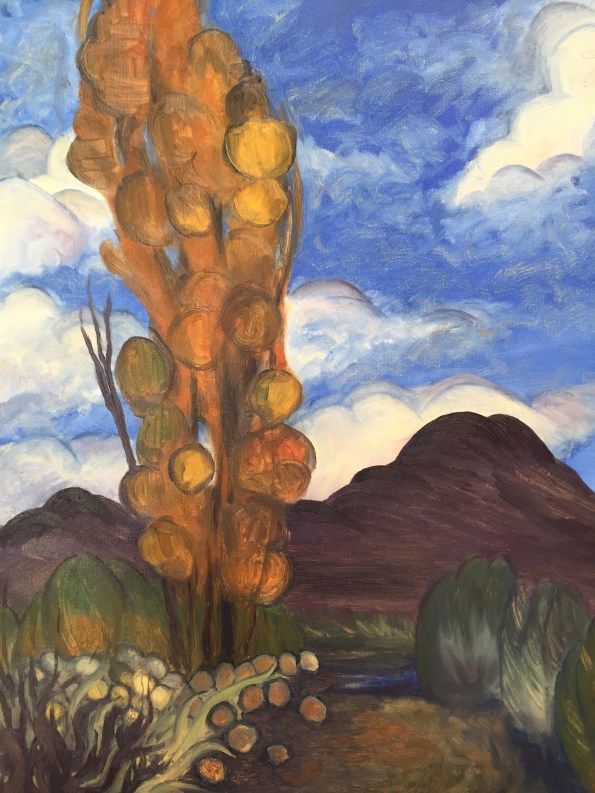
Cottonwood near Bishop, California. Robin L. Chandler, 2016.
The snow, fondant-like, blanketed the mountains. Rushing down the canyons, the rain wrote creeks on the landscape, like icing, on a cake. October brought me to the big empty, the Owens Valley, the tectonic, volcanic landscape, now a desert, once a vast ocean. The thirsty cottonwoods grow alongside the Zen-like creek, waiting months, sometimes years, for the river they know will come. In the big empty, I sang a prayer for this land. Staring deeply, intently at the mountains and the rivers, imagining the ocean that once was, I sang this blessing by Nanno Sakaki[1] for what was and what can be:
“One day from the ocean, from yesterday, I’m sure
A lost hump-back whale will swim up this river.
And someday, from the ocean, from tomorrow,
Countless whales will swim up the river
To revisit the ancient beech forest,
Whales swimming up the river, up the river.”
A few weeks later, I stand before a Marsden Hartley work, painted in 1918, entitled The Last of New England – the Beginning of New Mexico hanging in the Chicago Art Institute. Writing to his friend, Alfred Stieglitz, Hartley described the Southwest: “I like the country very well for it is big and clean and true, and there is nothing dirty standing between one and the sunlight.” Standing before this work, I absorbed the intensity of the landscape realized in the painter’s forms and colors. Like Proust and his tea and madeleines, the painting roused my memory of the Eastern Sierra desert, big and clean and true. Now more than ever, we need people to stand up and speak out like the Sioux tribal leaders now singing their prayers in protest of the pipeline at Standing Rock. We do not need anything dirty, like an unnecessary pipeline, standing between us and the sunlight on the land.
A great shadow threatens the land. Lies and abuse, dressed as truth and normalcy, threaten our democracy, so tenuous, so often taken for granted. To heal our selves, we must take our song to the streets and valleys and together loudly sing our prayers for our land, our peoples, and our democracy. It will be a tough fight, but we must continue to urge national investment in clean and renewable energies and demand the cessation of investments in projects like the pipeline perpetuating fossil fuel dependence. Here at home, the LA Times reports that California leads the nation in energy productivity, electricity from renewable resources, and reductions in carbon intensity. Like the Shaman, we will raise our voice in song to heal ourselves, each other, and our community. Together, open, guiding, we will sing our love of the land we hold so dear.
Because the whales will swim up river, only when they hear our song.
Cottonwood in the Owens Valley. Robin L. Chandler 2016
The lights dimmed and the spotlight focused on the figure center stage guitar in hand; she began to sing, the voice a little smoky and raspy, working towards the high, round notes so clear in my memory. Soon, “Saint” Joan Baez sang two of my favorites by Bob Dylan and Woody Guthrie respectively, “With God on Our Side” and “Deportee,”. Both songs are stories of love and tragic loss. Each story holding forth the possibility of redemption, that we can learn from our mistakes and take right action.
Election eve, the significance of this sainted singer was not lost on any of us in the audience. This deeply disturbing election season nearly over, we drank deeply of the songs offered us, believing in the promise of a world where all persons count, no matter their origin or identity, and that the fabric of our society is stronger, when our diverse threads are woven together. Listening, my heart responds, I will march again to her call to action to build a better and loving world.
Between songs, she spoke about her belief in the ideas and aspirations expressed by Bernie Saunders as he crossed the county this year connecting with the hopes and ideals of a new generation. But she also spoke admiringly of the courage of Hilary Clinton, withstanding the barrage of lies and intimidation hurled at her these last months.
On my recent trip to the Eastern Sierras, many a cottonwood was growing, singularly, isolated from other trees in the valley, telling a story, stately and proud. In some cases, it was unclear if a tree was near death because of lack of water, or if it was merely beginning the long winter sleep. These trees standing statuesque on a parched landscape, with the majestic sierras as their backdrop, called to mind the elm trees, deemed Liberty Trees by the colonists turned patriots at the time of our Revolution. The first such elm was located in Boston and celebrated in the revolutionary poetry of Thomas Paine. Soon Liberty Trees were anointed in towns and cities throughout the colonies; these majestic trees witnessed calls to action, celebrated victories, and mourned defeats. Trees bear witness to our story, and with this act they become part of our own story, symbols of strength, longevity, knowledge, loss, and redemption.
We are participating in the most historic election of our time. The stakes are high; it feels like the future of our nation and perhaps the world weighs upon our ballot box. At times, I have been paralyzed with fear of what may come. But I also know that there are persons, my fellow citizens, who think differently than I and will vote differently than I, and they too are fearful of change. And yet, we are all part of the same country, and we must move forward together, whatever changes comes. I think of the lone cottonwood in the Owens Valley, thirsty. Is the tree telling a story of suffering brought on by a changing climate? Is it hanging on for dear life hoping for the redemption winter snow in the mountains will bring? Is this cottonwood a symbol of my republic gasping, near death? Listening to the tree, my heart responds. While I fear the change that the election could bring, I will be strong like a tree, making connections, bringing the long-view, and sharing all the knowledge and wisdom found deep in my core. I will take right action continuing to build a better and loving world respecting the rights of all living beings.
Trees burned by fire in the drought stricken Owens Valley. Robin L. Chandler Copyright 2016.
Thanks to an early start, we reached the Owens Valley just before the storm closed Tioga Pass for the winter. Snow had dusted the peaks cradling Tuolumne meadow. There would be no pie today as we passed the Tioga Pass Resort; the diner long since closed, the windows boarded until the spring snowmelt. We were giddy, caught in the romance of the storm; dark thick clouds promised snow and rain to assuage our five-year drought.
Descending to Mono Lake, we made a right turn onto 395 towards Bishop and the Eastern Sierra Interpretive Association’s (ESIA) inaugural conference on the history of the eastern sierras. This is a desolate land, whose emptiness holds so many stories to be shared. The Owens Valley straddles two counties: Mono and Inyo. Mono County defined by Mono Lake and the volcanic fields at an elevation of 7,000 feet and the Mammoth Lakes ski resort. Inyo County, the table drops sharply, thousands of feet in altitude is lost, as we descend into ranch lands, cottonwoods and the meandering Owens River. We stopped often, capturing with camera and brush the conversation between brooding sky, dark mountains, parched landscape, and autumnal trees. A photographer and a painter, drawn to this sacred place, finding poetry at every compass point.
At the ESIA conference, David Carle spoke about water and the historic choices that shaped California. A long-term California State Park Ranger, Carle now writes full-time about land and water issues facing our state. According to Carle, in 1902 Los Angeles was a small town of 100,000 people, with a promising citrus industry, but desperately seeking water. Led by the engineer William Mulholland, businessmen and city planners set their sights on the Owens Valley, a region of 8,000 residents with a 75,000 acres of farm and pasture land producing 51,000 bushels of wheat annually. The Owens Valley also held lakes and rivers fed by the water stored in the snow covered Sierras. The aqueducts were completed in 1913, but it didn’t take long before Los Angeles was thirsty again. By 1924 Owens Lake was a dry lake bed where dust storms raged. Los Angeles had purchased all the water rights in the valley, but by the mid-1920s they owned all the towns too. Communities had been destroyed and ecological disaster created for the region. The author Mary Austin asked “ is all this worthwhile in order that Los Angeles should be so big?” Today, Los Angeles Department of Water and Power (LADWP) is working hard to implement water reclamation, and to their credit most of Orange County’s water now comes from reclamation. But for some, there will never be enough water, Southern California’s thirst will not be slaked. The proposed Twin Tunnels Project would move water from the Sacramento and San Joaquin Rivers to the southland. Recently, LADWP purchased five islands located in the heart of the river delta, just as LADWP purchased the Owens Valley a century ago. Stop the Tunnels provides information about establishing fair water policies in California.
Looking out across the Owens Valley, at a land so near, so precious, it is scary to know that actions taken by a few powerful people, so far away, change the land and communities forever.