there’s many a river that waters the land

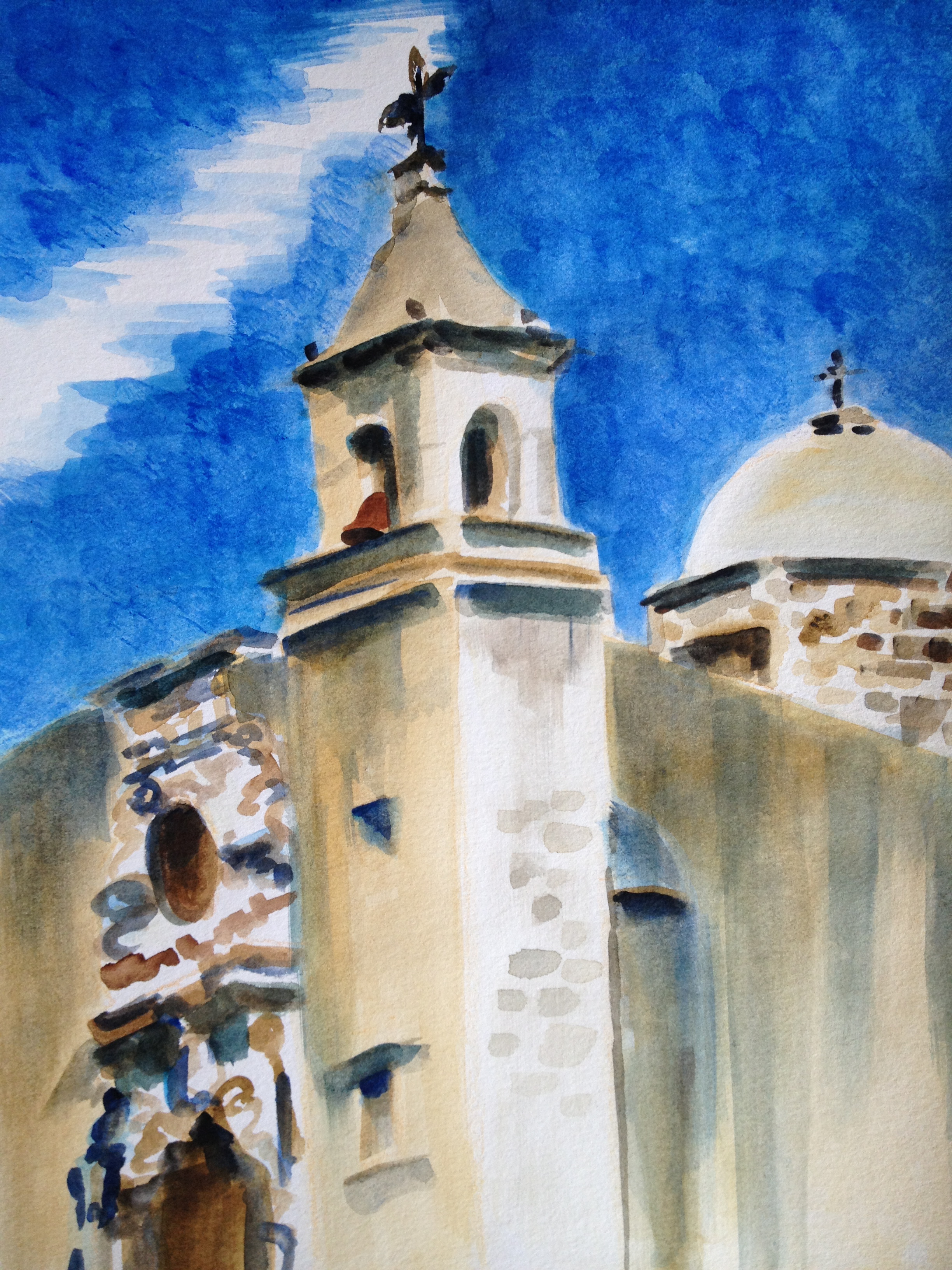
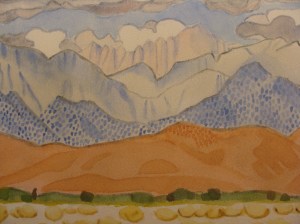
Springtime along Salado Creek, Texas.  Copyright April 2013 Robin L. Chandler
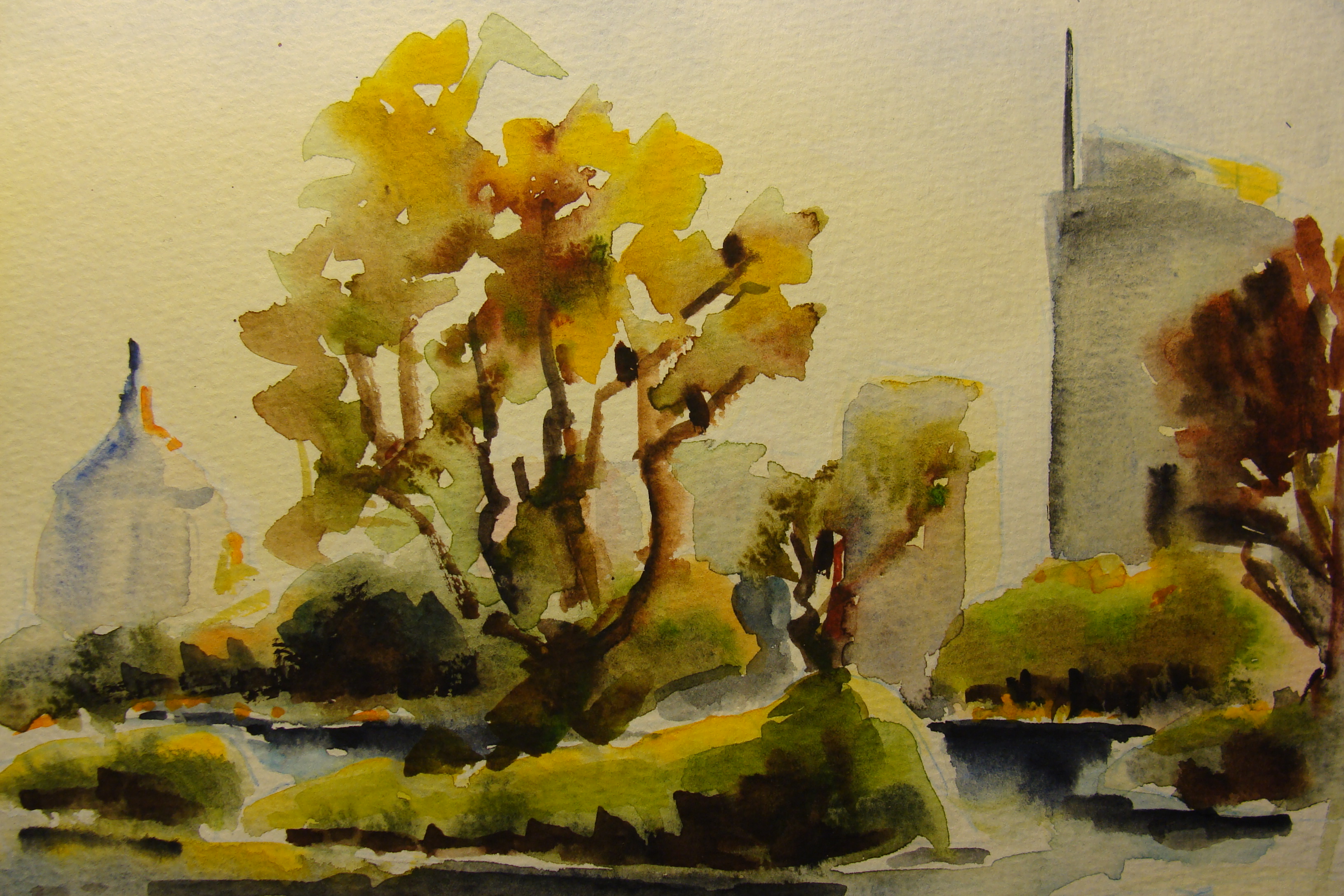
Springtime. Cottonwoods and willow trees along Salado Creek, Texas. Copyright 2013 Robin L. Chandler

“The Rivers of Texas” is an old cowboy song that mentions fourteen rivers in the Lone Star state; Lyle Lovett recorded his version  – The Texas River Song –  on the album Step Inside This House. My good friend Bill tells me Townes Van Zandt also recorded this classic. This excerpt of lyrics comes courtesy of Verne Huser’s book Rivers of Texas:

“We crossed the broad Pecos and we crossed the Nueces, Swam the Guadalupe and followed the Brazos; Red River runs rusty; the Wichita clear. Down by the Brazos I courted my dear…The sweet Angelina runs glossy and glidey; The crooked Colorado flows weaving and winding. The slow San Antonio courses the plain. I will never walk by the Brazos again.”

Nomadic by circumstance, or maybe I just like driving, I am on the road again, speeding northward into the oncoming night from San Antonio towards Austin and Waco.  I laugh out loud recalling an essay in High Country News by John Daniel; in A Word In Favor of Rootlessness he wrote “marriage to place is something we all need to realize in our culture, but not all of us are the marrying kind…it makes me very happy to drive the highways and back roads of the American West, exchanging talk with people who live where I don’t, pulling off somewhere to sleep in the truck and wake to a place I’ve never seen.” Out my side window, I search for the “Old Yellow Moon,” Emmylou Harris and Rodney Crowell croon about on my CD player.  Running north – south, I-35 intersects a series of rivers crisscrossing Texas roughly north-west to south-east; I catalog them in my mind: San Antonio, Guadalupe, Colorado and as I get closer to my destination the tributaries to the Brazos including the Leon, San Gabriel and Little Rivers and of course Salado Creek.

Mission San Jose, San Antonio, Texas.  Copyright April 2013, Robin L. Chandler.
Mission San Jose, San Antonio, Texas. Copyright 2013, Robin L. Chandler.

This year, Texas like many places in the Western and Midwest United States is suffering from drought. Not enough rain is falling to soak into and heal the land, fill the reservoirs and aquifers and bless the riparian areas providing a respite to migratory birds and a home for wildlife along the streambeds. At the same time the demand for the life-giving water grows for agriculture, industry, and the expanding suburbs.  In the thirty-some odd years I’ve been coming to Central Texas the population keeps increasing; more houses, more malls and with this expansion the burgeoning need for water.  But this is not a new story.  In San Antonio, I travelled parts of the San Antonio River Walk heading south to the Historic Missions National Park. Built in the early 18th century, close to rivers, the mission communities constructed dams and aqueducts to guide water for irrigating crops and powering flourmills.  The Belton Lake Dam on the Leon River is a 20th century version of the mission acequias; Belton just provides a lot more water for a lot more people.  The grandfather of Texas conservation, John Graves, wrote a book Goodbye to A River, published in 1959, now considered a classic about his late 1950s canoe trip down the Brazos River.  The book is often cited as a major reason only a limited number of dams were built on the Brazos. The current drought places a strain on stored water supplies.  But what can we do to make sure that there is enough water for all those  who need it, including the native plants and animals? In the 13th Century, it is believed the Anazasi left the Colorado Plateau for the Rio Grande valley of New Mexico when extreme drought caused these peoples to abandon their homes.  Where could we go?

Nomad that I appear to be, place and community do obsess me. Wherever I land, I want to understand the context of the place – the land and its people. I do not feel geographic detachment, but I realize this ability to move quickly from place to place comes at an expense. In Teaching About Place Hal Crimmel published the article “Teaching About Place in an Era of Geographical Detachment.”  Crimmel states “technology enables escape from any particular locale, accelerating the process of geographical detachment.  In fact, living in place may have more to do with restraint than passion these days.  Unprecedented access to distant energy sources, such as natural gas piped across the continent, and to mechanical or electrical technologies means people need not live within the ecological limits imposed by climate and topography.” I feel the contradiction deep in my bones; I hope my Prius buys me some credit when my judgement comes.

green fire

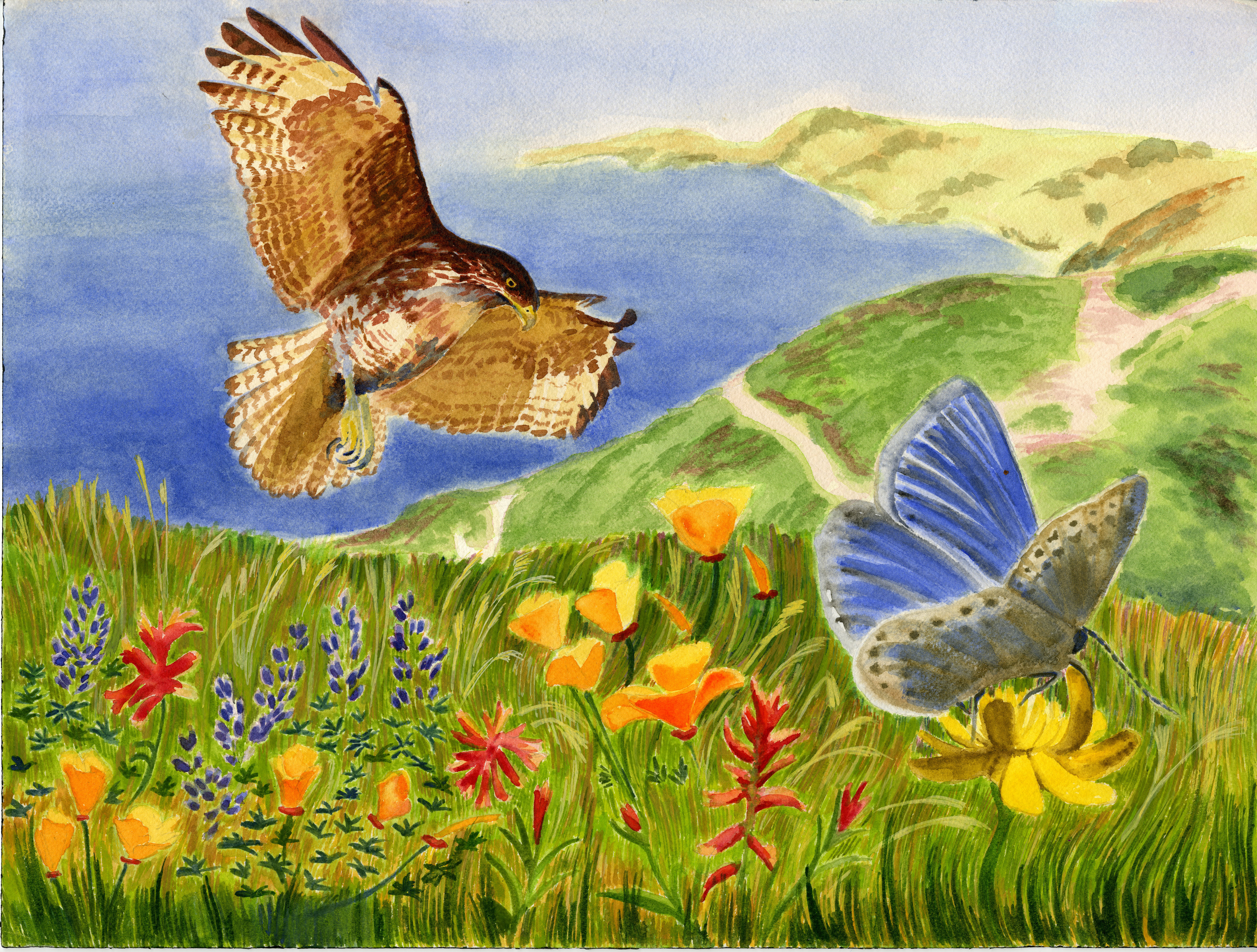
Hiking on the Bolinas Ridge Trail at the Geography of Hope. Copyright Robin L. Chandler
Hiking on the Bolinas Ridge Trail at the Geography of Hope. Copyright 2013 Robin L. Chandler

In his essay Thinking Like a Mountain, Aldo Leopold recorded the moment his ecological thinking evolved. “We reached the old wolf in time to watch a fierce green fire dying in her eyes.  I realized then, and I have known ever since, that there was something new to me in those eyes – something known only to her and to the mountain.  I was young then and full of trigger-itch; I thought that because wolves meant fewer deer, that no wolves would mean hunter’s paradise.  But after seeing the green fire die, I sensed that neither the wolf nor the mountain agreed with me.”

Leopold spent a lifetime as a forester, a professor and an environmentalist developing his ideas and perspectives on the ethics of nature and wildlife preservation. Ultimately, his philosophy, evolving over years of observation and contemplation became known as his Land Ethic, which is at the core of his most beloved book A Sand County Almanac.  Aldo Leopold joins Henry David Thoreau and John Muir as one of our three great American wilderness visionaries and writers.

This weekend March 15 – 17, 2013, Point Reyes Books (near Tomales Bay) is hosting its 4th Geography of Hope Conference entitled Igniting the Green Fire: Finding the Hope in Aldo Leopold’s Land Ethic. Typically held in March, these intellectual and spiritual gatherings are a gift to celebrate the coming of spring and rebirth encouraging us to think deeply about our relationships with the earth and our fellow living beings. At the conference’s center is the film Green Fire: Aldo Leopold and a Land Ethic for Our Time, a wonderful film directed by Steve Dunsky, edited by Ann Dunsky, written by Stephen Most and narrated by Curt Meine.  It was announced at the conference that the film would be shown on PBS stations nationwide in April 2013.

Surrounding the film is a series of panel discussions with writers, thinkers and doers engaged the building of communities, the importance of stewardship and discussing our responsibilities to the land and to each other. One of the most compelling conversations has been with Michael Howard, Director of Eden Place Nature Center (part of the Fuller Park Community Development Corporation).  Inspired by Leopold’s belief in the importance of community and the land, Michael Howard has built a park and a farm for the African-American community on Chicago’s South Side.  “Eden” is in a place that was the former site of meat packing industry slaughterhouses, also polluted with lead poisoning which has impacted the ability of children to learn for generations.  Howard deeply moved me with his work to try to persuade a people about the benefit of having a relationship with the land; a people whose daily concerns are about having money to pay bills and feed their children and who have spent years running away from a specter of linking the land to sharecropping and slavery.  Michael Howard’s experience evoked for many conferee’s Paul Hawken’s Blessed Unrest about the emergence of non-profit and community organizations engaged in the environmental and social justice movement.

There is so much wisdom flowing from this conference, I will need days, weeks, perhaps a lifetime to really grasp and understand it all, and to see my thinking evolve as Aldo Leopold has demonstrated.  But what rings clear and true is this: we need to understand that change is something that happens gradually, and it comes by engaging in deep listening, exchange with and respect for both humans and the land. We must learn to “think like a mountain.”

put down a color the paper will like

Earth, trees, sea and sky: Santa Cruz oil sketch. Copyright 2012 Robin L. Chandler

Like John Marin, I am a watercolorist who has begun to paint in oils.  In the the 1920s, Marin’s watercolors, as Winsow Homer’s before him, had again shown that watercolor need not be considered a second rate medium.  Seeking to explore new directions for his work, in the 1930s, Marin chose to experiment in oils. The experiment succeeded resulting in a dialogue across the two mediums spanning the rest of his life.   Marin’s choice of subject also draws me to his paintings.  Throughout his career, Marin was captivated by architecture but deeply inspired by what he described as the essential forces of nature: earth, trees, sea and sky.  Although sometimes associated with movements such as Abstract Expressionism or Surrealism because of his symbolic lines and evocative forms, Marin never considered himself a theoretician.  In the retrospective catalog of his work John Marin, 1870 – 1953: a centennial exhibit organized by the Los Angeles County Museum of Art, Larry Curry, curator writes “he had no patience with any kind of art that had its origin within the mind without reference to the outside world.  As a rule when Marin attempted to explain his work, he spoke of subject matter and his subjective reaction to it.”   Marin wrote “you cannot create a work of art unless the things you behold respond to something in you.”  Drawn passionately to landscape, my most successful paintings are born from a connection to place.  The paintings flow readily from this connection.  When I paint, Aldo Leopold’s words also resonate with me. In Sand County Almanac, Leopold writes,  “we abuse land, because we regard it as a commodity belonging to us; when we see land as a community to which we belong, we may begin to use it with love and respect.” Torn between a love of the road and a desire for roots, I am inspired to paint place when I sense the  intersections between land and people attempting to live honorably with it. John Marin, excerpted from the book John Marin by John Marin, strikes a similar note  when he describes how to paint a landscape. “First you make your bow to the Landscape – then you wait and if and when the Landscape bows to you then and not until then Can you paint the Landscape.”

in every grain of sand there is a story

Otters at Elkhorn Slough. Copyright 2012 Robin L. Chandler

The thirty-eight miles from Santa Cruz to Monterey can be a very busy road to navigate.  Route One is a major corridor with trucks carrying produce from the fields, and cars transporting farm workers, fishermen, tourists, recreation seekers of every stripe, and people like me who live and work at least part of their lives in this region.  Hurtling through space, my eye catches glimpses of life’s daily epic poem acted-out by the inhabitants – people, plants and animals – of this region.

Our Elkhorn Slough epic begins near Moss Landing, now a man-made harbor, but once an estuary, part of the Pajaro-Salinas river system that historically shared a common entrance to the Pacific Ocean.  Launching kayaks recently on a cold gray Sunday morning, we were treated to a new chapter in this epic story.  An important component of the Pacific Flyway for migratory birds, the harbor and slough are populated with many species. This day we spotted Bandt’s, Double-crested, and Pelagic Cormorants; Brown and White Pelicans; Common Loons; Clark’s, Western and Horned Grebes; Forester’s Terns,  and shorebirds including Curlews, Dowitchers and Godwits.  Elkhorn is also home to many marine mammals.  Hauled out on the beaches and mud banks, harbor seals and pups nap after a busy night seeking nourishment in the waters of the Pacific.  Sea Lions rest comfortably piled-up on man-made docks. At low-tide, we spot Sea Anenome’s anchored to pilings and there secure amongst the now visible Eel Grass and occasional wayward kelp strand, we find mother Otters and their pups.  The epic story of one such Otter pup is told in the movie Otter 501, a visual poem to stewardship.  Paradoxically, Elkhorn Slough  –  a safety net to many animals and plants –  is situated amongst a complex and encroaching human ecosystem including a  vibrant agricultural economy, a regional power plant, an active fisherman’s harbor, recreational area for birders, hikers and kayakers, and a major north-south highway transporting people and goods.   It is through tireless stewardship that these animals and plants survive in this amazing place.

To the uninitiated speeding by in their cars, Elkhorn Slough is just a flash of light reflecting off water, punctuated mostly by the two power-plant towers dominating the skyline.  But for the animals and plants it is a sanctuary part of the Monterey Bay National Marine Sanctuary (MBNMS).  In 1992, MBNMS became a Federally protected marine area offshore California’s Central Coast. Stretching from Marin County to Cambria near Hearst’s Castle San Simeon, the sanctuary encompasses some 276 miles of shoreline and over 6,000 square miles of ocean.  MBNMS is the home to one of the most diverse ecosystems in the world with more than 33 species of marine mammals, 94 species of birds and 345 species of fish.  MBNMS partners with organizations and institutions such as the Elkhorn Slough Foundation, the Monterey Bay Aquarium and research universities including the University of California and Stanford to preserve, perform research, and educate citizens about co-existing as members of this ecosystem on the central coast.

Elkhorn Slough is a fragile marine ecosystem.  Most of us quickly drive by the Slough, preoccupied with getting to our next destination. Most of us don’t grasp the Slough’s role as a sanctuary in an epic poem, and fewer grasp that we are actors in the story and that have responsibilities to co-exist with the animals and plants as members of this ecosystem.  We can actively choose to act as stewards; we can choose to oversee and protect places like Elkhorn Slough, places worth caring for and preserving because they provide sanctuary to living creatures  that enrich our lives and ensure our survival both spiritually and physically. Anyone can be a steward; it can be as simple as recycling plastic bottles and composting vegetable waste or casting a vote to raise tax revenue to keep California State Parks open and education affordable for students at the University of California.  Stewardship is becoming a member of the Elkhorn Slough Foundation to help create conservation easements or becoming a volunteer naturalist with the MBNMS or taking a child to the Monterey Bay Aquarium to teach them about the wonders of the ocean.

Stewardship is a story that must be shared with others, repeatedly.  Saddened, I fear that for every story told, there are thousands of people who will never hear the story, therefore never be educated to learn about and understand their role as stewards.  With education, we build empowerment, foster discussion, enable understanding, and  realize just actions through compromise.  These are noble aspirations, and evidence abounds that it is always an uphill battle.   However, as the church of baseball teaches and Yogi Berra preaches, “it ain’t over till its over.”   At the bottom of the ninth with two outs and down by five runs, the Sisyphus at the plate knows heaven is found in the uphill struggle (described in the The Great Wave blog entry).   And so we must continue the hard work to learn and to teach each other about our responsibilities as stewards of ecosystems, no matter how great the odds.  As Rachel Carson wrote in her 1958 article Our Ever Changing Shore republished the book Lost Woods: The Discovered Writing of Rachel Carson, “in every out thrust headland, in every curving beach, in every grain of sand there is the story of the earth.”

Dark, salt, clear, moving, utterly free*

Marin Headlands on the Pacific Ocean. Created by Robin L. Chandler. Copyright 2010 National Park Service.

In Moby Dick, Herman Melville described the Pacific Ocean as the “tide-beating heart of the earth that makes all coasts a bay in it.”   Describing the interconnectedness of the lands ringing the Pacific Rim he wrote “the same waves wash the moles of the new-built Californian towns, but yesterday…..lave the faded but still gorgeous skirts of the Asiatic lands, older than Abraham; while all between float milky-ways of coral isles, and low-lying, endless, unknown Archipelagoes, and impenetrable Japans.”  On Friday March 11, 2011, mankind was humbled by a 9.0 magnitude quake striking the northeastern coast of Japan and triggering a Tsunami whose force quickly silenced thousands of voices near Sendai and damaged harbors – including Crescent City and Santa Cruz –  5,000 miles to the east along the North American coastline.  Nature will always bind what man’s competitive psyche seeks to distance.  Hokusai’s woodblock print “The Great Wave” part of his  series Thirty-six Views of Mt. Fuji has long been a favorite of mine; mesmerized by the beauty of the wave, it is only now, newly humbled, that I truly grasp the precarious position of the fishing boats depicted in the print.

Last weekend I attended the Point Reyes Book’s third Geography of Hope conference bringing together people, place and literature to discuss water as both a life-giving and a life-taking force.  As rain poured outside in biblical proportions, the Japanese people were never far from our consciousness in this community located on the San Andreas Fault so near the Pacific Ocean.   An inspiring  gathering, we listened rapturously to poets, writers and scientists – including Robert Hass, Brenda Hillman, William Least Heat Moon, Tim Palmer, Philip Fradkin, Eddy Harris, Peter Gleick, Evelyn Reilly and Julia Whitty —  speak about rivers, lakes and oceans and their hopes and fears for the health of our planet.  The desire to teach children  – through art, literature and science – about the connections between humans and nature was a major theme, but concerns about the potential of social media and hand-held technology to disconnect society from the natural world was an undercurrent of the gathering.

My work as a digital archivist working in academic libraries fosters my belief that social media can be leveraged to enhance our connections with and understanding of the natural world.  If any good can be drawn from the tragedy of the Japanese earthquake and Tsunami, it is the knowledge that this is  likely the best documented disaster in recent history, and this information will be repurposed for constructive use. Numerous digital images and video recordings of the Tsunami’s destructive power were captured by survivors of these events and uploaded for sharing on social media sites. This week a BBC article published on March 21, 2011 “Japan Tsunami to Help Predict Future Waves” reported  how scientists will use this data to study Tsunamis. At the 2011 Institute for Museum and Library Services (IMLS) Webwise conference, Dr. Francine Berman, Vice President for Research at the Rennslaer Polytechnic and Dr. Joshua Greenberg, Director of Digital Information Technology and Dissemination of Knowledge Program at the Sloan Foundation delivered keynote addresses making several complimentary points: the role of the “crowd and the social network” in the generation of observational research data; the need for a macroscopic approach to gather comprehensive data sets and analyze and visualize data at scale; and the need for archivists, librarians and museum professionals to be central players in data curation workflows to appraise, manage, preserve and provide access to data supporting ongoing research.  Its important to note that this kind of work is underway.  The National Science Foundation (NSF) funded DataONE a multi-institutional and cross-discipline collaboration of universities and organizations including the California Digital Library to lay the foundation for a distributed framework and sustainable cyberinfrastructure that meets the needs of science and society for open, persistent, robust, and secure access to well-described and easily discovered Earth observational data.

Webwise also featured workshops and sessions on Libraries and Museums engaged in STEM (Science, Technology, Engineering and Mathematics) Learning.  STEM is part of President Obama’s program “Educate to Innovate,” a campaign to improve the participation and performance of America’s students in these disciplines.  Teachers, librarians and museum staff are developing many fun and engaging learning modules using social media and technology.  One particular module — Habit Tracker – caught my eye; I saw a demo of the prototype at the conference.  Using the Apps developed for iPhone and iPad2 technology, Habitat Tracker will help students learn about the nature of science by learning to ask their own questions about the natural world, recording observations, performing analysis and participating in peer review with fellow students.

A humble respect, enjoyment and love of the natural world and a belief in the utility of social media technology and services are not mutually exclusive.  They can be symbiotic and when so joined the resulting analysis can support greater understanding of the natural world and our place in the cycle of life.  It is my hope that technology advancements – like social media –  will bring individuals greater engagement with nature and help humankind shoulder the stewardship responsibilities required to ensure the natural world survives for future generations.

*From the poem At the Fish Houses by Elizabeth Bishop read by Eric Karpeles at the Geography of Hope Conference

Field notes: rain and watersheds

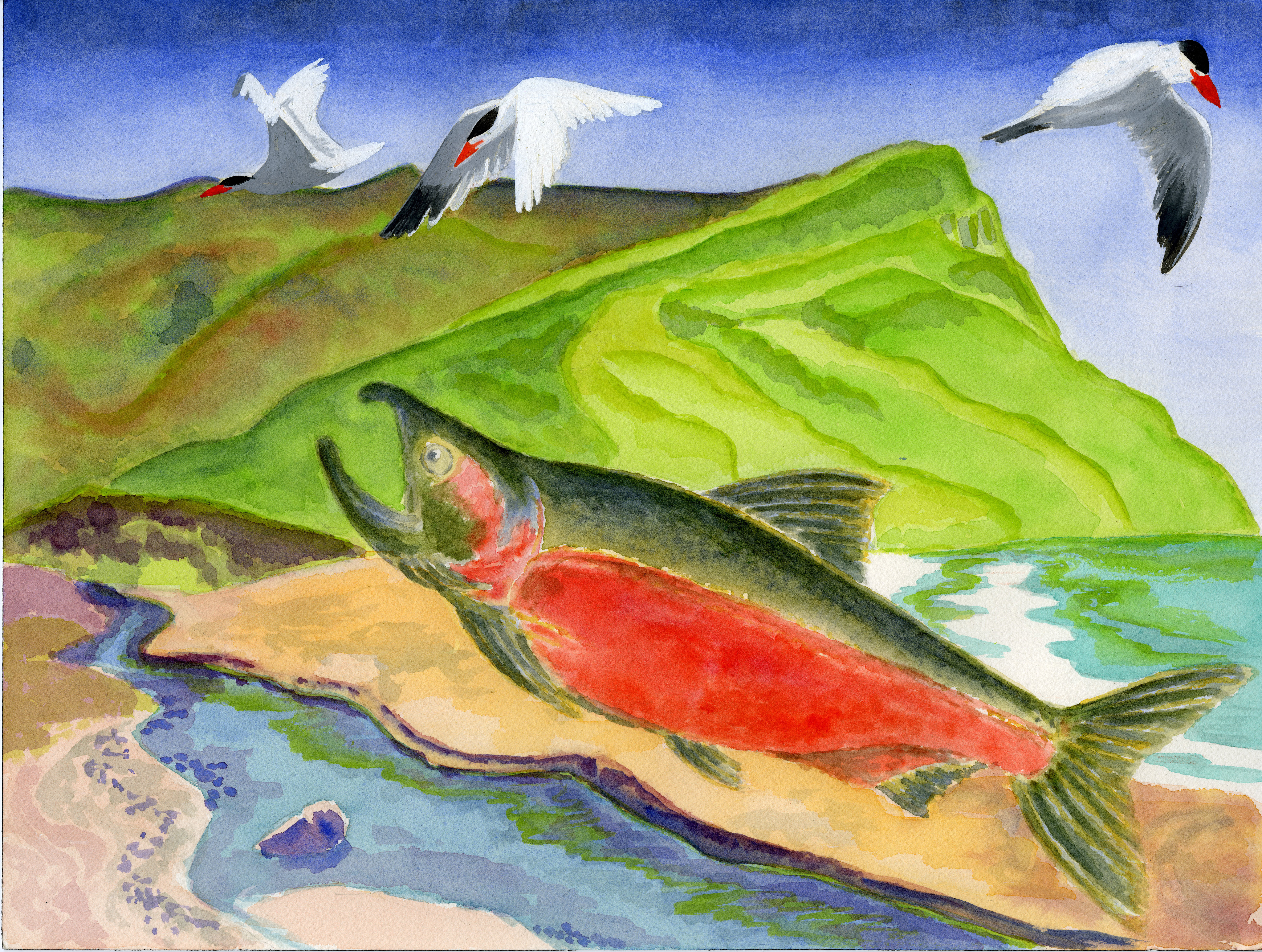
Salmon returning to Redwood Creek. Created by Robin L. Chandler. Copyright 2010 National Park Service.

In early January 2011, we participated in what is becoming a beloved annual ritual: naturalist guided creek walks in the Lagunitas watershed seeking glimpses of Coho Salmon and Steelhead Trout who have come home to spawn.  The Marin County based Salmon Protection and Watershed Network (SPAWN) is committed to restoring habitat, building community partnerships, and passing legislation supporting the survival of endangered Coho Salmon and Steelhead Trout in California and the Pacific Basin. Thankfully SPAWN is not alone; all along the Northern California coast educational, research and non-profit organizations are engaged in activities to save endangered fish species. In Marin county, the Golden Gate National Parks Conservancy is engaged in restoring salmon habitat along Redwood Creek and the river’s mouth at Muir Beach. While in Santa Cruz, increasing numbers of steelhead smolts are making their way along the San Lorenzo River back to the sea. Scientists attribute these rising numbers of Steelhead to increased rainfall and the efforts of citizens to reduce urban runoff and improve habitat.  These inroads are so important because some efforts in Southern California are foundering; recently the California Coastal Conservancy’s was forced to abandon’s its work to restore the Steelhead to San Mateo Creek in San Diego County.

For the past few years, we have been blessed with observing a pair or two of Salmon – their bodies touched with crimson – swimming upstream and building nests — called Redds – in preparation for laying eggs. But seeing these beautiful creatures is a rarity. Typically annual counts on the Lagunitas and San Geronimo creeks number only in the 60s.  Writing about Steelhead in The Sespe Wild, Bradley John Monsma described California a few centuries ago when “thousands of fish, fattened from the ocean, pool near the mouths of rivers…before dashing upstream to gravel spawning beds in the mountains.” Rain and healthy watersheds are essential for the survival of Salmon and Steelhead; rain provides easy passage for the journey upstream to lay eggs, and give birth to fry. Rain emboldens rivers and creeks to break the sand barriers to the sea permitting smolt to begin the ocean phase of their life.

People make a huge difference in building healthy watersheds. We need to care, we need to understand that our lives are better because these animals are part of our world. We need to grasp that we are living in a biodiversity crisis that can only be resolved by our understanding the power of our different interdependent lives.  Monsma quoting the human ecologist Paul Shepard writes “with the loss of species, we may be losing something essential to our humanity. It may be that we can approach the depth of ourselves only in relation to a diverse and healthy ecosystem” suggesting that mature societies are those that are “characterized by a view broad and forgiving involving a sense of the larger gift of life, a realistic sense of the self and other, a sense of the talents of generosity and circumspection.”

The Jewel of Turtle Island – Part Two

Another winter day at Lake Merritt. Copyright 2011 Robin L. Chandler

Last week we began the new chapter in our community history, Jean Quan was inaugurated as the first Asian and first woman Mayor of Oakland!  Quan brings over twenty years of experience on Oakland’s School Boards and City Council as well as the strong belief that communities and neighborhoods can work together to face the city’s challenges.  We find ourselves in challenging economic times: a deep gap exists between our expectations of government and society and the funding resources to realize these expectations.   We face tough choices in the years ahead, but we must trust and work together as a community to find the right balance. With the shooting of U.S. Congressman Gabrielle Giffords yesterday in Arizona, our society has received a startling wake-up call, and the dawn appears bleak, fueling trepidation about our abilities to discuss painful choices and work together to bring about non-violent change.  We must continue to engage each other in civil discourse to resolve our societal challenges. Our rallying cry will be a recommitment to our community, to our Turtle Island, because the alternative would be a geography of no-hope, and that simply is not an option.

Gary Snyder wrote in his book A Place in Space: Ethics, Aesthetics and Watersheds “Bioregionalism calls for commitment to this continent place by place in terms of biographical regions and watersheds.  It calls us to see our country in terms of its landforms, plant life, weather patterns, and seasonal changes….before the net of political jurisdictions was cast over it….it doesn’t mean some return to a primitive lifestyle or utopian provincialism; it simply implies an engagement with community…..some of the best bioregional work is being done in cities as people try to restore both human and ecological neighborhoods……such people are becoming natives of Turtle Island.”

The Jewel of Turtle Island – Part One

Winter day at Lake Merritt. Copyright 2011 Robin L. Chandler

Glen Echo Creek flows through Oakland’s Rockridge and Piedmont neighborhoods meandering from the East Bay Hills into Lake Merritt.  We first discovered this creek on a December Sunday afternoon after an IPA and a good game of scrabble at Catos our local pub. Glen Echo Creek daylights briefly paralleling Broadway and Piedmont for a mile before being channeled through underground culverts resurfacing to flow into Lake Merritt near the Veterans Memorial Building on Grand Avenue.   Walking home we traced the creek’s path and final destination, enjoying the reflection of Oakland’s twilight skyline and the “necklace of lights” in the water.   It was beautiful.

Walking on this cold January morning, the fresh water creeks and salty tidal flow create a flux where brown pelicans, snowy egrets, herons and cormorants seek fish and seagulls dive for mussels amongst the creek and sewer runoff, and stream of trash – a beer can, a plastic water bottle, a tennis shoe, a Christmas wreath, oil residue and the carcass of a possum – deposited after the heavy rains of December. Passing a homeless gentleman just beginning his day’s journey, I imagine this space two centuries ago when coho salmon and steelhead trout entered the estuary on their journey to spawn in one of the watershed’s four creeks** then sheltered among the redwood trees but now largely hidden, paved over with asphalt.

Ishmael Reed in his book Blues City: A Walk in Oakland describes Lake Merritt as the “largest saltwater lake in the United States….and before it was dammed it was part of the larger San Francisco Bay.”  In his discussions with Malcolm Margolin author of The  Ohlone Way and with naturalist and historian Stephanie Benevides, Reed learned the lake was originally an estuary and part of one of the largest marshlands on the Pacific Coast, a major stop of the Pacific Flyway for migrating birds coming south from Canada and Alaska for the winter. The marshlands were part of the larger ecosystem of grasslands and oak trees rising to hillsides with crevices cradling creeks and redwood trees.  Wildlife included grizzly bears, mountain lions, condors, bald eagles, deer and wolves.  In 1869, Dr. Samuel Merritt worked with the California State Legislature to make Lake Merritt the first wildlife refuge in North America.

Many an early morning, I have circumnavigated this body of water andcontemplated what an amalgam the estuary is and how this mixture serves as a metaphor for the City of Oakland.   Literally the lake is a mixture of fresh and salt water, their balances dictated by tidal influx and watershed creek runoff; and it is an urban park which merges the sublime natural beauty of  migrating winter birds, such as canvasbacks, goldeneyes and scaups, with the urban discharge of trash and waste.   Figuratively, Oakland’s jewel is a dynamic public space – a cultural estuary – where mingle peoples of many cultures, races, creeds, gender identity and sexual preference: rich and poor, young and old, the fortunate and desperate, those with homes and those heartbreakingly homeless.  They come seeking a safe harbor in which to play, exercise, rest, and draw inspiration from the tranquil beauty of the lake and its surroundings.   As Wallace Stegner wrote in his Wilderness Letter “we simply need that wild country available to us, even if we never do more than drive to its edge and look in.  For it can be a means of measuring ourselves of our sanity as creatures, a part of the geography of hope. “  Lake Merritt is Oakland’s geography of hope.

In November 2002, more than  80 % of Oakland voters passed measure DD, a $ 198.25 million bond measure to improve and restore Lake Merritt including reducing traffic, improving pedestrian and bicycle access to the park, renovating historic buildings such as the Boat House, landscaping and improving water quality through the upgrading of creek culverts and opening of the channel to the Oakland estuary.  Work has been proceeding the last several years, and we are benefitting from the fruits of these labors. New life is breathing into the lake and it’s surroundings.    But the story doesn’t end with the completion of the project — it is just the beginning of a new chapter of our community responsibility for this jewel of Turtle Island.

*for many months this homeless gentleman employed a car battery to power his television and a hotplate, setting-up camp near the Alameda County Courthouse

**the four creeks are Glen Echo, Pleasant Valley, Trestle Glen and Park Boulevard

In the shadow of the ancients

The Topatopa bluffs are part of the Condor Sanctuary in the Sespe Wilderness; the sanctuary is a space where the Condors can mate, breed and raise their chicks undisturbed by humans.  At sunset seen from the Ojai Valley, the bluffs glow “pink” from the last rays of the setting sun.

Topatopa Bluffs near Ojai. Copyright 2010 Robin L. Chandler

With their nine foot wingspan, Condors glide at fifty-five miles per hour ranging three hundred miles a day on the look for expired creatures that will sustain them.  Bradley John Monsma in The Sespe Wild writes “attempting to see the lay of the land through the eye of the condor quickly turns a wide-angle wilderness into a lesson in the limitations that we impose on other species.”  The Sespe is a crucial link in the foraging habitat used by the Condor for thousands of years ranging from the the Ventana Wilderness through the Sespe and Tejon Ranch to the Sierra Nevadas. Humankind continues to encroach upon the condor’s “home” as rolling oak grasslands situated along I-5 north of Los Angeles too often become real estate development opportunities.  But sometimes people do get it right.  In May 2008, a coalition of conservation groups – the Natural Resources Defense Council, the Sierra Club and the Audubon Society of California negotiated a conservation easement to preserve 178,000 acres in Fort Tejon that will supplement the public lands forming the condor habitat.  There are approximately seventy condors in the wild and space and water are key to their survival.  I marvel at the condor’s ability to daily traverse a “u-shaped” area from Big Sur to the Range of Light.

Mt. Whitney and the Range of Light. Copyright 2008 Robin L. Chandler

Their need for habitat, fires my imagination contributing to my personal geography.  As Stephen S. Hall writes in his essay I Mercator in the book You Are Here, “I have roamed across state lines and oceans and continents, backwards in time, each thought colored according to a personal legend, corresponding to the elevation and depressions of my private humors: pride, wonder, sadness, remorse.”  We are here, now, navigating our personal maps, facing the emptiness of our  intelligence in a space and time where nature balances precariously between our greed and our benevolence.

waves of glass

Fall is here.  There is a little chill in the air and the sun’s journey southward gives forth a particular quality of light.  This week has found me cycling as much as possible, and I naturally gravitate to the coast to ride the 101 as it meanders through the communities of La Jolla, Del Mar, Cardiff, Encinitas and Leucadia. Every few miles I get a spectacular view of crystalline blue waves peaking and crashing into torrents of white foam and see the surfers catch a wave and joyously ride the crest balanced precariously somewhere between chaos and nirvana. “Clear and sweet is my soul, clear and sweet is all that is not my soul,” wrote Walt Whitman in Leaves of Grass.

Swamis_encinitas
Sunset North County San Diego: Swami’s Beach. Copyright 2009 Robin L. Chandler

A few weeks ago, I visited Cape Cod and I was thrilled to see a group of surfers anglin’ on ankle busters, but I think they imagined the waves as a bonsai pipeline.

Truro_CapeCod
Near Truro on Cape Cod. Copyright 2009 Robin L. Chandler

The view of the ocean from the saddle of my bike is where my soul opens up, and my spirit returns to balance.  On the bike, I scout out places to paint and observe the world at a pace that allows for interaction, reflection and a laugh or two.  Yesterday it was great fun to see  Surfrider Foundation members  on street corners  in Cardiff  for their “Hold onto Your Butts” campaign.  They were spending their Saturday morning reminding us that cigarette butts do not belong on the beach.  It is another of Surfrider Foundation’s good causes  part of their beach clean-up efforts  and their larger campaigns like “Save Trestles”  which kept a  toll road out of San Onofre State Park. They do good work.  They teach us to be responsible for our beaches and oceans as we should be for any good friend.   These are two watercolors that I’ve recently painted of late afternoons  in North County San Diego and Truro on Cape Cod.  Both pristine and soul redeeming spaces.