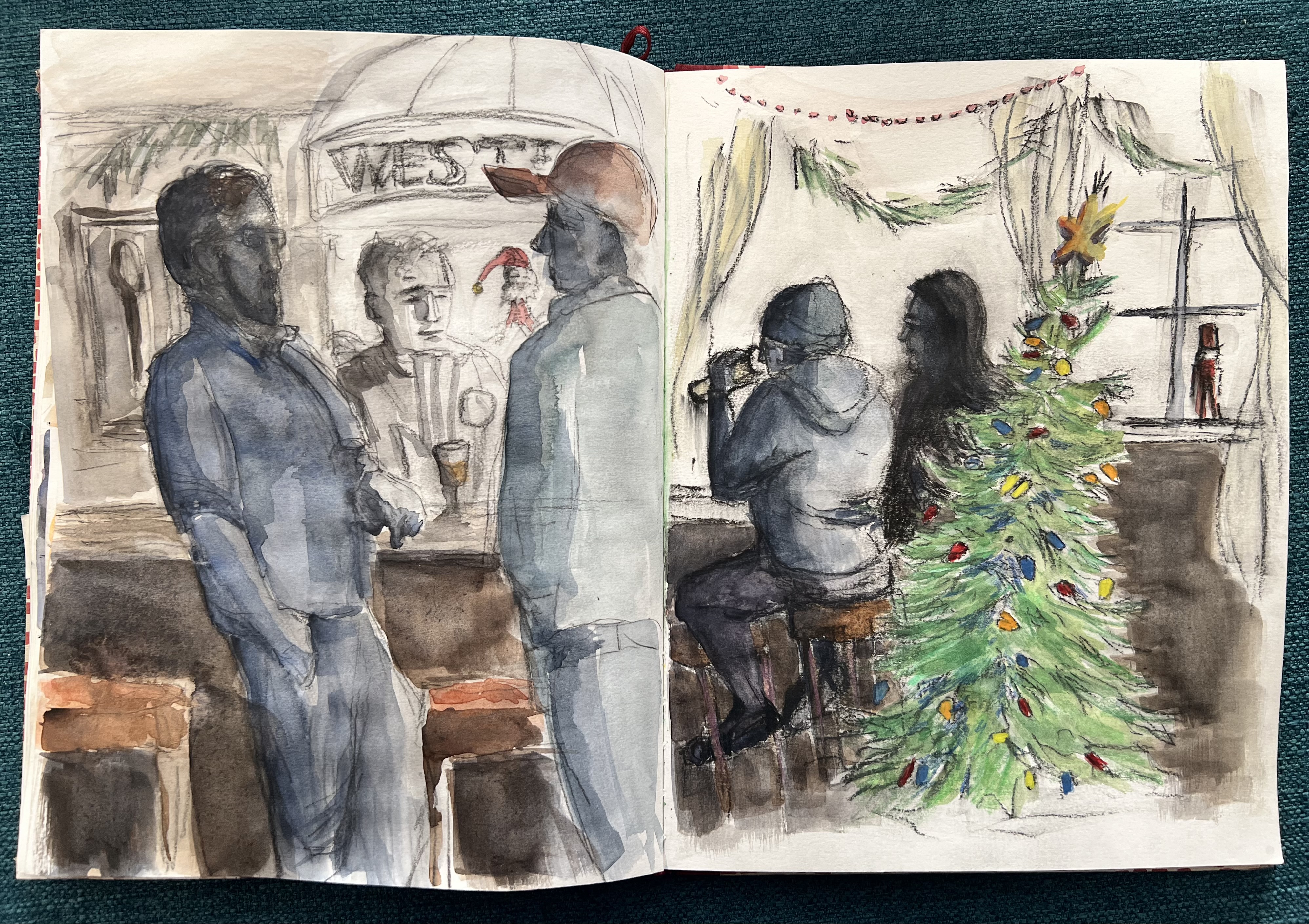
Sketch of holiday cheer in Point Reyes Station. Robin L. Chandler, 2025.
“In 1935, the National Park Service recommended an 83-square mile park, but there was no action until 1958. By this time, subdivisions were again being planned, logging was underway at Inverness Ridge, and the state was planning a freeway that would replace Highway 1 and open the area to suburban development. One lobbyist told a Congressional committee that by the year 2000
‘there will no longer be a Marin County. There will be a greater San Francisco..…the section we have under discussion today, gentlemen, will be as intensely built over as Palo Alto, or Burlingame or San Mateo.’
The MCL [Marin Conservation League] worked with Marin’s representative in Congress Clem Miller, who introduced and tirelessly promoted his Point Reyes National Seashore bill in the House, while California’s US Senator Clair Engle, pushed it through in the Senate…..In a compromise with ranchers, the park bill allowed cattle and dairy ranching to continue for 25 years in a 27-square mile “pastoral zone,” while livestock grazing elsewhere would be phased out. Congress passed the bill, and President Kennedy signed it on September 13, 1962. The park was authorized to include 83 square miles, just as the Park Service had originally recommended…..”
“Mass extinctions are extremely rare and catastrophic events, but the human-driven one is seldom deemed newsworthy by the dominant media. This is not an incidental oversight: the destruction of life’s diversity must remain invisible or obscure in the public domain, because it is fully entangled with the freedoms that people (are goaded to) value and seek.”
Long-billed Curlews at Limantour Beach, Point Reyes National Seashore in Winter. Robin L. Chandler, 2025
“Thomas Berry was a US cultural historian who introduced the broader legal concept of Earth jurisprudence early in the twenty-first century. Earth jurisprudence is the philosophy of law and human governance that says humans are just one element in a wider community of beings, and that the welfare of one speaks to the welfare of all. “The universe is a communion of subjects, not a collection of objects, “ Berry argued, and it’s through the work of people such as Stone, Berry, Kimmerer, Kolbert, and others that we are moving our collective understanding, and our will, toward a more environmentally just world. In the face of the ecological catastrophes beating down on us, we must remember the collective good of countless people as well as the rights of trees, and of the land that supports and nurtures us all.”
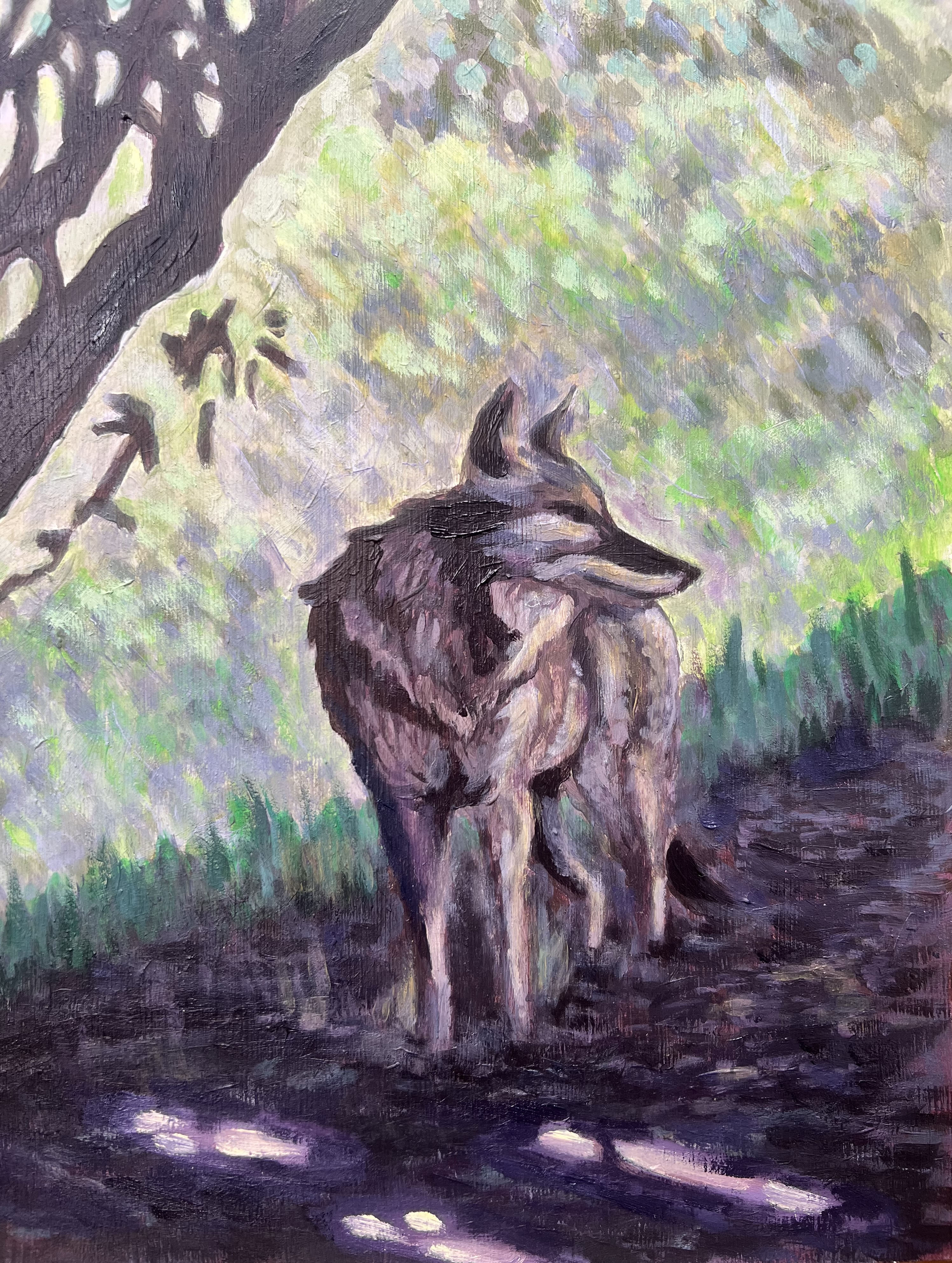
Coyote walking on the Inverness Ridge Trail, Point Reyes National Seashore. Robin L. Chandler, 2025.
“One day Old Man Coyote was bored, and so he decided to have some fun and made a basket. A big basket, round like an acorn storage basket, only much bigger and rounder…..he wove his tracks into the pattern to give a hint who’d made it. When it was finished, he put everything People would need, forever, into the basket. And then he put the basket by the trail to see what would happen.
Sure enough, along came some People, and when they saw the big basket they said ‘Hey? What’s this?’ They knew it was a basket, but they had never seen any basket this big before…..when they looked inside and saw that it had everything they needed, they said, ‘We can live in it!’ So they did.
Well. Old Man Coyote had put everything We the People would need into that basket, but he never imagined that there would someday be so many of us, and some of us would invent needs that Coyote could never imagine we needed! Pretty soon he began to hear lots of fighting and arguing in the basket. And before long some of his strongly woven strands began to tear, and the basket got holes in it, and some of the People who went in together got thrown out through the holes! Just imagine!
Well, again. Old Man Coyote wasn’t really surprised. He’s not surprised at anything, of course. Being a Trickster, he just wants to try something and see what will happen – which is why he put the big basket by the trail that day when he was bored in the first place. But…Coyote was a bit sad anyway, seeing that his gift basket had become the place for a big fight among the People. That’s why you sometimes hear him crying and singing to himself at night.” (p.178-179)
…..David Hinton, a translator of classical Chinese poetry, argues in his book China Root: Taoism, Ch’an, and Original Zenthat Ch’an began during the Tang dynasty of ninth-century China as an intellectual and cultural rebellion. Ch’an practice was seeking to recapture the feeling and experience of immediacy and wholeness of the Paleolithic human mind and to overcome the alienation of humans from the world that resulted from the agricultural revolution and its modus operandi of humans taking control of wild nature. (p.195)
…..Shunryu Suzuki wrote in the prologue to his 1970 book, Zen Mind, Beginner’s Mind, that ‘if your mind is empty, it is always ready for anything; it is open to everything. In the beginner’s mind there are many possibilities; in the expert’s mind there are few.’…..The bottom line would be that language and it’s constructs can get in the way of nondual, holistic perception and experience, of what Suzuki Roshi called beginner’s mind.” (p.196)
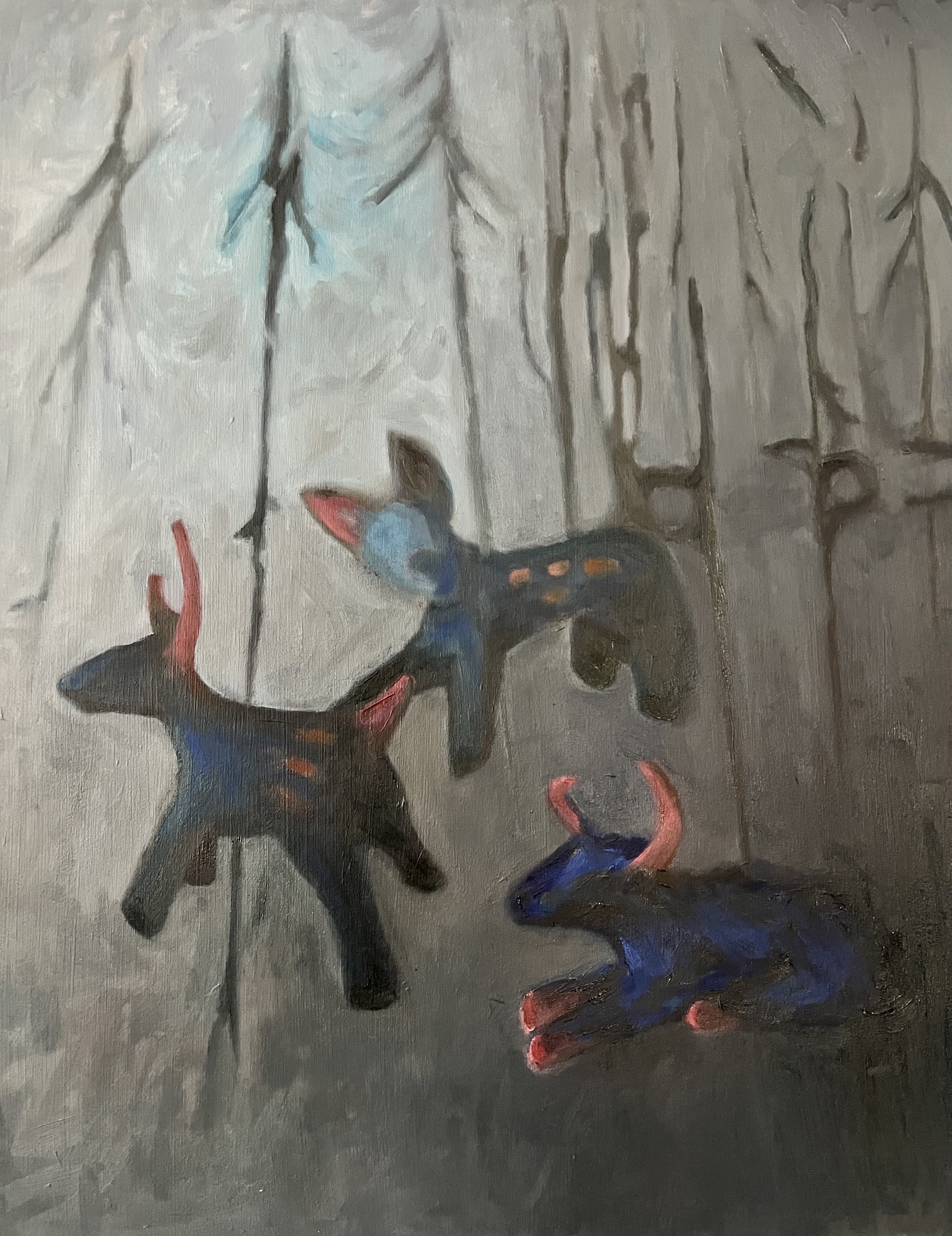
Black tailed deer in the forest near Drake’s Estero, Point Reyes. Robin L. Chandler, 2025.
“What can turn us from this deserted future, back into the sphere of our being, the great dance that joins us to our home, to each other and to other creatures, to the dead and the unborn? I think it is love. I am perforce aware how badly and embarrassingly that word now lies on the page – for we have learned at once to overuse it, abuse it, and hold it in suspicion. But I do not mean any kind of abstract love, which is probably a contradiction in terms, but particular love for particular things, places, creatures, and people, requiring stands and acts, showing its successes or failures in practical or tangible effects. And it implies a responsibility just as particular, not grim or merely dutiful, but rising out of generosity…”
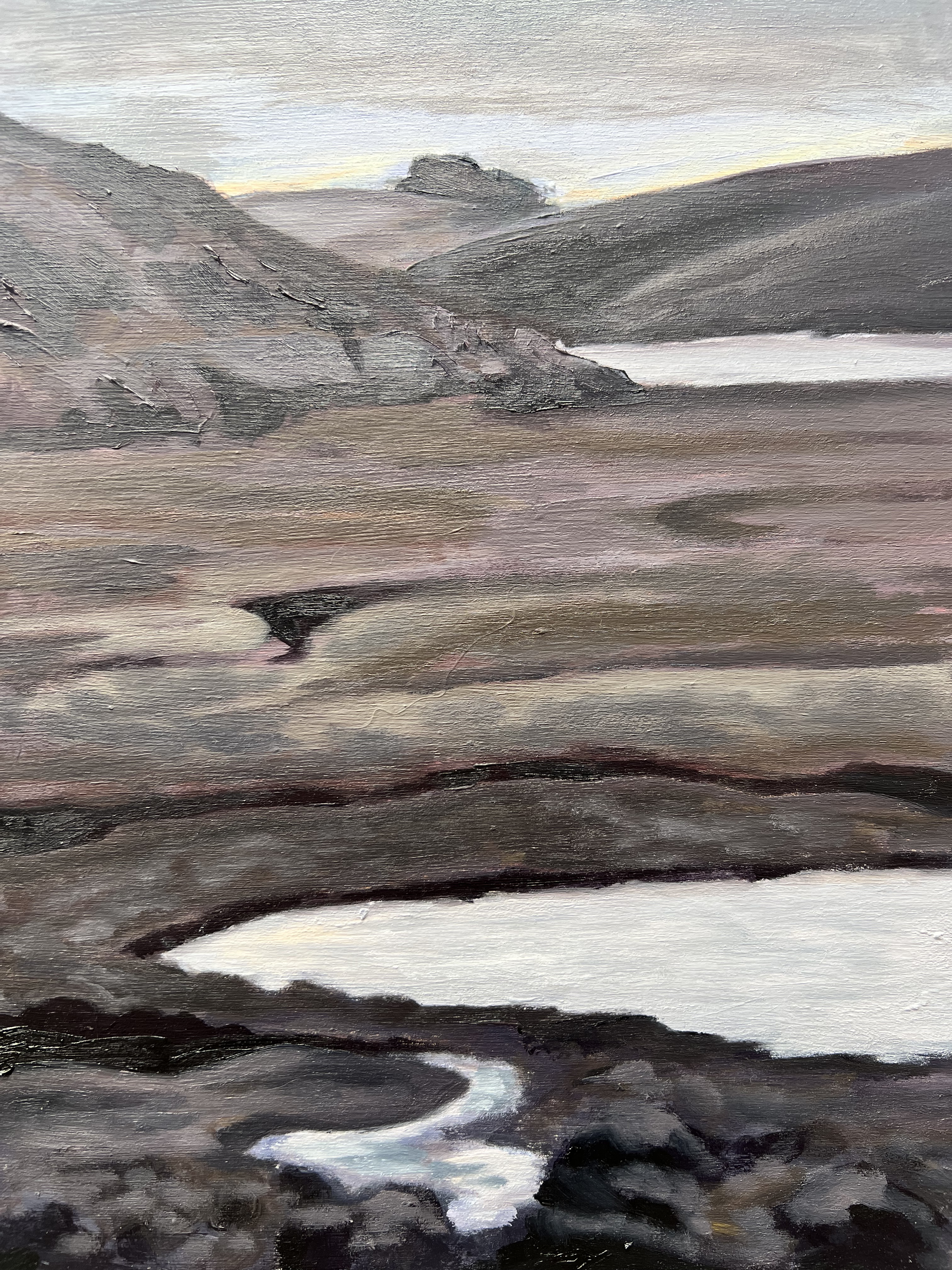
Limantour Estero, Point Reyes. Robin L. Chandler, 2025
“I think of two landscapes – one outside the self, the other within. The external landscape is the one we see – not only the line and color of the land and its shading at different times of the day, but also its plants and animals in season, its weather, its geology, the record of its climate and evolution. If you walk up, say, a dry arroyo in the Sonoran Desert you will feel a mounding and rolling of sand and silt beneath your foot that is distinctive. You will anticipate the crumbling of sedimentary earth in the arroyo bank as your hand reaches out and in the tangible evidence you will sense a history of water in the region. Perhaps a black-throated sparrow lands in a paloverde bush – the resiliency of the twig under the bird, that precise shade of yellowish green against the milk-blue sky, the fluttering whir of the arriving sparrow, are what I mean by “the landscape.” Draw on the smell of creosote bush, or clack stones together in the dry air. Feel how light is the desiccated dropping of the kangaroo rat. Study an animal track obscured by the wind. These are the elements of the land and what makes the landscape comprehensible are the relationships between them. One learns a landscape finally not by knowing the name or identity of everything in it, but by perceiving the relationships in it – like that between the sparrow and the twig. The difference between the relationships and the elements is the same as that between history and a catalog of events.
The second landscape I think of is an interior one, a kind of projection within a person of a part of the exterior landscape. Relationships in the exterior landscape include those that are named and discernable, such as the nitrogen cycle, or a vertical sequence of Ordovician limestone, and others that are uncodified or ineffable, such as winter light falling on a particular kind of granite, or the effect of humidity on the frequency of a blackpoll warbler’s burst of song. That these relationships have purpose and order, however inscrutable they may seem to us, is a tenet of evolution. Similarly, the speculations, intuitions, and formal ideas we refer to as “mind” are a set of relationships in the interior landscape with purpose and order; some of these are obvious, many impenetrably subtle. The shape and character of these relationships in a person’s thinking, I believe, are deeply influenced by where on this earth one goes, what one touches, the patterns one observes in nature – the intricate history of one’s life in the land, even a life in the city, where wind, the chirp of birds, the line of a falling leaf, are known. These thoughts are arranged, further, according to the thread of one’s moral, intellectual, and spiritual development. The interior landscape responds to the character and subtlety of the exterior landscape; the shape of the individual mind is affected by land as it is by genes.”
Excerpt from Barry Lopez’s essay “Landscape and Narrative” published in the ebook Vintage Lopez (p.3 -4)
Walking along Inverness Ridge among the new growth of bishop pines after the Vision Fire (1995); in the distance are douglas firs burned in the Woodward Fire (2020). Robin L. Chandler, 2025.
We were afraid to go back
afraid to listen to the stories
ash and bone might tell
We wanted to believe our lives were immutable
untouchable by nature, fate or disaster
At twilight we skirted the base of the first burned hill
reclaimed her scorched shoulder
her ruined slope
The ground beneath our feet released puffs of smoke
“When Sir Francis Drake spent a month in 1579 repairing his ship in the bay that now bears his name, the hills and ridges to the east would have been mostly open grassland or coastal scrub because of the Miwok’s liberal use of fire as a key tool of their ecological management and because of grazing by herds of elk, which benefited from the anthropogenic burning. The same was true when Sebastian Ceremeno, a Portuguese navigator and explorer sailing on the Manilla galleon route, was shipwrecked in Drakes Bay in 1595. Richard Henry Dana, visiting San Francisco Bay in 1840 described the herds of elk he could see on the open headlands.” (p.84)
“The [Mt.] Vision Fire started on October 3, 1995, and burned for about a week in an area mostly designated as park wilderness, eventually burning almost twelve thousand acres. Some local boys apparently thought they had drowned their campfire, but they hadn’t. It’s a story that reminds me of Henry David Thoreau; on a camping trip with a friend in April 1844, their campfire got out of control and almost burned down their hometown of Concord, Massachusetts. Many years later, that experience led Thoreau to investigate the fire ecology of his local ecosystem. He recognized the influence of past Native American burning on the landscape and became essentially the first published fire ecologist through his writing on the subject. The Vision Fire burned an area partly dominated by bishop pine, Pinus muricata. Bishop pine became so familiar with fire that it evolved a relationship that could be called “friends with fire.” (p.86-87)
Mt. Whitney from a hilltop near Tuttle Creek. Robin L. Chandler, 2024
“…Beauty in the Song is clearly not the idealized, symmetrical, or abstract beauty of the Greeks, although occasional references to symmetry occur as in the images of twin gazelles and twin teeth (4:3, 4:5, 6:6, 7:4). The poet presents impressionistic images rather than a definitive likeness. Beauty in the song is visual, aromatic and tactile; it is textured and complex – a synesthetic experience. Beauty is a function of the abundance of the natural world. It is a function of aliveness. Beauty only becomes intelligible through the Song’s figurative language, which collapses the distance between the lovers and the land they inhabit. What beauty actually looks like in the Song is a luxurious land, alive with sheep grazing on hillsides, gazelles bounding through mountains, and trees laden with fruit.” (p.22)
Wit-Sa-Nap Creek Winter Sunset. Robin L. Chandler, 2024
“[According to the Avatamsaka Sutra,] Indra’s net is pictured as stretching indefinitely in all directions, and at each of the knots of the net is a glittering jewel. All the other jewels in the net are reflected in each individual jewel, and each jewel reflected is also reflecting all the other jewels. This metaphor describes what was called, in Pali (the original language of the Buddhist canon), paticca samupadda, “dependent co-arising.” Modern Buddhist teachers have called it “interbeing,” or “the harmony of universal symbiosis.” This is a theory of mutual intercausality, interconnectedness, and interdependence. It is a worldview from the same ecophilosophical galaxy as Alexander von Humboldt’s “kosmos,” the Nuu-chah-nulth First Nation’s principle of hisuknis cawaak, and the “everything is connected” view at the heart of ecology. When Thoreau wrote that humans need to “realize where we are and the infinite extent of our relations,” he had this kind of idea in mind.
We think in metaphors, often — and even scientists do. Metaphors are the templates of pattern, and having those templates helps scientists — and everyone — “see” the patterns and relationships underlying the superficial “data” of experience, which often appear chaotic. Thoreau wrote in his journal on August 5, 1851, “The question is not what you look at, but what you see.” Seeing deep patterns needs a metaphoric, poetic mind.” (p.166)
The Sierra Nevada Red Fox pictured in my painting is endangered; there are less than forty of these beautiful creatures remaining in the California counties of Alpine, Fresno, Inyo, Madera, Mono and Tuolumne. As an artist, I choose to make art that fosters kinship with the earth by capturing glimpses of the world’s beauty. I hope that inspiring others to understand our interconnectedness with nature will help preserve the earth- and in this case, the Sierra Nevada Red Fox – for future generations.




 alive in the sea of information