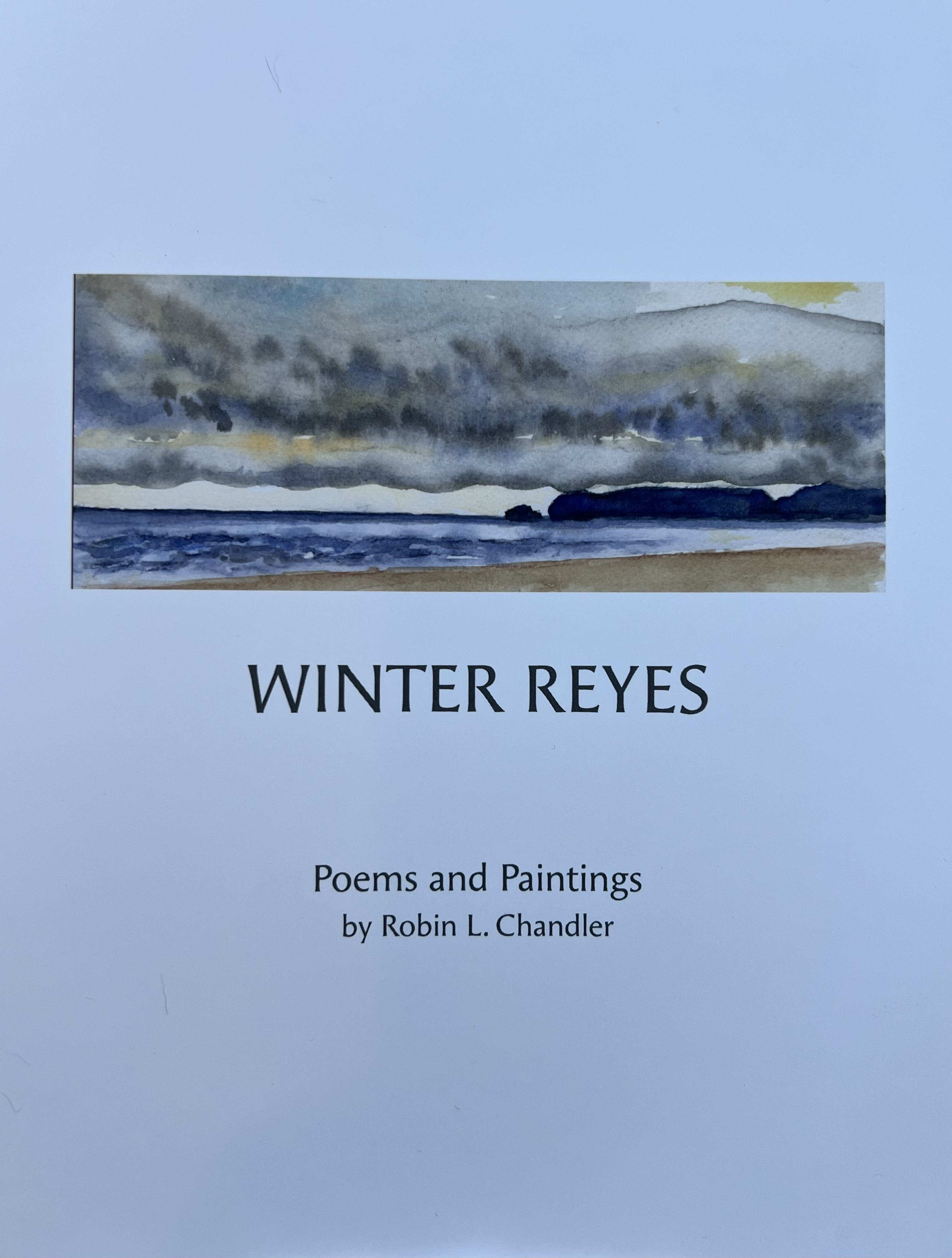
Cover of the book Winter Reyes: Poems and Paintings by Robin L. Chandler
The vernal equinox arrived and brought a blast of summer in typically springtime March. But I’m holding on to the memories of rain and wind, cold nights, frosty mornings, and blue winter light. And luckily, I can easily reconnect by opening a book that captures the feeling of winter in painting and poetry.
Inspired by my midwinter hikes, Winter Reyes rejoices in the hibernal beauty of Point Reyes National Seashore and shares the hope I find in nature’s resilience. My paintings and poems commemorate this jewel of the National Park Service. Copies of the book can be purchased on my website. I hope you have as much pleasure reading as I had in the making.
“reaching the bridge, the water parts, brush arches to the block page
Wet on wet, the work begins, the atmosphere emerges
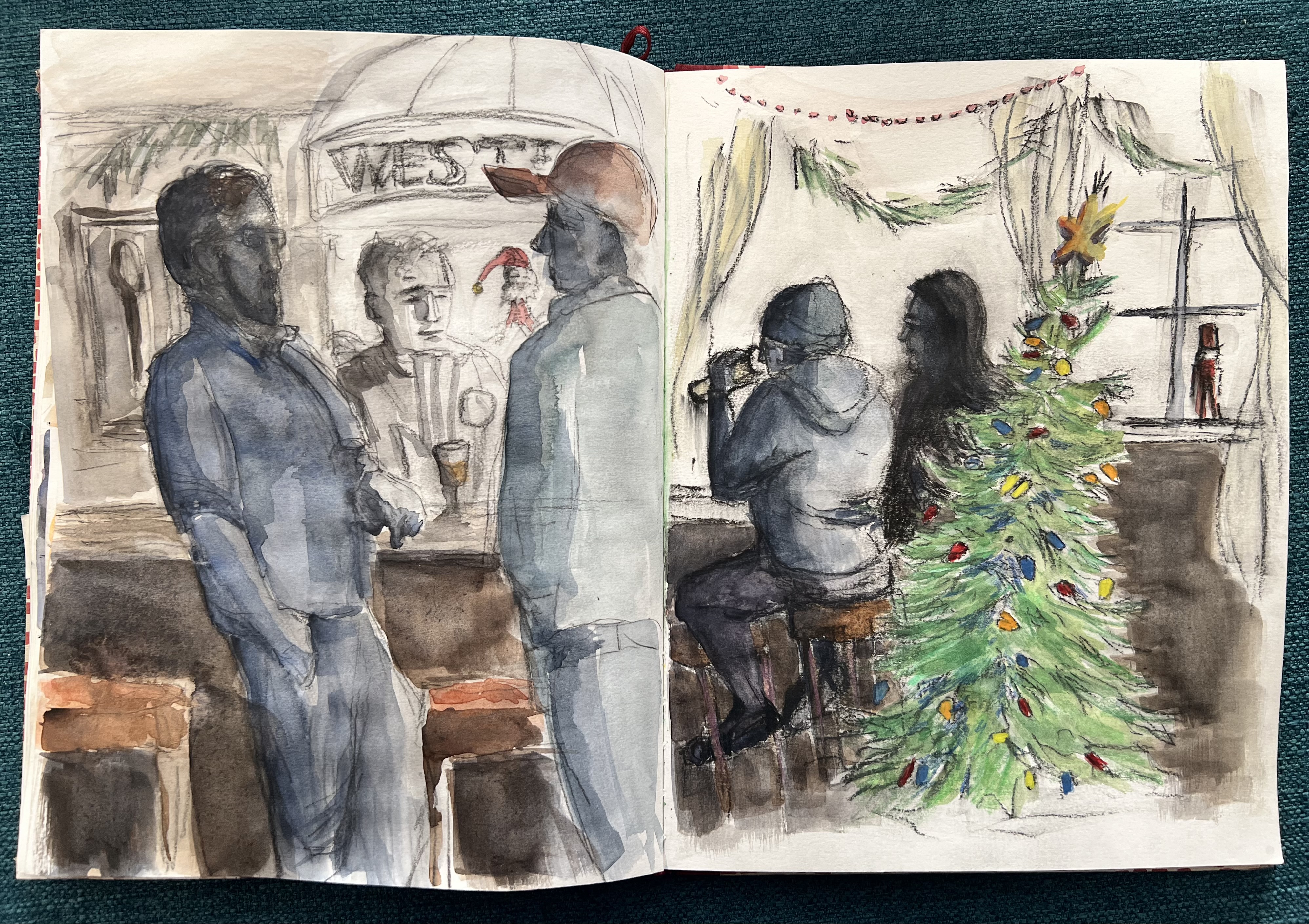
Sketch of holiday cheer in Point Reyes Station. Robin L. Chandler, 2025.
“In 1935, the National Park Service recommended an 83-square mile park, but there was no action until 1958. By this time, subdivisions were again being planned, logging was underway at Inverness Ridge, and the state was planning a freeway that would replace Highway 1 and open the area to suburban development. One lobbyist told a Congressional committee that by the year 2000
‘there will no longer be a Marin County. There will be a greater San Francisco..…the section we have under discussion today, gentlemen, will be as intensely built over as Palo Alto, or Burlingame or San Mateo.’
The MCL [Marin Conservation League] worked with Marin’s representative in Congress Clem Miller, who introduced and tirelessly promoted his Point Reyes National Seashore bill in the House, while California’s US Senator Clair Engle, pushed it through in the Senate…..In a compromise with ranchers, the park bill allowed cattle and dairy ranching to continue for 25 years in a 27-square mile “pastoral zone,” while livestock grazing elsewhere would be phased out. Congress passed the bill, and President Kennedy signed it on September 13, 1962. The park was authorized to include 83 square miles, just as the Park Service had originally recommended…..”
Glenbrook Trail, Point Reyes National Seashore. Robin L. Chandler, 2025.
“So while this is a book about the music of memory, it also necessarily becomes a book about the memory of music and the deeper social memory of art – its ability to recall the catastrophes of war but also the optimistic promise and gleam of earlier eras, or what the critic Walter Benjamin called, with touching simplicity, “hope in the past.” This book in fact draws inspiration from Benjamin’s vision of the true purpose of history: to sort through the rubble of earlier eras in order to recover these buried shards of unrealized hope, to reclaim them, to redeem them. They are, as he saw it, nothing more or less than the moral and spiritual building blocks of an alternate future.”
Long-billed Curlews at Limantour Beach, Point Reyes National Seashore in Winter. Robin L. Chandler, 2025
“Thomas Berry was a US cultural historian who introduced the broader legal concept of Earth jurisprudence early in the twenty-first century. Earth jurisprudence is the philosophy of law and human governance that says humans are just one element in a wider community of beings, and that the welfare of one speaks to the welfare of all. “The universe is a communion of subjects, not a collection of objects, “ Berry argued, and it’s through the work of people such as Stone, Berry, Kimmerer, Kolbert, and others that we are moving our collective understanding, and our will, toward a more environmentally just world. In the face of the ecological catastrophes beating down on us, we must remember the collective good of countless people as well as the rights of trees, and of the land that supports and nurtures us all.”
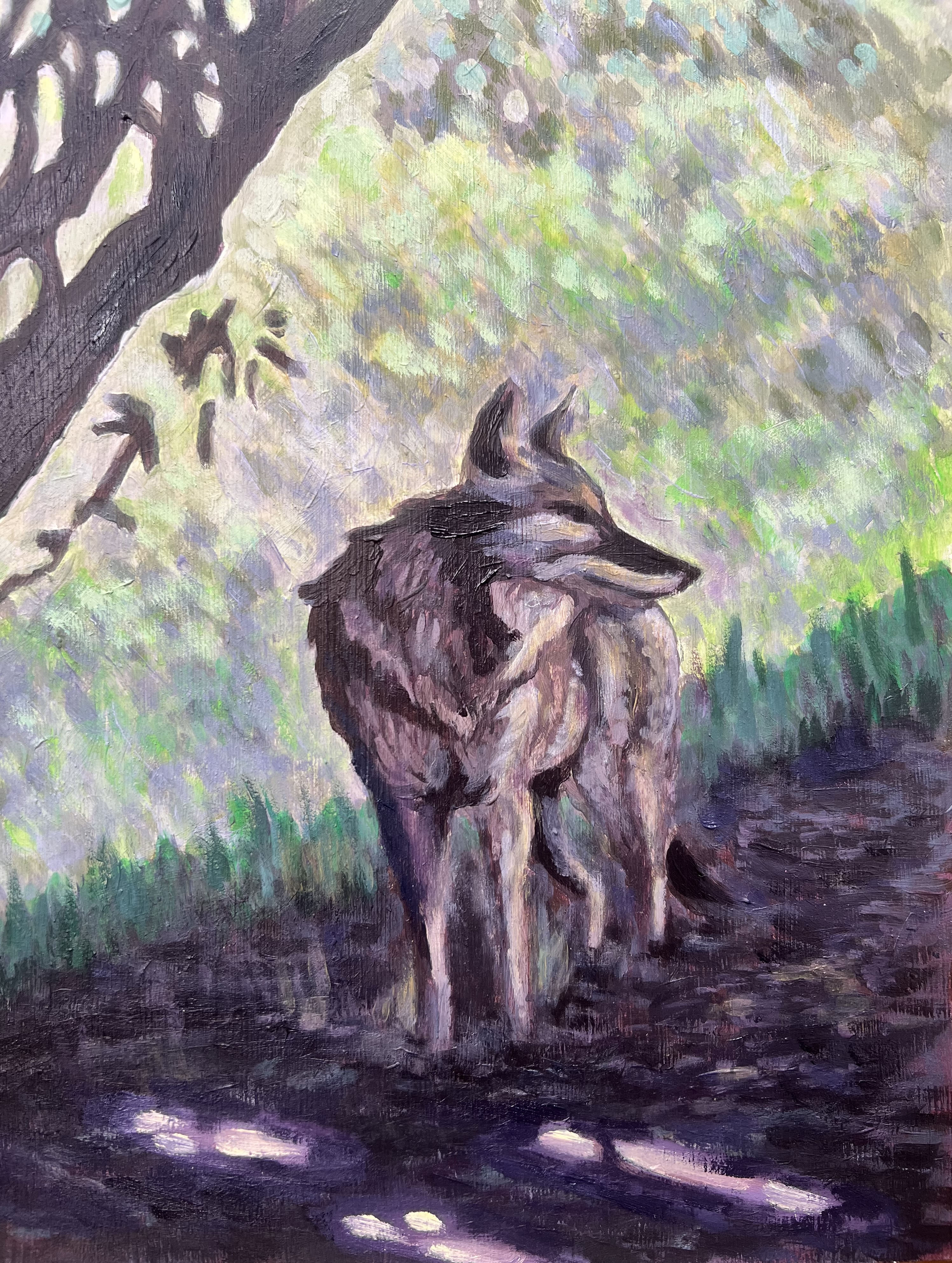
Coyote walking on the Inverness Ridge Trail, Point Reyes National Seashore. Robin L. Chandler, 2025.
“One day Old Man Coyote was bored, and so he decided to have some fun and made a basket. A big basket, round like an acorn storage basket, only much bigger and rounder…..he wove his tracks into the pattern to give a hint who’d made it. When it was finished, he put everything People would need, forever, into the basket. And then he put the basket by the trail to see what would happen.
Sure enough, along came some People, and when they saw the big basket they said ‘Hey? What’s this?’ They knew it was a basket, but they had never seen any basket this big before…..when they looked inside and saw that it had everything they needed, they said, ‘We can live in it!’ So they did.
Well. Old Man Coyote had put everything We the People would need into that basket, but he never imagined that there would someday be so many of us, and some of us would invent needs that Coyote could never imagine we needed! Pretty soon he began to hear lots of fighting and arguing in the basket. And before long some of his strongly woven strands began to tear, and the basket got holes in it, and some of the People who went in together got thrown out through the holes! Just imagine!
Well, again. Old Man Coyote wasn’t really surprised. He’s not surprised at anything, of course. Being a Trickster, he just wants to try something and see what will happen – which is why he put the big basket by the trail that day when he was bored in the first place. But…Coyote was a bit sad anyway, seeing that his gift basket had become the place for a big fight among the People. That’s why you sometimes hear him crying and singing to himself at night.” (p.178-179)
…..David Hinton, a translator of classical Chinese poetry, argues in his book China Root: Taoism, Ch’an, and Original Zenthat Ch’an began during the Tang dynasty of ninth-century China as an intellectual and cultural rebellion. Ch’an practice was seeking to recapture the feeling and experience of immediacy and wholeness of the Paleolithic human mind and to overcome the alienation of humans from the world that resulted from the agricultural revolution and its modus operandi of humans taking control of wild nature. (p.195)
…..Shunryu Suzuki wrote in the prologue to his 1970 book, Zen Mind, Beginner’s Mind, that ‘if your mind is empty, it is always ready for anything; it is open to everything. In the beginner’s mind there are many possibilities; in the expert’s mind there are few.’…..The bottom line would be that language and it’s constructs can get in the way of nondual, holistic perception and experience, of what Suzuki Roshi called beginner’s mind.” (p.196)
View from the Estero Trail at Point Reyes. Robin L. Chandler, 2025
“Thomas [Mann] paid his bill and walked towards his grandmother’s house. He could see his two sisters now, waiting for the rest of the story. Both of them in their night attire, and he could see Heinrich sitting apart from them and always in a story their mother would sigh and say that she had work to do and would continue the story tomorrow. And they would appeal to her, beg her to finish the story and she always would.
The young composer’s name was Johann Sebastian Bach, she said, and he walked to Lübeck through wind and rain and often he could find no boardinghouse and had to sleep in haystacks or in fields. Often, he was hungry. Very often he was cold. But he was always sure of his purpose. If he could get to Lübeck, he would meet the man who would help him to become a great composer.
Buxtehude was almost in despair. Some days he really believed that his sacred knowledge would be buried with him. On other days, in his heart, he knew that someone would come and he dreamed that he would recognize the man immediately and he would take him to church, and he would share his secrets with him.
‘How would he recognize the man?’ Carla asked. ‘The man would have a light in his eyes, or something special in his voice,’ her mother said.
‘How could he be sure?’ Heinrich asked.
‘Wait! He is still on the journey and worried,’ she went on.
Every day the walk seems longer. He has told the man he works for that he will be away only a short time. He does not realize how far Lübeck is. But he does not turn back. He walks on and on, asking all the time how far Lübeck is. But it is so far that some people he meets have never even heard of Lübeck and they advise him to turn back. But he is determined not to, and eventually when he reaches Lüneberg, he is told that he is not far from Lübeck. And the fame of Buxtehude has spread to there. But because of all his time on the road, poor Bach, normally so handsome, looks like a tramp. He knows that Buxtehude will never receive a man as badly dressed as he is. But he is lucky. A woman in Lüneberg, when she learns of Bach’s plight, offers to lend him the clothes. She has seen the light in him.
And so Bach arrives in Lübeck. And when he asks for Buxtehude, he is told that he will be in the Marienkirche practicing the organ. And as soon as Bach steps into the church, Buxtehude senses that he is no longer alone. He stops playing and looks down from the gallery and sees Bach and behind him he sees the light, the light Bach has carried with him all the way, something glowing in his spirit. And he knows that this is the man to whom he can tell the secret.
‘But what is the secret?’ Thomas asked.
‘If I tell you, will you promise to go to bed’
‘Yes.’
‘It is called beauty,’ his Mother said. ‘The secret is called beauty. He told him not to be afraid to put beauty in his music. And then for weeks and weeks and weeks, Buxtehude showed him how to do just that.’
‘Did Bach ever give the woman back the clothes?’ Thomas asked.
‘Yes, he did on his way home. And on their piano, he played music for her that she thought came from heaven.’ “
Black tailed deer in the forest near Drake’s Estero, Point Reyes. Robin L. Chandler, 2025.
“What can turn us from this deserted future, back into the sphere of our being, the great dance that joins us to our home, to each other and to other creatures, to the dead and the unborn? I think it is love. I am perforce aware how badly and embarrassingly that word now lies on the page – for we have learned at once to overuse it, abuse it, and hold it in suspicion. But I do not mean any kind of abstract love, which is probably a contradiction in terms, but particular love for particular things, places, creatures, and people, requiring stands and acts, showing its successes or failures in practical or tangible effects. And it implies a responsibility just as particular, not grim or merely dutiful, but rising out of generosity…”
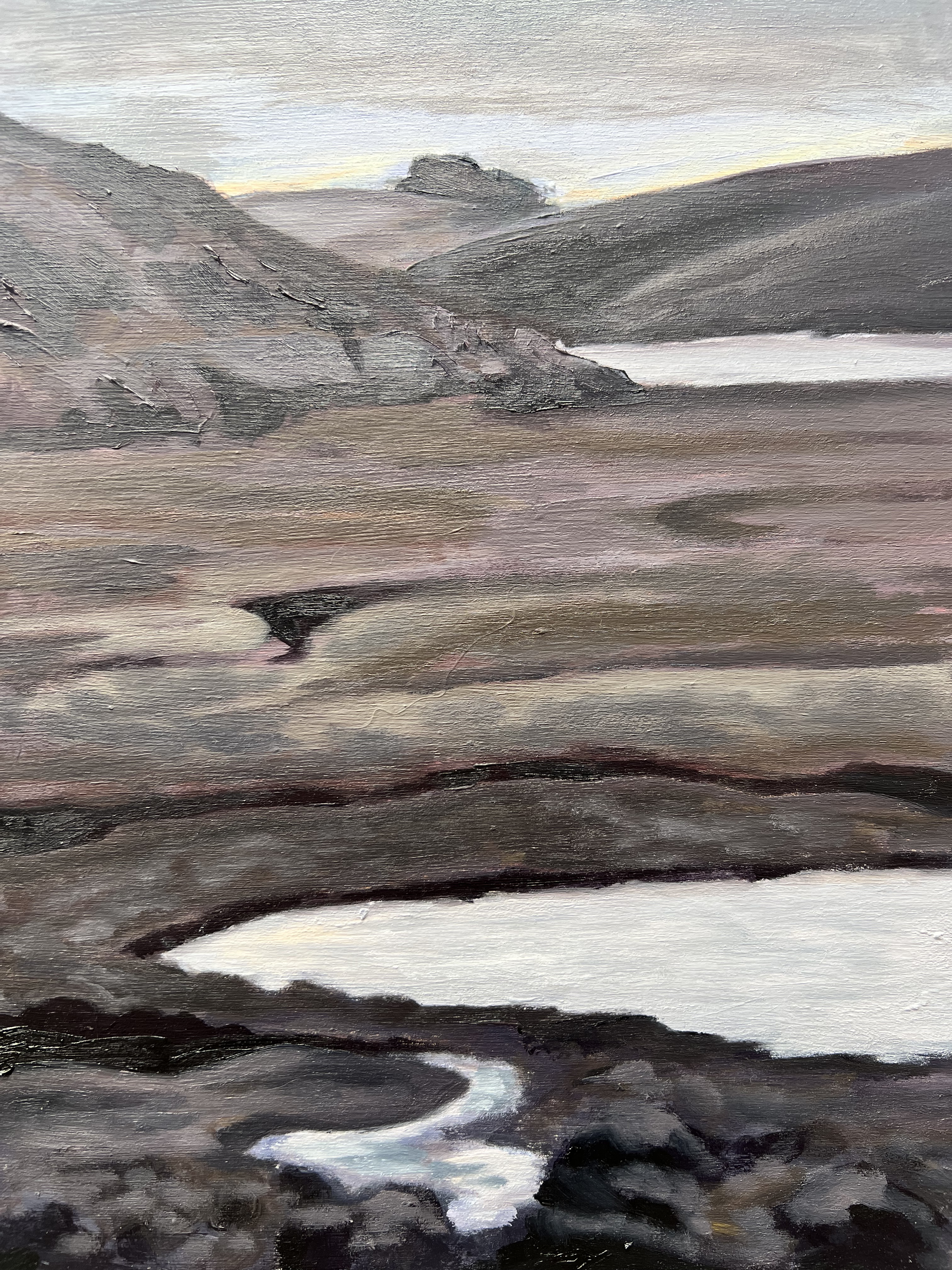
Limantour Estero, Point Reyes. Robin L. Chandler, 2025
“I think of two landscapes – one outside the self, the other within. The external landscape is the one we see – not only the line and color of the land and its shading at different times of the day, but also its plants and animals in season, its weather, its geology, the record of its climate and evolution. If you walk up, say, a dry arroyo in the Sonoran Desert you will feel a mounding and rolling of sand and silt beneath your foot that is distinctive. You will anticipate the crumbling of sedimentary earth in the arroyo bank as your hand reaches out and in the tangible evidence you will sense a history of water in the region. Perhaps a black-throated sparrow lands in a paloverde bush – the resiliency of the twig under the bird, that precise shade of yellowish green against the milk-blue sky, the fluttering whir of the arriving sparrow, are what I mean by “the landscape.” Draw on the smell of creosote bush, or clack stones together in the dry air. Feel how light is the desiccated dropping of the kangaroo rat. Study an animal track obscured by the wind. These are the elements of the land and what makes the landscape comprehensible are the relationships between them. One learns a landscape finally not by knowing the name or identity of everything in it, but by perceiving the relationships in it – like that between the sparrow and the twig. The difference between the relationships and the elements is the same as that between history and a catalog of events.
The second landscape I think of is an interior one, a kind of projection within a person of a part of the exterior landscape. Relationships in the exterior landscape include those that are named and discernable, such as the nitrogen cycle, or a vertical sequence of Ordovician limestone, and others that are uncodified or ineffable, such as winter light falling on a particular kind of granite, or the effect of humidity on the frequency of a blackpoll warbler’s burst of song. That these relationships have purpose and order, however inscrutable they may seem to us, is a tenet of evolution. Similarly, the speculations, intuitions, and formal ideas we refer to as “mind” are a set of relationships in the interior landscape with purpose and order; some of these are obvious, many impenetrably subtle. The shape and character of these relationships in a person’s thinking, I believe, are deeply influenced by where on this earth one goes, what one touches, the patterns one observes in nature – the intricate history of one’s life in the land, even a life in the city, where wind, the chirp of birds, the line of a falling leaf, are known. These thoughts are arranged, further, according to the thread of one’s moral, intellectual, and spiritual development. The interior landscape responds to the character and subtlety of the exterior landscape; the shape of the individual mind is affected by land as it is by genes.”
Excerpt from Barry Lopez’s essay “Landscape and Narrative” published in the ebook Vintage Lopez (p.3 -4)




 alive in the sea of information