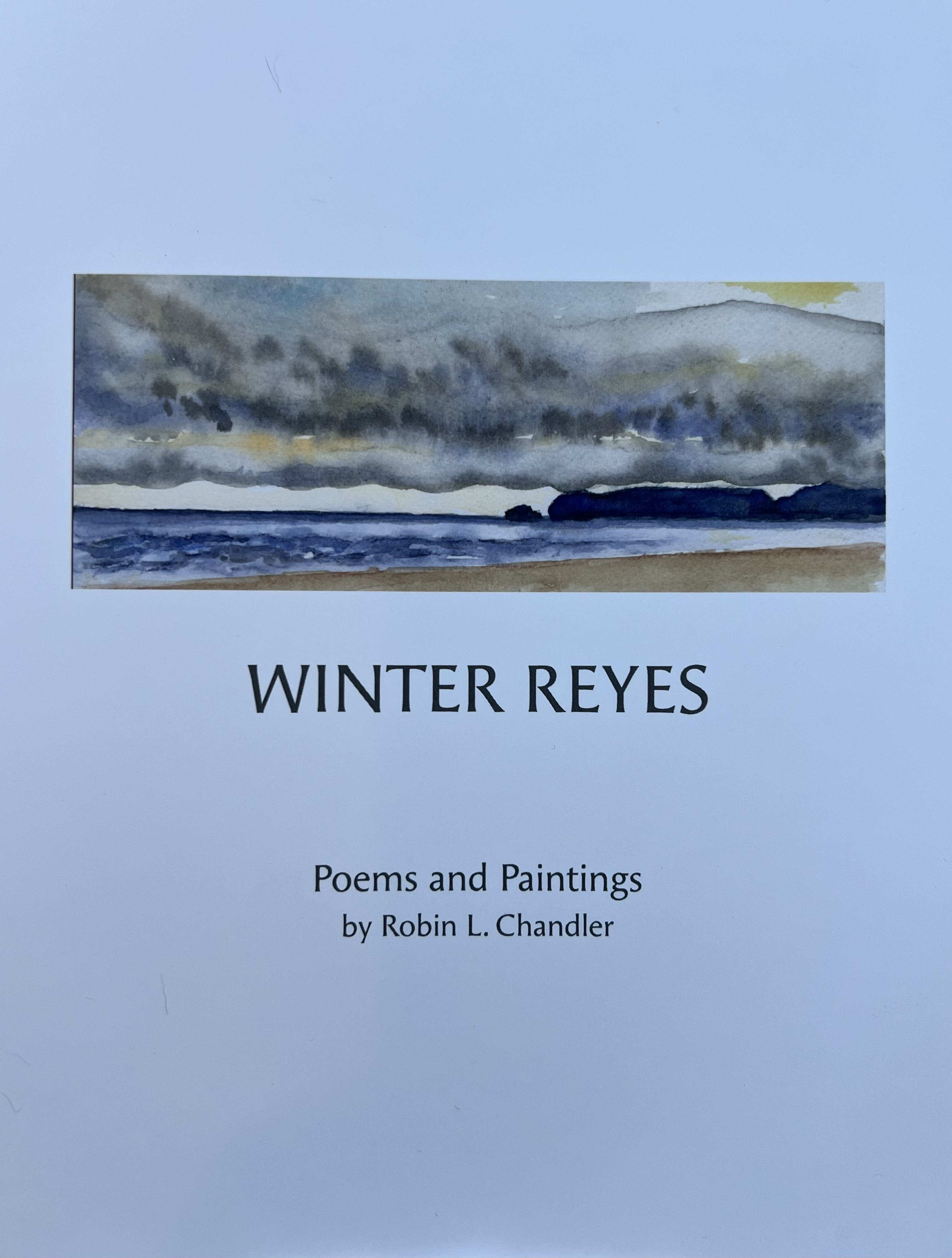
Cover of the book Winter Reyes: Poems and Paintings by Robin L. Chandler
The vernal equinox arrived and brought a blast of summer in typically springtime March. But I’m holding on to the memories of rain and wind, cold nights, frosty mornings, and blue winter light. And luckily, I can easily reconnect by opening a book that captures the feeling of winter in painting and poetry.
Inspired by my midwinter hikes, Winter Reyes rejoices in the hibernal beauty of Point Reyes National Seashore and shares the hope I find in nature’s resilience. My paintings and poems commemorate this jewel of the National Park Service. Copies of the book can be purchased on my website. I hope you have as much pleasure reading as I had in the making.
“reaching the bridge, the water parts, brush arches to the block page
Wet on wet, the work begins, the atmosphere emerges
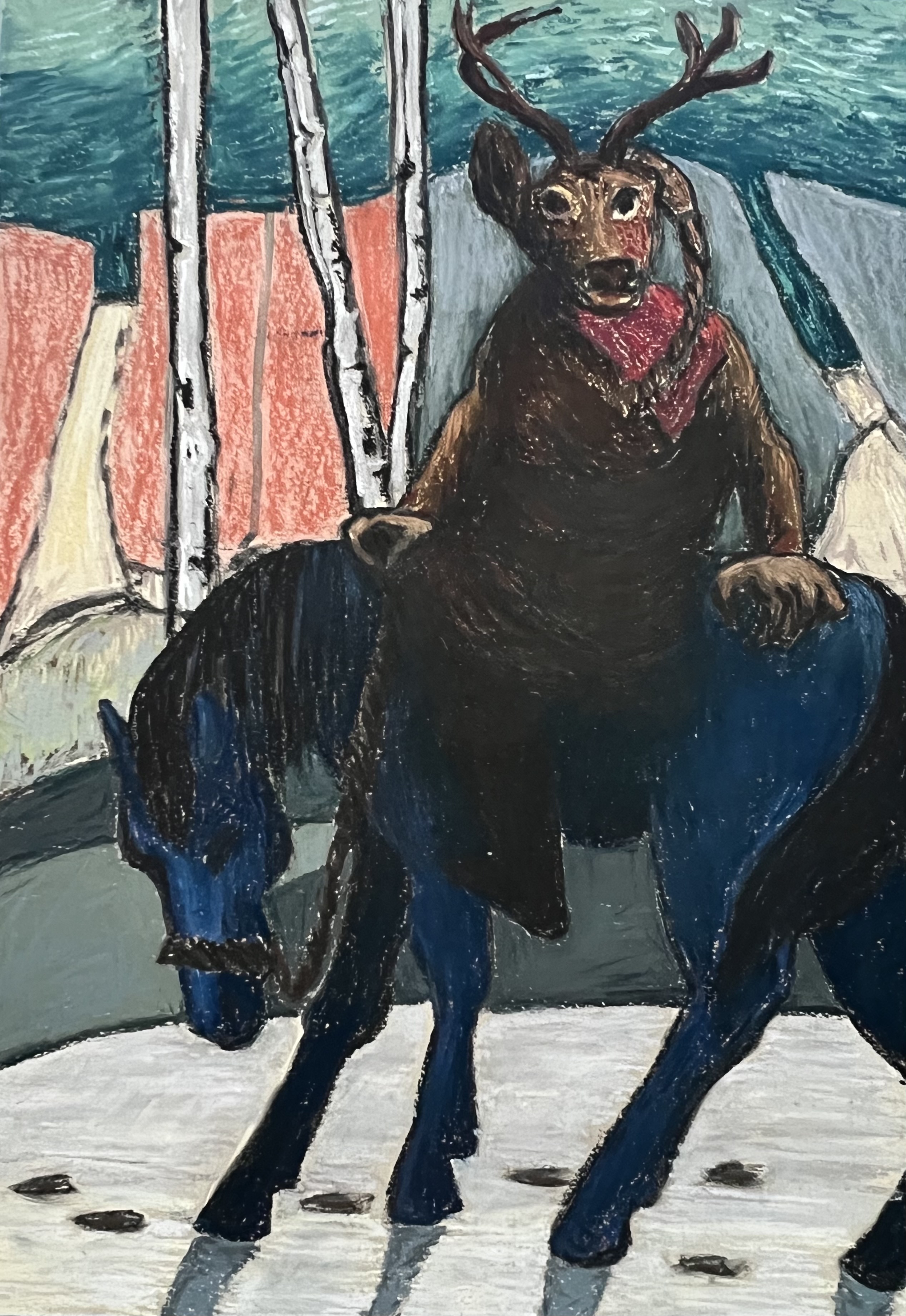
Black tailed deer in the forest near Drake’s Estero, Point Reyes. Robin L. Chandler, 2025.
“What can turn us from this deserted future, back into the sphere of our being, the great dance that joins us to our home, to each other and to other creatures, to the dead and the unborn? I think it is love. I am perforce aware how badly and embarrassingly that word now lies on the page – for we have learned at once to overuse it, abuse it, and hold it in suspicion. But I do not mean any kind of abstract love, which is probably a contradiction in terms, but particular love for particular things, places, creatures, and people, requiring stands and acts, showing its successes or failures in practical or tangible effects. And it implies a responsibility just as particular, not grim or merely dutiful, but rising out of generosity…”
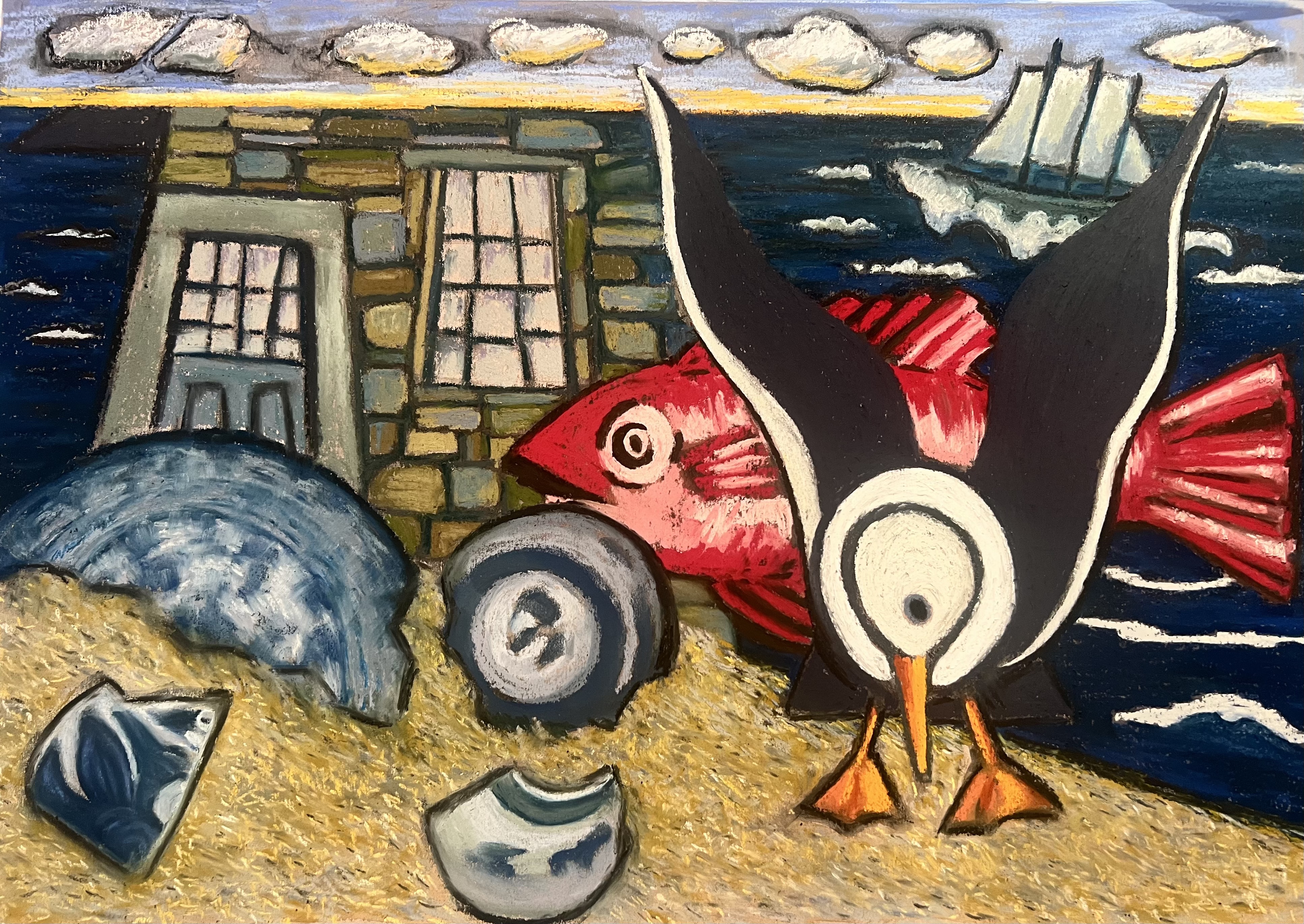
Walking along Inverness Ridge among the new growth of bishop pines after the Vision Fire (1995); in the distance are douglas firs burned in the Woodward Fire (2020). Robin L. Chandler, 2025.
We were afraid to go back
afraid to listen to the stories
ash and bone might tell
We wanted to believe our lives were immutable
untouchable by nature, fate or disaster
At twilight we skirted the base of the first burned hill
reclaimed her scorched shoulder
her ruined slope
The ground beneath our feet released puffs of smoke
“When Sir Francis Drake spent a month in 1579 repairing his ship in the bay that now bears his name, the hills and ridges to the east would have been mostly open grassland or coastal scrub because of the Miwok’s liberal use of fire as a key tool of their ecological management and because of grazing by herds of elk, which benefited from the anthropogenic burning. The same was true when Sebastian Ceremeno, a Portuguese navigator and explorer sailing on the Manilla galleon route, was shipwrecked in Drakes Bay in 1595. Richard Henry Dana, visiting San Francisco Bay in 1840 described the herds of elk he could see on the open headlands.” (p.84)
“The [Mt.] Vision Fire started on October 3, 1995, and burned for about a week in an area mostly designated as park wilderness, eventually burning almost twelve thousand acres. Some local boys apparently thought they had drowned their campfire, but they hadn’t. It’s a story that reminds me of Henry David Thoreau; on a camping trip with a friend in April 1844, their campfire got out of control and almost burned down their hometown of Concord, Massachusetts. Many years later, that experience led Thoreau to investigate the fire ecology of his local ecosystem. He recognized the influence of past Native American burning on the landscape and became essentially the first published fire ecologist through his writing on the subject. The Vision Fire burned an area partly dominated by bishop pine, Pinus muricata. Bishop pine became so familiar with fire that it evolved a relationship that could be called “friends with fire.” (p.86-87)
“With [Charles] Olson his identity with the place, with Gloucester, give his major work, The Maximus Letters, a deep emotional center. The only other American writer who gives me the same sense of responding to a place, in both an historical and philosophic sense is Thoreau in his first book, A Week On the Concord And Merrimack Rivers.”
“Olson, in one of the Letters’ most persistent themes, uses Gloucester as a poetic expression of the realities of history…..the sense of place in the letters is – in a final sense – so compelling because what Olsen is trying to hold on to is the sense of place in time, as well as the sense of the immediate place of Gloucester.”
“The Letters become less of the poet’s expression and more the historian’s as they go on, even though the history is handled as poetic material. In any of the single Letters the history is almost without meaning – odd facts, lists of provisions, inserted paragraphs on the fishing industry – but with the growth of the poem as a whole it is clear that something else is involved.”
“Sometimes I find myself thinking of Olson as an artisan, a worker with his hands, a carpenter, New England journeyman…..It is difficult to be both a historian and a poet, but by using some of his materials as an artisan he is usually able to keep the two together within the poem.”
“The fullest aspect of the poem is still its involvement with Gloucester, but it is also about the painter Marsden Hartley – the period of his work in Gloucester, the powerful, mythic, almost folk paintings of the 1930s. The emphasis of the Letter is still circular – within, from, and to Gloucester – but Olson has separated out a part of this experience, and given it a distinct, separate identity outside of the main currents of the rest of the Letters.”
“I’ve never decided whether or not Olson considers his poems difficult to follow or if he cares, but he is difficult, one of the most difficult of the modern poets to follow…sometimes as in the inner references of Letter 7 its because he doesn’t give enough away – at other times, as in the overall structure of the Letters, because he includes a maze of only distantly related material.
“The glimpse that Olson gives of Hartley does have its inner intensity. Is it only for someone who knows the paintings? Who is already familiar with Hartley’s life? It could be. The response to anything in Maximus has to be personal. For someone already deeply familiar with the painter and his work Olson’s poem, with all it’s rambling and discursion, is a sensitive, moving portrait…..whatever someone decides about the poem any American poet beginning to sort out his poetic background will have to find his own place in the Letters – to find his own place in the American vision of Charles Olson’s Gloucester.”
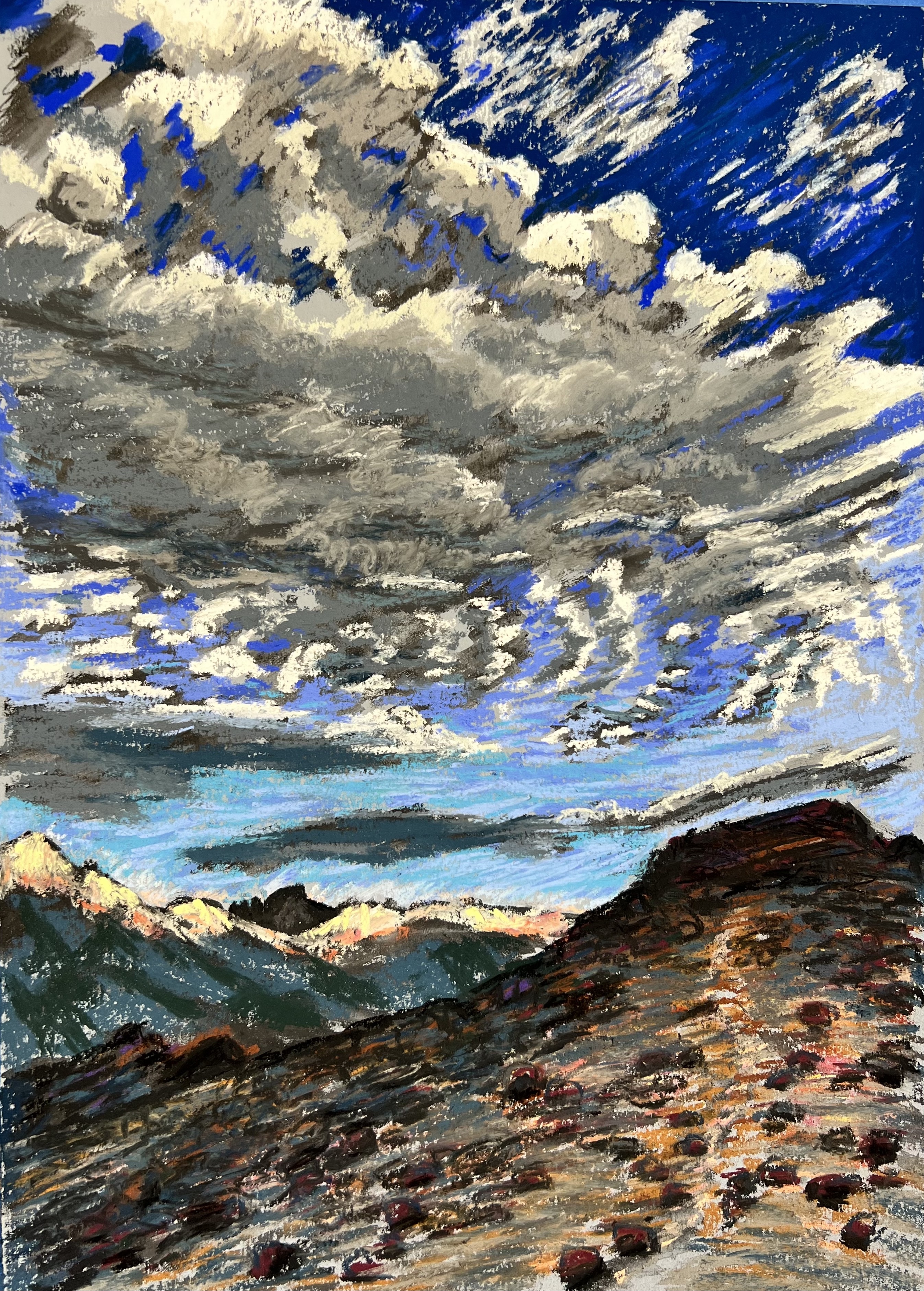
Mt. Whitney from a hilltop near Tuttle Creek. Robin L. Chandler, 2024
“…Beauty in the Song is clearly not the idealized, symmetrical, or abstract beauty of the Greeks, although occasional references to symmetry occur as in the images of twin gazelles and twin teeth (4:3, 4:5, 6:6, 7:4). The poet presents impressionistic images rather than a definitive likeness. Beauty in the song is visual, aromatic and tactile; it is textured and complex – a synesthetic experience. Beauty is a function of the abundance of the natural world. It is a function of aliveness. Beauty only becomes intelligible through the Song’s figurative language, which collapses the distance between the lovers and the land they inhabit. What beauty actually looks like in the Song is a luxurious land, alive with sheep grazing on hillsides, gazelles bounding through mountains, and trees laden with fruit.” (p.22)
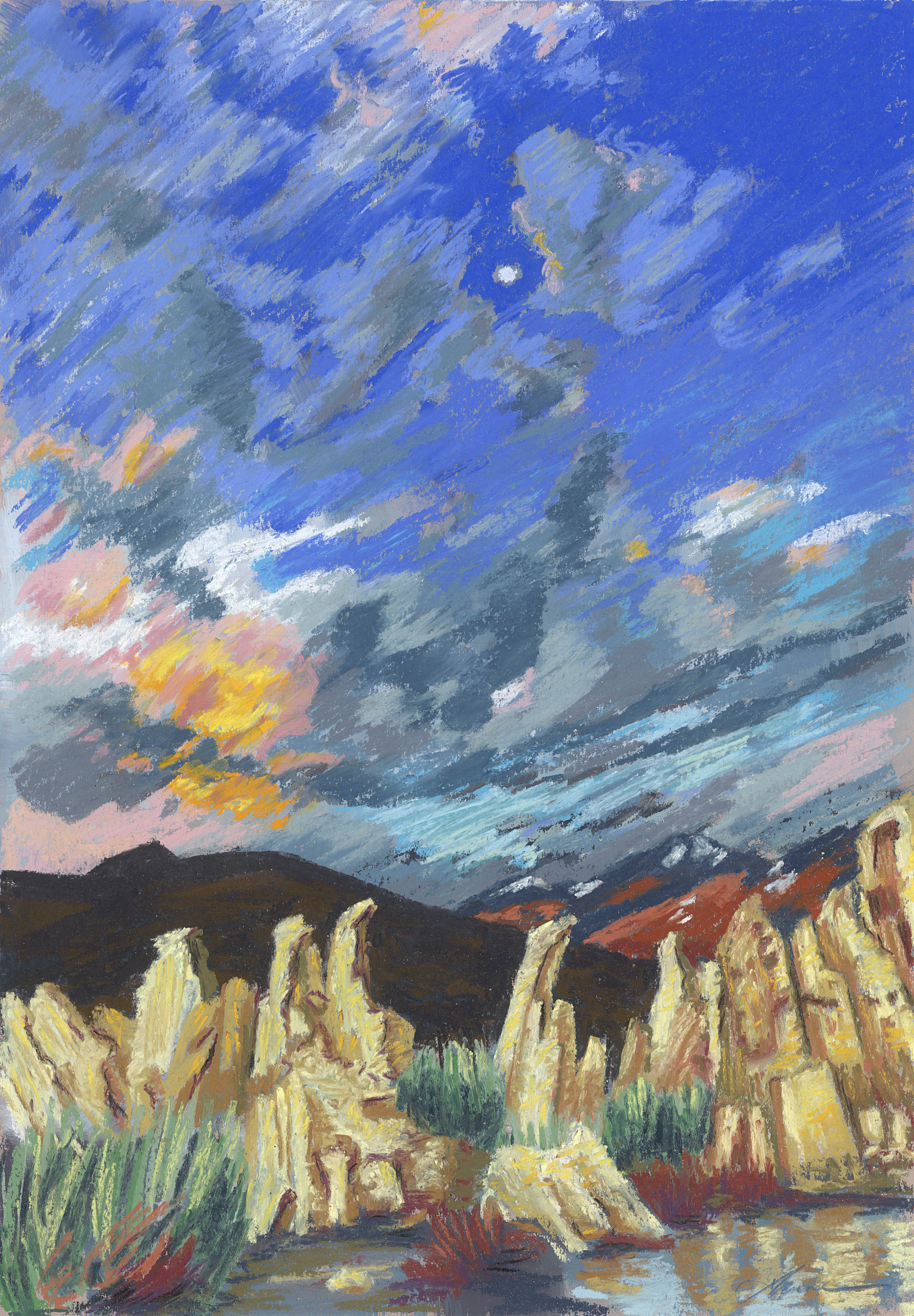
Mono Lake: Stormclouds, Sunrise & Moonset. Robin L. Chandler, 2024
“His father owned watermills and windmills; he understood
weather from childhood.
Of hail squalls in spring he had this to say: ‘The clouds
accumulate in very large masses,
And from their loftiness seem to move but slowly; immediately
on these large clouds
Appear numerous opaque patches, which are only small clouds
passing rapidly
Before them. Those floating much nearer the earth may
perhaps fall in with
A stronger current of wind, which drives them with greater
rapidity from light to shade
Through the lanes of the clouds; hence they are called by
wind-millers and sailors, Messengers,
And always portend bad weather.’ Therefore Constable learned
the craft of chiaroscuro.” (p.46)
Excerpt from Ciaran Carson’s poem John Constable, Study of Clouds, 1822 published in his book Still Life
“[J.M.W. ] Turner was well aware of the differences between painting and poetry, but he was also keenly aware of their affinities – as indicated in his 1812 assertion that ‘Painting and Poetry, flowing from the same fount mutually by vision…reflect, and heighten each other’s beauties like…mirrors.’ ” (p.6)
“Ut Pictura Poesis.” A phrase used by the Roman poet Horace (circa BCE 20) ‘meaning as painting, so is poetry’…..the relationship between the two arts is usually said to lie in their imitation of nature (see mimesis).



 alive in the sea of information