Auld Lang Syne

Farmer’s Market, Splashpad Park, Oakland. Copyright 2011 Robin L. Chandler

“How do you do that?” said Terrell.  About six years old, my admirer sat beside me on the concrete wall.  “I like to paint too…Santa brought me some paints, brushes and paper.”  While his grandmother watched, I loaned my new friend some paper and a brush and, we painted together in the brilliant sunshine of this last day of 2011.  The Saturday Farmer’s Market is a worthy subject: a unique cityscape with the mixing and mingling of so many kinds of people engaged in reaping the fruits of farmer’s labor.  As I walk through the market and see the bounty of the harvest, I recall the stories from a wonderful book  Cultivating a Movement. Edited by Irene Reti and Sarah Rabkin, the book draws from oral histories documenting the lives of individuals engaged in organic farming and sustainable agriculture on California’s Central Coast. The interviews dig deep into the social, cultural and environmental history of California on a range of topics concerning organic / sustainable agriculture including the influence of the hippie movement of the 1960s and 1970s; the influence of Alan Chadwick on farming; the organizing of Mexican-American farm workers resulting in the formation of the United Farm Workers (UFW) union; the publication of Rachel Carson’s Silent Spring; the creation of the California Certified Organic Farmers (CCOF); and the influence of the UC Santa Cruz Center for Agroecology and Sustainable Food Systems. Recommended reading!

Our urban life blossoms in this space called Splashpad Park; an island of trees, shrub and grass floating between a major freeway and busy city streets.  Cars rush by; children and their parents line-up to see movies at the Grand Lake Theater; activists pass-out buttons and leaflets for Occupy Oakland while others gather signatures for a referendum against the death penalty; musicians play folk songs and Grateful Dead tunes; and shoppers visit the bakery, dry cleaners and other specialty shops as well as the Farmer’s Market.   Oakland’s community awakens on Saturday mornings, re-energized after the busy workweek, engaging in the timeless ritual of gathering those items necessary for sustenance.    Not sure if his little self will grasp all I wish him to know, but I pass on to Terrell the wise words of my drawing teacher Rob Anderson “draw what you know, what you see, what you feel, continue on until it is what you are.”  Grandmother gently urges Terrell that its time to leave; she rattles off the items they still need to buy: navel oranges, beets, radichio and arugula.

Turning back to my painting, I modestly attempt to capture on paper something reminiscent of the grand American Experiment performed by the Ashcan Painters – including Robert Henri, John Sloan, George Luks, William Glackens and Everett Shinn – a vivid description of America’s bustling cities and her people. My favorite painter of this Group – George Bellows – created some of the most moving depictions of the urban landscape: “The Lone Tenement”  and “Blue Morning.”  So, on this December 31, 2011 I raise my brush in celebration of painters old long ago, always brought to mind.
To shape the future

There are two holidays that serve as book ends for my mother’s life: the 4th of July marks her death and Labor day marks her birth. This year – 2009 – marks the 20th anniversary of her passing and would have been her 92nd birthday were she still with us. My mother was an energetic woman hugely impacting my life; it wasn’t always easy, but I know and love the gifts she gave me. She loved making music and creating things. Growing up, there was always some kind of project in the works be it making candles  (and spray painting them gold for whatever reason), sewing clothes for me and my sister, or preparing for her teaching job or her girl scout troop. She had so much energy and intelligence and she was driven to do something helpful for others.

When I was very young, my mom worked as an occupational therapist. One of her patients was a young man with polio confined to an iron lung. I remember that he painted the most wonderful paintings using only the movements he could make with his big toe. My mother had built a splint for that big toe enabled to cradle a paint brush and she spent hours with him making sure it fit correctly and gave him the support he needed to do his art. From my mother I learned that a person could do anything with a little help and kindness, and beautiful artwork flows from everyone.

healthcare
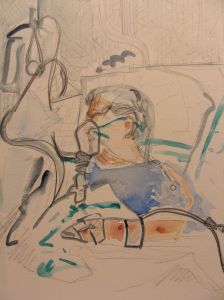
Pain. Copyright 1989 Robin L. Chandler

Unfortunately, the last years of my mother’s life were spent in nursing facilities and hospitals. Our family was fortunate, because the government’s Medicare provision and my father’s health insurance covered those expenses. During the last few weeks of her life, I visited my mom in the hospital and I tried to capture those moments in watercolor. Robert Henri wrote in his book Art Spirit “the beauty of the lines of the drawing rest in the fact that you do not realize them as lines, but are only conscious of what they state of the living person…you have been let into that life.” It was important to paint her, so that I would never forget her pain. Over the years I have returned to those paintings to remember my mother and think about the good things she did for others. I share one with you now to serve as a call to action. This is our time we can make a difference and help others.

In the middle of August 2009, the group Remote Area Medical provided free health care services to some 10,000 residents of Los Angeles for eight days providing the uninsured with routine services like eye and dental exams, mammograms and access to special treatments like kidney dialysis. There is a crying need for healthcare reform in this country. We need to find the right model so that no one is without healthcare in our country. The latest recession figures indicate there are 40 million Americans living in poverty and they cannot afford healthcare. T. R. Reid’s book The Healing of America: A Global Quest for Better, Cheaper, and Fairer Health Care describes four basic models of health care at work in the world: Britain’s Beveridge Model where health care is provided and financed by the government; Germany and France’s Bismark Model where private insurance funds — financed by employers and employees — cover everyone and are government regulated to keep costs low; Canada’s National Health Insurance model which uses private-sector providers financed by government insurance plans into which every citizen pays; and lastly the “out-of-pocket” model most found in undeveloped nations where you get what you can pay for. We can do better than the last model. Wednesday night, President Obama laid out his vision of healthcare reform stating “if you’re one of the tens of millions of Americans who don’t currently have health insurance, the second part of this plan will finally offer you quality, affordable choices. If you lose your job or change your job, you will be able to get coverage.” He went onto say we can help people in need and we can solve this big problem. When I remember my mom, I think of someone who was always trying to do something useful to help someone in need. Like my mother, everyone deserves access to healthcare through every stage of their life. Now it’s our generation’s turn to help others. Lets bring about healthcare reform and shape the future by our actions.