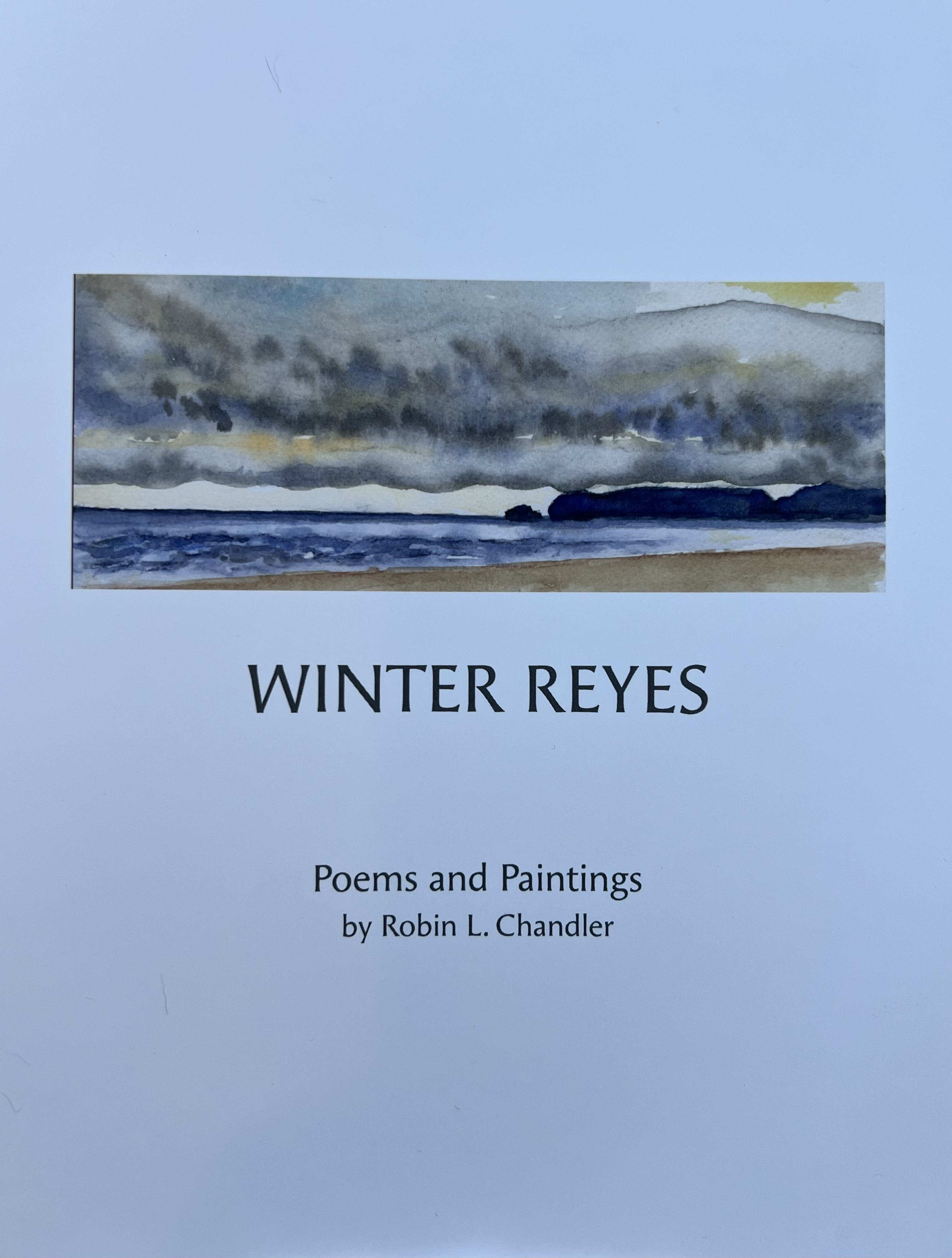
Cover of the book Winter Reyes: Poems and Paintings by Robin L. Chandler
The vernal equinox arrived and brought a blast of summer in typically springtime March. But I’m holding on to the memories of rain and wind, cold nights, frosty mornings, and blue winter light. And luckily, I can easily reconnect by opening a book that captures the feeling of winter in painting and poetry.
Inspired by my midwinter hikes, Winter Reyes rejoices in the hibernal beauty of Point Reyes National Seashore and shares the hope I find in nature’s resilience. My paintings and poems commemorate this jewel of the National Park Service. Copies of the book can be purchased on my website. I hope you have as much pleasure reading as I had in the making.
“reaching the bridge, the water parts, brush arches to the block page
Wet on wet, the work begins, the atmosphere emerges
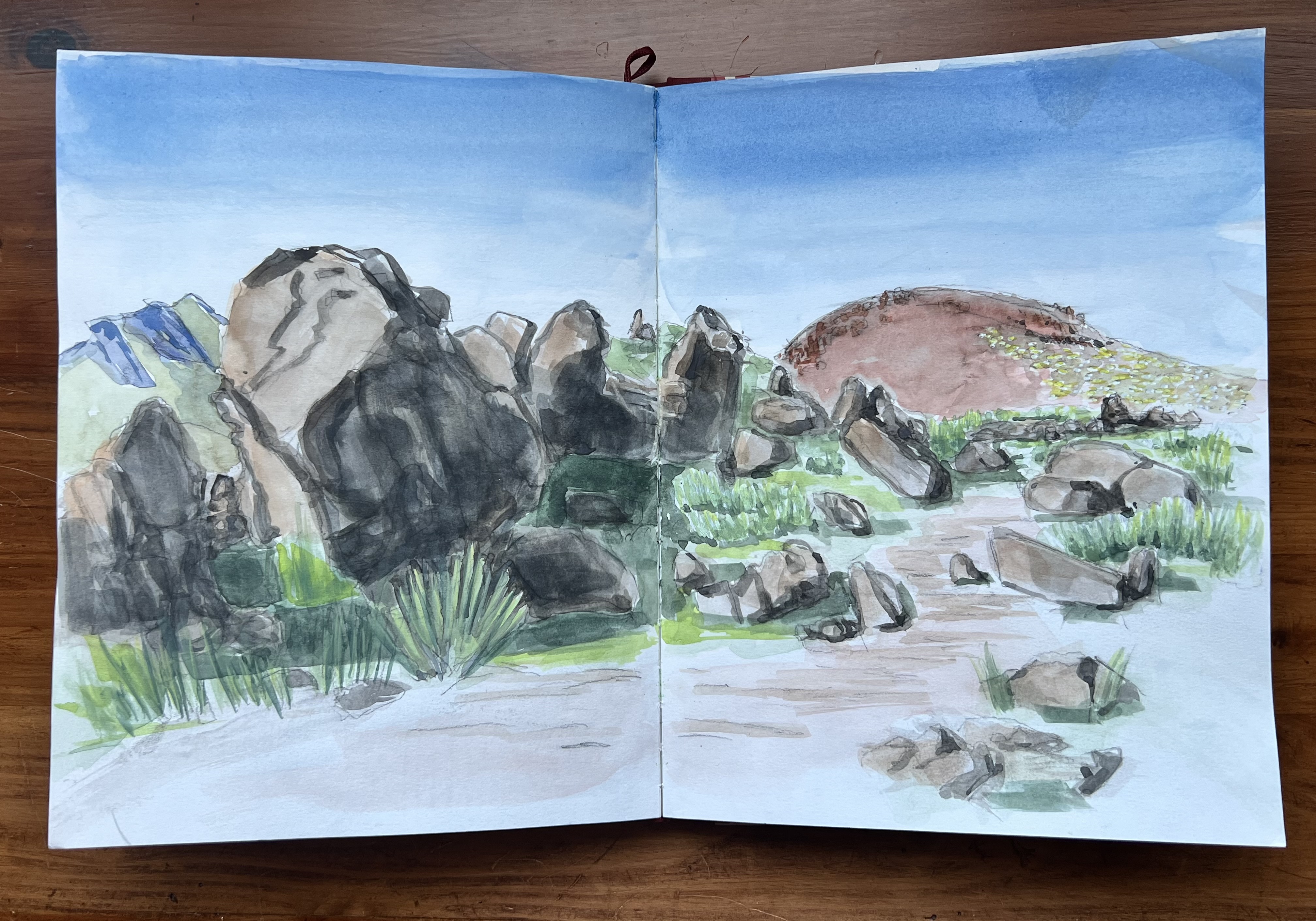
Sketch of the Coso Volcanic Field and Red Hill near Fossil Falls, Owens Valley. Robin L. Chandler, 2026.
The production of a work of art throws a light upon the mystery of humanity. A work of art is an abstract or epitome of the world. It is the result or expression of nature in miniature. For, although the works of nature are innumerable and all different, the result or the expression of them all is similar and single. Nature is a sea of forms radically alike and even unique. A leaf, a sunbeam, a landscape, the ocean, make an analogous impression on the mind. What is common to them all, — that perfectness and harmony, is beauty. The standard of beauty is the entire circuit of natural forms, — the totality of nature; which the Italians expressed by defining beauty “il piu nell’ uno.” Nothing is quite beautiful alone: nothing but is beautiful in the whole. A single object is only so far beautiful as it suggests this universal grace. The poet, the painter, the sculptor, the musician, the architect, seek each to concentrate this radiance of the world on one point, and each in his several work to satisfy the love of beauty which stimulates him to produce. Thus is Art, a nature passed through the alembic of man. Thus in art, does nature work through the will of man filled with the beauty of her first works.
Excerpt from Ralph Waldo Emerson’s essay Nature published in Ralph Waldo Emerson Collection: Collected Essays and Lectures (p.9)published in 1849.
“Dürer was the first to take nature – a grassy meadow, for example, something completely mundane – and portray it. That kind of depiction hadn’t been done before. Until then, plants were always symbolic, like the lilies in a picture of the Virgin Mary. Earlier, each plant had a specific meaning. Dürer portrayed the meadow simply as a meadow – and that was completely revolutionary…..art doesn’t reside in nature as pure reality that you can depict directly. That doesn’t work anymore. Nature is no longer the innocent nature if once was…..
to make secretive is also to create a clearing in which something becomes visible, in which room for a new perception is created, but not in the scientific sense, in the mythological……
art brings all of the disparate kinds of knowledge into a new system. It brings this knowledge together and creates a unified view that must be constantly reinterpreted. It cannot be defined for all time…..
as a painter, one always hopes that under the surface, underneath what is visible, whether bricks or whatever, there’s something that will later mean more than what people see today. That is the veil…..that the painting already knows what will be in two centuries, what those looking at the painting will see in it in two hundred years. The veil of Isis can be a brick or a forest or whatever is painted and what is hidden beneath it is fed by the proceeding centuries but will also work in the centuries to come.”
Excerpt from Anselm Kiefer: In Conversation with Klaus Dermutz (New Delhi, India: Seagull Books, 2019) pps. 230 – 234
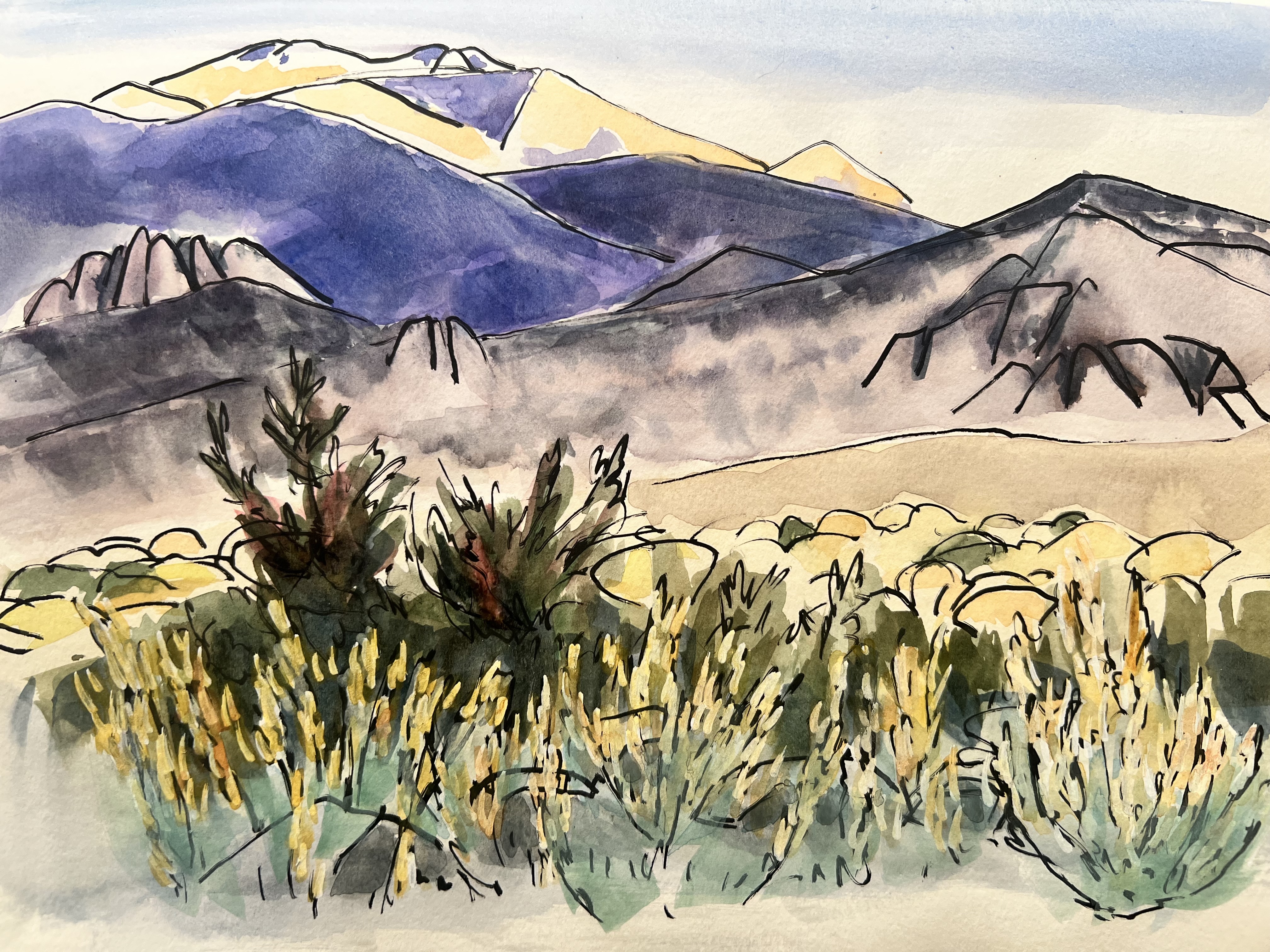
Twilight in a meadow in Bishop. Robin L. Chandler, 2025
“…there in the empty desert; there are the arid mountains; they shimmer in the ashen heart of noon, or swim in the far elusive colors of evening – a reality that appears unreal, challenging the imagination…you cannot argue with the silence. It returns your questionings to you, to your own inner silence which becomes aware – a mystical something that is neither reason nor intelligence nor intuition, a recognition of some nameless truth that may not be denied.” (p.234)
Quote from a letter written by the artist Maynard Dixon on the occasion of a retrospective exhibit of his work held in November 1945 at the Scripps College art gallery. This is an excerpt from The Life of Maynard Dixon by Donald J. Hagerty
“Over that [1929] summer, [Georgia] O’Keefe worked her way through the standard paintings of santos, Ranchos de Taos church, and Taos Pueblo itself, but hints of her later work appeared as well. Particularly in a series of paintings of penitence crosses against a backdrop of a southwestern night sky, O’Keefe illustrated the spiritual inspiration she found in the New Mexico landscape. Perhaps the best-known painting from the summer, however, is The Lawrence Tree…..O’Keefe described the painting…..’I had one particular painting, that tree in Lawrence’s front yard as you see when you lie under it on the table with the stars it looks as tho it is standing on its head.’…..the work shows O’Keefe’s sensual appreciation of New Mexico as well as her engagement with [D. H.] Lawrence‘s writing. Lawrence had described the tree himself in St. Mawr, and Lawrence’s work remained in O’Keefe’s library throughout her life. Although Lawrence typically saw the tree with some ambivalence, O’Keefe made it entirely her own. In the painting, the tree reaches up and seems to kiss the sky, much as O’Keefe herself once said she wanted to do.” (177)
Excerpt from Flannery Burke‘s From Greenwich Village to Taos: Primitivism and Place at Mabel Dodge Luhan’s (Lawrence, Kansas: University of Kansas Press, 2008)
“The rivers of fluid fire that suddenly fell out of the sky and exploded on the earth near by, as if the whole earth had burst like a bomb, frightened her from the very core of her, and made her know secretly and with cynical certainty, that there was no merciful God in the heavens. A very tall, elegant pine-tree just above her cabin took the lightning, and stood tall and elegant as before, but with a white seam spiraling from its crest, all down its tall trunk, to earth. The perfect scar, white and long as lightning itself. And every time she looked at it, she said to herself, in spite of herself: There is no Almighty loving God. The God there is shaggy as the pine-trees, and horrible as the lightning. Outwardly, she never confessed this. Openly, she thought of her dear New England Church as usual. But in the violent undercurrent of her woman’s soul, after the storms, she would look at that living seamed tree, and the voice would say in her, almost savagely: What nonsense about Jesus and God of Love, in a place like this!This is more awful and more splendid. I like it better. The very chipmunks, in their jerky helter-skelter, the blue jays wrangling in the pine-tree in the dawn, the grey squirrel undulating to the tree-trunk, then pausing to chatter at her and scold her, with a show of fearlessness, as if she were the alien, the outsider, the creature that should not be permitted among the trees, all destroyed the illusion she cherished, of love, universal love. There was no love on this ranch. There was life, intense, bristling life, full of energy, but also, with an undertone of savage sordidness.” (167-168)
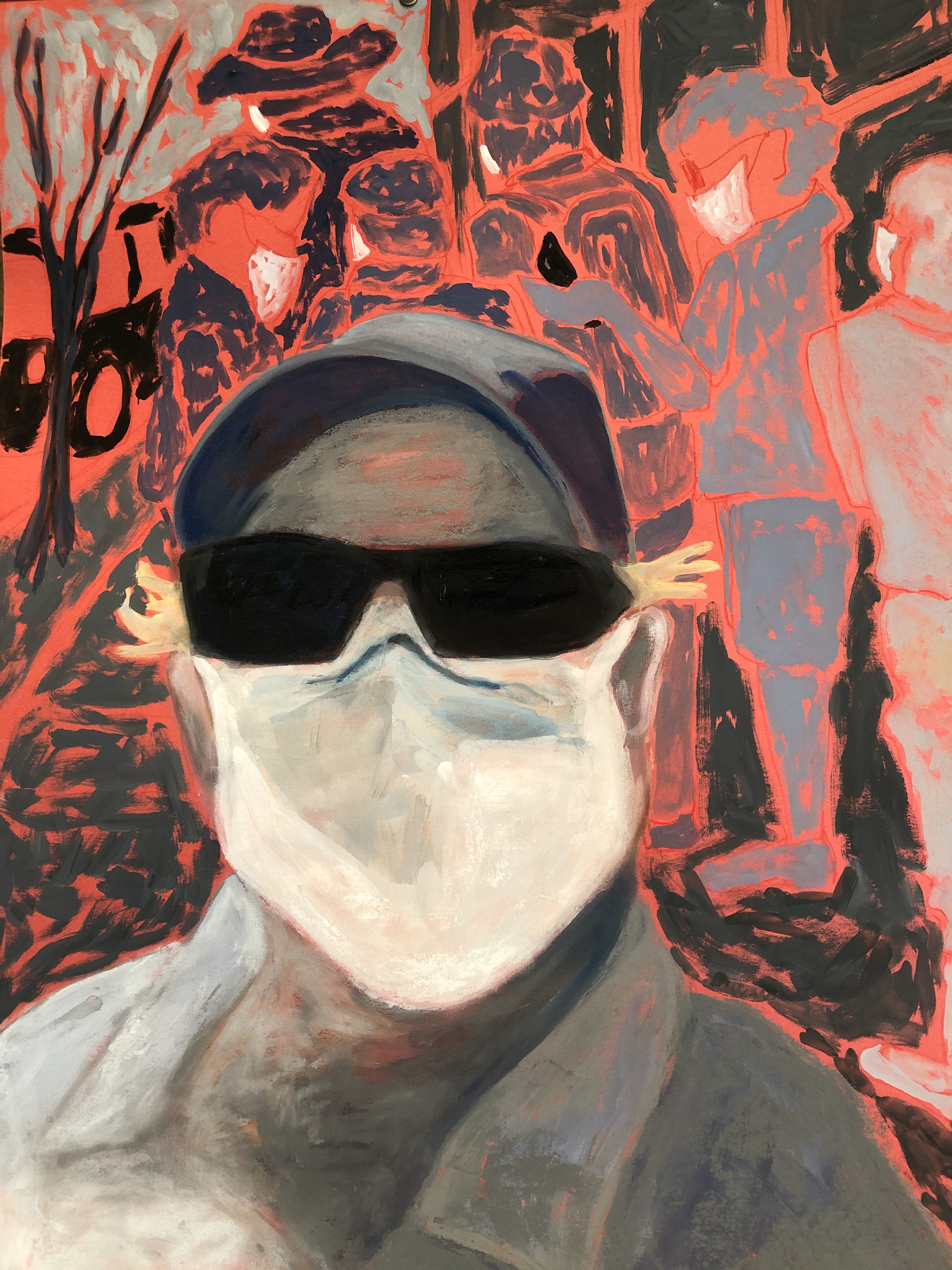
In a recent UC Berkeley Arts & Ideas panel discussion called Literature and Art in Times of Crisis, the brilliant art historian Darcy Grimaldo Grigsby discussed how the great paintings establish a connection when “dissonance, discrepancy and distance separate us” by bridging “isolation, economic inequalities, and racial hierarchies.” Grigsby opened my mind by describing how the act of painting – optical rendering – evokes our empathies by creating intimacy and a sense of touch, when facing the abyss of space and time.
For the last several weeks, I have been sketching (and painting) my life during the Coronavirus. Sheltering in place since March 17th, I have sketched my interior and exterior life… my home and garden, my housebound companions, and socially distanced street life, captured when walking my neighborhood and waiting in-line at the grocery store. Sketching keeps me grounded in the here and now and keeps the deathly shadows at bay. It prevents my mind from wandering and mourning the past, an act that quickly becomes fear of a lost future. By sketching I remain connected to the present world, building intimacy when masks all but cloak our humanity. In this momentary limbo, we all grieve for our time we have lost, but must never give up hope of finding our time again.
Thank you T. S. Elliot for the loan of your first line from The Waste Land.
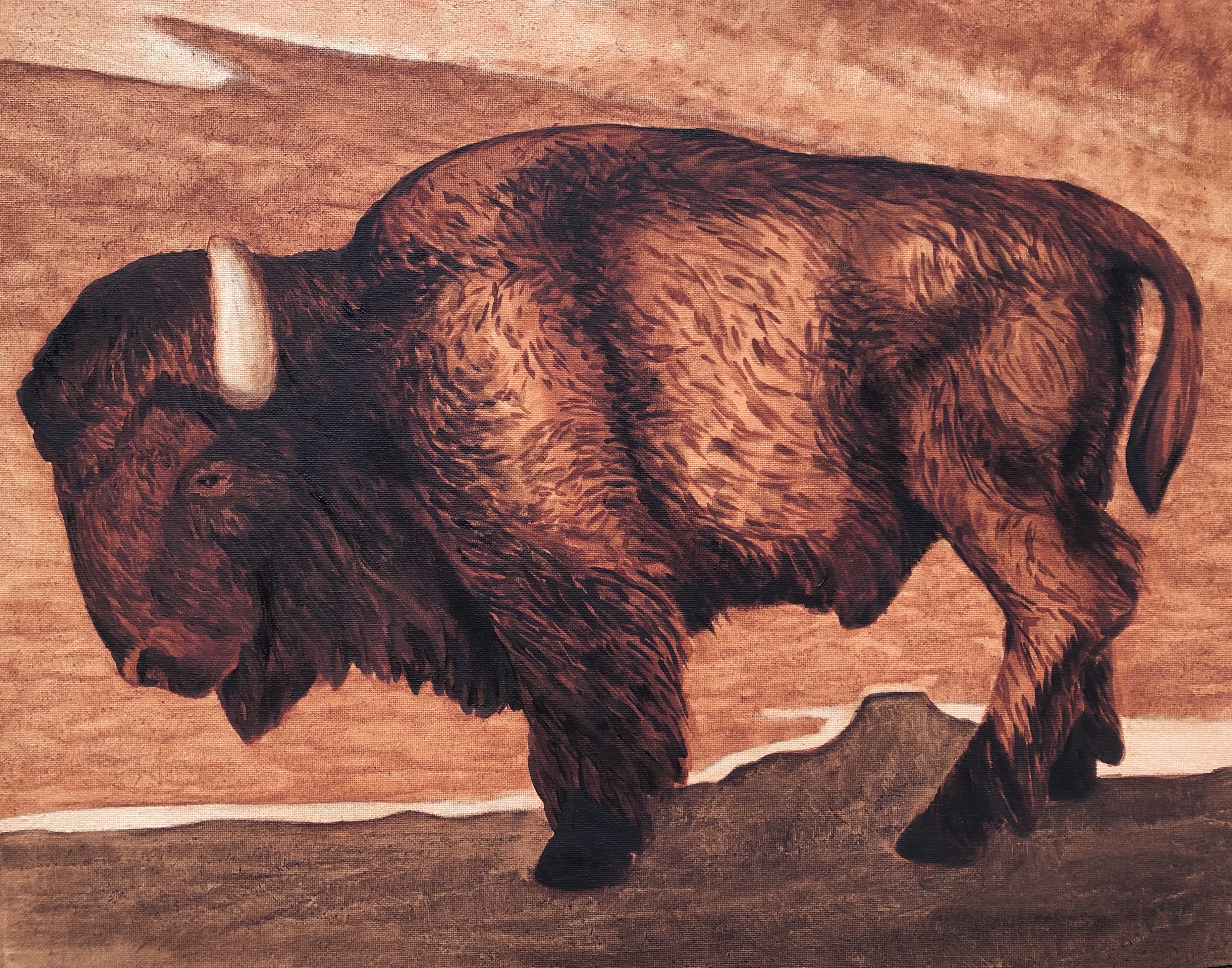
“Artists render things.” In my case, landscapes, cityscapes, human figures, combinations of artifacts, and even toys are rendered on canvas as they appear to me. Selecting a subject to paint calls upon both external and internal factors. Shapes, volumes, colors, and textures engage my senses – establishing my experience of the “thing” – while simultaneously my subjective connections, associations, and memories open a hailing frequency. For children (and grownups) toys (and art) are gateways to worlds we imagine where we are inspired to create a balance between what we observe and what we experience. And so play, and in this case, a painting, begins.
There were twelve toy animals on the table; the one that spoke loudest to me was the Bison. Though only inches in height and width, the expertly modeled Schleich toy called to me. I was captivated by the massive strong body, the tones of sepia, burnt umber, and yellow ochre, and the sense of the thick shaggy fur. Instantly my mind surfaced thoughts of John Muir’s wilderness and my associations with ecologically minded indigenous peoples, capitalist resource exploitation, and land stewardship combined with my memories of hiking and camping. I could easily imagine the cloud of breath released from the Bison’s nostrils on a cold winter Yellowstone morning. The “thing” reached out, grabbed me, and as all good toys do, brought a joyous smile to my face.
The German philosopher Immanuel Kant believed “humans were like citizens of two worlds, occupying both the world of the Ding an sich (the thing-in-itself) which was the external world, and the internal world of one’s perception (how things appeared to individuals).” According to Kant “when we experience an object, it becomes a thing-as-it appears-to-us. Our senses as much as our reason are like tinted spectacles through which we perceive the world.” [1]
The world, unfortunately through other spectacles, is gritty and grim. I read this morning about how the Bison herds in Yellowstone Park are managed.[2] Because this is the sole remaining place in the United States where the public can experience bison living free-range, sustainable herd percentages are identified (4800), and numbers beyond the benchmarks are destroyed by capture and slaughter or by hunting. Range management is rational, and yet I weep at the loss of numbers realized through our ongoing conquest of the planet. “According to the naturalist Ernest Thompson Seton, North America at the time of Columbus was home to sixty million bison, thirty to forty million pronghorns, ten million elk, ten million mule deer, and as many as two million mountain sheep…incredible to imagine today, bison roamed from New York to Georgia.”[3]
[1] Wulf, Andrea. The Invention of Nature: Alexander Von Humboldt’s New World. (Vintage Books: New York, 2016). p.38-39
Snow in the San Gabriel Mountains. Robin L. Chandler, 2019. Pastel sketch.
A week ago the dangers of fire season loomed in California; but this week an atmospheric river flows across the Pacific bringing rain and snow across the land from San Francisco to Los Angeles. The change has been radical and sudden, and we are grateful for the rainy weather. During the Thanksgiving weekend, snow blanketed the San Gabriel Mountains. At sunset, we walked in the Huntington Library Gardens and gazed at the twilight storm clouds glowing orange with purple shadows, seeming to feast upon the mountains. Gorgeous. Sublime. We gave thanks for this moment of beauty.
Moments before in the gallery, our eyes had feasted upon the exhibit John Ruskin and His “Frenemies:” Prints and Drawings from the Huntington’s Collection,” featuring works on paper by John Ruskin and his friends and colleagues including J.M.W. Turner and the Pre-Raphaelites and his enemies such as John Constable and James McNeil Whistler. “As much as he praised artists whose style, technique, or subject matter aligned with his own approach, he could be strongly critical of others.” Inspired by these works, I began sketching in an attempt to capture the evolving sublime scene of the mountains and sky above me. Ruskin believed that the principal role of the artist is “truth to nature” and he wrote about the challenges of working plein air:
“The clouds will not wait while we copy their heaps or clefts; the shadows will escape us as we try to shape them…in all that we do now, therefore, direct imitation becomes more or less impossible…whatever skill you may reach, there will always be need of judgment to choose, and of speed to seize certain things that are principal…”[1]
In this time of climate change we find graceful transitions vanish and blunt onsets prevail. Last week it was dry, and the threat of fire loomed. This week it is wet, and we are battered by wind, flood, ice, and snow. Our civilization believes it can conquer and control nature and in our acts of hubris, we have pushed nature to extremes. Writing about two great painters, Giorgione and J.M.W. Turner, Ruskin compared the civilizations in which they lived. The architecture of the Venetian Republic impacted Giorgione greatly; he “saw only strength and immortality, could not but paint both; conceived the form of man as deathless, calm with power, and fiery with life.”[2] And Turner, living in Victorian England saw the exact reverse of this “in the present work of men, meanness, aimlessess, unsightliness: thin-walled, lath-divided, narrow-garreted houses of clay; booths of a darksome Vanity Fair, busily base…as to the strength of men to Giorgione, to Turner their weakness and vileness were alone visible…[Turner] must be a painter of the strength of nature; there was no beauty elsewhere…he must also paint the labour and sorrow and passing away of men; this was the great human truth visible to him.”[3]
[1] Ruskin, John. The Elements of Drawing. Aquitaine Media, 2010. p.92
[2] Ruskin, John. Unto This Last and Other Writings. London: Penguin, 1997. p.151
[3] Ruskin, John. Unto This Last and Other Writings. London: Penguin, 1997. p.151
Watercolor sketch from memory. Robin L. Chander, 2019.
My uptown train pulled into the 77th Street Station oh so briefly. This speeding apparatus is hurtling me towards an exhibit by the Expressionist painter Ernst Ludwig Kirchner, a member of Die Brucke, known for paintings of city streets in high-key colors and rough exaggerated lines. So my mind’s eye is primed for heightened awareness. I glance up from my book as the light changes from dark tunnel to bright station and see a Tex-Mex band across the tracks. A human jukebox of sorts, I recall an old Jimmie Rodgers’ tune and start to sing quietly “though my pocketbook is empty and my heart is full of pain. I’m a thousand miles away from home, just waiting for a train.” Fragments overlaying fragments of sound and light and color and text, making new connections and associations, looking, listening and learning; a collage of the mind.
New York City, The City That Never Sleeps, always delights and surprises. Around every corner waits a story to be told which is why I love it. Who are those musicians…a professional band? Where will the green-line train take them? Flatbush? Why this day and why mid-morning…a job…a festival? Are they playing for a gig celebrating Hispanic Heritage Month? I have a million questions to ask these troubadours to learn from their life experience. They bring me a story, a story I want to get off the subway and ask them about, hear their words and hear their song, but the train hurtling through space, travels onward. Content must I be with another special glimpse of New York on a subway platform. In his essay The StorytellerWalter Benjamin wrote “…experience has fallen in value…when someone goes on a trip, he has something to tell …every morning brings us the news of the globe, and yet we are poor in noteworthy stories…the value of information does not survive the moment in which it was new. It lives only at that moment; it has to surrender to it completely and explain itself to it without losing any time. A story is different. It does not expend itself. It preserves and concentrates its strength and is capable of releasing it even after a long time…it resembles the seeds of grain which have lain for centuries in the chambers of the pyramids shut up air-tight and have retained their germinative power to this day.”
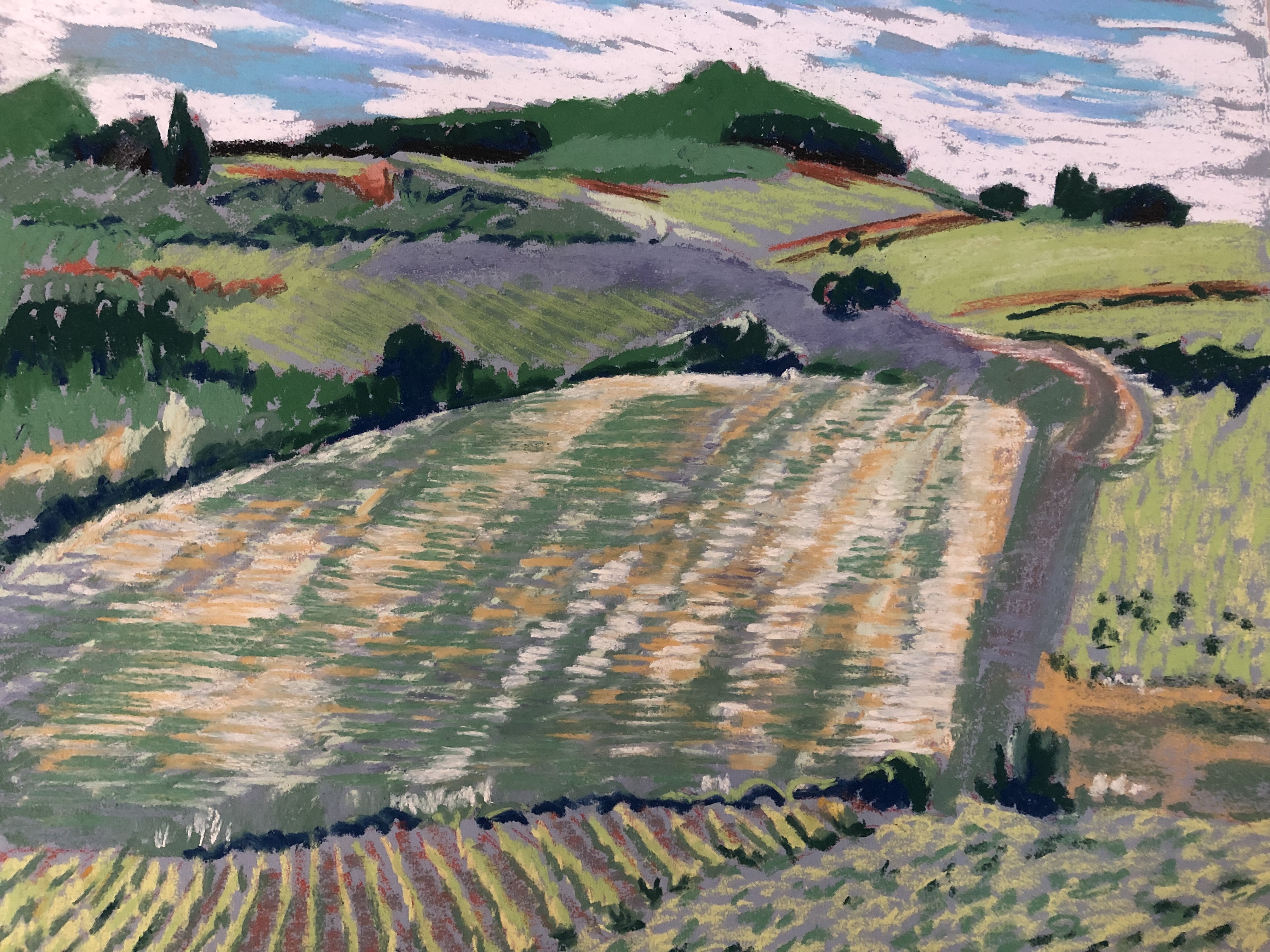
old vineyard, Southern France. Robin L. Chandler, 2019.
August 1888
“And in the same way a child in the cradle, if you watch it at leisure, has the infinite in its eyes. In short, I know nothing about it, but it is just this feeling of not knowing that makes the real life we are actually living now like a one-way journey in a train. You go fast, but cannot distinguish any object very close up, and above all you do not see the engine.”
September 1888
“And in a picture I want to say something comforting as music is comforting. I want to paint men and women with that something of the eternal which the halo used to symbolize, and which we seek to confer by the actual radiance and vibration of our colourings.”
“If we study Japanese Art, we see a man who is undoubtedly wise, philo-sophic and intelligent, who spends his time how? In studying the distance between the earth and the moon? No. In studying the policy of Bismarck? No. He studies a single blade of grass. But this blade of grass leads him to draw every plant and then the seasons, the wide aspects of the countryside, then animals, then the human figure.”
September 1889
“My dear brother, you know that I came to the South [of France] and threw myself into my work for a thousand reasons. Wishing to see a different light, thinking that to look at nature under a brighter sky might give us a better idea of the Japanese way of feeling and drawing. Wishing also to see this stronger sun, because one feels that without knowing it one could not understand the pictures of Delacroix…”
“What a queer thing touch is, the stroke of the brush.”
“…if you work diligently from nature without saying to yourself beforehand – I want to do this or that – if you work as if you were making a pair of shoes, without artistic preoccupations, you will not always do well, but the days you least anticipate it you will find a subject which holds its own with the work of those who have gone before us. You learn to know a country which is fundamentally quite different from its appearance at first sight.”
“…confronted by the difficulties of weather and of changing effects, [ideas] are reduced to being impracticable, and I end by resigning myself and saying that it is the experience and the meager work of every day which alone ripens in the long run and allows one to do things that are more complete and true. Thus slow long work is the only way, and all ambition and resolve to make a good thing of it, false. For you must spoil quite as many canvases when you return to the onslaught every morning as you succeed with.”




 alive in the sea of information