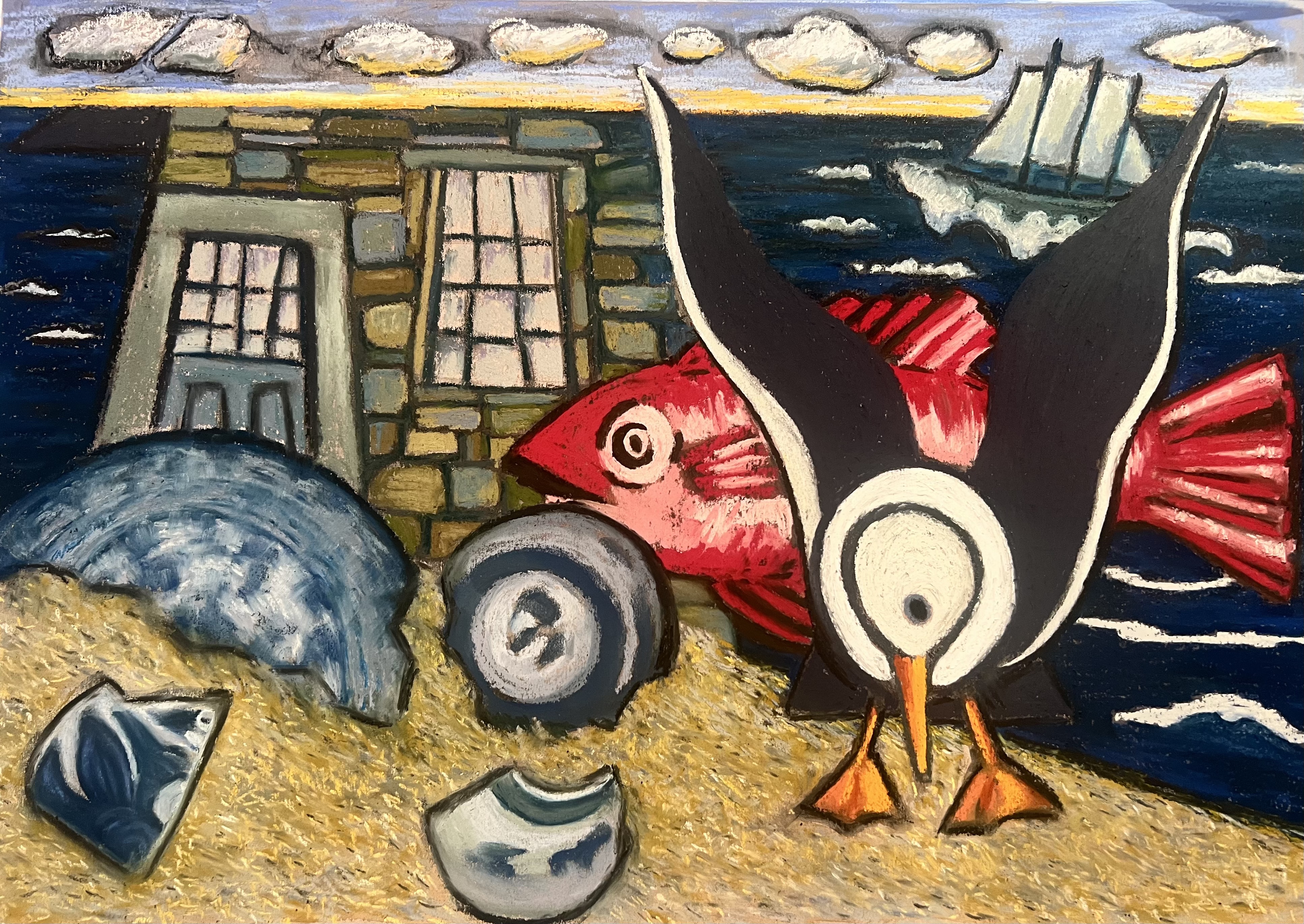
ode to Gloucester

ode to Gloucester. Robin L. Chandler, 2024

Liberty for the few

Equality for the many

The criminal copies the oligarchy

Which is an international fold of moneys

The gulls of New England

Close their bills against the oil

Spills. At night pleasure rocks

In chairs and harbors

Wine colors contort on the goblets

From Selected Poems (2000) by Fanny Howe (p.105)

*****

“With [Charles] Olson his identity with the place, with Gloucester, give his major work, The Maximus Letters, a deep emotional center. The only other American writer who gives me the same sense of responding to a place, in both an historical and philosophic sense is Thoreau in his first book, A Week On the Concord And Merrimack Rivers.

“Olson, in one of the Letters’ most persistent themes, uses Gloucester as a poetic expression of the realities of history…..the sense of place in the letters is – in a final sense – so compelling because what Olsen is trying to hold on to is the sense of place in time, as well as the sense of the immediate place of Gloucester.”

“The Letters become less of the poet’s expression and more the historian’s as they go on, even though the history is handled as poetic material. In any of the single Letters the history is almost without meaning – odd facts, lists of provisions, inserted paragraphs on the fishing industry – but with the growth of the poem as a whole it is clear that something else is involved.”

“Sometimes I find myself thinking of Olson as an artisan, a worker with his hands, a carpenter, New England journeyman…..It is difficult to be both a historian and a poet, but by using some of his materials as an artisan he is usually able to keep the two together within the poem.”

“The fullest aspect of the poem is still its involvement with Gloucester, but it is also about the painter Marsden Hartley – the period of his work in Gloucester, the powerful, mythic, almost folk paintings of the 1930s. The emphasis of the Letter is still circular – within, from, and to Gloucester – but Olson has separated out a part of this experience, and given it a distinct, separate identity outside of the main currents of the rest of the Letters.”

“I’ve never decided whether or not Olson considers his poems difficult to follow or if he cares, but he is difficult, one of the most difficult of the modern poets to follow…sometimes as in the inner references of Letter 7 its because he doesn’t give enough away – at other times, as in the overall structure of the Letters, because he includes a maze of only distantly related material.

“The glimpse that Olson gives of Hartley does have its inner intensity. Is it only for someone who knows the paintings? Who is already familiar with Hartley’s life? It could be. The response to anything in Maximus has to be personal. For someone already deeply familiar with the painter and his work Olson’s poem, with all it’s rambling and discursion, is a sensitive, moving portrait…..whatever someone decides about the poem any American poet beginning to sort out his poetic background will have to find his own place in the Letters – to find his own place in the American vision of Charles Olson’s Gloucester.”

From Young Tom and Charlie: Two American Poets at Home in Gloucester Seven Poems by T.S. Eliot and Charles Olson and Two Commentaries by Amanda Cook and Samuel Charters Selected with an Introduction by Ann Charters (p.72 – 81)

The quotes are from the commentary by Samuel Charters.

solstice at sea

The view from Limantour
The view from Limantour Beach, Point Reyes. Robin L. Chandler, 2019.

From Limantour Beach at Point Reyes you can see the edge of San Francisco and all the sea between. Some hundred years ago steam schooners, barkentines, and four- masted ships would have plied the waters beyond the Golden Gate.  I think of Ishmael leaving Nantucket in search of the great white whale….

“At last the anchor was up, the sails were set, and off we glided. It was a sharp, cold Christmas; and as the short northern day merged into night, we found ourselves almost broad upon the wintry ocean, whose freezing spray cased us in ice, as in polished armor. The long rows of teeth on the bulwarks glistened in the moonlight; and like the white ivory tusks of some huge elephant, vast curving icicles depended from the bows….as the old craft deep dived into the green seas and sent the shivering frost all over her, and the winds howled and the cordage rang, [Lank Bildad, as pilot] his steady notes were heard

 “Sweet fields beyond the swelling flood,

Stand dressed in living green.

So to the Jews old Canaan stood,

While Jordon rolled between.”[1]

Some thirty-five years ago, while I worked as a Photo Archivist at the San Francisco Maritime National Historical Park, I solo bicycled part of the Pacific Coast. On that ride, I made a point of visiting the legendary Captain Frederick Klebingat (see his fine biography on the Online Archive of California finding aid for his photography collection[2]). It was a great honor to meet the ninety-five year-young gentleman, who voiced great concern for my safety cycling the Pacific Coast. Expressing my deep admiration for the man who at sixteen (in 1905) rounded Cape Horn as a deckhand on a full-rigged ship, I reassured him that his risks had been much greater than mine. Imagine the strength, skill and courage it would take to furl the sails a’top the masts in the wind and rain ‘round the Horn all the while diving deeply into Ishmael’s great green seas! Talk about taking risks! Captain Klebingat was a person forged by nature’s forces; a rarity in a time when now most are shaped by a reality more virtual. During his lifetime, Captain Klebingat sailed barks, schooners, Liberty Ships and tankers, and served as a key figure in the restoration and preservation of historic sailing ships, particularly Honolulu’s Falls of Clyde. Captain Klebingat’s research papers about restoring the Falls of Clyde can be found at the University of Glasgow[3] (the vessel was built in Glasgow’s shipyards). During our visit, Captain Klebingat autographed and gifted me his book Christmas at Sea[4]inscribing To Robin, May All Your Christmases be Merry. Frederick Klebingat. I keep the book remembering my visit with the great sailor. About six months later in March 1985, Captain Klebingat passed away; but our visit that fall day in 1984, remains a treasured memory. In fond remembrance, for Captain Klebingat at Christmas, I share an excerpt from his book.

On a Christmas Eve a few years after the 1906 Earthquake, young deckhand Fred Klebingat, his friend Tommy, and first mate Hagen are on watch aboard the barkentine the S.N. Castle, anchored in San Francisco Bay. The sailors are grateful to have a job and thankful for the turkey roasting in the ship’s galley for their Christmas dinner.  On deck they watched as

“the great beam [of lighthouse on Alcatraz Island]…searched out the hills of Richmond as it turned; momentarily it glanced by the brightly lighted windows of the houses in Berkeley…and blinked at the ferry boats…the searchlight also winked at those Bohemians who lived on Telegraph Hill, and for a second it peered into the windows of Nob Hill. It flashed by and lit up the spars of the ships anchored off Meiggs Wharf. On it turned, to beacon those mariners bound through the Golden Gate…[and Hagen said] “to me that light seems to be a beacon of liberty, to guide you to freedom – to all of us who first came here through the Golden Gate…there may not be all the freedom we may want, but it is much more than what we left behind.”

[1]Melville, Herman. Moby Dick. New York, New York: The New American Library, 1961. p.113

[2]https://oac.cdlib.org/findaid/ark:/13030/c8dv1mcm/admin/#bioghist-1.3.7

[3]https://archiveshub.jisc.ac.uk/search/archives/a8574677-b733-39a7-a018-c41c656aca62

[4]https://trove.nla.gov.au/work/18890471?q&versionId=22175323

awaken at the beach

Limantour Beach
Limantour Beach. Robin L. Chandler, 2018.

Winter is my favorite time of year; I love the journey to the year’s shortest day and the new pilgrimage for the year’s longest day. Precious the light of day and the warmth of the sun; most welcome is the night when blessed with a good book by the fire and my cat curled sleeping in my lap.

On Christmas Eve, I walked the landscape of Drakes Estero and Limantour Beach with my beloved wife and dear friend. Just a few days past the solstice the day remained short, and to commemorate the day, I made a watercolor sketch and reflected on darkness and light asking myself what can well-meaning souls do to make the world a better place?

And by a better place I mean: end the rapacious exploitation of the earth’s flora and fauna; take measures to resolve the increasing disparity between rich and poor; respect the diversity of global cultures; and stop the egregious use of violence. No small challenge. No simple answer. In fact, it sounds so impossible to resolve, I might as well give up and run away. Run as far away as possible from the suffering and the death, building tall strong walls to protect me from the pain.

It takes great courage to sit and listen to the suffering, the death, and the pain: within yourself and in others. Many of us feel compelled to fix the problems, and when we can’t we give up and salve our pain with whatever money can buy. Not knowing what to do or how to fix a problem is impossibly hard. But through my Buddhist studies, I have learned that there is a place to begin: listen, stay open minded and be generous. This is how the suffering ends and the healing starts. We are not born knowing all things, and will never learn all there is to know. Mitchell Thomashow writes in his essay Nature. Love. Medicine. Reciprocity. Generosity. “…we can cultivate generosity, open-mindedness, graciousness, and humility in the space of that glorious unknowing. I don’t have the capacity to love every species and every person, but I can develop the capacity to be more generous with those people and species that I do encounter.” Blessings on us all for this New Year!