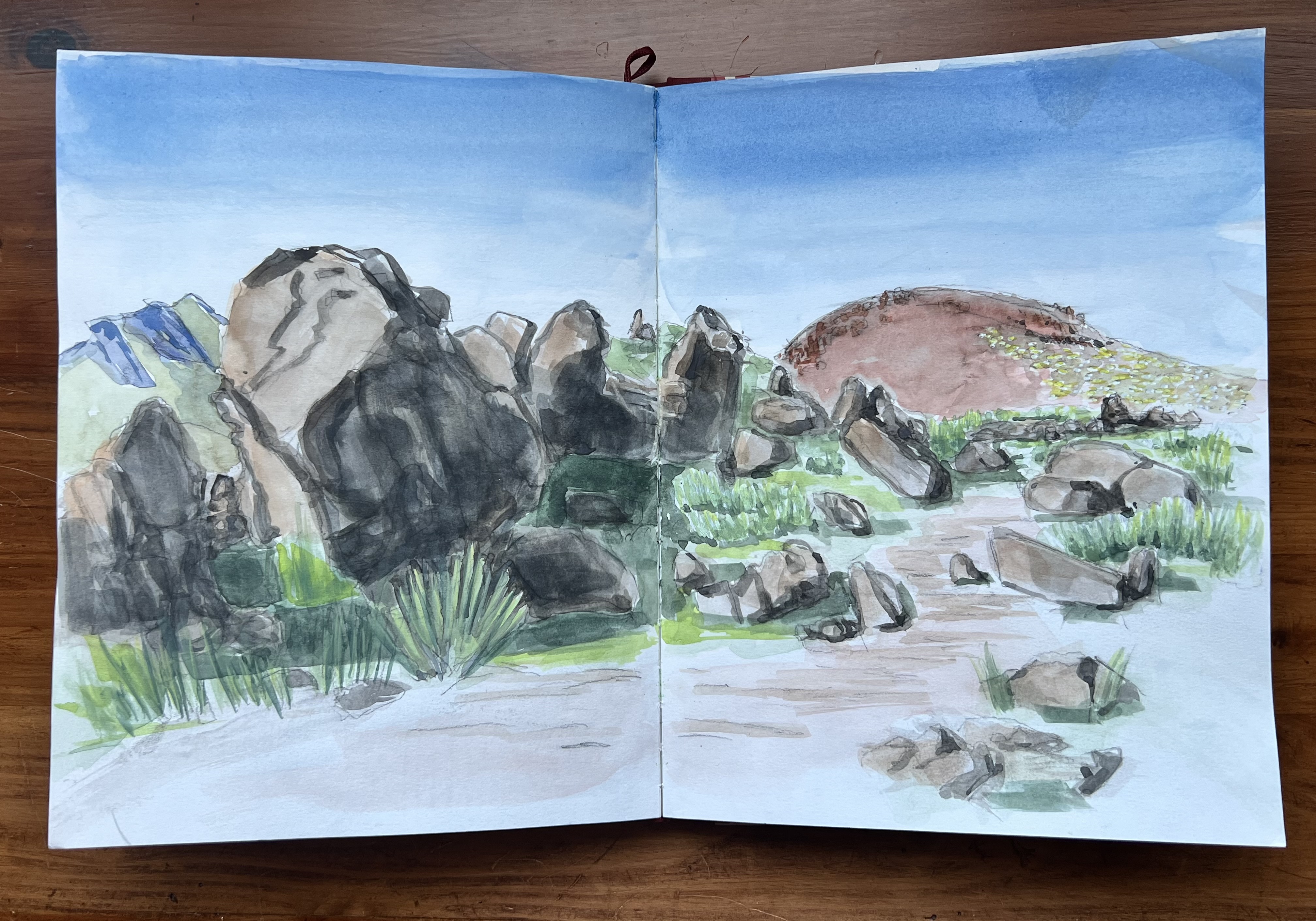
Sketch of the Coso Volcanic Field and Red Hill near Fossil Falls, Owens Valley. Robin L. Chandler, 2026.
The production of a work of art throws a light upon the mystery of humanity. A work of art is an abstract or epitome of the world. It is the result or expression of nature in miniature. For, although the works of nature are innumerable and all different, the result or the expression of them all is similar and single. Nature is a sea of forms radically alike and even unique. A leaf, a sunbeam, a landscape, the ocean, make an analogous impression on the mind. What is common to them all, — that perfectness and harmony, is beauty. The standard of beauty is the entire circuit of natural forms, — the totality of nature; which the Italians expressed by defining beauty “il piu nell’ uno.” Nothing is quite beautiful alone: nothing but is beautiful in the whole. A single object is only so far beautiful as it suggests this universal grace. The poet, the painter, the sculptor, the musician, the architect, seek each to concentrate this radiance of the world on one point, and each in his several work to satisfy the love of beauty which stimulates him to produce. Thus is Art, a nature passed through the alembic of man. Thus in art, does nature work through the will of man filled with the beauty of her first works.
Excerpt from Ralph Waldo Emerson’s essay Nature published in Ralph Waldo Emerson Collection: Collected Essays and Lectures (p.9)published in 1849.
Walking along Inverness Ridge among the new growth of bishop pines after the Vision Fire (1995); in the distance are douglas firs burned in the Woodward Fire (2020). Robin L. Chandler, 2025.
We were afraid to go back
afraid to listen to the stories
ash and bone might tell
We wanted to believe our lives were immutable
untouchable by nature, fate or disaster
At twilight we skirted the base of the first burned hill
reclaimed her scorched shoulder
her ruined slope
The ground beneath our feet released puffs of smoke
“When Sir Francis Drake spent a month in 1579 repairing his ship in the bay that now bears his name, the hills and ridges to the east would have been mostly open grassland or coastal scrub because of the Miwok’s liberal use of fire as a key tool of their ecological management and because of grazing by herds of elk, which benefited from the anthropogenic burning. The same was true when Sebastian Ceremeno, a Portuguese navigator and explorer sailing on the Manilla galleon route, was shipwrecked in Drakes Bay in 1595. Richard Henry Dana, visiting San Francisco Bay in 1840 described the herds of elk he could see on the open headlands.” (p.84)
“The [Mt.] Vision Fire started on October 3, 1995, and burned for about a week in an area mostly designated as park wilderness, eventually burning almost twelve thousand acres. Some local boys apparently thought they had drowned their campfire, but they hadn’t. It’s a story that reminds me of Henry David Thoreau; on a camping trip with a friend in April 1844, their campfire got out of control and almost burned down their hometown of Concord, Massachusetts. Many years later, that experience led Thoreau to investigate the fire ecology of his local ecosystem. He recognized the influence of past Native American burning on the landscape and became essentially the first published fire ecologist through his writing on the subject. The Vision Fire burned an area partly dominated by bishop pine, Pinus muricata. Bishop pine became so familiar with fire that it evolved a relationship that could be called “friends with fire.” (p.86-87)
“Over that [1929] summer, [Georgia] O’Keefe worked her way through the standard paintings of santos, Ranchos de Taos church, and Taos Pueblo itself, but hints of her later work appeared as well. Particularly in a series of paintings of penitence crosses against a backdrop of a southwestern night sky, O’Keefe illustrated the spiritual inspiration she found in the New Mexico landscape. Perhaps the best-known painting from the summer, however, is The Lawrence Tree…..O’Keefe described the painting…..’I had one particular painting, that tree in Lawrence’s front yard as you see when you lie under it on the table with the stars it looks as tho it is standing on its head.’…..the work shows O’Keefe’s sensual appreciation of New Mexico as well as her engagement with [D. H.] Lawrence‘s writing. Lawrence had described the tree himself in St. Mawr, and Lawrence’s work remained in O’Keefe’s library throughout her life. Although Lawrence typically saw the tree with some ambivalence, O’Keefe made it entirely her own. In the painting, the tree reaches up and seems to kiss the sky, much as O’Keefe herself once said she wanted to do.” (177)
Excerpt from Flannery Burke‘s From Greenwich Village to Taos: Primitivism and Place at Mabel Dodge Luhan’s (Lawrence, Kansas: University of Kansas Press, 2008)
“The rivers of fluid fire that suddenly fell out of the sky and exploded on the earth near by, as if the whole earth had burst like a bomb, frightened her from the very core of her, and made her know secretly and with cynical certainty, that there was no merciful God in the heavens. A very tall, elegant pine-tree just above her cabin took the lightning, and stood tall and elegant as before, but with a white seam spiraling from its crest, all down its tall trunk, to earth. The perfect scar, white and long as lightning itself. And every time she looked at it, she said to herself, in spite of herself: There is no Almighty loving God. The God there is shaggy as the pine-trees, and horrible as the lightning. Outwardly, she never confessed this. Openly, she thought of her dear New England Church as usual. But in the violent undercurrent of her woman’s soul, after the storms, she would look at that living seamed tree, and the voice would say in her, almost savagely: What nonsense about Jesus and God of Love, in a place like this!This is more awful and more splendid. I like it better. The very chipmunks, in their jerky helter-skelter, the blue jays wrangling in the pine-tree in the dawn, the grey squirrel undulating to the tree-trunk, then pausing to chatter at her and scold her, with a show of fearlessness, as if she were the alien, the outsider, the creature that should not be permitted among the trees, all destroyed the illusion she cherished, of love, universal love. There was no love on this ranch. There was life, intense, bristling life, full of energy, but also, with an undertone of savage sordidness.” (167-168)
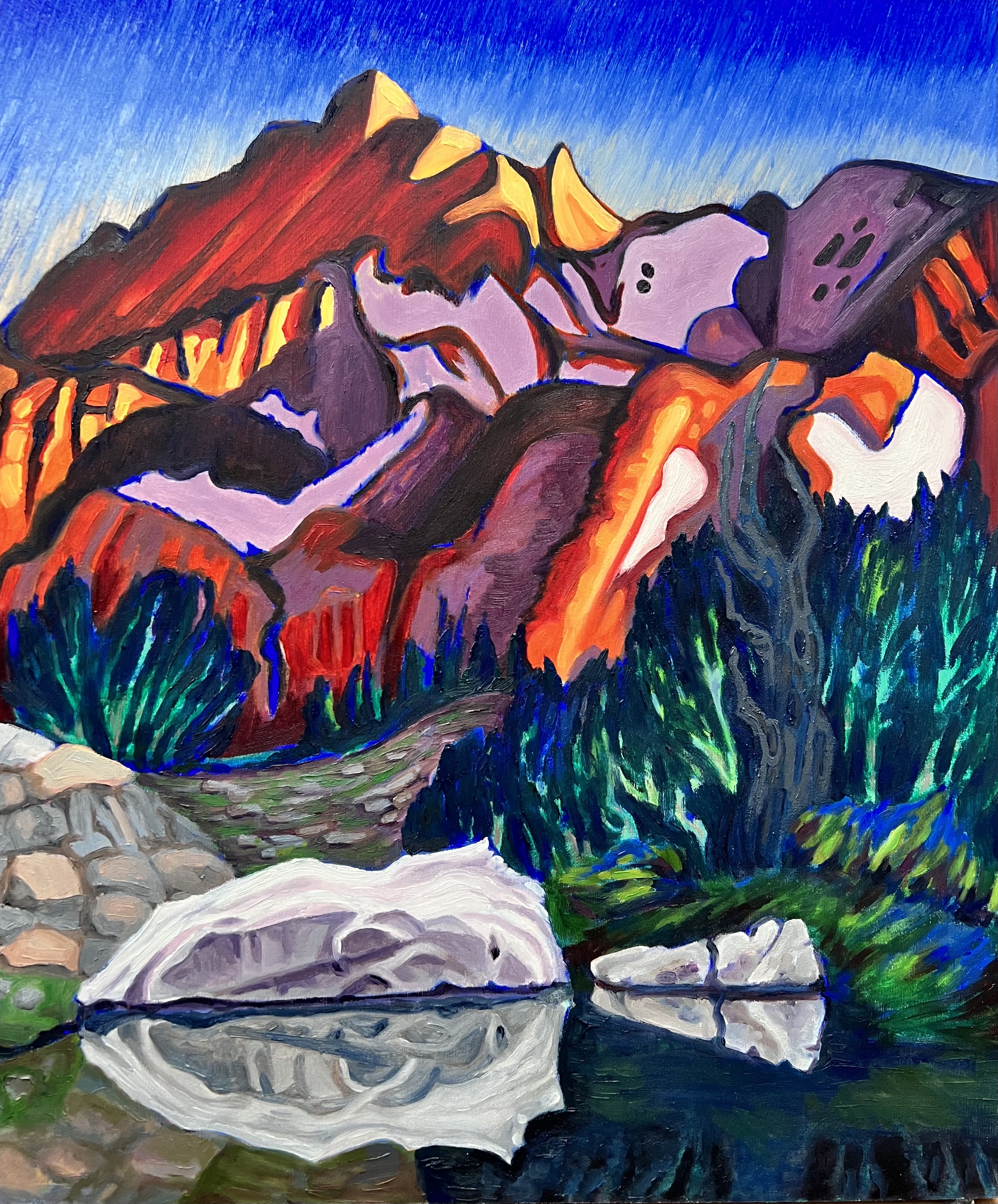
Wit-Sa-Nap Creek Winter Sunset. Robin L. Chandler, 2024
“[According to the Avatamsaka Sutra,] Indra’s net is pictured as stretching indefinitely in all directions, and at each of the knots of the net is a glittering jewel. All the other jewels in the net are reflected in each individual jewel, and each jewel reflected is also reflecting all the other jewels. This metaphor describes what was called, in Pali (the original language of the Buddhist canon), paticca samupadda, “dependent co-arising.” Modern Buddhist teachers have called it “interbeing,” or “the harmony of universal symbiosis.” This is a theory of mutual intercausality, interconnectedness, and interdependence. It is a worldview from the same ecophilosophical galaxy as Alexander von Humboldt’s “kosmos,” the Nuu-chah-nulth First Nation’s principle of hisuknis cawaak, and the “everything is connected” view at the heart of ecology. When Thoreau wrote that humans need to “realize where we are and the infinite extent of our relations,” he had this kind of idea in mind.
We think in metaphors, often — and even scientists do. Metaphors are the templates of pattern, and having those templates helps scientists — and everyone — “see” the patterns and relationships underlying the superficial “data” of experience, which often appear chaotic. Thoreau wrote in his journal on August 5, 1851, “The question is not what you look at, but what you see.” Seeing deep patterns needs a metaphoric, poetic mind.” (p.166)
The Sierra Nevada Red Fox pictured in my painting is endangered; there are less than forty of these beautiful creatures remaining in the California counties of Alpine, Fresno, Inyo, Madera, Mono and Tuolumne. As an artist, I choose to make art that fosters kinship with the earth by capturing glimpses of the world’s beauty. I hope that inspiring others to understand our interconnectedness with nature will help preserve the earth- and in this case, the Sierra Nevada Red Fox – for future generations.
“So is ecology a kind of art? And, of course, art, like anything humans (or members of other species) do, is one kind of “interaction” between us and our environment. The logical conclusion from these definitions is inescapable: art is one aspect of human ecology, and ecological science is a kind of art. And since art is a kind of behavior, it may be an example of ecologically adaptive behavior…..if the art of Audubon and the Hudson River School painters has helped save parts of our biosphere, I’d say they are contributing to human survival – and that’s by definition, adaptive.” (p. 63-64)
“Most forms of Western ethics view persons as independent egos, centers of individual choice and action. But the Buddhist “dependent co-arising” view doesn’t see persons in that way. Ecology and evolutionary biology don’t either. The ethics that inspired these differing views – the Western ego-self view versus the Buddhist eco-self view – come out to be quite different. Aldo Leopold argued articulately, from an ecological perspective, for this broader view of self and community. He believed that ethics depend on the premise that the individual is a member of a community of interdependent parts. His “land ethic” enlarged the concept of this “community” to include soils, waters, plants, and animals.” (p.174)
“When it comes to actions and lifestyles, a world of total interdependence has both a negative and a positive side. On the negative side, anything that a person does can affect the whole system. Our ego-selfish actions have a global reach. But the positive side of total interdependence is that our actions and our choices, no matter how small, can send ripples of healing through the whole system.” (p. 175)”


 alive in the sea of information