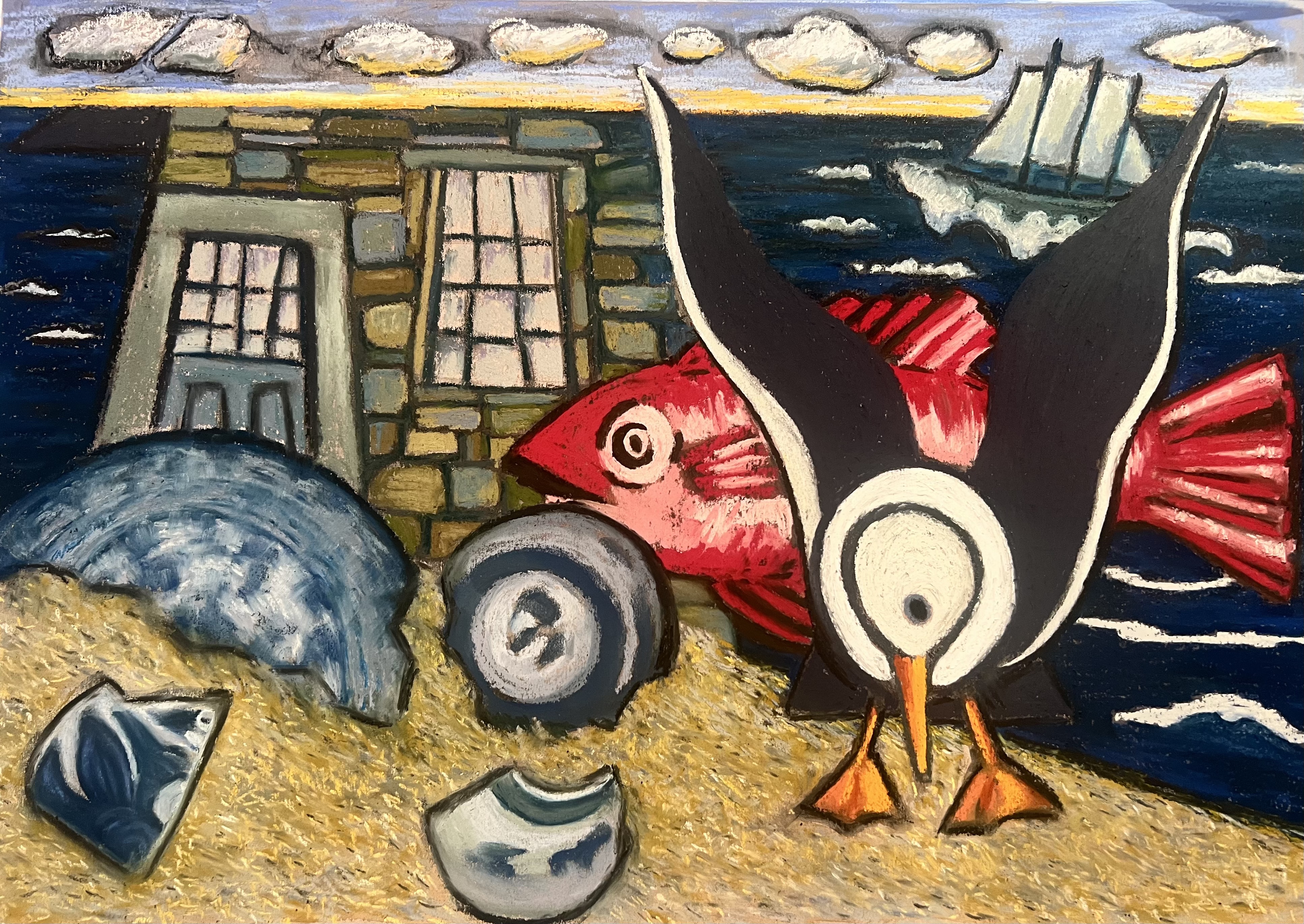
Liberty for the few
Equality for the many
The criminal copies the oligarchy
Which is an international fold of moneys
The gulls of New England
Close their bills against the oil
Spills. At night pleasure rocks
In chairs and harbors
Wine colors contort on the goblets
From Selected Poems (2000) by Fanny Howe (p.105)
*****
“With [Charles] Olson his identity with the place, with Gloucester, give his major work, The Maximus Letters, a deep emotional center. The only other American writer who gives me the same sense of responding to a place, in both an historical and philosophic sense is Thoreau in his first book, A Week On the Concord And Merrimack Rivers.”
“Olson, in one of the Letters’ most persistent themes, uses Gloucester as a poetic expression of the realities of history…..the sense of place in the letters is – in a final sense – so compelling because what Olsen is trying to hold on to is the sense of place in time, as well as the sense of the immediate place of Gloucester.”
“The Letters become less of the poet’s expression and more the historian’s as they go on, even though the history is handled as poetic material. In any of the single Letters the history is almost without meaning – odd facts, lists of provisions, inserted paragraphs on the fishing industry – but with the growth of the poem as a whole it is clear that something else is involved.”
“Sometimes I find myself thinking of Olson as an artisan, a worker with his hands, a carpenter, New England journeyman…..It is difficult to be both a historian and a poet, but by using some of his materials as an artisan he is usually able to keep the two together within the poem.”
“The fullest aspect of the poem is still its involvement with Gloucester, but it is also about the painter Marsden Hartley – the period of his work in Gloucester, the powerful, mythic, almost folk paintings of the 1930s. The emphasis of the Letter is still circular – within, from, and to Gloucester – but Olson has separated out a part of this experience, and given it a distinct, separate identity outside of the main currents of the rest of the Letters.”
“I’ve never decided whether or not Olson considers his poems difficult to follow or if he cares, but he is difficult, one of the most difficult of the modern poets to follow…sometimes as in the inner references of Letter 7 its because he doesn’t give enough away – at other times, as in the overall structure of the Letters, because he includes a maze of only distantly related material.
“The glimpse that Olson gives of Hartley does have its inner intensity. Is it only for someone who knows the paintings? Who is already familiar with Hartley’s life? It could be. The response to anything in Maximus has to be personal. For someone already deeply familiar with the painter and his work Olson’s poem, with all it’s rambling and discursion, is a sensitive, moving portrait…..whatever someone decides about the poem any American poet beginning to sort out his poetic background will have to find his own place in the Letters – to find his own place in the American vision of Charles Olson’s Gloucester.”
From Young Tom and Charlie: Two American Poets at Home in Gloucester Seven Poems by T.S. Eliot and Charles Olson and Two Commentaries by Amanda Cook and Samuel Charters Selected with an Introduction by Ann Charters (p.72 – 81)
The quotes are from the commentary by Samuel Charters.
 alive in the sea of information