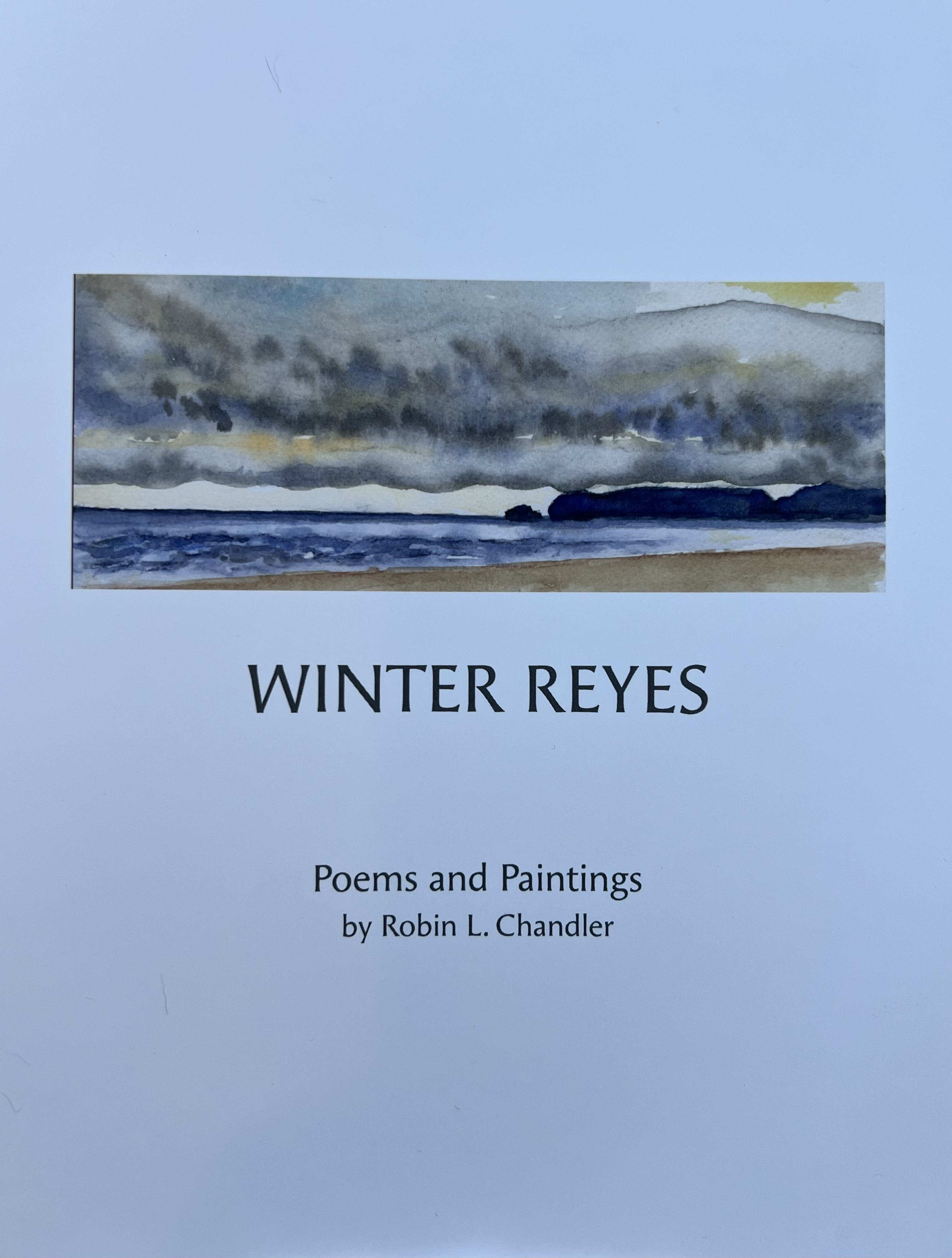
Cover of the book Winter Reyes: Poems and Paintings by Robin L. Chandler
The vernal equinox arrived and brought a blast of summer in typically springtime March. But I’m holding on to the memories of rain and wind, cold nights, frosty mornings, and blue winter light. And luckily, I can easily reconnect by opening a book that captures the feeling of winter in painting and poetry.
Inspired by my midwinter hikes, Winter Reyes rejoices in the hibernal beauty of Point Reyes National Seashore and shares the hope I find in nature’s resilience. My paintings and poems commemorate this jewel of the National Park Service. Copies of the book can be purchased on my website. I hope you have as much pleasure reading as I had in the making.
“reaching the bridge, the water parts, brush arches to the block page
Wet on wet, the work begins, the atmosphere emerges
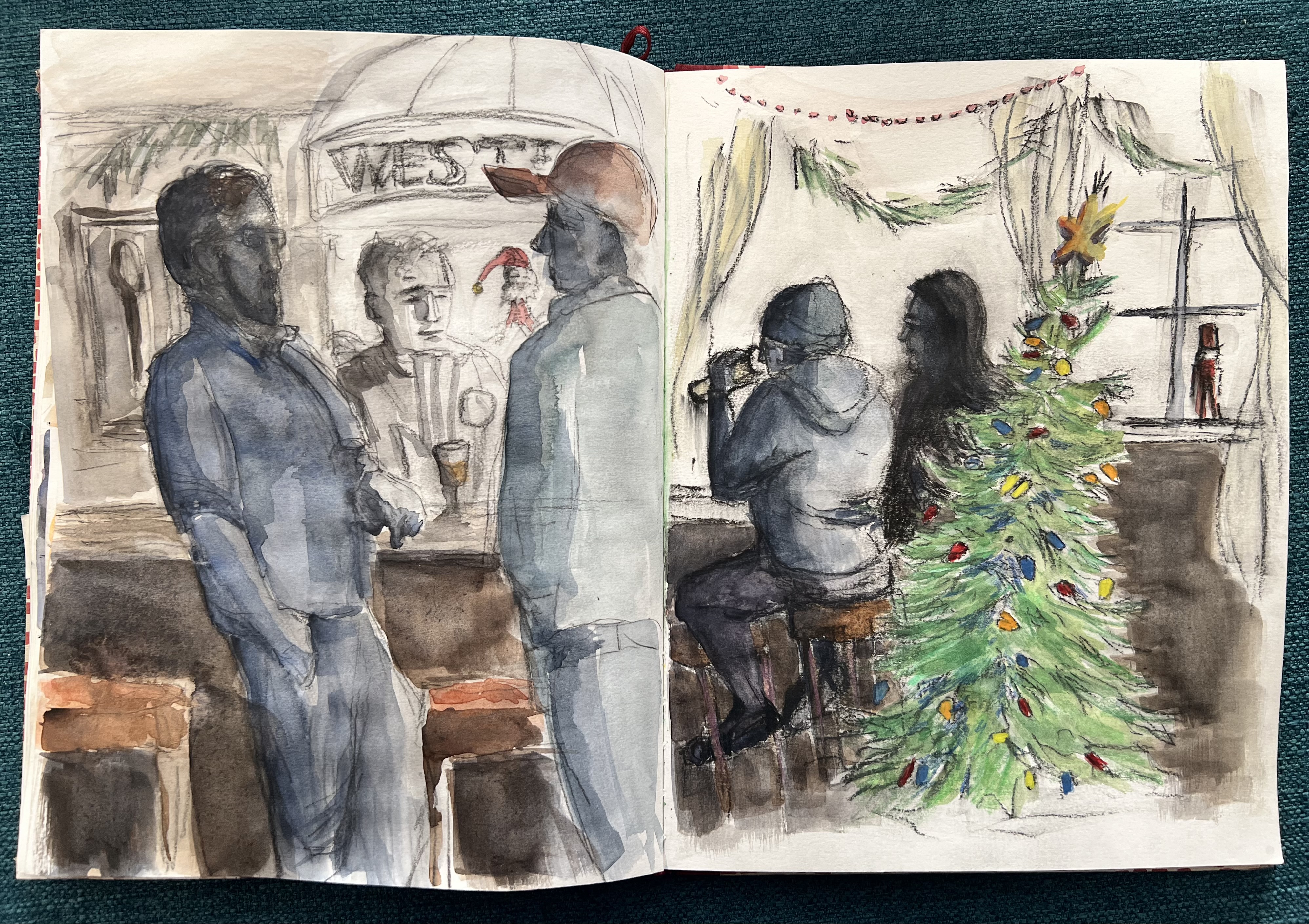
Sketch of holiday cheer in Point Reyes Station. Robin L. Chandler, 2025.
“In 1935, the National Park Service recommended an 83-square mile park, but there was no action until 1958. By this time, subdivisions were again being planned, logging was underway at Inverness Ridge, and the state was planning a freeway that would replace Highway 1 and open the area to suburban development. One lobbyist told a Congressional committee that by the year 2000
‘there will no longer be a Marin County. There will be a greater San Francisco..…the section we have under discussion today, gentlemen, will be as intensely built over as Palo Alto, or Burlingame or San Mateo.’
The MCL [Marin Conservation League] worked with Marin’s representative in Congress Clem Miller, who introduced and tirelessly promoted his Point Reyes National Seashore bill in the House, while California’s US Senator Clair Engle, pushed it through in the Senate…..In a compromise with ranchers, the park bill allowed cattle and dairy ranching to continue for 25 years in a 27-square mile “pastoral zone,” while livestock grazing elsewhere would be phased out. Congress passed the bill, and President Kennedy signed it on September 13, 1962. The park was authorized to include 83 square miles, just as the Park Service had originally recommended…..”
“Mass extinctions are extremely rare and catastrophic events, but the human-driven one is seldom deemed newsworthy by the dominant media. This is not an incidental oversight: the destruction of life’s diversity must remain invisible or obscure in the public domain, because it is fully entangled with the freedoms that people (are goaded to) value and seek.”
Glenbrook Trail, Point Reyes National Seashore. Robin L. Chandler, 2025.
“So while this is a book about the music of memory, it also necessarily becomes a book about the memory of music and the deeper social memory of art – its ability to recall the catastrophes of war but also the optimistic promise and gleam of earlier eras, or what the critic Walter Benjamin called, with touching simplicity, “hope in the past.” This book in fact draws inspiration from Benjamin’s vision of the true purpose of history: to sort through the rubble of earlier eras in order to recover these buried shards of unrealized hope, to reclaim them, to redeem them. They are, as he saw it, nothing more or less than the moral and spiritual building blocks of an alternate future.”
Long-billed Curlews at Limantour Beach, Point Reyes National Seashore in Winter. Robin L. Chandler, 2025
“Thomas Berry was a US cultural historian who introduced the broader legal concept of Earth jurisprudence early in the twenty-first century. Earth jurisprudence is the philosophy of law and human governance that says humans are just one element in a wider community of beings, and that the welfare of one speaks to the welfare of all. “The universe is a communion of subjects, not a collection of objects, “ Berry argued, and it’s through the work of people such as Stone, Berry, Kimmerer, Kolbert, and others that we are moving our collective understanding, and our will, toward a more environmentally just world. In the face of the ecological catastrophes beating down on us, we must remember the collective good of countless people as well as the rights of trees, and of the land that supports and nurtures us all.”
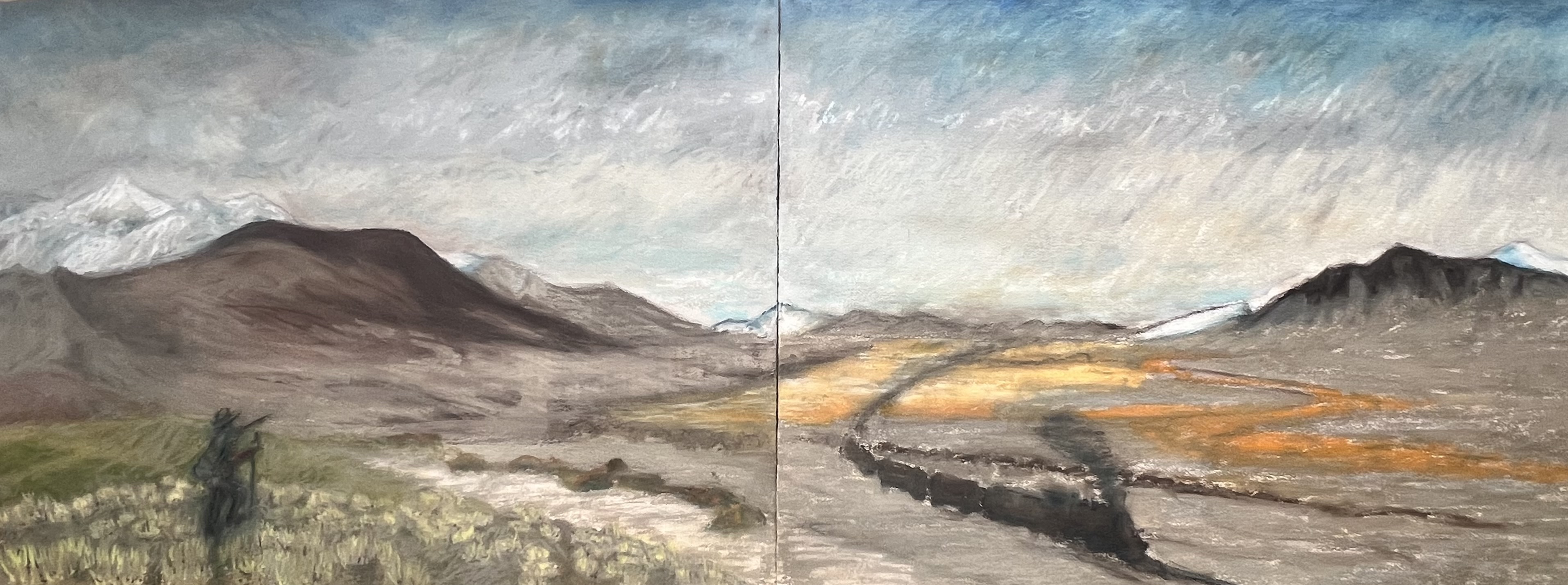
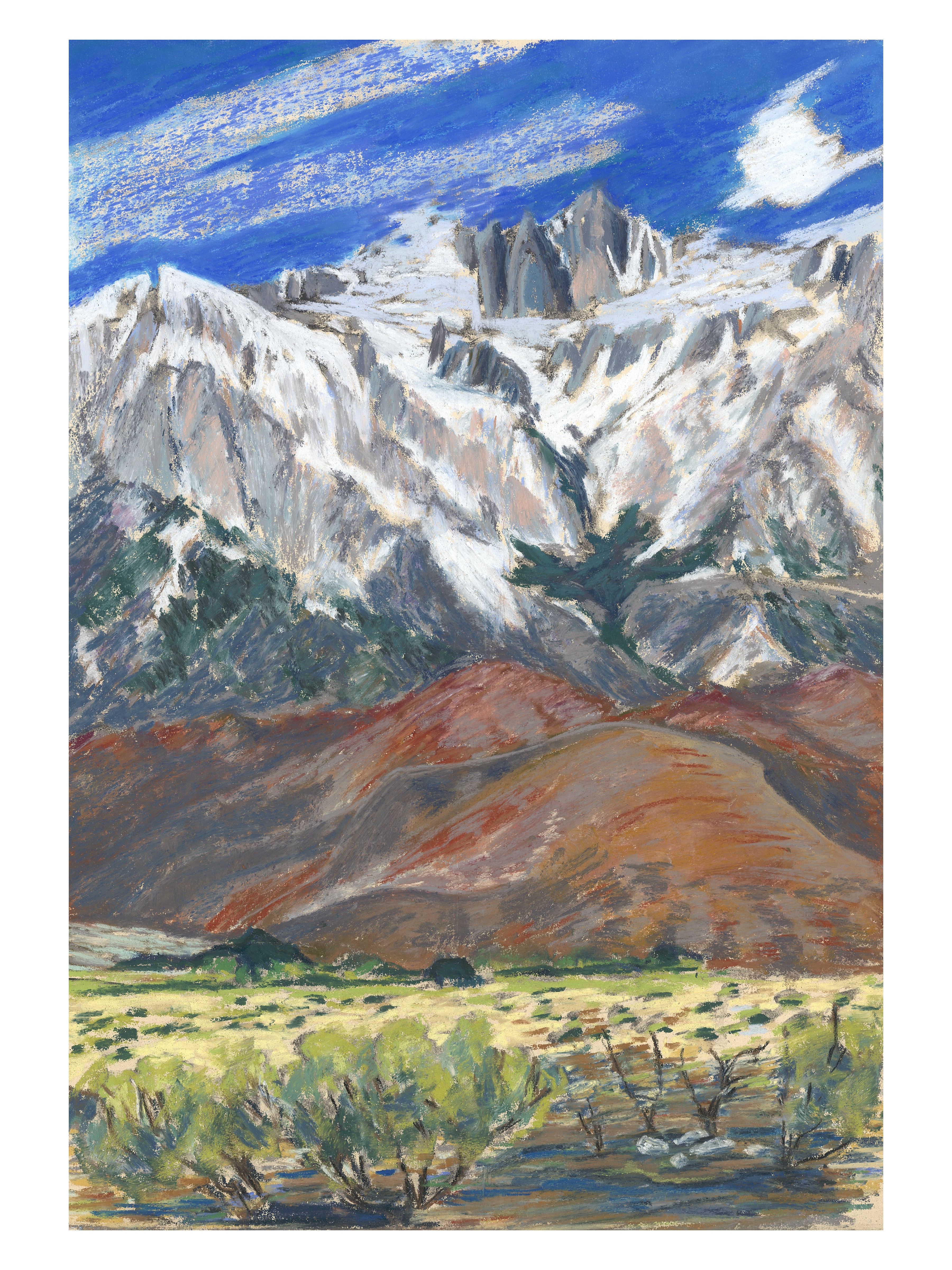
Tumanguya, also known as Mt. Whitney, in Spring. Robin L. Chandler, 2024.
“In 1750, nearly all of the world’s 750 million people, regardless of where they were or what political or economic system they had, lived and died within the biological old regime. The necessities of life – food, clothing, shelter, and fuel for heating and cooking – mostly came from the land, from what could be captured from annual energy flows from the sun to the Earth. Industries too, such as textiles, leather, and construction, depended on products from agriculture or the forest. Even iron and steel making in the biological old regime, for instance, relied upon charcoal made from wood. The biological old regime thus set limits not just on the size of the human population but on the productivity of the economy as well.
These limits would begin to be lifted over the century from 1750 to 1850, when some people increasingly used coal to produce heat and then captured that heat to fuel repetitive motion with steam-powered machines, doing work that previously had been done with muscle. The use of coal-fired steam to power machines was a major breakthrough, launching human society out of the biological old regime and into a new one no longer limited by annual solar energy flows. Coal is stored solar energy, laid down hundreds of millions of years ago. Its use in steam engines freed human society from the limits imposed by the biological old regime, enabling the productive powers and numbers of humans to grow exponentially. The replacement – with steam generated by burning coals – of wind, water, and animals for powering industrial machines constitutes the beginning of the Industrial Revolution and ranks with the much earlier agricultural revolution in importance for the course of history. The use of fossil fuels – first coal and then petroleum – not only transformed economies around the world but also added greenhouse gases to Earth’s atmosphere.”
The concept of the biological old regime, as discussed by Dr. Marks in great detail in Chapter One of the book, is based upon relationships, such as the rise of civilization and the agricultural revolution, the relationships between towns or cities and the countryside, between elites and peasants (also called agriculturalists or villagers), between civilizations and nomadic pastoralists, and between people and the environment
Lodgepole Pines along the Little Lakes Trailhead. Robin L. Chandler, 2024
“In the beginning there were stories and the stories were made of Earth. Rocks and rivers, mountains and sea, these were the gods and the gods moved within them.” (p.225)
In 2013, the entirety of the novel Moby Dick was translated into emojis, those little ideograms of smiling faces and pets and objects that populate our phones and number around 1000…their appeal seems to be based on the strange and paradoxical combination of specificity and obscurity that they embody…they purport to transcend cultural difference and cut a line of sincerity and clarity straight to the nebulous heart of what we mean to say. Yet for all that, emojis, particularly in combination, open wormholes of ambiguity.” (p.228)
“Yet directness and certainty remain a dream despite our words, despite our codes, despite our cyphers. Who can state for sure the meaning of Moby Dick? ‘Of whales in paint; in teeth; in wood; in sheet-iron; in stone; in mountains; in stars’: Ishmael, its narrator, could find them everywhere. Yet the whale itself, the white whale, the named whale, is elusive. What did it mean to Ahab? Why the obsession, the desire, the pursuit? Everything can mean something else, if only we could agree what. Augustine wondered whether we could decide simply by pointing and naming. Remember that Moby Dick, whose title names its prey, itself begins with an act of naming: ‘Call me Ishmael.’ Yet in saying that, it is clear, too, that any name would have sufficed. The willow is also ‘sallow,’ is also ‘osier.’ In such simple acts lie a world of ambiguity, and a history concealed from the eyes of the everyday. Nothing is steady. Meaning sways like the hull of a ship. Ahab, with leg of wood, and scars on his body like the ‘seam sometimes made in the straight, lofty trunk of a great tree,’ hunts over ocean and sea in a vessel of timber from which a mast extends like a great oak into the sky above. Nailed to it is a gold doubloon and at its top a man sits, in the masthead, watching the horizon, searching.” (p.228-229)



 alive in the sea of information