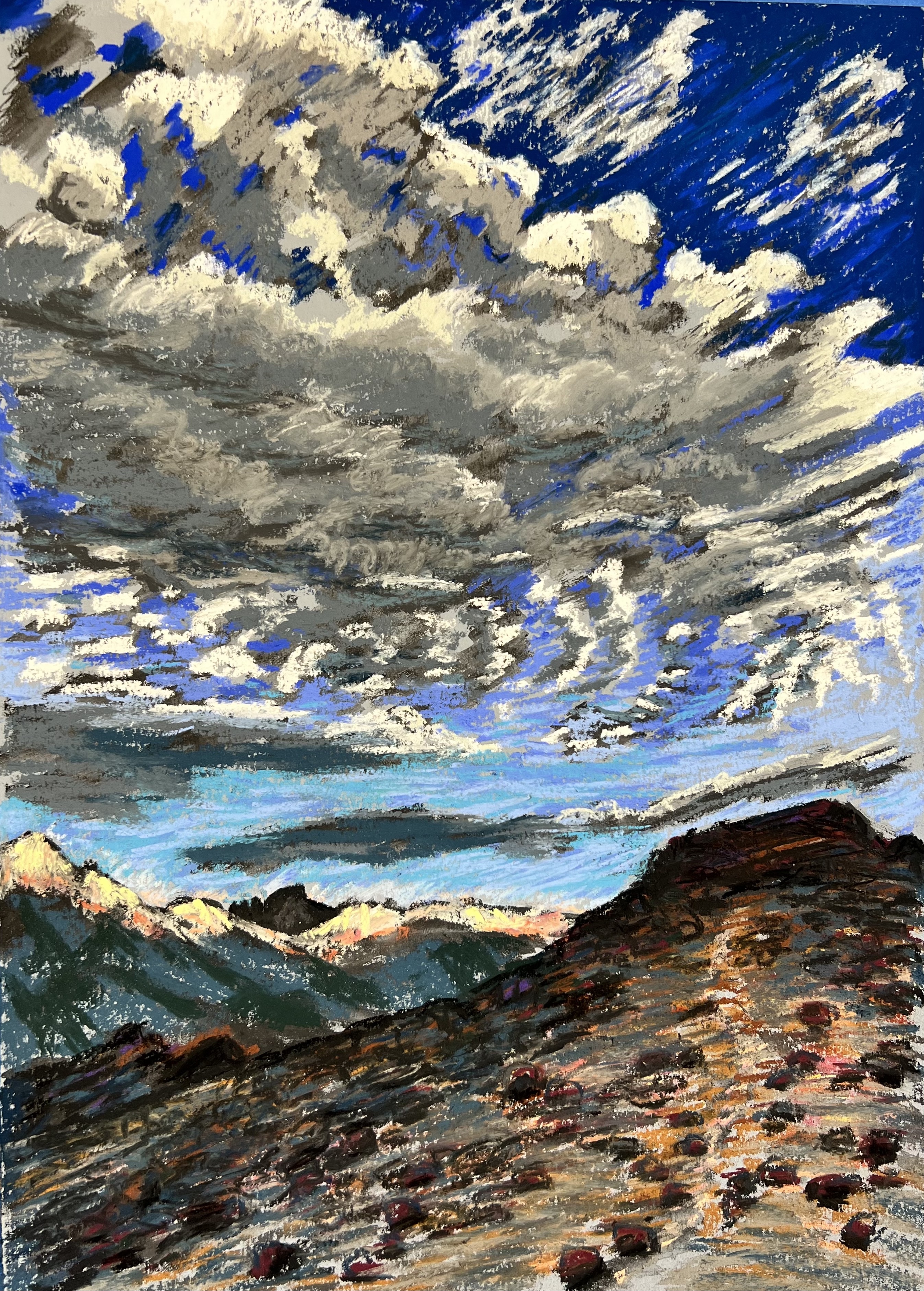
Mt. Whitney from a hilltop near Tuttle Creek. Robin L. Chandler, 2024
“…Beauty in the Song is clearly not the idealized, symmetrical, or abstract beauty of the Greeks, although occasional references to symmetry occur as in the images of twin gazelles and twin teeth (4:3, 4:5, 6:6, 7:4). The poet presents impressionistic images rather than a definitive likeness. Beauty in the song is visual, aromatic and tactile; it is textured and complex – a synesthetic experience. Beauty is a function of the abundance of the natural world. It is a function of aliveness. Beauty only becomes intelligible through the Song’s figurative language, which collapses the distance between the lovers and the land they inhabit. What beauty actually looks like in the Song is a luxurious land, alive with sheep grazing on hillsides, gazelles bounding through mountains, and trees laden with fruit.” (p.22)
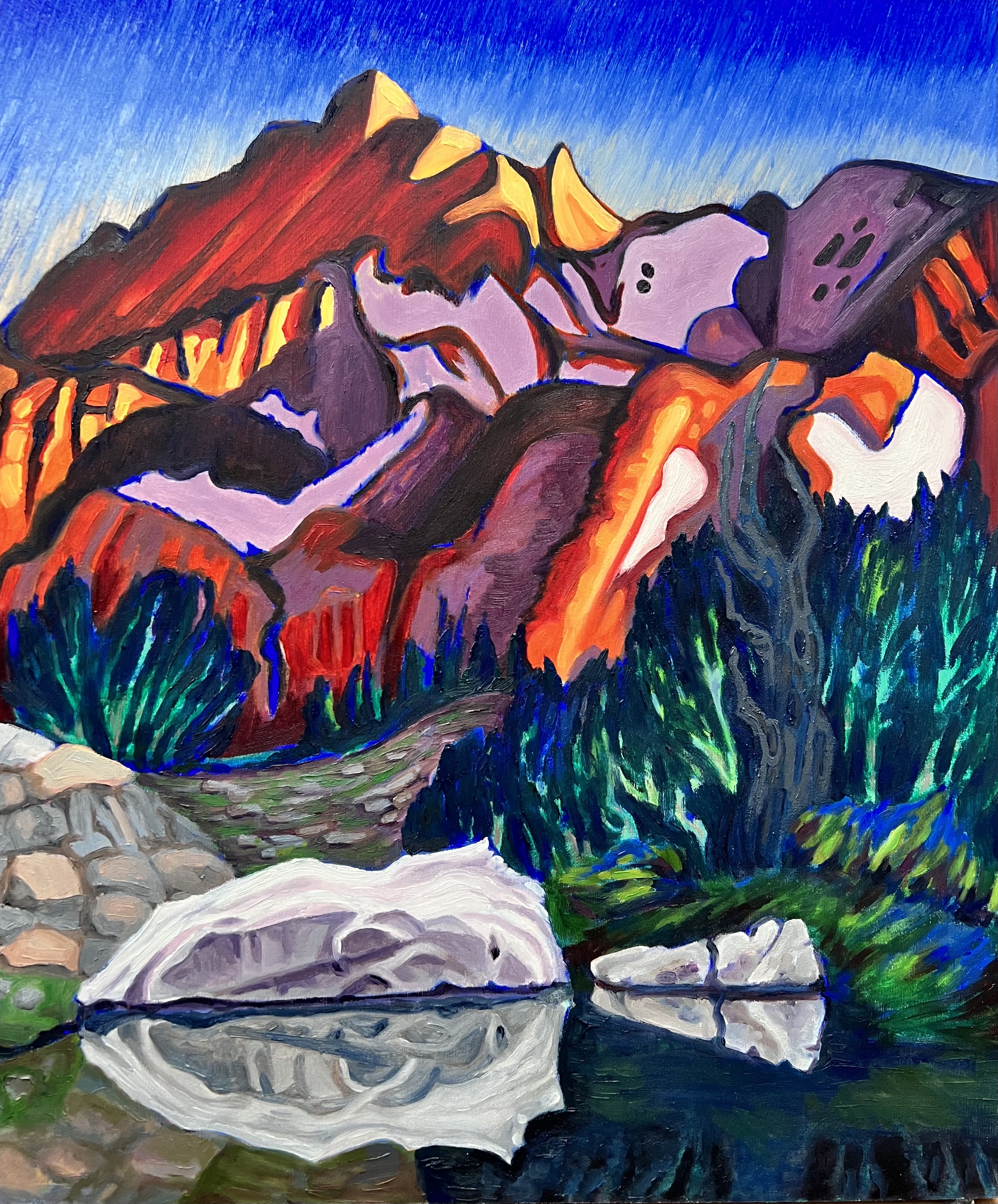
Wit-Sa-Nap Creek Winter Sunset. Robin L. Chandler, 2024
“[According to the Avatamsaka Sutra,] Indra’s net is pictured as stretching indefinitely in all directions, and at each of the knots of the net is a glittering jewel. All the other jewels in the net are reflected in each individual jewel, and each jewel reflected is also reflecting all the other jewels. This metaphor describes what was called, in Pali (the original language of the Buddhist canon), paticca samupadda, “dependent co-arising.” Modern Buddhist teachers have called it “interbeing,” or “the harmony of universal symbiosis.” This is a theory of mutual intercausality, interconnectedness, and interdependence. It is a worldview from the same ecophilosophical galaxy as Alexander von Humboldt’s “kosmos,” the Nuu-chah-nulth First Nation’s principle of hisuknis cawaak, and the “everything is connected” view at the heart of ecology. When Thoreau wrote that humans need to “realize where we are and the infinite extent of our relations,” he had this kind of idea in mind.
We think in metaphors, often — and even scientists do. Metaphors are the templates of pattern, and having those templates helps scientists — and everyone — “see” the patterns and relationships underlying the superficial “data” of experience, which often appear chaotic. Thoreau wrote in his journal on August 5, 1851, “The question is not what you look at, but what you see.” Seeing deep patterns needs a metaphoric, poetic mind.” (p.166)
The Sierra Nevada Red Fox pictured in my painting is endangered; there are less than forty of these beautiful creatures remaining in the California counties of Alpine, Fresno, Inyo, Madera, Mono and Tuolumne. As an artist, I choose to make art that fosters kinship with the earth by capturing glimpses of the world’s beauty. I hope that inspiring others to understand our interconnectedness with nature will help preserve the earth- and in this case, the Sierra Nevada Red Fox – for future generations.
“So is ecology a kind of art? And, of course, art, like anything humans (or members of other species) do, is one kind of “interaction” between us and our environment. The logical conclusion from these definitions is inescapable: art is one aspect of human ecology, and ecological science is a kind of art. And since art is a kind of behavior, it may be an example of ecologically adaptive behavior…..if the art of Audubon and the Hudson River School painters has helped save parts of our biosphere, I’d say they are contributing to human survival – and that’s by definition, adaptive.” (p. 63-64)
“Most forms of Western ethics view persons as independent egos, centers of individual choice and action. But the Buddhist “dependent co-arising” view doesn’t see persons in that way. Ecology and evolutionary biology don’t either. The ethics that inspired these differing views – the Western ego-self view versus the Buddhist eco-self view – come out to be quite different. Aldo Leopold argued articulately, from an ecological perspective, for this broader view of self and community. He believed that ethics depend on the premise that the individual is a member of a community of interdependent parts. His “land ethic” enlarged the concept of this “community” to include soils, waters, plants, and animals.” (p.174)
“When it comes to actions and lifestyles, a world of total interdependence has both a negative and a positive side. On the negative side, anything that a person does can affect the whole system. Our ego-selfish actions have a global reach. But the positive side of total interdependence is that our actions and our choices, no matter how small, can send ripples of healing through the whole system.” (p. 175)”

 alive in the sea of information