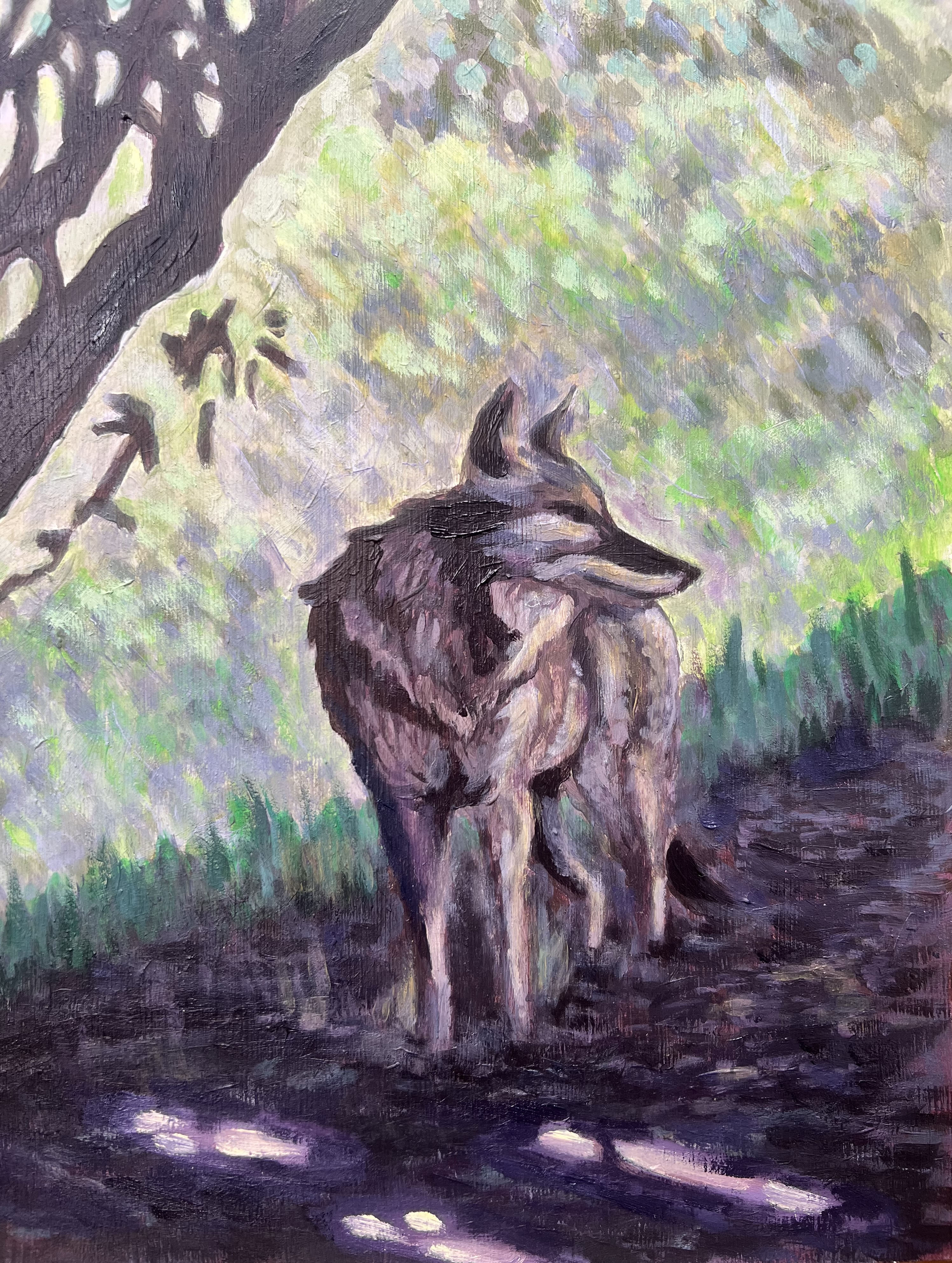
“One day Old Man Coyote was bored, and so he decided to have some fun and made a basket. A big basket, round like an acorn storage basket, only much bigger and rounder…..he wove his tracks into the pattern to give a hint who’d made it. When it was finished, he put everything People would need, forever, into the basket. And then he put the basket by the trail to see what would happen.
Sure enough, along came some People, and when they saw the big basket they said ‘Hey? What’s this?’ They knew it was a basket, but they had never seen any basket this big before…..when they looked inside and saw that it had everything they needed, they said, ‘We can live in it!’ So they did.
Well. Old Man Coyote had put everything We the People would need into that basket, but he never imagined that there would someday be so many of us, and some of us would invent needs that Coyote could never imagine we needed! Pretty soon he began to hear lots of fighting and arguing in the basket. And before long some of his strongly woven strands began to tear, and the basket got holes in it, and some of the People who went in together got thrown out through the holes! Just imagine!
Well, again. Old Man Coyote wasn’t really surprised. He’s not surprised at anything, of course. Being a Trickster, he just wants to try something and see what will happen – which is why he put the big basket by the trail that day when he was bored in the first place. But…Coyote was a bit sad anyway, seeing that his gift basket had become the place for a big fight among the People. That’s why you sometimes hear him crying and singing to himself at night.” (p.178-179)
…..David Hinton, a translator of classical Chinese poetry, argues in his book China Root: Taoism, Ch’an, and Original Zen that Ch’an began during the Tang dynasty of ninth-century China as an intellectual and cultural rebellion. Ch’an practice was seeking to recapture the feeling and experience of immediacy and wholeness of the Paleolithic human mind and to overcome the alienation of humans from the world that resulted from the agricultural revolution and its modus operandi of humans taking control of wild nature. (p.195)
…..Shunryu Suzuki wrote in the prologue to his 1970 book, Zen Mind, Beginner’s Mind, that ‘if your mind is empty, it is always ready for anything; it is open to everything. In the beginner’s mind there are many possibilities; in the expert’s mind there are few.’…..The bottom line would be that language and it’s constructs can get in the way of nondual, holistic perception and experience, of what Suzuki Roshi called beginner’s mind.” (p.196)
Excerpts from Bruce Byer’s Nature on the Edge: Lessons for the Biosphere form the California Coast
…



 alive in the sea of information