Poinciana on Central Avenue

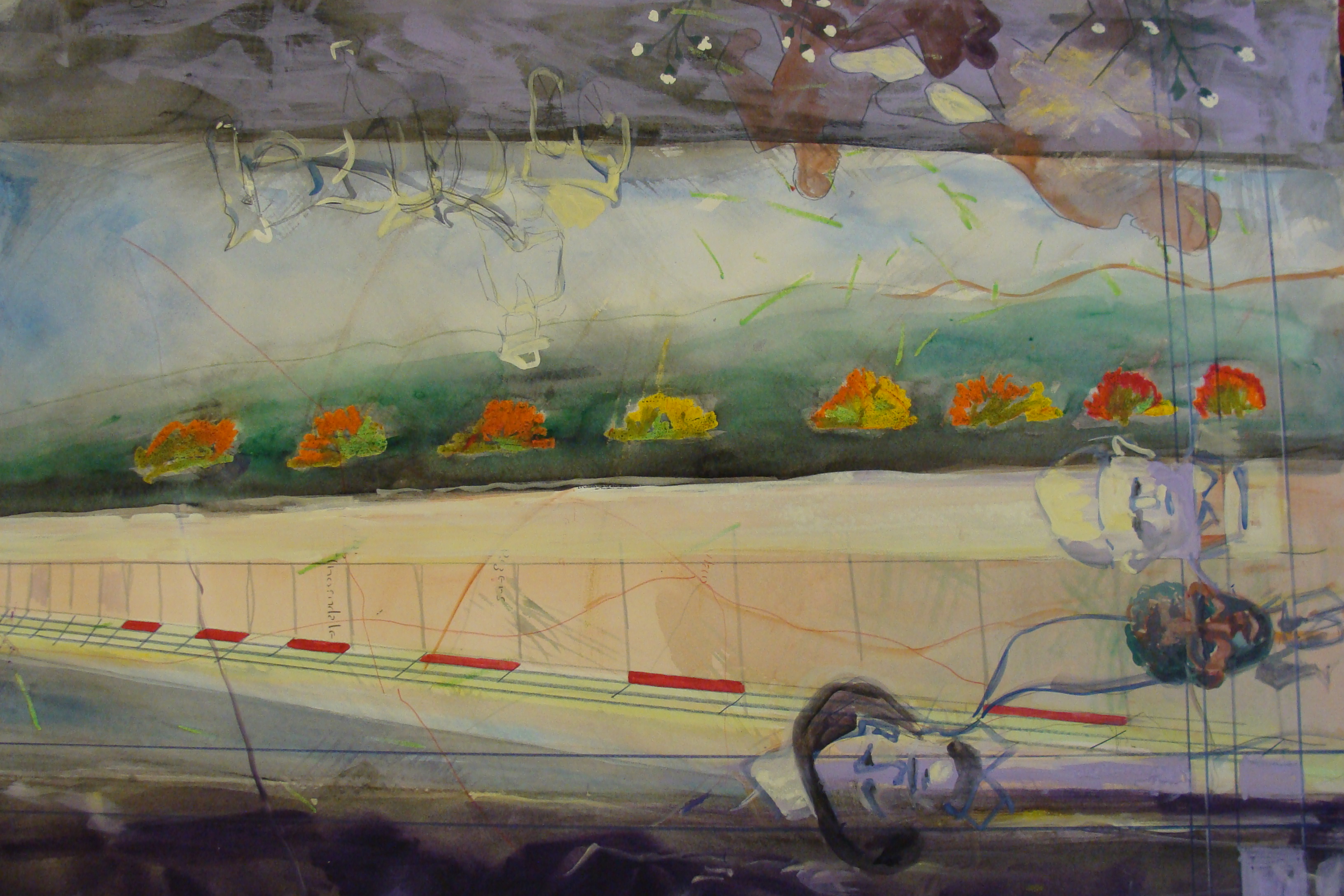
Circuit M.T.G.: Yumiko Koshima, Adrian Turner and Darrell Morgan.  Copyright 2013 Robin L. Chandler
Circuit M.T.G.: Yumiko Koshima, Adrian Turner and Darrell Morgan. Copyright 2013 Robin L. Chandler

“Check this out.” I listened closely as Adrian Turner queued up Poinciana by the Ahmad Jamal Trio.  “It’s highly structured and orchestrated…the spaces deliberate, equal to the sounds.”  In his book The History of Jazz, Ted Gioia wrote “Jamal was a harbinger of the future of jazz…his studied use of space influenced Miles Davis and anticipated the later work of Bill Evans…the charm of Jamal’s music came rather from his ability to maintain the swing, emotional conviction, and mood of his music even when playing the fewest notes.” Moments later, Adrian and his friends Darrell Morgan and Yumiko Koshima took up the bass, drums and piano, respectively, and the trio began the hard work of crafting their original compositions into a performance, inspired by the sparse, cool sounds of Ahmad’s piano and his colleagues Vernal Fournier on drums and Israel Crosby on bass (archival film footage of the Ahmad Jamal Trio in 1959 is available on YouTube). Three months later in June 2013 the trio  – Adrian, Darrell and Yumi –  now calling themselves Circuit M.T.G  – are joined by saxaphonist Dereck Mclyn and vocalist Annabel Lee for an evening of jazz and dance called Prime Spirit at ArtShare L.A. (a sanctuary for the arts in downtown Los Angeles providing live/work lofts and spaces for performance and exhibition). Their music is sublime; inspired, I sketch while they perform. It is a perfect evening, and I hope the music never ends; it brings me such joy to experience my good friend Adrian’s art, and although I’ve only briefly spent time with Darrell and Yumi I feel connected to them by experiencing their love for and commitment to jazz.

ArtShare L.A. is near the Fashion District and a couple of blocks from South Central; the steamy hot day is coming to closure as the sun sets behind the high rises of Bunker Hill. There is historical context for jazz performance in this place. In his forward to Central Avenue Sounds, Steven Isoardi, a cultural history writer and oral historian states “from the 1920s through the early 1950s…Central Avenue, extending from downtown Los Angeles south through Watts, was the economic and social center of the black population of a segregated Los Angeles…at night it became a social and cultural mecca, attracting thousands of people from throughout southern California to its eateries, theaters, nightclubs and music venues…this nonstop, vibrant club scene produced some of the major voices in jazz and rhythm and blues and it was the only integrated setting in Los Angeles.”  The book is based on excerpts from the UCLA Oral History Program’s interviews with musicians such as female trumpeter Clora Bryant (who played with Count Basie and Duke Ellington) and Buddy Collette (well known as a member of Chico Hamilton’s quintet).  Looking West at the sunset for a moment I imagine the community, so vibrant in the years just before I was born, documented pictorially in Carolyn Kozo Cole’s Shades of L.A.: Pictures from Ethnic Family Albums and captured by Walter Mosley’s hero Easy Rawlins in a series of novels starting with Devil in a Blue Dress.  Paraphrasing the historian Mina Yang, many factors played a role in the demise of Central Avenue: a downsizing post-WWII economy deprived many African-Americans of jobs; upwardly mobile black families were able to move out of South Central with the U.S. Supreme Court 1948 ruling making housing covenants illegal; and the merger of formerly segregated musician’s unions permitted black musicians to play in venues in other parts of Los Angeles.  But for insight into the role police played in the destruction of the neighborhood read Yang’s article A Thin Blue Line down Central Avenue: The LAPD and the Demise of a Musical Hub.

green fire

Hiking on the Bolinas Ridge Trail at the Geography of Hope. Copyright Robin L. Chandler
Hiking on the Bolinas Ridge Trail at the Geography of Hope. Copyright 2013 Robin L. Chandler

In his essay Thinking Like a Mountain, Aldo Leopold recorded the moment his ecological thinking evolved. “We reached the old wolf in time to watch a fierce green fire dying in her eyes.  I realized then, and I have known ever since, that there was something new to me in those eyes – something known only to her and to the mountain.  I was young then and full of trigger-itch; I thought that because wolves meant fewer deer, that no wolves would mean hunter’s paradise.  But after seeing the green fire die, I sensed that neither the wolf nor the mountain agreed with me.”

Leopold spent a lifetime as a forester, a professor and an environmentalist developing his ideas and perspectives on the ethics of nature and wildlife preservation. Ultimately, his philosophy, evolving over years of observation and contemplation became known as his Land Ethic, which is at the core of his most beloved book A Sand County Almanac.  Aldo Leopold joins Henry David Thoreau and John Muir as one of our three great American wilderness visionaries and writers.

This weekend March 15 – 17, 2013, Point Reyes Books (near Tomales Bay) is hosting its 4th Geography of Hope Conference entitled Igniting the Green Fire: Finding the Hope in Aldo Leopold’s Land Ethic. Typically held in March, these intellectual and spiritual gatherings are a gift to celebrate the coming of spring and rebirth encouraging us to think deeply about our relationships with the earth and our fellow living beings. At the conference’s center is the film Green Fire: Aldo Leopold and a Land Ethic for Our Time, a wonderful film directed by Steve Dunsky, edited by Ann Dunsky, written by Stephen Most and narrated by Curt Meine.  It was announced at the conference that the film would be shown on PBS stations nationwide in April 2013.

Surrounding the film is a series of panel discussions with writers, thinkers and doers engaged the building of communities, the importance of stewardship and discussing our responsibilities to the land and to each other. One of the most compelling conversations has been with Michael Howard, Director of Eden Place Nature Center (part of the Fuller Park Community Development Corporation).  Inspired by Leopold’s belief in the importance of community and the land, Michael Howard has built a park and a farm for the African-American community on Chicago’s South Side.  “Eden” is in a place that was the former site of meat packing industry slaughterhouses, also polluted with lead poisoning which has impacted the ability of children to learn for generations.  Howard deeply moved me with his work to try to persuade a people about the benefit of having a relationship with the land; a people whose daily concerns are about having money to pay bills and feed their children and who have spent years running away from a specter of linking the land to sharecropping and slavery.  Michael Howard’s experience evoked for many conferee’s Paul Hawken’s Blessed Unrest about the emergence of non-profit and community organizations engaged in the environmental and social justice movement.

There is so much wisdom flowing from this conference, I will need days, weeks, perhaps a lifetime to really grasp and understand it all, and to see my thinking evolve as Aldo Leopold has demonstrated.  But what rings clear and true is this: we need to understand that change is something that happens gradually, and it comes by engaging in deep listening, exchange with and respect for both humans and the land. We must learn to “think like a mountain.”

Ghosts of Aprils Past

Cotton. Copyright 2011 Robin L. Chandler

Guarded by the monuments honoring the defenders from the northern aggression

A town square, now sits quiet

Bypassed

The highway  leads to the WalMart suburbs, spaces filled with fast food and fast fun, a drive through espresso and a MySpace page

The rhythms of cicadas, drowned by the roar of air conditioners

In the shade of live oaks, by the County Courthouse, I sit with my father and uncle

They speak of my grandfather – Eph – Manager of the cotton gin in Thorndale, Texas

With their voices the past comes alive:

The wagons creaking under their load

Bales of cotton

Products of hours of picking under a hot sun

Sweat streaming

Backs bent with pain

Bloody hands

Callused hands scarred by the thorns of the south’s cash crop

White hands and black hands made equal

By the pain and the heat

Sunlight streams through the cracks

Revealing cotton dust rising

Filling the spaces between breaths

The cotton enters the gin

Separating fibers from seeds

Long white fibers

To form the clothes on our backs

Dark seeds pressed

Oil for margarine, meal to feed cattle

They say the cotton gin killed Eph

Years of dust caused the cancer in his brain

A working man

A hard man

No time for tenderness

Love meant food on the table and a roof over their heads

My father’s sense of duty and responsibility flow from him

Father buried Eph in Taylor – as he asked — with a good view of the  road to Thorndale

Later that evening, we watch a little league game, April brings the nation’s pastime

A hot wind blows across the field

A reminder of the scorching Texas day

Grasshoppers by the hundreds fly towards the electric lights.

A black child walks by

Interrupting the serenity of our colorless existence

Watch him, a stranger says, he may have a knife

Shaken, I am horrified: the cotton gin cranks on, separating the light from the dark

Suburban streets cannot mask

Centuries of hurt, neglect and segregation

Revisiting our country’s Civil War, April resonates: Sumter, Appomattox, Lincoln’s Assassination

Bypass not these one-hundred and fifty years

Bypass not these struggles for justice

Mold not history to political need

Pick not the path of easy memory and least resistance

Sift the evidence, seek the truths

For we hold these truths to be self-evident

That “all” are created equal

Long before his death in Memphis in April 1968

Dr. King dreamed on the 100th Anniversary of the Emancipation Proclamation at the  steps of the Lincoln Memorial:

“…..we will be able to transform the jangly discords of our nation into a beautiful symphony of brother hood.”

A New Deal

Born in the 1970s in the African American, Afro-Carribean and Latino communities of the Bronx, Hip Hop culture includes DJing, breakdancing, graffiti writing and rapping.  According to Johnny Otis, rhythm and blues musician and teacher, in 1975, Mayor Abe Beame was faced with New York City going bankrupt. His choices were few as neither the federal or state governments would come to his aid.  So, to solve his problem he fired over 19,000 city workers, and 15,000 of those workers were teachers responsible for instruction in the humanities: literature, art and music.  Suddenly a generation of children had no access to instruments and formal music instruction.   But ever resilient, these communities looked inward, drew upon their cultural heritage and created a new musical genre “rap,” one of the pillars of hip hop culture, using all that was available to them: language and percussion.  The human spirit creates no matter how stripped bare. 

Despair
Despair. Copyright 2007 Robin L. Chandler

Today our society, and by default, our educational systems are undergoing transformative change. To manage the fiscal crisis, our California state government is making deep cuts to our public universities, and campus and university administrators are now struggling with how to manage these reductions that will no doubt profoundly change our educational system. They will be faced with choices making decisions about what programs, what departments what campus units are sustainable and support the core mission of the university.  External funding from public and private sources, though comprised during this economic crisis, continues to be available to support research in medicine, science and engineering, but not so readily available to the arts and humanities, Institute Museum Library Services (IMLS), National Endowment for the Arts (NEA), National Endowment for the Humanites (NEH), National Historic Publications Record Commission (NHPRC) and the Mellon Foundation being among the most valiant exceptions.  Writing in the New York Times recently, Drew Gilpin Faust, President of Harvard University wrote “since the 1970s there has been a steep decline in the percentage of students majoring in the liberal arts and sciences, and an accompanying increase in pre-professional undergraduate degrees. Business is now by far the most popular undergraduate major, with twice as many bachelor’s degrees awarded in this area than in any other field of study. In the era of economic constraint before us, the pressure toward vocational pursuits is likely only to intensify.  As a nation, we need to ask more than this from our universities. Higher learning can offer individuals and societies a depth and breadth of vision absent from the inevitably myopic present. Human beings need meaning, understanding and perspective as well as jobs. The question should not be whether we can afford to believe in such purposes in these times, but whether we can afford not to.”

gritty
Oakland gritty streets. Copyright 2007 Robin L. Chandler

In the September issue of Harpers Magazine, Mark Slouka (Professor of Creative Writing at Columbia University) wrote “the humanities, done right, are the crucible within which our evolving notions of what it means to be fully human are put to the test; they teach us, incrementally, endlessly, not what to do but how to be. Their method is confrontational, their domain unlimited, their “product” not truth but the reasoned search for truth.”  Slouka also wrote “By downsizing what is most dangerous (and most essential) about our education, namely the deep civic function of the arts and the humanities, we’re well on the way to producing a nation of employees, not citizens. Thus is the world made safe for commerce, but not safe.”

During the Great Depression, Franklin Roosevelt’s New Deal Works Progress Administration invested in creating jobs across a wide spectrum including the arts and humanities. These became the Federal Art Project, the Federal Music Project, the Federal Theater Project and the Federal Writer’s Project.  There was also the Historic Records Survey which employed archivists to identify, collect and conserve historic records throughout the United States.  Rand Jimerson writes in the introduction to his recently published book Archives Power: Memory, Accountability, and Social Justice “Archivists [can] contribute to a richer human experience of understanding and compassion. They can help protect the rights of citizens, and to hold public figures in government and business accountable for their actions. Archivists provide resources for people to examine the past, to understand themselves in relation to others, and to deepen their appreciation of people with different backgrounds and perspectives. This is the essence of our common humanity.” Archives and teaching in the humanities are crucial to the formation of citizens able to participate fully in our democracy.

In February 2009, Congress passed and President Obama signed into law the American Recovery and Reinvestment Act ARRA which included stimulus funding making investments in infrastructure such as transportation, public schools, college financial aid, renewable energy programs, healthcare and homeland security.  Conspicuously absent is direct funding for teaching and research in the arts and  humanities, nor for libraries and archives. In his public high school rhetoric class Marcus Eure provides students with critical thinking skills as they study issues about civic morality.  Eure believes “every marriage, every job, every parent-teacher meeting hinges in some way on the ability to understand and empathize with others, to challenge one’s beliefs, to strive for reason and clarity. “  The time is now to invest and provide federal stimulus packages in our arts, humanities, libraries and archives.  It is our duty and obligation to the future, to build citizens to grapple with the challenges of today.