the essence of folk music

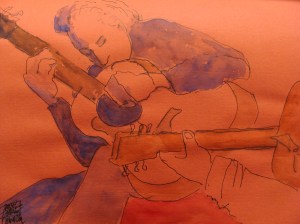
Yesterday morning I woke up to an National Public Radio (NPR)  story about the sounds of Haiti one week after the devastating earthquake.  My ears were filled with the voices of children singing joyously in French about Joshua tumbling down the walls of Jericho.  Ironic choice of song, but I was deeply moved by the music and I began to think how music sometimes  breaks down walls between people.   And then Kate McGarrigle passed away on January 18th, 2010.  What a loss.  So much music and joy came from Kate and her sister Anna and their collaborations over the years with Emmylou Harris, Linda Ronstadt, Joan Baez, Leonard Cohen and The Chieftans to name but a few.  Last weekend I was in New England and I  got the chance to make music with a couple of wonderful people – Keith and Mickey.  Keith is one of my oldest and dearest friends and music has always been a part of our bond.  Sometimes I sang, sometimes I listened, and sometimes I tried to paint them playing, happy to be a part of the music.

Mickey. Copyright 2010 Robin L. Chandler

Mike Rigenstrief wrote in the Montreal Gazette this week “but perhaps Kate and Anna’s most enduring musical legacy is communal music-making: the way they’d gather friends and family together in concerts….and make thousands of people, most of whom they’d never met, all feel like they were sitting around the kitchen table or in a living room, making music together. That is the essence of folk music. “ I think about all of the people I’ve shared  or made music with over the years in all the living rooms, kitchens, stairwells and cars on road trips. Music is the tie that binds and can help to heal sadness, loss and despair.

Keith. Copyright 2010 Robin L. Chandler

Musicians are reaching out to Haiti with “Download to Donate – Songs for Haiti” with 100% of the funds going to Doctors Without Borders, the Red Cross and Wyclef Jean’s Yele Haiti Earthquake Fund.  If she was with us, I’m sure Kate would be a part of this music for relief.  Kate you raced the Matapedia, you could not slow down, and you were not afraid.

Jammin’. Copyright 2010 Robin L. Chandler

In the shadow of the ancients

The Topatopa bluffs are part of the Condor Sanctuary in the Sespe Wilderness; the sanctuary is a space where the Condors can mate, breed and raise their chicks undisturbed by humans.  At sunset seen from the Ojai Valley, the bluffs glow “pink” from the last rays of the setting sun.

Topatopa Bluffs near Ojai. Copyright 2010 Robin L. Chandler

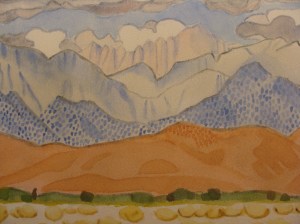
With their nine foot wingspan, Condors glide at fifty-five miles per hour ranging three hundred miles a day on the look for expired creatures that will sustain them.  Bradley John Monsma in The Sespe Wild writes “attempting to see the lay of the land through the eye of the condor quickly turns a wide-angle wilderness into a lesson in the limitations that we impose on other species.”  The Sespe is a crucial link in the foraging habitat used by the Condor for thousands of years ranging from the the Ventana Wilderness through the Sespe and Tejon Ranch to the Sierra Nevadas. Humankind continues to encroach upon the condor’s “home” as rolling oak grasslands situated along I-5 north of Los Angeles too often become real estate development opportunities.  But sometimes people do get it right.  In May 2008, a coalition of conservation groups – the Natural Resources Defense Council, the Sierra Club and the Audubon Society of California negotiated a conservation easement to preserve 178,000 acres in Fort Tejon that will supplement the public lands forming the condor habitat.  There are approximately seventy condors in the wild and space and water are key to their survival.  I marvel at the condor’s ability to daily traverse a “u-shaped” area from Big Sur to the Range of Light.

Mt. Whitney and the Range of Light. Copyright 2008 Robin L. Chandler

Their need for habitat, fires my imagination contributing to my personal geography.  As Stephen S. Hall writes in his essay I Mercator in the book You Are Here, “I have roamed across state lines and oceans and continents, backwards in time, each thought colored according to a personal legend, corresponding to the elevation and depressions of my private humors: pride, wonder, sadness, remorse.”  We are here, now, navigating our personal maps, facing the emptiness of our  intelligence in a space and time where nature balances precariously between our greed and our benevolence.

waves of glass

Fall is here.  There is a little chill in the air and the sun’s journey southward gives forth a particular quality of light.  This week has found me cycling as much as possible, and I naturally gravitate to the coast to ride the 101 as it meanders through the communities of La Jolla, Del Mar, Cardiff, Encinitas and Leucadia. Every few miles I get a spectacular view of crystalline blue waves peaking and crashing into torrents of white foam and see the surfers catch a wave and joyously ride the crest balanced precariously somewhere between chaos and nirvana. “Clear and sweet is my soul, clear and sweet is all that is not my soul,” wrote Walt Whitman in Leaves of Grass.

Swamis_encinitas
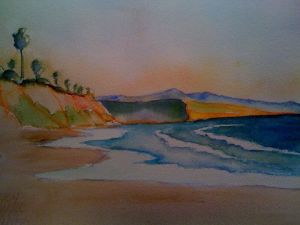
Sunset North County San Diego: Swami’s Beach. Copyright 2009 Robin L. Chandler

A few weeks ago, I visited Cape Cod and I was thrilled to see a group of surfers anglin’ on ankle busters, but I think they imagined the waves as a bonsai pipeline.

Truro_CapeCod
Near Truro on Cape Cod. Copyright 2009 Robin L. Chandler

The view of the ocean from the saddle of my bike is where my soul opens up, and my spirit returns to balance.  On the bike, I scout out places to paint and observe the world at a pace that allows for interaction, reflection and a laugh or two.  Yesterday it was great fun to see  Surfrider Foundation members  on street corners  in Cardiff  for their “Hold onto Your Butts” campaign.  They were spending their Saturday morning reminding us that cigarette butts do not belong on the beach.  It is another of Surfrider Foundation’s good causes  part of their beach clean-up efforts  and their larger campaigns like “Save Trestles”  which kept a  toll road out of San Onofre State Park. They do good work.  They teach us to be responsible for our beaches and oceans as we should be for any good friend.   These are two watercolors that I’ve recently painted of late afternoons  in North County San Diego and Truro on Cape Cod.  Both pristine and soul redeeming spaces.

A New Deal

Born in the 1970s in the African American, Afro-Carribean and Latino communities of the Bronx, Hip Hop culture includes DJing, breakdancing, graffiti writing and rapping.  According to Johnny Otis, rhythm and blues musician and teacher, in 1975, Mayor Abe Beame was faced with New York City going bankrupt. His choices were few as neither the federal or state governments would come to his aid.  So, to solve his problem he fired over 19,000 city workers, and 15,000 of those workers were teachers responsible for instruction in the humanities: literature, art and music.  Suddenly a generation of children had no access to instruments and formal music instruction.   But ever resilient, these communities looked inward, drew upon their cultural heritage and created a new musical genre “rap,” one of the pillars of hip hop culture, using all that was available to them: language and percussion.  The human spirit creates no matter how stripped bare. 

Despair
Despair. Copyright 2007 Robin L. Chandler

Today our society, and by default, our educational systems are undergoing transformative change. To manage the fiscal crisis, our California state government is making deep cuts to our public universities, and campus and university administrators are now struggling with how to manage these reductions that will no doubt profoundly change our educational system. They will be faced with choices making decisions about what programs, what departments what campus units are sustainable and support the core mission of the university.  External funding from public and private sources, though comprised during this economic crisis, continues to be available to support research in medicine, science and engineering, but not so readily available to the arts and humanities, Institute Museum Library Services (IMLS), National Endowment for the Arts (NEA), National Endowment for the Humanites (NEH), National Historic Publications Record Commission (NHPRC) and the Mellon Foundation being among the most valiant exceptions.  Writing in the New York Times recently, Drew Gilpin Faust, President of Harvard University wrote “since the 1970s there has been a steep decline in the percentage of students majoring in the liberal arts and sciences, and an accompanying increase in pre-professional undergraduate degrees. Business is now by far the most popular undergraduate major, with twice as many bachelor’s degrees awarded in this area than in any other field of study. In the era of economic constraint before us, the pressure toward vocational pursuits is likely only to intensify.  As a nation, we need to ask more than this from our universities. Higher learning can offer individuals and societies a depth and breadth of vision absent from the inevitably myopic present. Human beings need meaning, understanding and perspective as well as jobs. The question should not be whether we can afford to believe in such purposes in these times, but whether we can afford not to.”

gritty
Oakland gritty streets. Copyright 2007 Robin L. Chandler

In the September issue of Harpers Magazine, Mark Slouka (Professor of Creative Writing at Columbia University) wrote “the humanities, done right, are the crucible within which our evolving notions of what it means to be fully human are put to the test; they teach us, incrementally, endlessly, not what to do but how to be. Their method is confrontational, their domain unlimited, their “product” not truth but the reasoned search for truth.”  Slouka also wrote “By downsizing what is most dangerous (and most essential) about our education, namely the deep civic function of the arts and the humanities, we’re well on the way to producing a nation of employees, not citizens. Thus is the world made safe for commerce, but not safe.”

During the Great Depression, Franklin Roosevelt’s New Deal Works Progress Administration invested in creating jobs across a wide spectrum including the arts and humanities. These became the Federal Art Project, the Federal Music Project, the Federal Theater Project and the Federal Writer’s Project.  There was also the Historic Records Survey which employed archivists to identify, collect and conserve historic records throughout the United States.  Rand Jimerson writes in the introduction to his recently published book Archives Power: Memory, Accountability, and Social Justice “Archivists [can] contribute to a richer human experience of understanding and compassion. They can help protect the rights of citizens, and to hold public figures in government and business accountable for their actions. Archivists provide resources for people to examine the past, to understand themselves in relation to others, and to deepen their appreciation of people with different backgrounds and perspectives. This is the essence of our common humanity.” Archives and teaching in the humanities are crucial to the formation of citizens able to participate fully in our democracy.

In February 2009, Congress passed and President Obama signed into law the American Recovery and Reinvestment Act ARRA which included stimulus funding making investments in infrastructure such as transportation, public schools, college financial aid, renewable energy programs, healthcare and homeland security.  Conspicuously absent is direct funding for teaching and research in the arts and  humanities, nor for libraries and archives. In his public high school rhetoric class Marcus Eure provides students with critical thinking skills as they study issues about civic morality.  Eure believes “every marriage, every job, every parent-teacher meeting hinges in some way on the ability to understand and empathize with others, to challenge one’s beliefs, to strive for reason and clarity. “  The time is now to invest and provide federal stimulus packages in our arts, humanities, libraries and archives.  It is our duty and obligation to the future, to build citizens to grapple with the challenges of today.

To shape the future

There are two holidays that serve as book ends for my mother’s life: the 4th of July marks her death and Labor day marks her birth. This year – 2009 – marks the 20th anniversary of her passing and would have been her 92nd birthday were she still with us. My mother was an energetic woman hugely impacting my life; it wasn’t always easy, but I know and love the gifts she gave me. She loved making music and creating things. Growing up, there was always some kind of project in the works be it making candles  (and spray painting them gold for whatever reason), sewing clothes for me and my sister, or preparing for her teaching job or her girl scout troop. She had so much energy and intelligence and she was driven to do something helpful for others.

When I was very young, my mom worked as an occupational therapist. One of her patients was a young man with polio confined to an iron lung. I remember that he painted the most wonderful paintings using only the movements he could make with his big toe. My mother had built a splint for that big toe enabled to cradle a paint brush and she spent hours with him making sure it fit correctly and gave him the support he needed to do his art. From my mother I learned that a person could do anything with a little help and kindness, and beautiful artwork flows from everyone.

healthcare
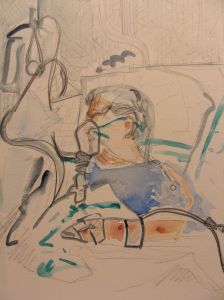
Pain. Copyright 1989 Robin L. Chandler

Unfortunately, the last years of my mother’s life were spent in nursing facilities and hospitals. Our family was fortunate, because the government’s Medicare provision and my father’s health insurance covered those expenses. During the last few weeks of her life, I visited my mom in the hospital and I tried to capture those moments in watercolor. Robert Henri wrote in his book Art Spirit “the beauty of the lines of the drawing rest in the fact that you do not realize them as lines, but are only conscious of what they state of the living person…you have been let into that life.” It was important to paint her, so that I would never forget her pain. Over the years I have returned to those paintings to remember my mother and think about the good things she did for others. I share one with you now to serve as a call to action. This is our time we can make a difference and help others.

In the middle of August 2009, the group Remote Area Medical provided free health care services to some 10,000 residents of Los Angeles for eight days providing the uninsured with routine services like eye and dental exams, mammograms and access to special treatments like kidney dialysis. There is a crying need for healthcare reform in this country. We need to find the right model so that no one is without healthcare in our country. The latest recession figures indicate there are 40 million Americans living in poverty and they cannot afford healthcare. T. R. Reid’s book The Healing of America: A Global Quest for Better, Cheaper, and Fairer Health Care describes four basic models of health care at work in the world: Britain’s Beveridge Model where health care is provided and financed by the government; Germany and France’s Bismark Model where private insurance funds — financed by employers and employees — cover everyone and are government regulated to keep costs low; Canada’s National Health Insurance model which uses private-sector providers financed by government insurance plans into which every citizen pays; and lastly the “out-of-pocket” model most found in undeveloped nations where you get what you can pay for. We can do better than the last model. Wednesday night, President Obama laid out his vision of healthcare reform stating “if you’re one of the tens of millions of Americans who don’t currently have health insurance, the second part of this plan will finally offer you quality, affordable choices. If you lose your job or change your job, you will be able to get coverage.” He went onto say we can help people in need and we can solve this big problem. When I remember my mom, I think of someone who was always trying to do something useful to help someone in need. Like my mother, everyone deserves access to healthcare through every stage of their life. Now it’s our generation’s turn to help others. Lets bring about healthcare reform and shape the future by our actions.

The Great Wave

On Labor Day I kayaked on Tomales Bay.  2PM and it was high tide when I launched near the town of Marshall and the wind was dancing across the water leaving whitecaps in its wake. It was the first time I would be taking my new single kayak on the water. Wave and I have safely captained a two-person kayack on many trips on Tomales Bay  where the center of gravity is low and the craft moves very deliberately through water.  In my watercolors, I’ve documented kayackers  in singles paddling across this water and now it would be my turn.  Wave ably helped me launch the craft, and just after my paddle cut through the water,  I heard a voice from the shore  asking if I had a plan should I capsize out on the Bay. Well, the truth was, no, I didn’t have a plan. I didn’t think I needed a plan. I felt I had the experience to handle any situation that might come up. I just wanted to get out and enjoy the last few hours of sunshine on a laborless day.

Kayaking near Hog Island, Tomales Bay
Kayaking near Hog Island, Tomales Bay. Copyright 2009 Robin L. Chandler

I was eager to feel  the joy of moving across the water, and  have the wind and spray on my face and see the sun dappling the water. I imagined the feel of my arms working hard to create forward movement against the wind blown waves breaking across the bow. I imagined the moment, when one turns and  with the wind at your back, experience the joy of being rocked forward momentarily airborne on the back of a breaking wave. But the voice spoke a truth that suggested listening.  One of the staff for onsite operations  for Blue Water kayaks on Tomales Bay took a few minutes out of her busy life and reviewed  with me how to manage the unimaginable. A little later I was on the water and the wind was strong and the waves presented a fun challenge. I was deeply grateful that a person previously unknown to me spontaneously showed concern, and I was able to hear the truth of the concern, put my eagerness in check and gently accept the gift.

Later that day driving home, I thought of learning life lessons aknew. While one gleans much knowledge over the years, one must embrace daily life with the openness of a beginner. Christopher Benfey in his book The Great Wave describes an essay by Shuzo Kuki called “Considerations on Time.” Written in 1928, the essay describes two Japanese responses to the theme “man and time.” These are the  Buddhist annihilation of the will, i.e. extinction of desire,  and the Samurai’s bushido, i.e.  affirmation of the will. Kuki saw the myth of Sisyphus as the very embodiment of the moral ideal of bushido. “Sisyphus rolls a rock almost to the summit of a hill, only to see it tumble back down again. And he is, thus, set to perpetually beginning anew. Is there misfortune, is there punishment in this fact?….Everything depends of the subjective attitude of Sisyphus. His good will, a will firm and sure in ever beginning anew, in ever rolling the rock, finds in this very repetition an entire system of morals and consequently, all is happiness…..he is a man impassioned by moral sentiment…..he is not in hell, he is in heaven.” Camus, describing Sisyphus, would write some years later “the struggle itself toward the heights is enough to fill a man’s heart.”

Toeing potshards

Monument Valley. Copyright 2009 Robin L. Chandler

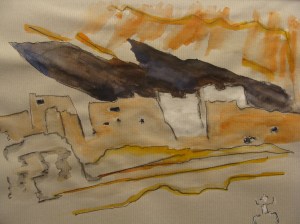
In the late Spring, when we vacationed on the Colorado Plateau, I discovered a book by Patricia Limerick called Desert Passages.  Dr. Limerick describes the American encounter with deserts in terms of three attitudes towards nature “as a biological reality in human life…hunger, thirst, injury, disease and death….as an economic resource…a container of treasures awaiting extraction…or as an aesthetic spectacle. “  We affectionately called our trip the archaeology tour as we visited the ruins of the Ancient Pueblo Peoples at Wupatki, Monument  Valley, Mesa Verde, and Canyon de Chelly. Wave and I spent many hours at the ruins in quiet meditation while I attempted to capture the  essence of these amazing cultural resources on watercolor paper.

White House ruin, Canyon de Chelly
White House ruin, Canyon de Chelly. Copyright 2009 Robin L. Chandler

One of the great mysteries is what happened to the ancient peoples?  Archaeological evidence reveals that sometime in the late 13th century these peoples abandoned their homes amongst the mesas and canyon walls and it is theorized that environmental changes —  possibly extreme drought — caused these peoples to abandon their homes.  One feels a certain twinge given the current state of  drought in San Diego, Los Angeles and the rest of California, and of course the fire still burning in the San Gabriel mountains.   It is believed that they left the Colorado Plateau and migrated to join other pueblos along the Rio Grande river in New Mexico.   How would we best characterize the Ancient Pueblo peoples encounters with the desert?  As a biological reality?  Probably yes.  As an economic resource?  Probably yes.  As an aesthetic spectacle?  Probably yes.  We  preserve the artifacts they left us and look for answers in the patterns as we piece the pot shards together.   Ann Weiler Walka’s poem  “Other Dreams: Grand Gulch”  in Waterlines: Journeys on a Desert River gives us something to ponder.  “My thumb polishes the fragment of a bowl, its shallow curve delicately cross hatched with black…some woman dug this clay from a slip of mud…she kneaded the clay with sand and spun a ball into coils….she painted the bowl with a yucca leaf…and dreamed the design from her fingers…she blessed the bowl…that night in her sleep she saw clouds piling over a mesa, spirits coming home. She dreamed of the clay along the creek cool and slippery as a freshly opened heart.”

Ben and Jerry got married

Celebrating the legalization of gay marriage in Vermont, Ben and Jerry’s ice cream makers have for the month of September renamed their popular ‘Chubby Hubby’ flavor ‘Hubby Hubby.’ I completely understand why ‘Wifey, Wifey’ wasn’t an option and I will forgive them for my sadness at this momentary gender exclusion. So three cheers for Ben and Jerry’s and pass me that pint of Cherry Garcia! (lovingly named in honor of the late Jerry Garcia legendary guitarist of the Grateful Dead). In August, my wife and I celebrated our one year anniversary as a married couple — one of the 18,000 or so couples that tied the knot when gay marriage was briefly legal in California. Our anniversary was a very special occasion graced with champagne and a piece of the wedding cake.  For our wedding announcement, we used a watercolor I painted of Isola Bella in Taormina, Sicily

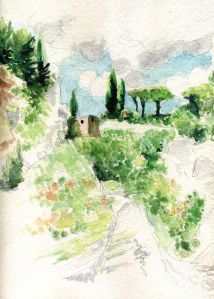
Isola Bella, Taormina, Sicily
Isola Bella, Taormina, Sicily. Copyright 2005  Robin L. Chandler

the beautiful place where we celebrated our 20th anniversary as a couple.   So though we’ve only legally been married in California for just over a year, we’ve been a couple for nearly twenty-five wonderful years. Some day in the future, gay marriage will be the norm in our country, and not the exception or blasphemy as some see it today.

There is that wonderful saying “as California goes, so goes the country,” which in my mind translates as California sets the trends and others follow a good idea. But that hasn’t always been the case. Many of the leading abolitionists fighting to end the practice of slavery in the United States were from New England including Ralph Waldo Emerson, William Lloyd Garrison, Henry David Thoreau and John Greenleaf Whittier. Interesting coincidence but Connecticut, Maine, Massachusetts, New Hampshire, and Vermont — all New England states — have legalized gay marriage.   Plucky Iowa has too, but that’s another longitude.  Slavery was an inhuman practice codified in the Constitutional Convention of 1787, but the rhetoric of the New England abolitionists served as the country’s conscience arguing slavery must end, and all must be free and equal.   Equality under the law is a fundamental freedom was the argument against Proposition 8 heard by the California Supreme Court.  While the court upheld Proposition 8 ending gay marriage in my state, the fight will continue here in California and throughout our country.   Equality is one of those fine old New England traditions that runs deep.   I look forward to the day I can say ” as New England goes, so goes the country.”

Smokey the Bear

When I moved to San Diego last year, I did two wonderful things. First I joined the Sierra Club San Diego Chapter and enrolled in the Wilderness Basics Course.  Second I started hiking with my brother-in-law Doug. We chose hikes in the San Bernadino and San Gabriel mountains because of their proximity to Doug’s home and since I had spent thirty some years in Northern California any trail in Southern California would be an adventure for me. Our first explorations in the San Bernadinos included a hike through Jeffrey Pines on the snow covered Siberia Creek Trail, documented in this watercolor,

Hiking on the Siberia Creek trail
Hiking on the Siberia Creek trail. Copyright 2008 Robin L. Chandler

and a trek to the Pacific Coast Trail where it brushes by Big Bear Lake.   Our final adventure of last year was in the San Gabriels  hiking  Mt. San Antonio (known affectionately as Old Baldy) with my friend Dan.   Baldy is some twenty-two miles to the east of Mt. Wilson and Big Tujunga Canyon where the fires continue to burn now in their sixth day.  I keep thinking about those mountains — a challenge for  the north-south driver — but also a strong range charged with protecting the Los Angeles basin from the harsh temperatures of the Mojave desert and capturing moisture during the winter for the times of drought.   I keep thinking about the wildlife and people uprooted by such a massive fire and the lives lost, some heroically and others needlessly.  This evening I opened Gary Snyder’s essays Back on the Fire and thumbed to the “Regarding the Smokey the Bear Sutra” and this brief excerpt reads “a handsome smokey-colored brown bear standing on his hind legs showing that he is aroused and watchful, bearing in his right paw the Shovel that digs to the truth beneath appearances….his left paw in the Mudra of Comradely Display  indicating that all creatures have the full right to live to their limits…wearing the blue work overalls symbolic of slaves and laborers, the countless men oppressed by a civilization that claims to save but only destroys…wearing the broad-brimmed hat of the West, symbolic of the forces that guard the Wilderness….round-bellied to show his kind nature and that the great Earth has food enough for everyone who loves her and trusts her….”  Thank you Smokey.

On the fireline

Sunday afternoon I swam on campus at the Canyonview pool. The cool water was delicious as I did my laps, a good way to exercise on a hot day! Built on a mesa, the pool provides a great view down the canyon to the northeastern section of San Diego County.  On a typical Summer’s day the view from this part of UC San Diego extends across the Carmel Valley to the foothills southwest of Escondido.   I’ve tried to capture this summertime view in my ink and watercolor drawing.

Canyon view
Canyon view. Copyright 2009 Robin L. Chandler

On a crisp clear day in Winter after a cold rain, one can see a dusting of snow on the hills — sometimes catching a glimpse of a snow capped Palomar Mountain (some 5300 feet above sea level) in the Agua Tibia mountain range. In August, however, snow is a distant promise, and on this day the sky was a very hazy and thick gray-pink color, a result I believe of the fires burning in the San Gabriel mountains north of Los Angeles.  Crossing the Tehacapi and the San Gabriel mountains is the final driving test before Northern Californians  —  tired from slogging through the endless miles of Interstate 5 —  are permitted to enter the City of Angels.  It is dramatic country.  The San Andreas rift zone lies on the San Gabriel ridgeline  neatly separating the Mojave Desert from the Los Angeles Basin.   The San Gabriels are also the majestic backdrop to the craftsman bungalows of Pasadena.  In the autumn of 1888, Mary Austin — future author of  The Land of Little Rain —  journeyed from Pasadena to the San Joaquin valley.  The journey  — described in her book One Hundred Miles on Horseback —  took her across the San Gabriels via the towns of San Fernando and Newhall and up the San Francisquito Canyon to the ridgeline and finally Tejon Pass.  On her way to San Fernando she ambled past orchards and vineyards alternating with stony stretches “marking the wash of some mountain stream and covered with brown tangled chapparal, bristling with the dried stalks of that species of yucca known as the Spanish Bayonet…these stony places are the favorite haunts of the prickly pear.” Once she began to climb the walls of the San Francisquito canyon she encountered the “dark red satin smooth stems, and olive green foliage of the manzanita;  sometimes bare and ragged cliffs with strata turned and twisted, and folded back upon itself, bearing on its face the marks of primeval fire and flood.” California has a summer drought followed by a risky fire season and native plants many of which have adapted so well to this climate that they don’t reproduce until after a fire.  As Californians we all know that flood, fire and earthquake are part of living in this beautiful place, and many of us prepare as best we can, but their significance as life changing events cannot be overstated.