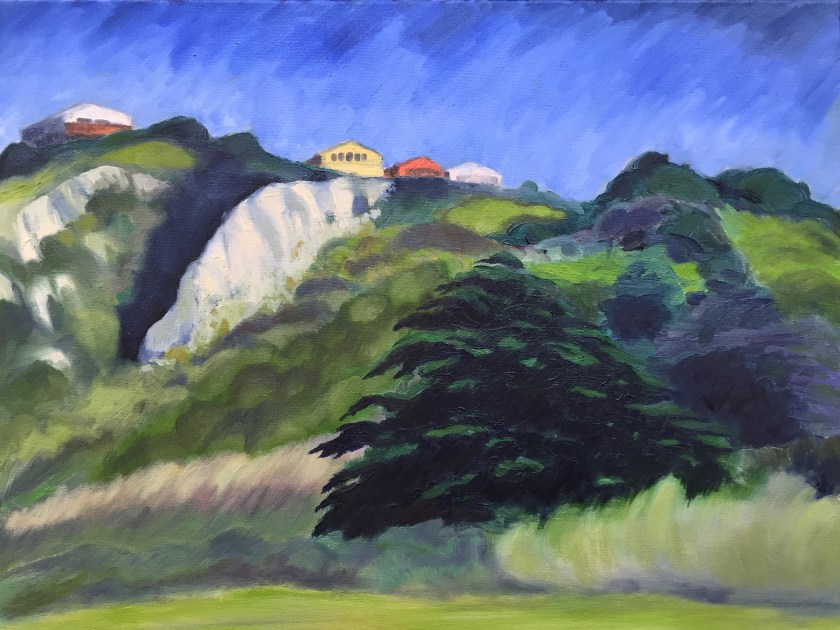
Mount Saint Helena after the rain. Robin L. Chandler 2017.
This morning brought another glorious day of painting here at my Chalk Hill Artist’s Residency. For the last three weeks, I have walked acres of vineyards cradled between the Russian River and Mount Saint Helena here in beautiful Sonoma County. During this time, I’ve forged deep connections with this beautiful landscape and the people, animals and birds that call this place home, and I’ve tried my best to put those feelings into my paintings.
The morning also brought a couple of “lost” dogs: Okie and Shadow. Out in my yard, I found these two out and about. They weren’t really lost, they were just not where they were supposed to be. But that said, I was happy they graced my porch and gave me their joy and friendship on such a beautiful day. Dogs and people soon all fell in to place, and they were on the next stage of their journey, and I was off to my studio to paint and paint some more!
Recently, my good friend Pam introduced me to a very talented musician Sarah Jarosz who is also a gifted songwriter. I can’t get this beautiful song Sarah wrote out of my head: Lost Dog. Maybe it sticks with me because all of us, bury old bones and find new ones, and all of us lose ourselves, and with determination, talent, good friends, and a wee bit of luck, find ourselves, again.
“Totem poles are about cultural identity. They are a way of native people saying, “We’re here. We’re still here and our culture is still here…you treat a totem pole with respect, just like a person, because in our culture that’s what it is. A totem pole is another person…born into the family, except he is the storyteller,” wroteNorman Tait, a British Columbia First Nation sculptor and carver, in Hilary Stewart’s bookLooking at Totem Poles. Totem poles are carved from a western red cedar tree, selected for their beauty, strength, and proximity to the sea or a river, so they could be easily transported to the village artist for carving. Before felling, the tree spirit was addressed in prayer, part of a ritual honoring the tree’s identity before it began a new identity as a totem, a community storyteller.
“Trees are communal…they grow together in large groups…they have relationships…and even communicate with other trees within their stands, including trees of their own kind as well as those of other species; they function for the benefit of the whole…and they enter into mutualistic partnerships with other species…to understand a single tree, we must understand the entire forest” writesDavid Suzukiand Wayne Grady inTree: A Life Story. Western civilization for the most part views trees as a commodity. Trees are one of many resources our society extracts from the land to become lumber, Masonite, and paper. But as a culture we say no prayer to the tree spirit before felling the forest.
As a species we extract resources from the air, land and water on a vast scale. We use these precious resources to develop products for mass consumption that touch all aspects of our lives: the water we drink, the energy we burn, the houses we live in, the food we eat and the air we breathe. But without thinking deeply about how those resources are extracted and products created and disposed of, we also create pollution and devastation on an equally vast scale. Open your eyes. See the impact both local and global. Question your motives. We have the ability to respect nature, the lives of others and to live sustainably and responsibly. But today many of our leaders are making easy choices and taking quick actions that are neither respectful nor thoughtful about nature and the lives of our global neighbors. They could lead us to make hard decisions that consider the big picture, but their eyes are on focused on 2018 mid-term elections. They are influenced by the greed and corruption that comes with power. Their mouths open and lip service is given to care and concern for others, but in truth, they do not take responsibility for the Long Now. We are in a dark morass, and we need to raise our totems, to tell our story loud and clear, and to listen to totems of others, for only by talking and listening, will we be guide each other through the darkness. This mutual understanding will not come quickly. It will take time and patience. But we must take time and have patience.
“What’s happening in China makes a difference to us in the United States [and what’s happening in the United States makes a difference to China]. The amount that we drive cars or the amount that we misuse fossil fuels is going to or already has affected some other group of people or animals, the earth and the environment. These interconnected interpenetrating personal and global events are what we are being asked to be aware of. Once we become aware in this way then the teaching starts to transform us. This understanding will strengthen and guide our aspirations to respond to each situation anew with ethical and skillful responses…this is the mind of the Buddha,” writes UjiShinshu Robertsin “Astride the Highest Mountain: Dogen’s Being/Time, A Practitioner’s Guide” in Receiving the Marrow.
“I long ago lost a hound, a bay horse, and a turtle dove, and I am still on their trail,“ wrote Henry David Thoreau in Walden; or Life in the Woods. “Many are the travellers I have spoken to concerning them describing their tracks and what calls they answered to. I have met one or two who have heard the hound, the tramp of the horse, and have even seen the dove disappear behind a cloud, and they seemed as anxious to recover them as if they had lost them themselves.” Thoreau’s words can just as readily apply to animals in the wild, especially those we are endanger of losing all trace of.
On Wednesday February 15, 2017 the U.S. Senate Environment and Public Works Committee held a hearing to consider “modernizing” the Endangered Species Act (ESA) to eliminate red tape and bureaucratic burdens that eliminate jobs. According to the Washington Post, during the two-hour session, lawmakers discussed how “federal efforts to keep species from going extinct encroaches on states’ rights, is unfair to landowners, and stymies efforts by mining companies to extract resources and create jobs.” The ESA is a 43 year old law, enacted during the Nixon Administration, when we were beginning to grapple with the devastating impact of chemical use and human development on the environment. This legislation has likely saved from extinction the bald eagle, the California condor, gray wolves, black-footed ferret, American alligator, and the Florida manatee.
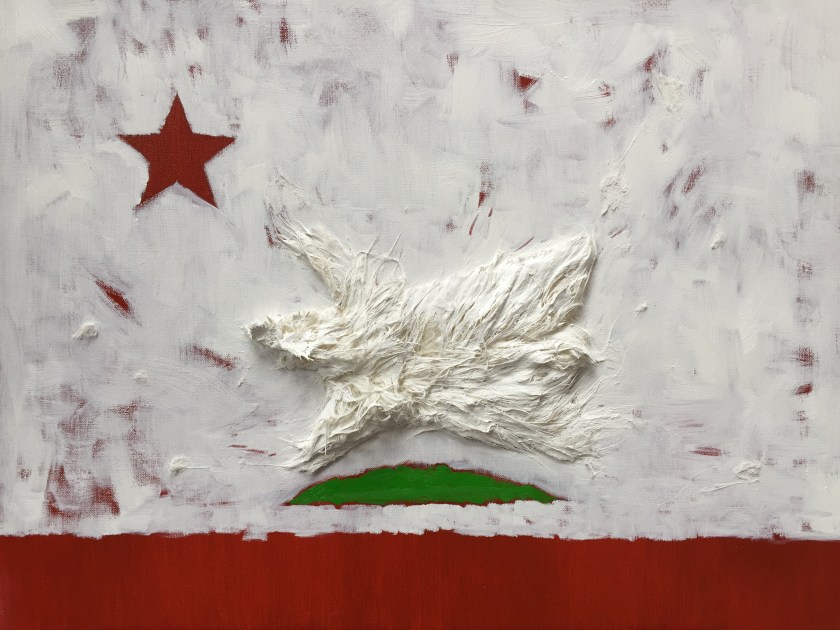
The Center for Outdoor Ethics developed the Leave no Trace Principles to protect the outdoors by teaching and inspiring people to enjoy nature responsibly. Ironically, the meaning of these words “leave no trace” could be twisted to serve as an epilogue for the Environmental Species Act. This phrase, used malevolently, can mask and suppress the evidence at the murder scene. Leave no Trace. Should the Environmental Species Act be terminated, or so diluted as to be ineffective, we can “leave no trace” giving a green light to actions that would “endanger” species. We should take note of our crimes locally and consider disappearing the California Grizzly from the California State Flag. The last California Grizzly Bear was shot in Tulare County in 1922, and the last believed sighting was in Sequoia National Park in 1924.
It is not too late to fight the proposed destruction of the Endangered Species Act, in my humble opinion, one of the noblest pieces of legislation in our country’s history.
“All of this is made more precious, not less, by it’s impermanence. No matter what goes missing…disappearance reminds us to notice, transience to cherish, fragility to defend wrote Kathryn Schultz in her article “Losing Streak” published in The New Yorker February 13 & 20, 2017. Loss is a kind of external conscience urging us to make better use of our finite days. As [Walt] Whitman knew, our brief crossing is best spent attending to all that we see: honoring what we find noble, denouncing what we cannot abide, recognizing that we are inseparably connected to all of it, including what is not yet upon us, including what is already gone.”
Mindfulness, the Buddhist practice of self-awareness, is needed. We must recognize that the vanishing of others is akin to the vanishing of our selves. All life on the planet is endangered. Take action today: call your Senators and Representatives and advocate to preserve and strengthen the Endangered Species Act. Because the ESA ultimately protects you and me, as well as other endangered creatures.
The days are dark and grey; the skies stormy and the ocean restless. Will we reach the shore? Or will we be battered by the tides? A weak hand at the tiller, doubt and anxiety grip our ship. We take our stand, voicing our opinion. Unsure. Will our words be heard, or will they fall on deaf ears, lost in the chaos?
Heroic action is needed to fight the fear mongers, but my special powers come from the brush in my hand. Will art signify in such a time?
In Defiant Spirits: the Modernist Revolution of the Group of Seven, Ross King proposed that an artist, and in this case, Tom Thomson, the great Canadian landscape painter and outdoorsman, could be “the hero in a time of need, [who] goes forth from his homeland and into an underworld of dangerous wonders. Here he contends against mighty forces and undergoes a series of trials before returning home, armed with special powers that give vitality to his community.” As an artist, Tom Thomson was engaged in the vision quest, “the single most pervasive literary plot in western literature…from Homer and the Bible, to Grail legends and the Native American hanblecheya.”
At this time in the history of our country, I believe each of us must undertake the vision quest; it is the eleventh hour and our land, and the creatures inhabiting the land, are under attack. To defend what we cherish, the hero within is desperately needed.
“When the aboriginal man goes walkabout, traveling along his ancestral songline, he chants the verses originally sung by his dreaming ancestor, singing the land into view as he walks through it. And in this manner, he renews not only his own life, but the very life of the land itself.”[1] Each place has it’s story, a story of the land and the creatures native to that place and time, and those stories must be described and shared to be remembered, to remain alive. The Greek word Aesthesis, origin of aesthetics, means the “work of the senses: touching, hearing, seeing, smelling and tasting.” Stories are created from aesthetic experiences, but theses stories must be preserved to be remembered.
In his 1980 Nobel Prize for Literature lecture, the great poet Czelaw Milosz wrote that the poet must possess two qualities: to see and describe. The poet is the one “who flies above the Earth and looks at it from above, but at the same time see’s it in every detail.” Milosz makes the point “to see means not only to have before one’s eyes. It may mean also to preserve in memory. To see and to describe may also mean to reconstruct in imagination. A distance achieved, thanks to the mystery of time, must not change events, landscapes, human figures into a tangle of shadows growing paler and paler. On the contrary, it can show them in full light, so that every event, every date becomes expressive and persists as an eternal reminder of human depravity and human greatness. Those who are alive receive a mandate from those who are silent forever. They can fulfill their duties only by trying to reconstruct precisely things as they were, and by wresting the past from fictions and legends.”
We must see and describe, to make stories, to make memories and fight the nihilism lurking in the current chaos. And yes, using my special powers, brush in my hand, I will see and describe, I will spark the memory of particular stories, associated with particular places and times and particular creatures, and it will signify.
[1] David Abram. “Gary Snyder and the Renewal of Oral Culture.” A Sense of the Whole: Reading Gary Snyder’s Mountains and Rivers Without End. Counterpoint: Berkeley, 2015. p. 94
The break between storms brought me to the beach. Oh the rain! Such a much needed gift. But I am glad for this day to enjoy the hazy winter sunshine. Meeting my friend, we set up our easels and started sketching in oil, the sun at our backs and the wind in our faces, capturing the coming storm moving eastward over the Pacific. It was a beautiful day – cool and grey – and I lost myself in its splendor while trying to capture it on canvas. On my way home, I stopped in Pescadero purchasing some hot chocolate and fresh baked artichoke bread to warm my body and soul and celebrate this precious life after growing cold and warn by hours of plein air painting.
The wonderful novel I am reading is called War and Turpentine; Stefan Hertman’s homage to his grandfather, awarded the 2014 AKO Literature prize, is the story of a man “tossed back and forth between the soldier he had to be and the artist he wished to become.” War and turpentine. Painting the seascape, this passage from the book came to mind:
“There is a great deal on this planet to arouse an enduring sense of wonder, especially when seen in the light of one’s impending departure. The way molecules move in the water, for instance, yielding the subtlest play of shifting light as evening falls over the sea in a southern bay – say, on the rocky beach of the Italian coastal town of Rapallo, when the wind has dropped and the pink of the evening clouds performs endless variations with the deepening blue or the sky mirrored in the sea – and how living beings with eyes and consciousness, two incomprehensibly complex adaptations to this whole wondrous biosphere, can take it all for granted and go on breathing, flawlessly designed for just this sort of system.”
The cliff above Mussel Beach. Robin L. Chandler 2016.
In December, the sun sleeps late and lays to rest early. Short winter days bring cold nights and chilly mornings. Mid-afternoon, we rejoice in the sun’s warmth and bask in the bright light bringing intense colors and deep shadows. On windswept Mussel Rock Beach, I painted alongside my friends, also painters, grateful for the beautiful sunny day and the winter light striking the rain-restored landscape: so many greens. For the moment, darkness was banished beyond the horizon, the place where threatening storms lay in wait. Finding solace in this place, momentarily I put aside my fears.
The poet Michael Palmer gave the keynote address On the Sustaining of Culture in Dark Times for the February 2004 Sustainable Living Conference at Evergreen State College. Drawing upon the actions and imagery of 9/11 and the subsequent Iraq War, Palmer states “demagoguery, deceit, and denial of the other, such crimes against language are the grounds of despotism. And all in the trusted name of “liberty,” “freedom” and “democracy…yet, for brazen and blatant lies to work, there must be people to believe them, or choose to believe them, or simply be indifferent…” The United States initiated the Iraq War for several reasons: save the world from alleged weapons of mass destruction held by the despot Saddam Hussein, seek retribution for the destruction of the World Trade Center, and re-engineer a nation based on democracy and free trade. What did it achieve? Considered an act of rebellion against the Roman Republic, Julius Caesar, marched his troops across the Rubicon uttering the famous words alea iacta est “the die is cast.” When the United States “crossed the Tigres and Euphrates,” the die was cast, setting in motion events drastically reshaping geo-political alliances and pressuring democracies to choose security over freedom.
Later today, across the nation, the Electoral College will meet in fifty state capitals casting ballots for the next President of the United States. Electors will vote – another die will be cast – and there will be no going back. Noir flourishes in the light of day.
Cottonwood near Bishop, California. Robin L. Chandler, 2016.
The snow, fondant-like, blanketed the mountains. Rushing down the canyons, the rain wrote creeks on the landscape, like icing, on a cake. October brought me to the big empty, the Owens Valley, the tectonic, volcanic landscape, now a desert, once a vast ocean. The thirsty cottonwoods grow alongside the Zen-like creek, waiting months, sometimes years, for the river they know will come. In the big empty, I sang a prayer for this land. Staring deeply, intently at the mountains and the rivers, imagining the ocean that once was, I sang this blessing by Nanno Sakaki[1] for what was and what can be:
“One day from the ocean, from yesterday, I’m sure
A lost hump-back whale will swim up this river.
And someday, from the ocean, from tomorrow,
Countless whales will swim up the river
To revisit the ancient beech forest,
Whales swimming up the river, up the river.”
A few weeks later, I stand before a Marsden Hartley work, painted in 1918, entitled The Last of New England – the Beginning of New Mexico hanging in the Chicago Art Institute. Writing to his friend, Alfred Stieglitz, Hartley described the Southwest: “I like the country very well for it is big and clean and true, and there is nothing dirty standing between one and the sunlight.” Standing before this work, I absorbed the intensity of the landscape realized in the painter’s forms and colors. Like Proust and his tea and madeleines, the painting roused my memory of the Eastern Sierra desert, big and clean and true. Now more than ever, we need people to stand up and speak out like the Sioux tribal leaders now singing their prayers in protest of the pipeline at Standing Rock. We do not need anything dirty, like an unnecessary pipeline, standing between us and the sunlight on the land.
A great shadow threatens the land. Lies and abuse, dressed as truth and normalcy, threaten our democracy, so tenuous, so often taken for granted. To heal our selves, we must take our song to the streets and valleys and together loudly sing our prayers for our land, our peoples, and our democracy. It will be a tough fight, but we must continue to urge national investment in clean and renewable energies and demand the cessation of investments in projects like the pipeline perpetuating fossil fuel dependence. Here at home, the LA Times reports that California leads the nation in energy productivity, electricity from renewable resources, and reductions in carbon intensity. Like the Shaman, we will raise our voice in song to heal ourselves, each other, and our community. Together, open, guiding, we will sing our love of the land we hold so dear.
Because the whales will swim up river, only when they hear our song.
Cottonwood in the Owens Valley. Robin L. Chandler 2016
The lights dimmed and the spotlight focused on the figure center stage guitar in hand; she began to sing, the voice a little smoky and raspy, working towards the high, round notes so clear in my memory. Soon, “Saint” Joan Baez sang two of my favorites by Bob Dylan and Woody Guthrie respectively, “With God on Our Side” and “Deportee,”. Both songs are stories of love and tragic loss. Each story holding forth the possibility of redemption, that we can learn from our mistakes and take right action.
Election eve, the significance of this sainted singer was not lost on any of us in the audience. This deeply disturbing election season nearly over, we drank deeply of the songs offered us, believing in the promise of a world where all persons count, no matter their origin or identity, and that the fabric of our society is stronger, when our diverse threads are woven together. Listening, my heart responds, I will march again to her call to action to build a better and loving world.
Between songs, she spoke about her belief in the ideas and aspirations expressed by Bernie Saunders as he crossed the county this year connecting with the hopes and ideals of a new generation. But she also spoke admiringly of the courage of Hilary Clinton, withstanding the barrage of lies and intimidation hurled at her these last months.
On my recent trip to the Eastern Sierras, many a cottonwood was growing, singularly, isolated from other trees in the valley, telling a story, stately and proud. In some cases, it was unclear if a tree was near death because of lack of water, or if it was merely beginning the long winter sleep. These trees standing statuesque on a parched landscape, with the majestic sierras as their backdrop, called to mind the elm trees, deemed Liberty Trees by the colonists turned patriots at the time of our Revolution. The first such elm was located in Boston and celebrated in the revolutionary poetry of Thomas Paine. Soon Liberty Trees were anointed in towns and cities throughout the colonies; these majestic trees witnessed calls to action, celebrated victories, and mourned defeats. Trees bear witness to our story, and with this act they become part of our own story, symbols of strength, longevity, knowledge, loss, and redemption.
We are participating in the most historic election of our time. The stakes are high; it feels like the future of our nation and perhaps the world weighs upon our ballot box. At times, I have been paralyzed with fear of what may come. But I also know that there are persons, my fellow citizens, who think differently than I and will vote differently than I, and they too are fearful of change. And yet, we are all part of the same country, and we must move forward together, whatever changes comes. I think of the lone cottonwood in the Owens Valley, thirsty. Is the tree telling a story of suffering brought on by a changing climate? Is it hanging on for dear life hoping for the redemption winter snow in the mountains will bring? Is this cottonwood a symbol of my republic gasping, near death? Listening to the tree, my heart responds. While I fear the change that the election could bring, I will be strong like a tree, making connections, bringing the long-view, and sharing all the knowledge and wisdom found deep in my core. I will take right action continuing to build a better and loving world respecting the rights of all living beings.
Trees burned by fire in the drought stricken Owens Valley. Robin L. Chandler Copyright 2016.
Thanks to an early start, we reached the Owens Valley just before the storm closed Tioga Pass for the winter. Snow had dusted the peaks cradling Tuolumne meadow. There would be no pie today as we passed the Tioga Pass Resort; the diner long since closed, the windows boarded until the spring snowmelt. We were giddy, caught in the romance of the storm; dark thick clouds promised snow and rain to assuage our five-year drought.
Descending to Mono Lake, we made a right turn onto 395 towards Bishop and the Eastern Sierra Interpretive Association’s (ESIA) inaugural conference on the history of the eastern sierras. This is a desolate land, whose emptiness holds so many stories to be shared. The Owens Valley straddles two counties: Mono and Inyo. Mono County defined by Mono Lake and the volcanic fields at an elevation of 7,000 feet and the Mammoth Lakes ski resort. Inyo County, the table drops sharply, thousands of feet in altitude is lost, as we descend into ranch lands, cottonwoods and the meandering Owens River. We stopped often, capturing with camera and brush the conversation between brooding sky, dark mountains, parched landscape, and autumnal trees. A photographer and a painter, drawn to this sacred place, finding poetry at every compass point.
At the ESIA conference, David Carle spoke about water and the historic choices that shaped California. A long-term California State Park Ranger, Carle now writes full-time about land and water issues facing our state. According to Carle, in 1902 Los Angeles was a small town of 100,000 people, with a promising citrus industry, but desperately seeking water. Led by the engineer William Mulholland, businessmen and city planners set their sights on the Owens Valley, a region of 8,000 residents with a 75,000 acres of farm and pasture land producing 51,000 bushels of wheat annually. The Owens Valley also held lakes and rivers fed by the water stored in the snow covered Sierras. The aqueducts were completed in 1913, but it didn’t take long before Los Angeles was thirsty again. By 1924 Owens Lake was a dry lake bed where dust storms raged. Los Angeles had purchased all the water rights in the valley, but by the mid-1920s they owned all the towns too. Communities had been destroyed and ecological disaster created for the region. The author Mary Austin asked “ is all this worthwhile in order that Los Angeles should be so big?” Today, Los Angeles Department of Water and Power (LADWP) is working hard to implement water reclamation, and to their credit most of Orange County’s water now comes from reclamation. But for some, there will never be enough water, Southern California’s thirst will not be slaked. The proposed Twin Tunnels Project would move water from the Sacramento and San Joaquin Rivers to the southland. Recently, LADWP purchased five islands located in the heart of the river delta, just as LADWP purchased the Owens Valley a century ago. Stop the Tunnels provides information about establishing fair water policies in California.
Looking out across the Owens Valley, at a land so near, so precious, it is scary to know that actions taken by a few powerful people, so far away, change the land and communities forever.






 alive in the sea of information