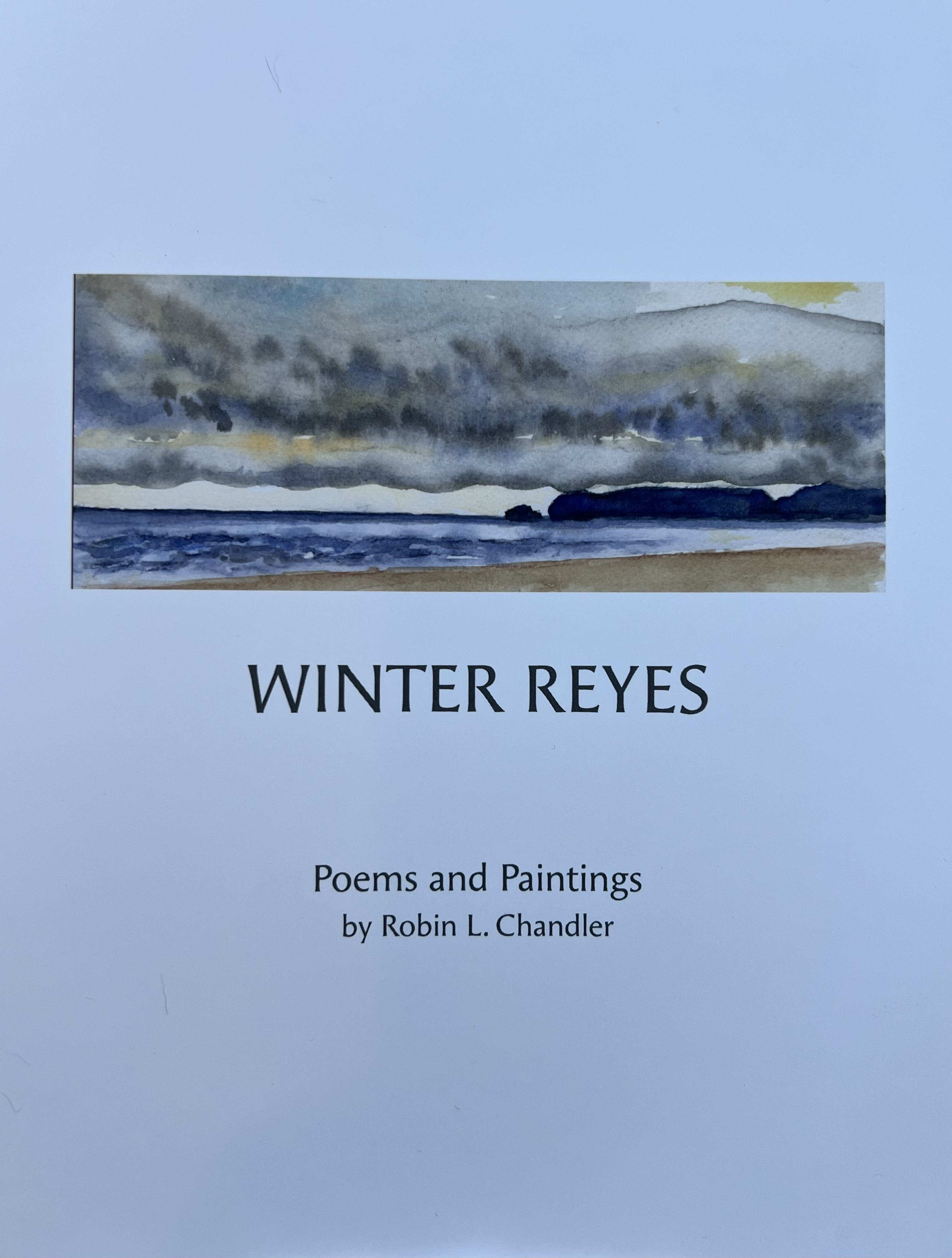
Cover of the book Winter Reyes: Poems and Paintings by Robin L. Chandler
The vernal equinox arrived and brought a blast of summer in typically springtime March. But I’m holding on to the memories of rain and wind, cold nights, frosty mornings, and blue winter light. And luckily, I can easily reconnect by opening a book that captures the feeling of winter in painting and poetry.
Inspired by my midwinter hikes, Winter Reyes rejoices in the hibernal beauty of Point Reyes National Seashore and shares the hope I find in nature’s resilience. My paintings and poems commemorate this jewel of the National Park Service. Copies of the book can be purchased on my website. I hope you have as much pleasure reading as I had in the making.
“reaching the bridge, the water parts, brush arches to the block page
Wet on wet, the work begins, the atmosphere emerges
“Mass extinctions are extremely rare and catastrophic events, but the human-driven one is seldom deemed newsworthy by the dominant media. This is not an incidental oversight: the destruction of life’s diversity must remain invisible or obscure in the public domain, because it is fully entangled with the freedoms that people (are goaded to) value and seek.”
“Over that [1929] summer, [Georgia] O’Keefe worked her way through the standard paintings of santos, Ranchos de Taos church, and Taos Pueblo itself, but hints of her later work appeared as well. Particularly in a series of paintings of penitence crosses against a backdrop of a southwestern night sky, O’Keefe illustrated the spiritual inspiration she found in the New Mexico landscape. Perhaps the best-known painting from the summer, however, is The Lawrence Tree…..O’Keefe described the painting…..’I had one particular painting, that tree in Lawrence’s front yard as you see when you lie under it on the table with the stars it looks as tho it is standing on its head.’…..the work shows O’Keefe’s sensual appreciation of New Mexico as well as her engagement with [D. H.] Lawrence‘s writing. Lawrence had described the tree himself in St. Mawr, and Lawrence’s work remained in O’Keefe’s library throughout her life. Although Lawrence typically saw the tree with some ambivalence, O’Keefe made it entirely her own. In the painting, the tree reaches up and seems to kiss the sky, much as O’Keefe herself once said she wanted to do.” (177)
Excerpt from Flannery Burke‘s From Greenwich Village to Taos: Primitivism and Place at Mabel Dodge Luhan’s (Lawrence, Kansas: University of Kansas Press, 2008)
“The rivers of fluid fire that suddenly fell out of the sky and exploded on the earth near by, as if the whole earth had burst like a bomb, frightened her from the very core of her, and made her know secretly and with cynical certainty, that there was no merciful God in the heavens. A very tall, elegant pine-tree just above her cabin took the lightning, and stood tall and elegant as before, but with a white seam spiraling from its crest, all down its tall trunk, to earth. The perfect scar, white and long as lightning itself. And every time she looked at it, she said to herself, in spite of herself: There is no Almighty loving God. The God there is shaggy as the pine-trees, and horrible as the lightning. Outwardly, she never confessed this. Openly, she thought of her dear New England Church as usual. But in the violent undercurrent of her woman’s soul, after the storms, she would look at that living seamed tree, and the voice would say in her, almost savagely: What nonsense about Jesus and God of Love, in a place like this!This is more awful and more splendid. I like it better. The very chipmunks, in their jerky helter-skelter, the blue jays wrangling in the pine-tree in the dawn, the grey squirrel undulating to the tree-trunk, then pausing to chatter at her and scold her, with a show of fearlessness, as if she were the alien, the outsider, the creature that should not be permitted among the trees, all destroyed the illusion she cherished, of love, universal love. There was no love on this ranch. There was life, intense, bristling life, full of energy, but also, with an undertone of savage sordidness.” (167-168)
Lodgepole Pines along the Little Lakes Trailhead. Robin L. Chandler, 2024
“In the beginning there were stories and the stories were made of Earth. Rocks and rivers, mountains and sea, these were the gods and the gods moved within them.” (p.225)
In 2013, the entirety of the novel Moby Dick was translated into emojis, those little ideograms of smiling faces and pets and objects that populate our phones and number around 1000…their appeal seems to be based on the strange and paradoxical combination of specificity and obscurity that they embody…they purport to transcend cultural difference and cut a line of sincerity and clarity straight to the nebulous heart of what we mean to say. Yet for all that, emojis, particularly in combination, open wormholes of ambiguity.” (p.228)
“Yet directness and certainty remain a dream despite our words, despite our codes, despite our cyphers. Who can state for sure the meaning of Moby Dick? ‘Of whales in paint; in teeth; in wood; in sheet-iron; in stone; in mountains; in stars’: Ishmael, its narrator, could find them everywhere. Yet the whale itself, the white whale, the named whale, is elusive. What did it mean to Ahab? Why the obsession, the desire, the pursuit? Everything can mean something else, if only we could agree what. Augustine wondered whether we could decide simply by pointing and naming. Remember that Moby Dick, whose title names its prey, itself begins with an act of naming: ‘Call me Ishmael.’ Yet in saying that, it is clear, too, that any name would have sufficed. The willow is also ‘sallow,’ is also ‘osier.’ In such simple acts lie a world of ambiguity, and a history concealed from the eyes of the everyday. Nothing is steady. Meaning sways like the hull of a ship. Ahab, with leg of wood, and scars on his body like the ‘seam sometimes made in the straight, lofty trunk of a great tree,’ hunts over ocean and sea in a vessel of timber from which a mast extends like a great oak into the sky above. Nailed to it is a gold doubloon and at its top a man sits, in the masthead, watching the horizon, searching.” (p.228-229)
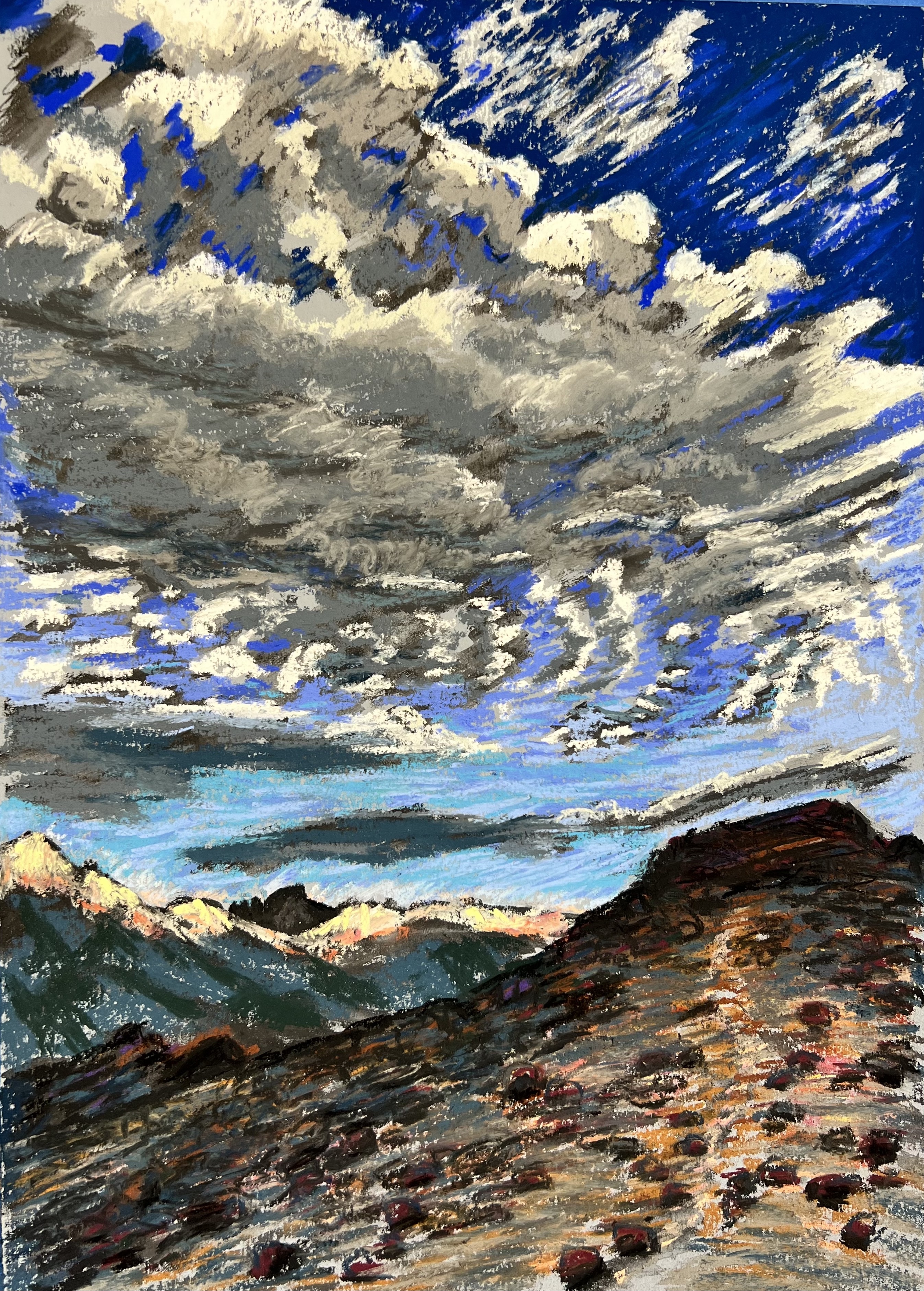
Mt. Whitney from a hilltop near Tuttle Creek. Robin L. Chandler, 2024
“…Beauty in the Song is clearly not the idealized, symmetrical, or abstract beauty of the Greeks, although occasional references to symmetry occur as in the images of twin gazelles and twin teeth (4:3, 4:5, 6:6, 7:4). The poet presents impressionistic images rather than a definitive likeness. Beauty in the song is visual, aromatic and tactile; it is textured and complex – a synesthetic experience. Beauty is a function of the abundance of the natural world. It is a function of aliveness. Beauty only becomes intelligible through the Song’s figurative language, which collapses the distance between the lovers and the land they inhabit. What beauty actually looks like in the Song is a luxurious land, alive with sheep grazing on hillsides, gazelles bounding through mountains, and trees laden with fruit.” (p.22)
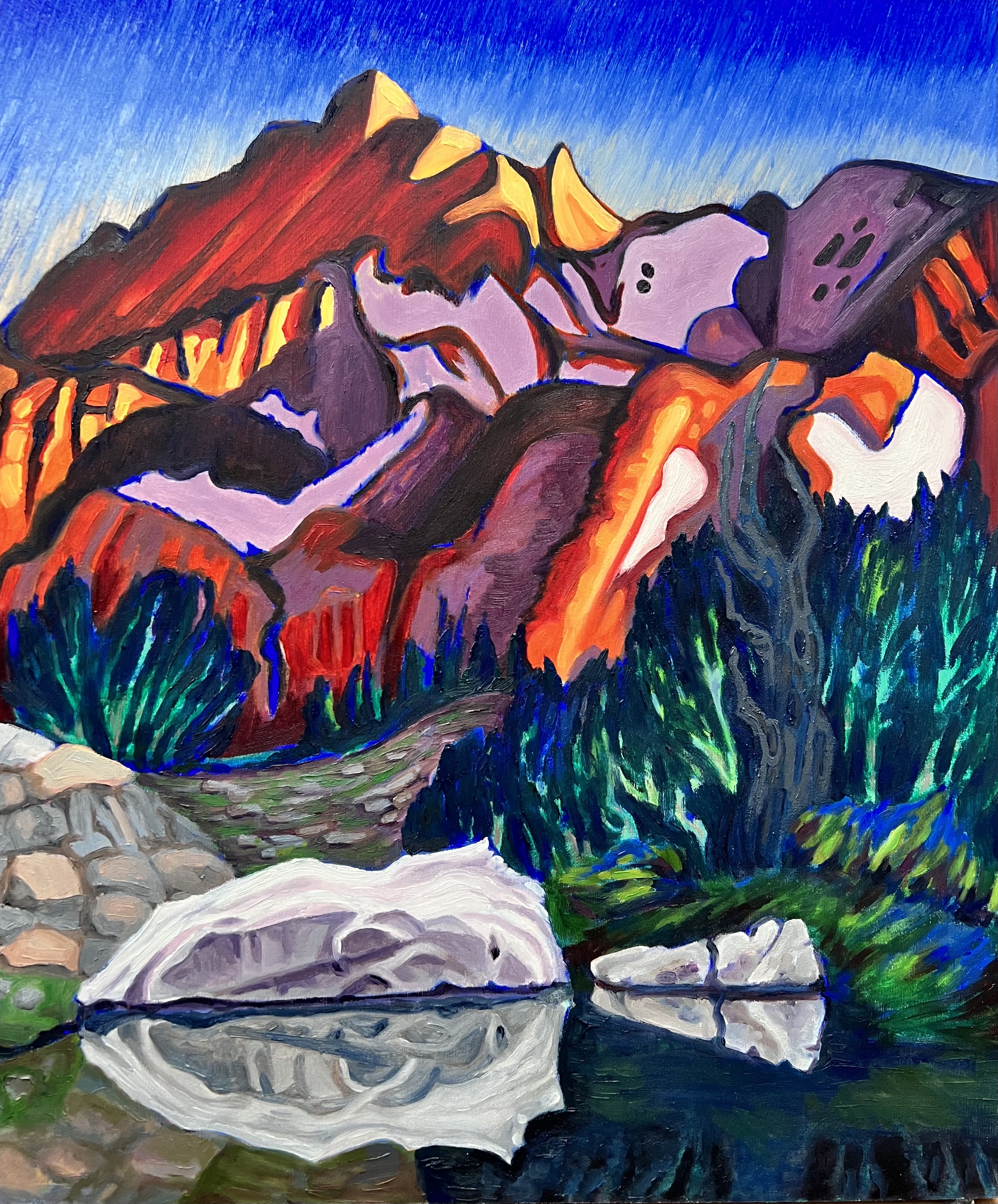
Wit-Sa-Nap Creek Winter Sunset. Robin L. Chandler, 2024
“[According to the Avatamsaka Sutra,] Indra’s net is pictured as stretching indefinitely in all directions, and at each of the knots of the net is a glittering jewel. All the other jewels in the net are reflected in each individual jewel, and each jewel reflected is also reflecting all the other jewels. This metaphor describes what was called, in Pali (the original language of the Buddhist canon), paticca samupadda, “dependent co-arising.” Modern Buddhist teachers have called it “interbeing,” or “the harmony of universal symbiosis.” This is a theory of mutual intercausality, interconnectedness, and interdependence. It is a worldview from the same ecophilosophical galaxy as Alexander von Humboldt’s “kosmos,” the Nuu-chah-nulth First Nation’s principle of hisuknis cawaak, and the “everything is connected” view at the heart of ecology. When Thoreau wrote that humans need to “realize where we are and the infinite extent of our relations,” he had this kind of idea in mind.
We think in metaphors, often — and even scientists do. Metaphors are the templates of pattern, and having those templates helps scientists — and everyone — “see” the patterns and relationships underlying the superficial “data” of experience, which often appear chaotic. Thoreau wrote in his journal on August 5, 1851, “The question is not what you look at, but what you see.” Seeing deep patterns needs a metaphoric, poetic mind.” (p.166)
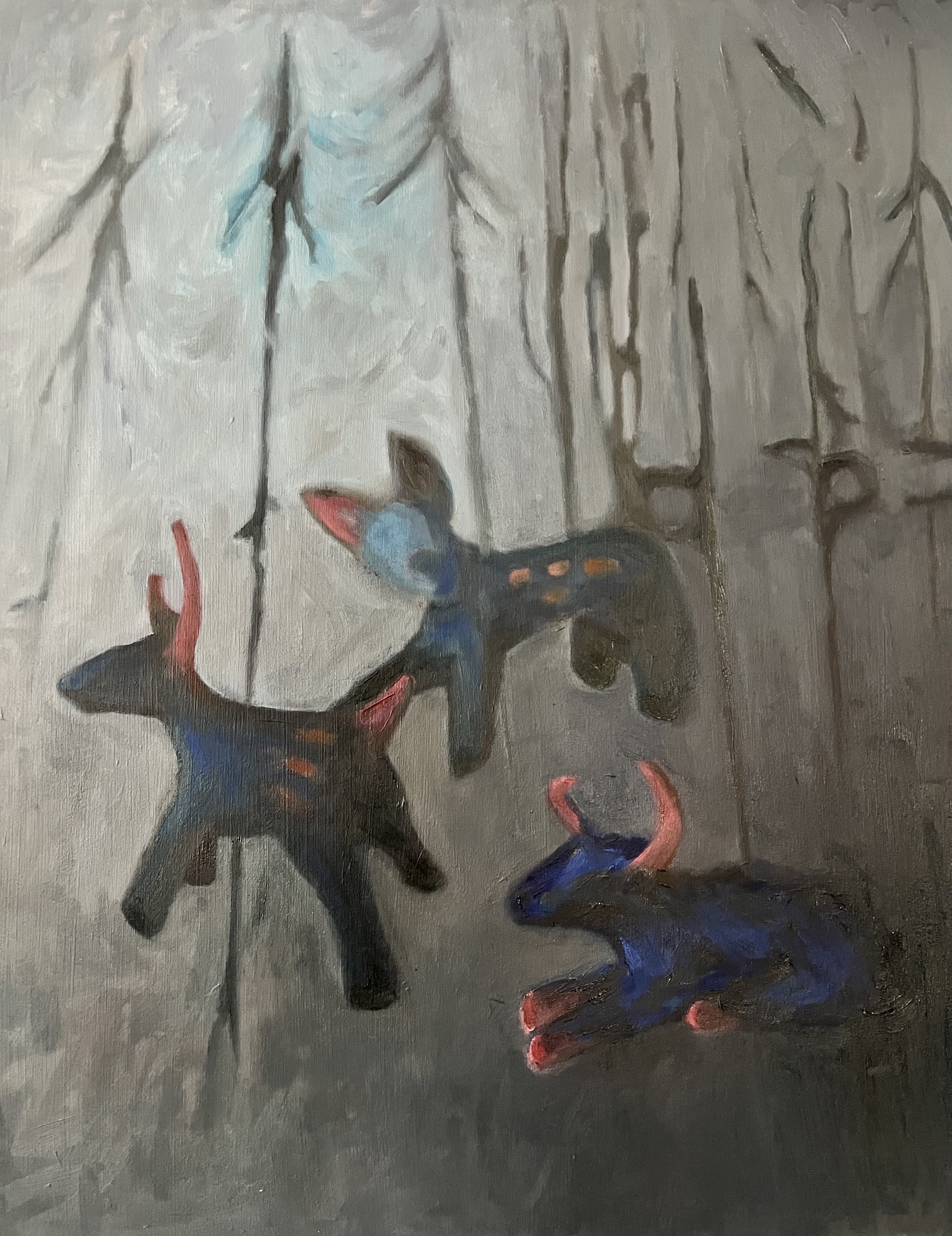
The Sierra Nevada Red Fox pictured in my painting is endangered; there are less than forty of these beautiful creatures remaining in the California counties of Alpine, Fresno, Inyo, Madera, Mono and Tuolumne. As an artist, I choose to make art that fosters kinship with the earth by capturing glimpses of the world’s beauty. I hope that inspiring others to understand our interconnectedness with nature will help preserve the earth- and in this case, the Sierra Nevada Red Fox – for future generations.
“So is ecology a kind of art? And, of course, art, like anything humans (or members of other species) do, is one kind of “interaction” between us and our environment. The logical conclusion from these definitions is inescapable: art is one aspect of human ecology, and ecological science is a kind of art. And since art is a kind of behavior, it may be an example of ecologically adaptive behavior…..if the art of Audubon and the Hudson River School painters has helped save parts of our biosphere, I’d say they are contributing to human survival – and that’s by definition, adaptive.” (p. 63-64)
“Most forms of Western ethics view persons as independent egos, centers of individual choice and action. But the Buddhist “dependent co-arising” view doesn’t see persons in that way. Ecology and evolutionary biology don’t either. The ethics that inspired these differing views – the Western ego-self view versus the Buddhist eco-self view – come out to be quite different. Aldo Leopold argued articulately, from an ecological perspective, for this broader view of self and community. He believed that ethics depend on the premise that the individual is a member of a community of interdependent parts. His “land ethic” enlarged the concept of this “community” to include soils, waters, plants, and animals.” (p.174)
“When it comes to actions and lifestyles, a world of total interdependence has both a negative and a positive side. On the negative side, anything that a person does can affect the whole system. Our ego-selfish actions have a global reach. But the positive side of total interdependence is that our actions and our choices, no matter how small, can send ripples of healing through the whole system.” (p. 175)”



 alive in the sea of information