“It has seemed to me sometimes as though the Lord breathes on this poor grey ember of Creation and it turns to radiance – for a moment or a year or the span of a life. And then it sinks back into itself again, and to look at it no one would know it had anything to do with fire or light…wherever you turn your eyes the world can shine like transfiguration. You don’t have to bring a thing to it except a little willingness to see. Only, who could have the courage to see it?”
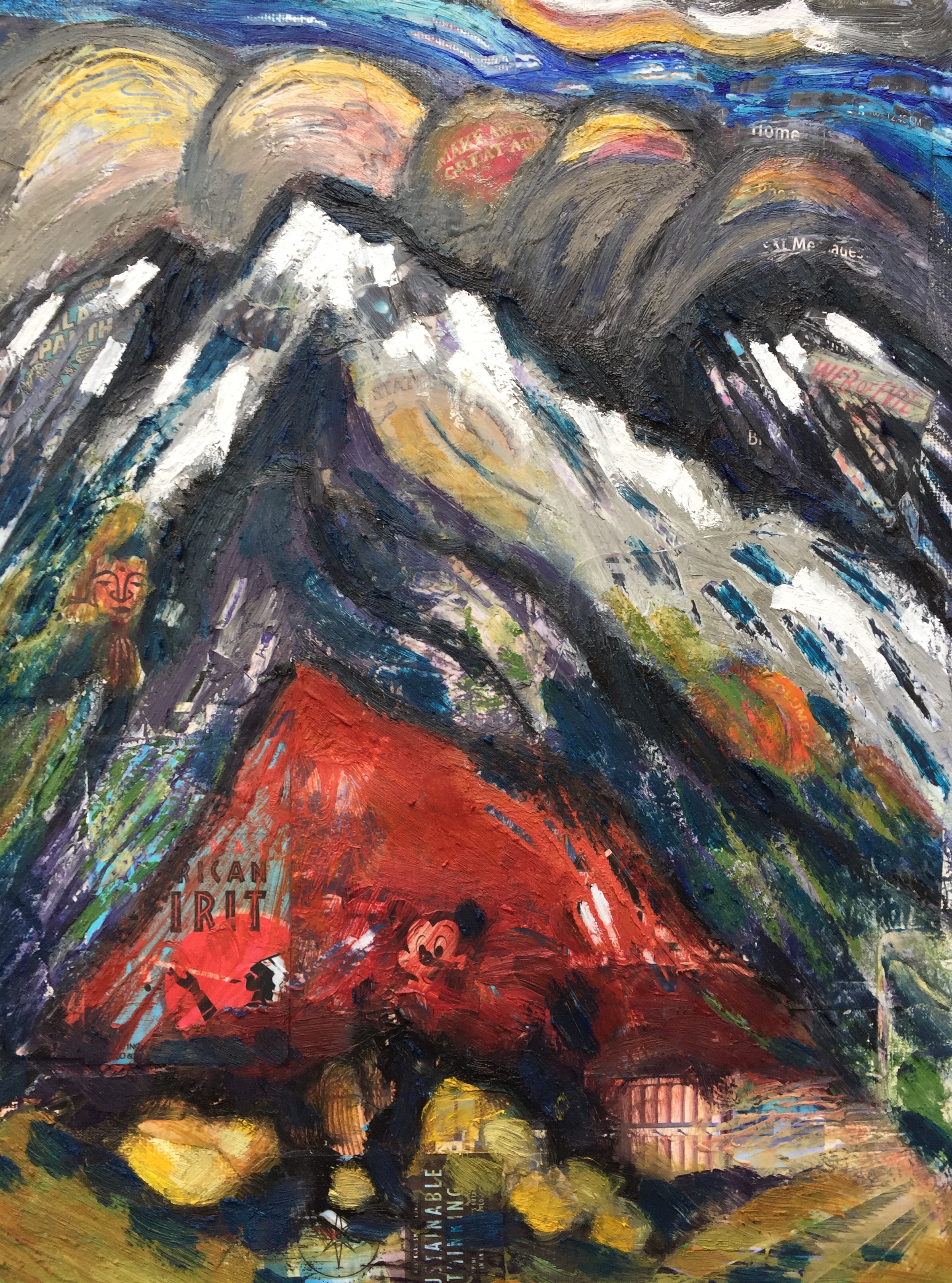
In mid-January, we drove northward on 395 through the Owens Valley from Los Angeles to Mammoth Lakes. Late afternoon, the sun flirted among the storm clouds and the Eastern Sierra mountain peaks creating a dramatic bright yellow light shining on the valley floor turning the White Mountains a mysterious blue. Ahead, a red cinder cone, a volcanic legacy, grew larger as we made our way closer to the sleeping Long Valley Caldera. The cinder cone, a beautiful rich red, still captivates my imagination.
Rebecca Fish Ewan wrote in A Land Between: The Owens Valley“ the landscape…reveals that stability in the West is both precious and fragile; the relationship between people and the land is deep and passionate, yet the balance of this union can be shaken overnight.” When settlers brought cattle to the Owens Valley in the 19thcentury, the new grazing animal destroyed the grasses and marshland environment that had been vital to the lives of the Pauite-Shoshone. When Los Angeles Water and Power Department diverted and transported snow-fed lakes, creeks and rivers of the Owens Valley to the Los Angeles basin, the ecosystem of the region was changed forever.
The Buddha teaches that we must accept that impermanence characterizes existence. But the Buddha’s noble eightfold path also teaches us to have right view, right resolve, right speech, right action, right livelihood, right effort right mindfulness and right concentration. The recent damage to Joshua Tree National Park caused during the Federal government shutdown may last for centuries. It is difficult for me to grasp the consciousness of people who cause such damage. Are they mindful of their actions consequences? Do they lack a relationship with place and community? Do they believe their “life” exists somewhere else in a different time and space? How can I teach that every moment is precious and our actions reflect our consciousness? We must understand our impact on the land and it’s inhabitants; our choices must be guided by sensitivity to the needs of others and not by our desires alone. Stewardship means never having to say your sorry.
In the 1970s, Gary Snyder heard a Crow elder say at a conference in Bozeman, Montana “you know I think if people stay somewhere long enough the spirits will begin to speak to them. It’s the power of the spirits coming up from the land. The spirits and the old powers aren’t lost, they just need people to be around long enough and the spirits will begin to influence them.”[1]
[1]Snyder, Gary. The Practice of the Wild. “The Place, The Region, The Commons.” p.42 San Francisco: North Point Press. 1990.
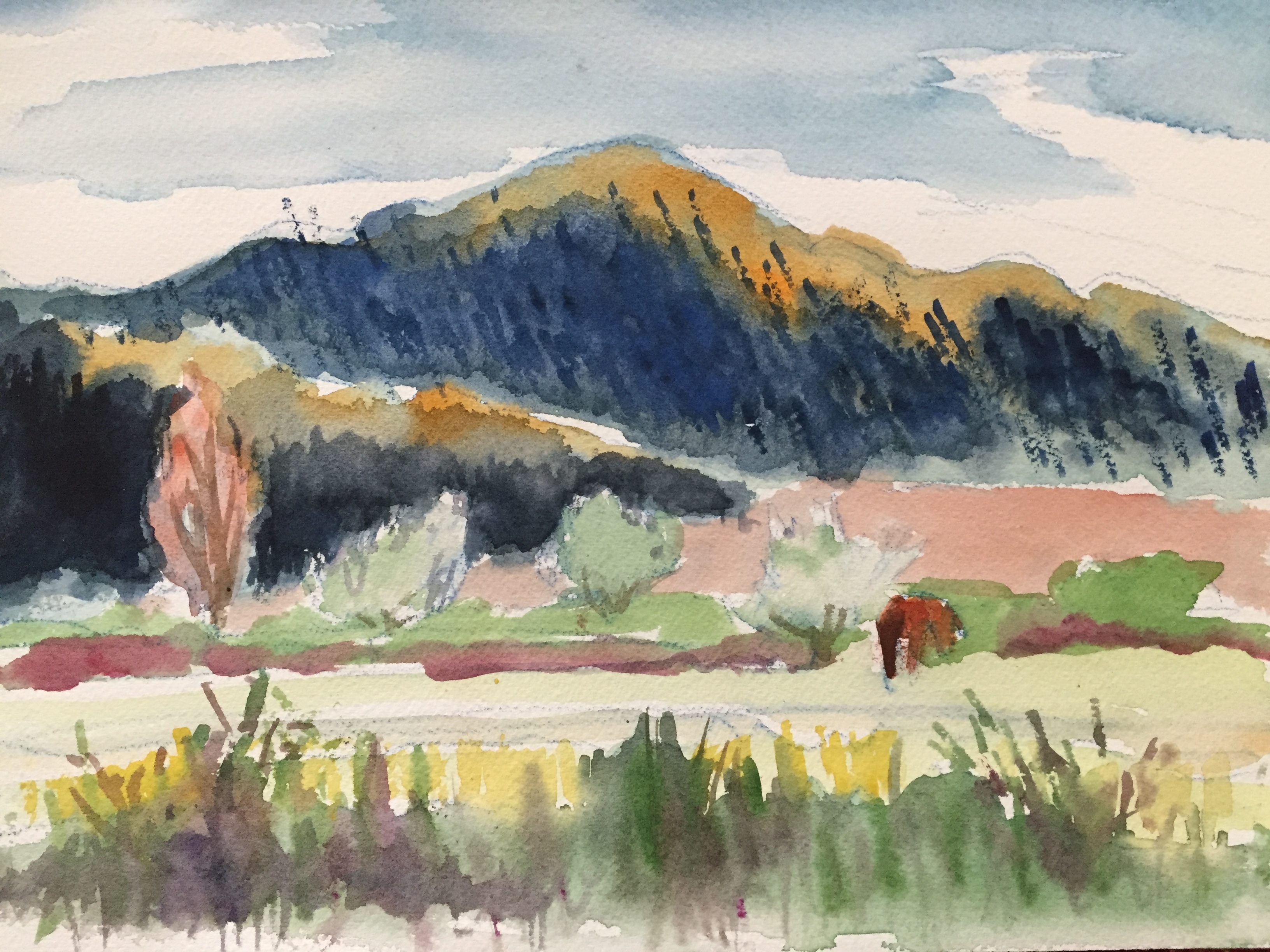
December Mt. Saint Helena Sonoma County. Robin L. Chandler, 2018.
December is my favorite time of the year in Northern California: bright sunshine and deep shadows; long nights alive with twinkling stars; and days of cold gray rain turning hillsides olive green and leaves burnt orange. I celebrate this time of the Winter Solstice measuring our shortest day and longest night on our journey around the sun. And as the New Year approaches, I reflect on days passed and days to come; counting blessings past and praying for a peaceful tomorrow.
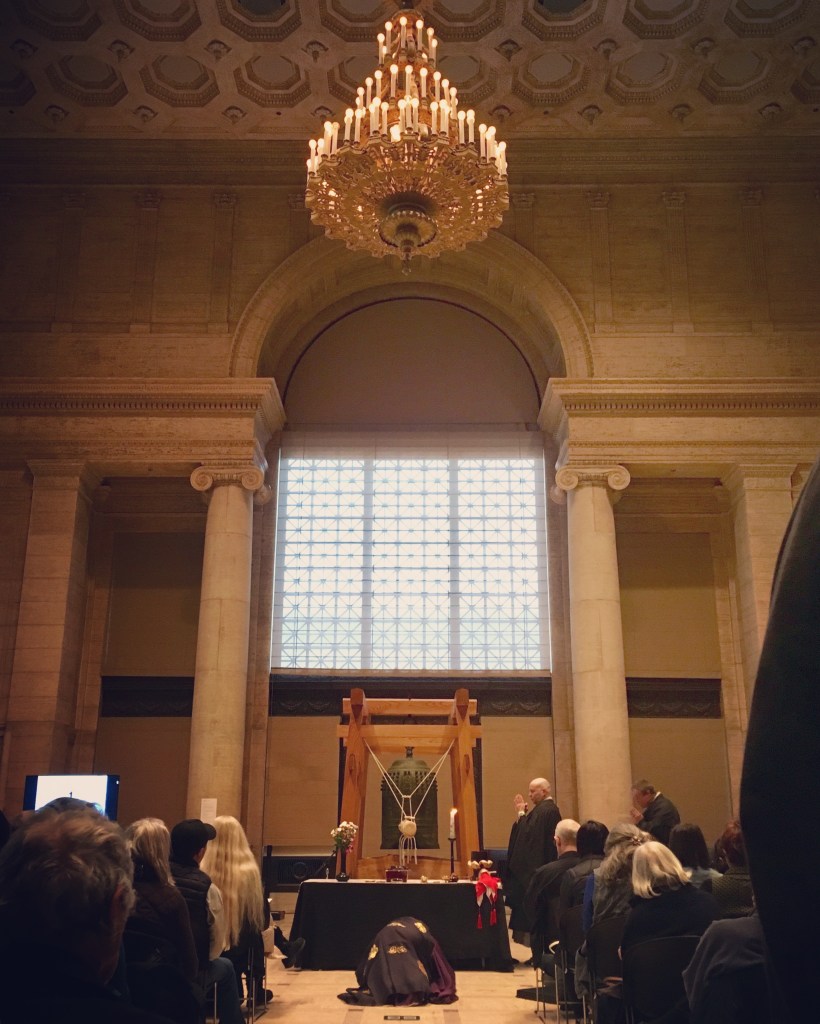
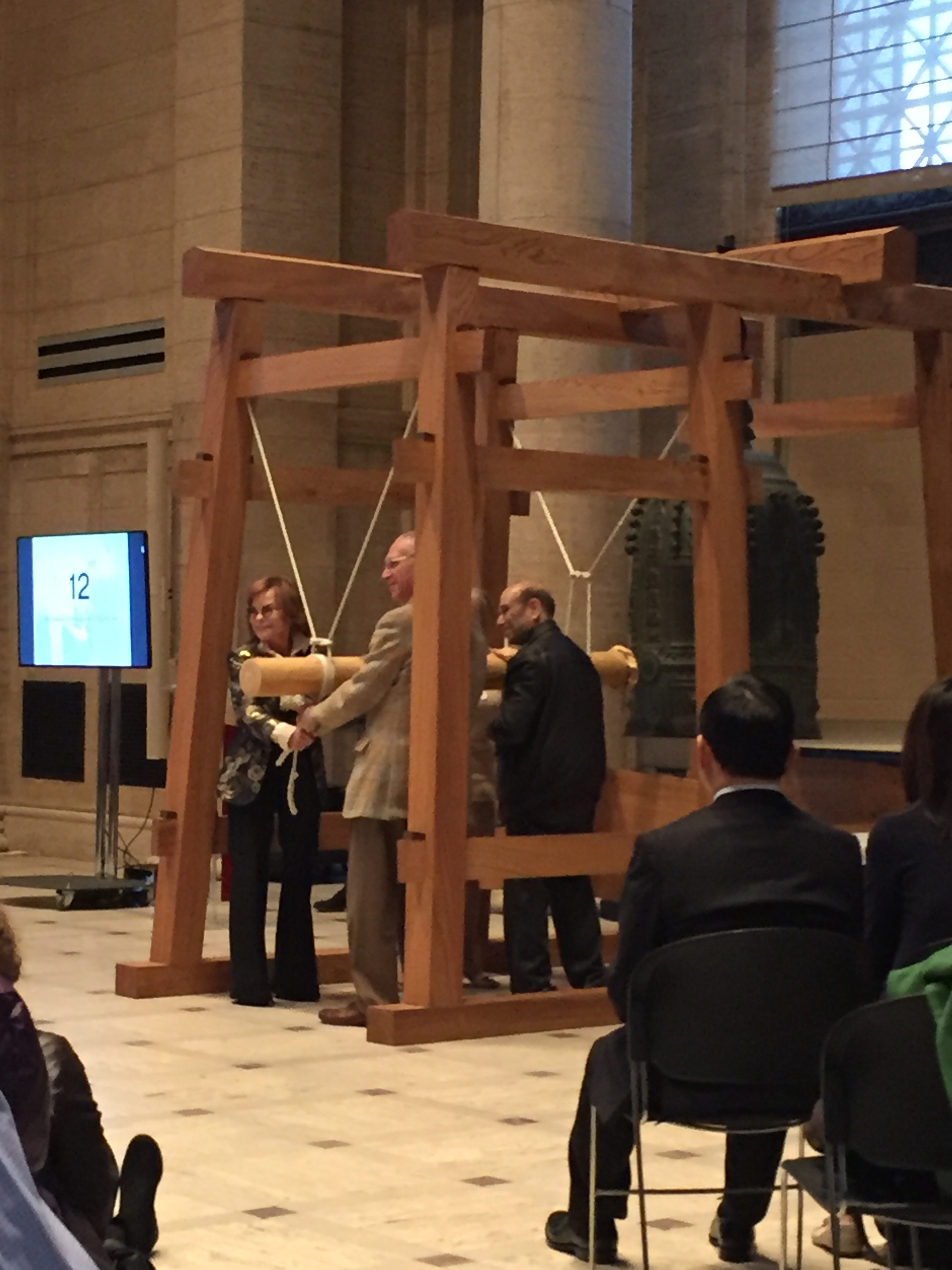
Yesterday in San Francisco (with very dear friends), we rang the Bonsho – the 16th Century Buddhist Temple Bell at the Asian Art Museum, symbolically eliminating darkness through the Joya ceremony, preparing to receive a bright new year of peace and happiness for everyone. The Buddhist priests at the ceremony wrote “ the deep and sonorous sound of the temple bell awakens people to the meaning of bussho – Buddha nature (intelligence, reasoning, and understanding) and wisdom – traits that are already within us.” May we all offer prayers for a peaceful 2019 awakening the good Buddhist nature and wisdom in us all.
For over two weeks, Northern California was wrapped in an apocalyptic blanket of toxic air caused by the raging “Camp Fire” in Butte County. The Camp Fire, the most deadliest and destructive fire in California’s history, burned over 150,000 acres. Drought, low humidity and high winds gave birth to a rapidly growing firestorm that took the communities of Paradise and Magalia by surprise destroying almost 14,000 homes and numerous habitats, claiming the lives of 88 humans and untold numbers of wild animals. Devastated by the losses, we wake soberly to the reality that Climate Change is here, now. Pretending is no longer a survival strategy.
Ironically, the desperately needed rain came with Thanksgiving, the shared holiday commemorating our nation’s beginnings; a day when we count our blessings and say thanks for all we share with our family, our friends, and our community. We have so much to be grateful for such as clean air and fresh water…..and there is so much we take for granted. But no longer. We can no longer ignore our impact on Earth, and shut our eyes and ears to the change the planet is experiencing. Clean air and fresh water are gifts that must be cherished instead of being trampled through our choices and ignorance. Climate is changing as a result of our actions, and animals and plants we assumed would share this planet with us forever are becoming extinct. Climate Change is real. On Friday November 23, 2018 the day after Thanksgiving, the U.S. Government released the Fourth National Climate Assessment reported by the San Francisco Chronicle:
Global warming is intensifying and will result in more disastrous fires, like the ones that have ravaged California, and other weather catastrophes unless governments act now to reduce carbon emissions, according to a stark new assessment of the impact of climate change…the 1,656-page analysis was unambiguous that climate change is here and getting worse. It said warming temperatures, melting ice, rising sea levels and fire are likely to take a terrible toll on the U.S. economy, reducing it by as much as 10 percent by century’s end that would mean annual losses of hundreds of billions of dollars by the end of the century from heat-related deaths, sea level rise and infrastructure damage.The impacts of climate change are already being felt in communities across the country.”
Humans have a great capacity for self-knowledge, but with this knowledge comes responsibility. And so we must step-up to the challenge, and open our hearts and minds to bringing balance and respect to our relationship with the Earth, her plants and animals and perhaps most importantly bring balance and respect to our relationship with our own self. With respect, for others and for ourselves, we can create solutions good for the many; without respect, we will sow the seeds of our own destruction.
Aspens, trees of life, sketched at Lundy Canyon. Robin L. Chandler, 2018.
Last Saturday morning – October 27, 2018 – I was standing on the rim of Panum Crater at the edge of Mono Lake looking across the long valley at John Muir’s “range of light” beginning to understand great fullness is found in the emptiness.* My dear companions were scrambling joyously across the rock and ash, relishing the beautiful obsidian and pumice fragments, shattered remains of a past volcanic event. Sadly, a text notified me of the tragedy befalling innocents worshipping at the Tree of Life synagogue in Pittsburgh over 3,000 miles distant. I kept the news to myself desiring my friends feel the joy of discovery, just a little longer. Looking West, I saw before me quaking yellow aspens dancing up the hillside along creeks fed by the alpine lakes Parker and Walker. A single perfect moment – shattered suddenly into a thousand fragments by the destruction at the Tree of Life. At the Eastern Side of the Sierras, we grasp our insignificance within the vastness of eternity, and realize the significance of our actions towards other living beings. May we all find healing, redemption, forgiveness and a mindful constructive path rising from the ashes of our volcano.
* “Before the emanations were emanated and the creations created, a most supreme, simple light filled the whole of existence. There was no vacant place, no aspect of empty space or void, but everything was filled by that simple, infinite light…what is called the light of the Infinite (Eyn Sof).” Luria, Issac. The Tree of Life (Etz Chayyim), Vol. 1. with an introduction by Donald Wilder Menzi and Zwe Padah, and ed. (New York: Arizal, 2008), p. 13.
“In a world without forest streams from which to drink, where shall I find forest streams from which to drink?”
From the poem In a World Without Forests by Dick Allen, Zen Master
Tramping alongside the Maacama, I rejoice to still find water flowing towards the Russian River. End of September, the air is dusty; golden fields are baked; creeks are typically dry; and the fear of fire haunts all of us who love California’s rolling hills and rivers. Almost a year ago, firestorms besieged Sonoma County, this beautiful place, displacing and forever changing the lives of humans and animals. I am grateful for all lives saved and mourn for all who lost their homes and loved ones. I am grateful for this yet babbling creek. The cup is yet half full. Little daylight remaining, a great blue heron soars by me settling alongside the quiet creek bank searching for the last catch. In the East, St. Helena soars, sheltering the vineyards below where harvest has begun. Equinox. I whisper a prayer “may we live in balance and at peace for one year more.”
“…experience has fallen in value…in every case the storyteller is a man who has counsel for his readers…counsel woven into the fabric of real life is wisdom. The art of storytelling is reaching its end because the epic side of truth, wisdom, is dying out.”*
“It is not the object of the story to convey a happening per se, which is the purpose of information; rather it embeds it in the life of the storyteller in order to pass it on as experience to those listening. It thus bears the marks of the storyteller much as the earthen vessel bears the marks of the potter’s hand…
[we] hold in our hands the scattered fragments of historical experience.” **
excerpts taken from Illuminations Walter Benjamin: Essays and Reflections, Edited and with an Introduction by Hannah Arendt
Borders deserve respect, but respect for asylum and respect for due process is deserved too. Danger lurks when we label others; people are not labels, they are human beings deserving dignity and respect. Human rights cannot be merely an abstraction, they must be the values by which we truly live every day. Human rights must be our primary colors; human rights cannot be whitewash. “The history of the Holocaust is not over. Its precedent is eternal, and its lessons have not yet been learned.”[1]
Taos, New Mexico is a beautiful place. Imagine a warm summer evening sitting by a creek that rolls quietly to the river Rio Grande; you feel the magic of water in the desert. Water grants life; renews life. So precious is a life. My mind’s eye travels miles in seconds. Looking down from the bridge that crosses the narrow Rio Grande gorge, I toss a pinyon branch and I watch it travel through the canyon by the pueblos on it’s journey to Santa Fe; and then at Albuquerque where the river flattens and widens and water birds play along the shore; and on past El Paso where the river becomes the border between Texas and Mexico – a shallow river – a place of crossings for wild things – those beings naturally wild, we call free and others made wild by violence and fear, tired, poor and hungry seeking relief and asylum. Precious lives. There is no need for brick and mortar; we have built a wall of fear.
Blessed am I able to freely sit and breathe and feel the special magic of a place. On this solstice day may the light shine and illuminate our way.
Happened upon the new Ry Cooder recording The Prodigal Son. It’s a good one. Keep thinking of the lyrics of his song Jesus and Woody inspired by Woody Guthrie’s song Jesus Christwhere Woody (writing in 1940) speculates modern capitalist society would kill Jesus too. Listen to Woody sing here on YouTube. Ry’s lyrics – singing from Jesus’ perspective – stick with me:
“so sing me a song ‘bout this land is your land’
and fascists bound to lose
you were a dreamer, Mr. Guthrie, and I was a dreamer too…..”
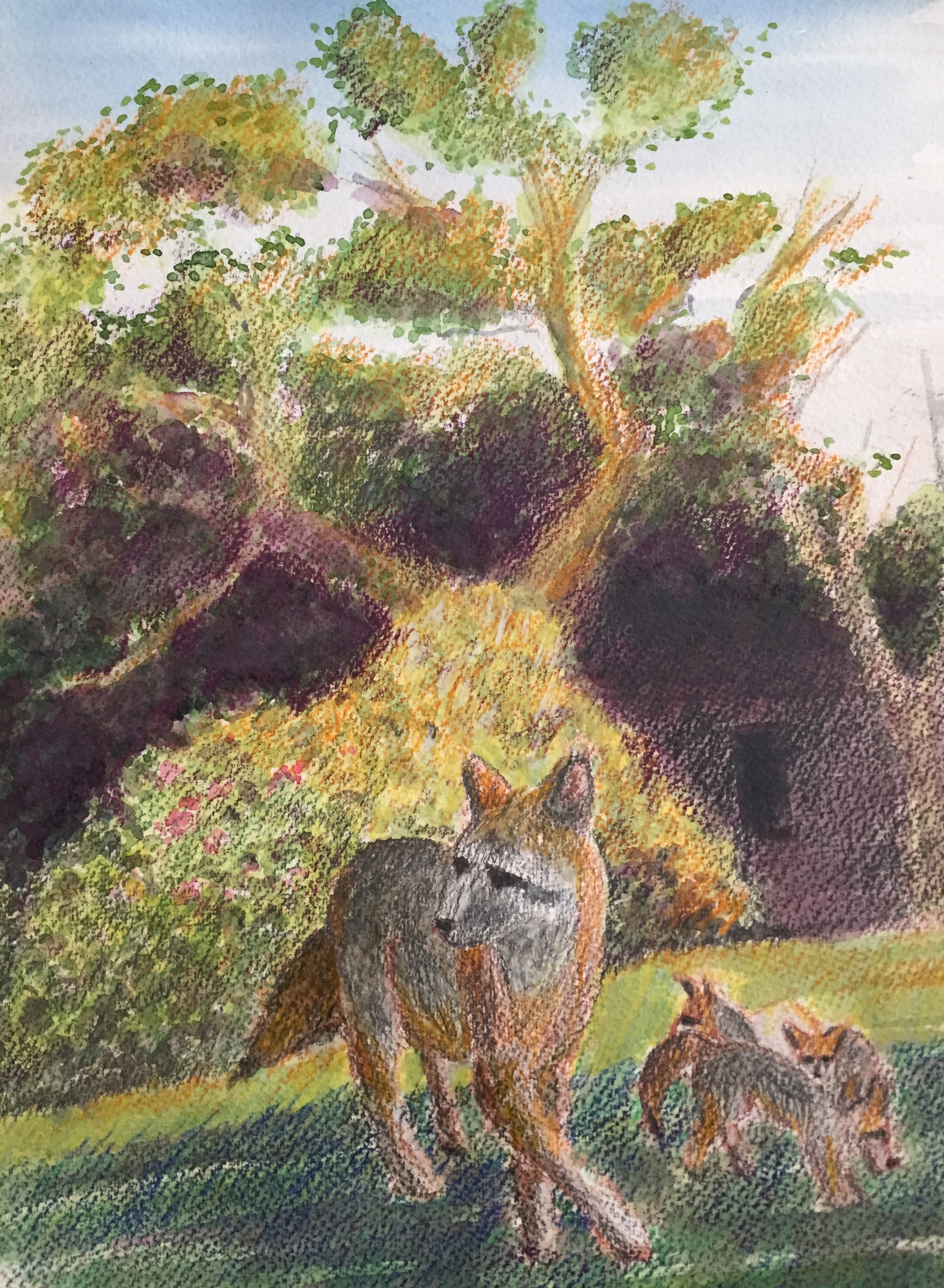
Foxes heading to their den at sunrise. Robin L. Chandler, 2018.
For the past week, I have slept little…my nights spent watching the family of Gray Foxes living underneath the old shed near my father’s house. Sleepy days give way to frenzied nights, as the three kits turn acrobat and lovingly and relentlessly tease their doting parents. I will always remember this trip to Texas and my new friends who opened doors in my dreams.
In Antoine de Saint-Exupery’s The Little Princethe fox gives important advice to the Prince:
“One only understands the things that one tames….men have no more time to understand anything. They buy things all ready made at the shops. But there is no shop anywhere where one can buy friendship, and so men have no friends any more… What is essential is invisible to the eye…It is the time you have wasted for your rose that makes your rose so important…[and] you become responsible, forever, for what you have tamed.”




 alive in the sea of information