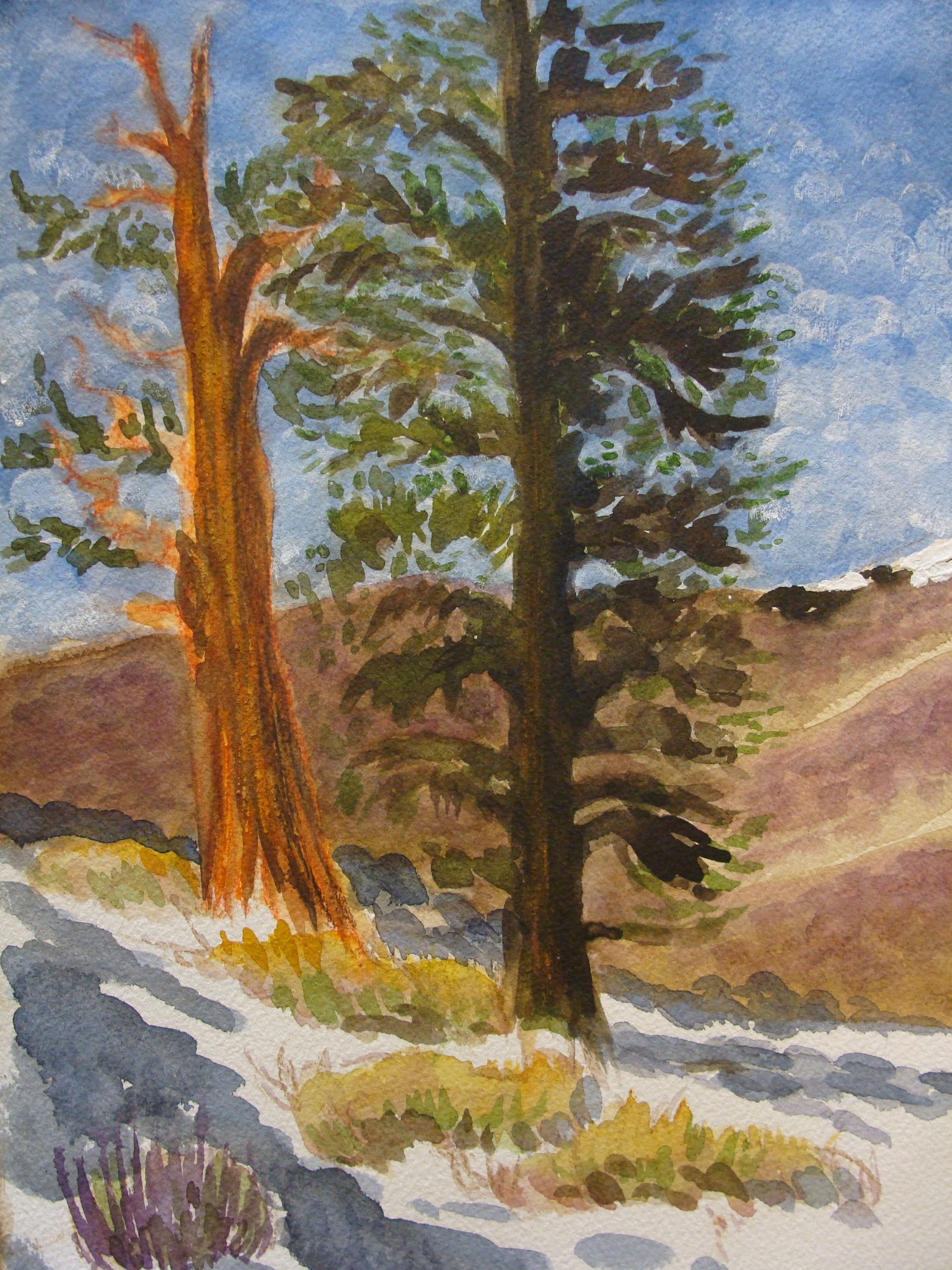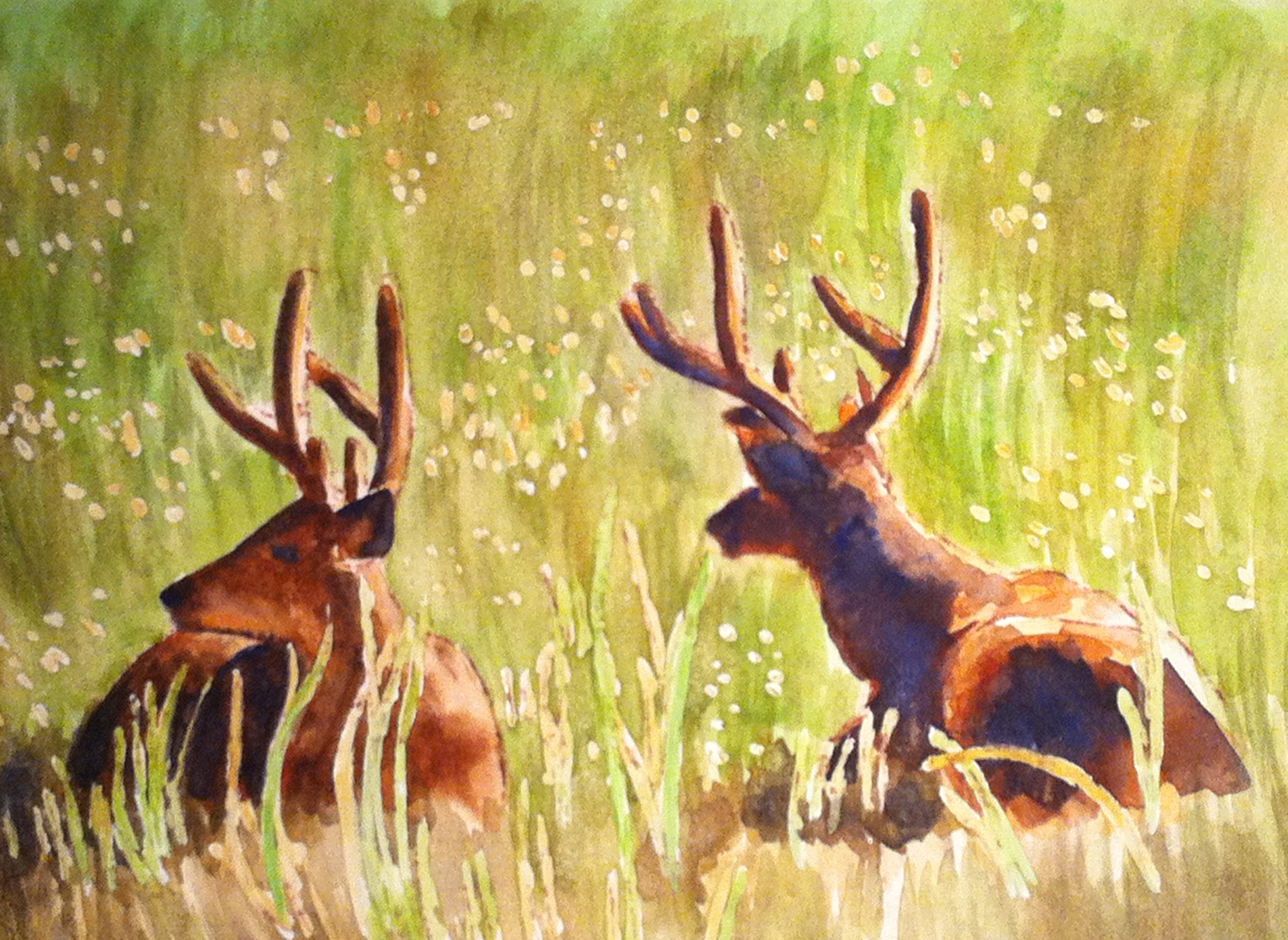
Young deer in the Santa Cruz meadow. Copyright 2013 Robin L. Chandler.
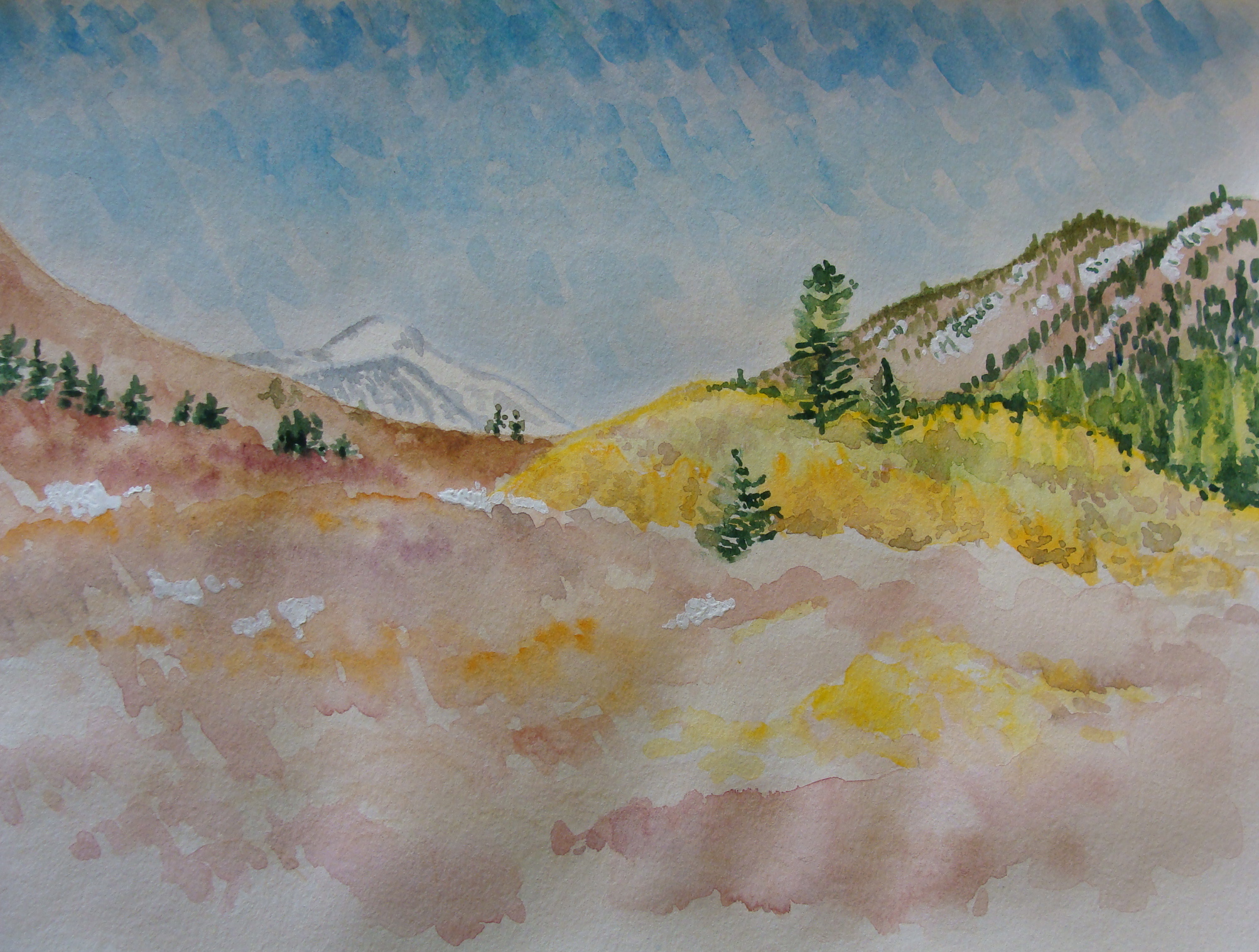
UC Santa Cruz is a special place; where else would you find a traffic sign flashing bright orange “be alert…deer crossing the roadway.” Cycling into work, I laughed lovingly acknowledging both the practical advice and the deeper meaning of mindfulness. Situated on a mountain overlooking the Pacific, the campus is replete with rolling meadows and coastal forests of tanoak, bay laurel, Pacific madrone and the regal Redwoods. An ecosystem intimately shared by animals, plants and people. After a quiet summer, September signals major events in certain campus populations: the academic cycle migration of homo sapiens and the advent of the breeding season for California mule deer. The traffic signal brings some needed intervention to manage the humans and deer inhabiting this space. All summer the bucks have roamed the meadows as a herd while their antlers grew big and strong preparing to compete for a mate. Next spring, fawns begin the cycle anew. Riding up the bike path through the thirsty meadow, I wonder from where the mountain lion watches these migrations and lifecycles. Will I ever see one?
Right mindfulness, an element of the Buddhist eight-fold path, teaches adherents to be alert, present, building awareness of the moment…the path to enlightenment. Earlier this year, I received a gift from the wife of a landscape painter whose work I greatly admire; she connected me to the work of Peter Matthiessen, Buddhist and writer of fiction and many well-respected books about the environment including the National Book Award winner The Snow Leopard. Trekking through Nepal with the ancient Buddhist shrine Shey Gompa on Crystal Mountain as their destination, Matthiessen and the field biologist George Schaller were seeking research data on the Blue Sheep and the Snow Leopard. Truly a book about his spiritual journey, Matthiessen finds the revered Lama of Shey who blesses him with a koan “Have you seen the snow leopard? No. Isn’t that wonderful!” Matthiessen writes “I feel great gratitude for being here, for being, rather for there is no need to hike oneself to the snow mountains in order to feel free. I am not here to seek the “crazy wisdom;” if I am, I shall never find it. I am here to be here, like these rocks and sky and snow, like this hail that is falling down out of the sun…the absurdity of a life that may well end before one understands it does not relieve one of the duty (to that self which is inseparable from others) to live it as bravely and generously as possible.”
It is the season when deer are on the minds of many. Last weekend we attended the fundraiser for the journal West Marin Review held by Point Reyes Books. Two great women poets read from their work: Kay Ryan and Jane Hirshfield and ironically among the many poems they read, they both chose to read works about deer. Selecting a poem from her book The Best of It, Ryan read “a buck looks up: the touch of his rack against wet bark whispers a syllable singular to deer; the next one hears and shifts; the next head stops and lifts; deeper and deeper into the park.” Hirschfeld choose a poem from The Lives of the Heart and read “a root seeks water. Tenderness only breaks open the earth. This morning, out the window, the deer stood like a blessing, then vanished.”
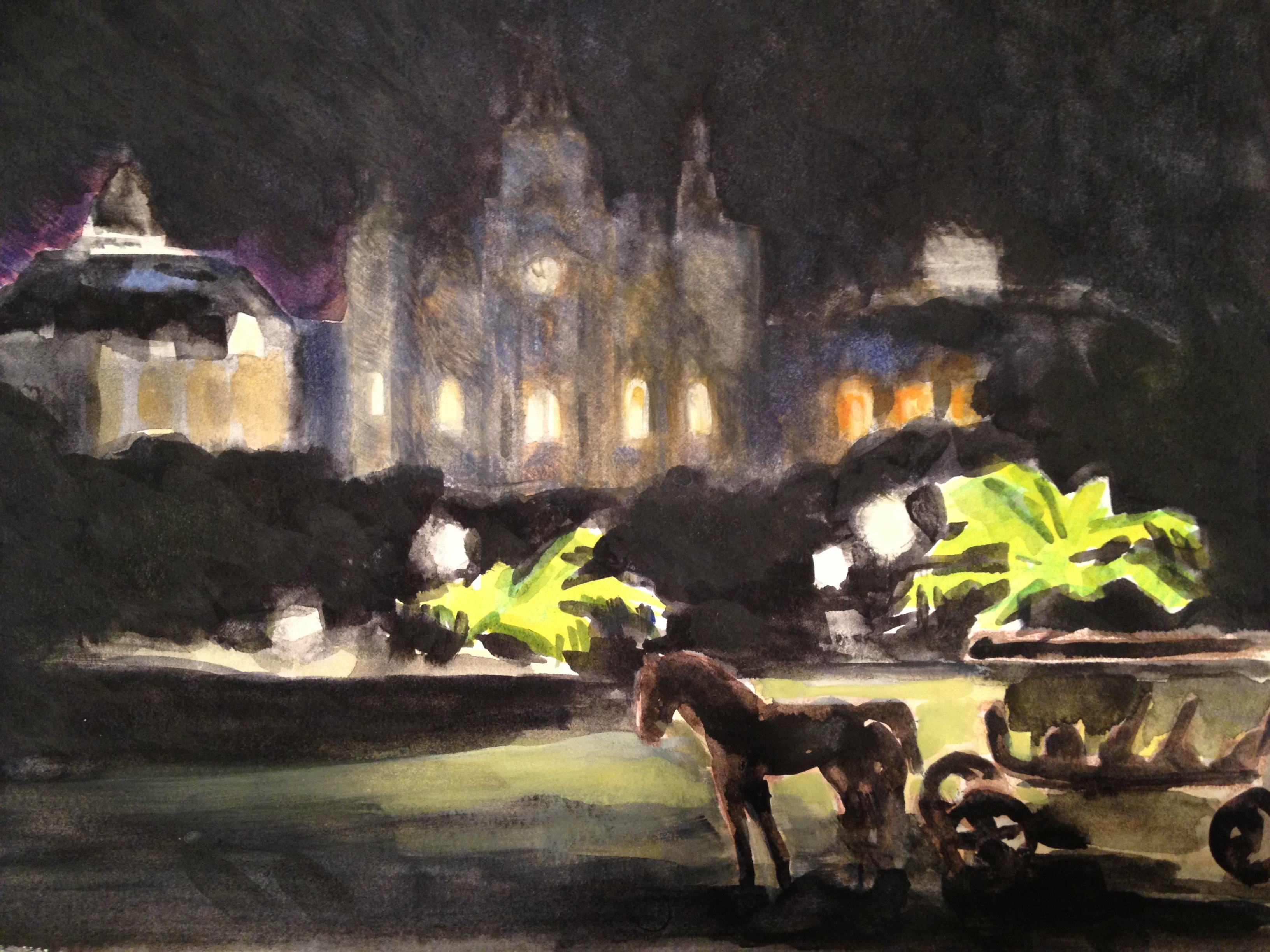
St. Louis Cathedral, Jackson Square facing the Mississippi River. Copyright 2013 Robin L. Chandler
The night was a feast for the senses. We walked into hot, steamy and packed Vaughns, everybody dancin’, greeted by Kermit Ruffin’s wailing St. James Infirmary. Dan Baum’s book Nine Lives: Mystery, Magic, Death and Life in New Orleans came to mind: “what lit Wil up inside was the music – a ship on the river sounding it’s horn across the Marigny, the clickety-clack of the trains along the Press Street tracks accompanied by the eighth-note ding-ding-ding of the signal lights at Dauphine…the music was all around him and inside him.”
New Orleans, Dan Baum writes, finds itself “perpetually whistling past the graveyard.” It is somehow fitting thatSt. James Infirmary, a blues single was first recorded by the New Orlean’s trumpeter Louis Armstrong in December 1928. St. James Infirmary is a death lament, rooted in a 18th century English folk song The Unfortunate Rake. This same ballad inspired the birth of the cowboy dirge the Street’s of Laredo, which in turn inspired Emmylou Harris and Guy Clark to write in memory of Emmylou’s father the poignant Bang the Drum Slowly. New Orleans jazz funeral bands accompanying a procession to the cemetery typically play dirges and hymns, slow sober songs like Nearer My God to Thee, Old Rugged Cross or St. James Infirmary. The lyrics of the three songs mashup well, a testament to their origin…went down to St. James Infirmary, saw my baby there, sat down on a long white table, so sweet, so cold, so fair…get six jolly cowboys to carry my coffin, get six pretty maidens to bear up my pall, put bunches of roses all over my coffin, roses to deaden the clods as they fall…bang the drum slowly, play the pipe lowly, to dust be returning, from dust we begin.”
In August 2005, just days before hurricane Katrina changed New Orleans forever, I attended the Society of American Archivist’s (SAA) annual meeting in The Big Easy. Eight years later the archivists returned to honor and engage with the life of this unique American city. The Quarter, six feet above sea level, experienced Katrina as just another hurricane, water rose, and it drained away. But the Lower Ninth Ward on the south side of the canal and below Lake Pontchartrain, was devastated when the levee broke, and an African-American community lay on it’s death bed and nearly passed away. Dan Baum described life across the canal in the Lower Ninth Ward in the mid-20th century as “heaven for newcomers from the country…the lots…big enough for chickens, pigs and even horses…neighbors understood each other…you took care of your family, sat on your porch in the evening, and went to church…a quiet country life right there by good waterfront jobs.” Change is the essence of life, and we must accept this truth. The Lower Ninth Ward will never regain it’s former self, but rebuilding is underway. Organizations like lowernine.org and Brad Pitt’s Make it Right Foundation are putting volunteer energy and funding into creating new homes for the Lower Ninth’s community members. Many archivists participated in SAA’s service day serving as volunteers with lowernine.org during the annual meeting; Bill Ross, Head of Special Collections and Archives at the University of New Hampshire where he teaches a class New Orleans: past, present and future, organized this opportunity working with Lowernine.
The last week of August 2013 my stepsister Linda died after a five-year battle with cancer. Linda was a wonderful person: devoted to her family and friends, fun, and smart…so smart. I know life is about impermanence, but the pain feels so permanent for those that loved her. And so many loved her; she was a much beloved daughter, friend, mother, and wife. Attending her funeral at the graveside in Texas, I remixed (again) and riffed on the lyrics of St. James Infirmary, Streets of Laredo, and Bang the Drum Slowly: let her go, let her go, god bless her…we beat the drum slowly and played the fifth lowly, and bitterly we wept as we bore her along, take her to the valley and lay the sod o’er her, for she’s a young cowgirl and she did no wrong.
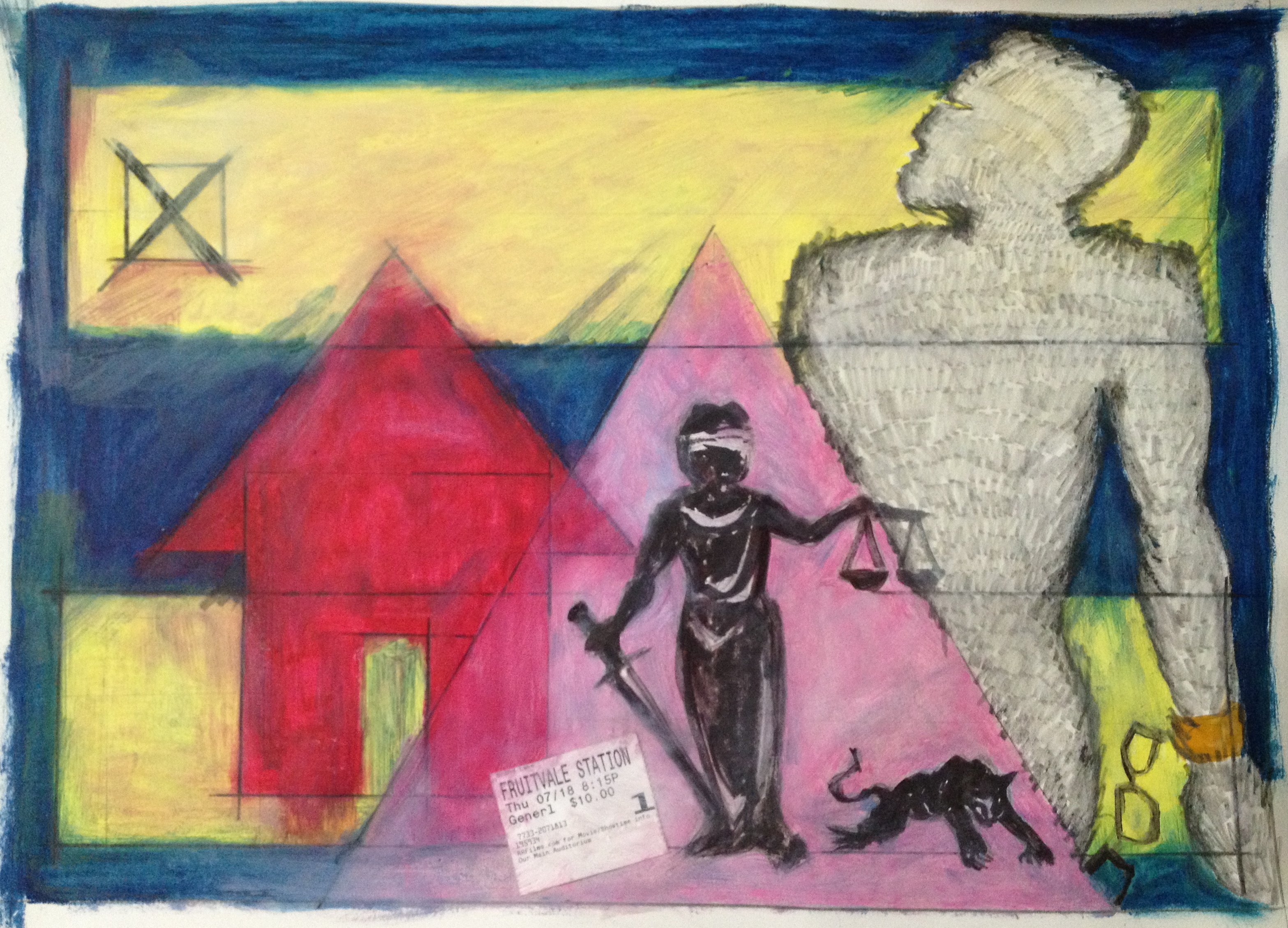
Freedom, justice and rights. Copyright 2013 Robin L. Chandler
Summer is typically the time for blockbuster movies and their sequels: Iron Man, Star Trek, X-Men; the list goes on. But this summer, you don’t need to go to the movies to participate in blockbusters and their sequels. History it seems is a series of blockbuster events with sequels, taking the form of declarations, laws, court-decisions, executive-orders, opinion-pages, blogs, marches, rallies, and the unfortunate loss of dialogue manifesting itself as gridlock, filibuster or most regretfully as violence and battlegrounds on the streets where we work and live.
Several anniversaries of blockbuster events concerning freedom, justice, and rights in our nation’s history occur this summer; some are annual rituals, others are commemorations of significant anniversaries. Juneteenth celebrated annually on June 19 commemorates the day slavery was abolished in Texas in 1865 as a result of Abraham Lincoln’s 1863 Emancipation Proclamation. The Stonewall Riots in New York’s Greenwich Village on June 28, 1969 were a series of spontaneous and sometimes violent demonstrations by members of the gay community (many of whom were angry and fed-up drag queens) protesting a police raid on gay bars. As a result gay rights organizations and newspapers were formed in New York and nationwide seeking civil rights for gay Americans. As a result, the first gay pride march was established in 1970, an event celebrated annually in cities throughout the United States and the world. July 1 – July 3, 2013 was the 150th anniversary of the Battle of Gettysburg considered by many historians to be the turning point in the Civil War, whose origins lay in contentions over the abolition or extension of slavery in the United States. July 4th is of course our annual commemoration of the adoption of the Declaration of Independence proclaiming all men are created equal, a statement universally adopted as human rights. On August 28th, our country will commemorate the 50th Anniversary of the March on Washington for Jobs and Freedom where in 1963 more than 300,000 Americans rallied at the Lincoln Memorial calling for civil and economic rights for African Americans; this march is credited for the passage of the Civil Rights Act (1964) and the Voting Rights Act (1965).
This summer has brought several poignant sequels to these litany of History blockbusters. On June 25, 2013, the U.S. Supreme Court struck down a key part of the 1965 Voting Rights Act, originally passed by Congress and signed into law by President Lyndon Johnson aimed at eliminating various legal strategies to prevent African Americans and other minorities from voting by preventing racial gerrymandering among other actions. The Court’s decision freed nine states mostly in the South, to change their election laws without federal approval. Justice Ruth Bader Ginsburg dissenting from the bench declared “the nation’s commitment to justice had been dis-served” Shortly after the decision, the State of Texas announced the voter identification law would be in effect immediately and that redistricting maps would no longer need approval.
On June 26, 2013 the U.S. Supreme Court supported gay rights with two decisions favoring same-sex marriage ruling the Defense of Marriage Act (DOMA) unconstitutional and the permitting a lower court ruling to stand that struck down the state of California’s Proposition 8 ballot initiative defining marriage as between one man and one woman. Practically, the decisions mean that married same-sex couples are entitled to federal benefits and by declining to decide a California case, effectively permitted same-sex marriages to occur there, increasing to thirteen the number of states permitting same-sex marriage. The Court did not say there is a constitutional right to these unions, and the ruling left in place laws banning same-sex marriage around the country. In expressing the majority opinion on DOMA, Justice Anthony Kennedy declared the law’s basic flaw was the “deprivation of liberty of the person protected by the Fifth Amendment.”
The blockbuster historical events and their sequels continue. Will we take part? To be measured, History must be made, and each of us has a role in History making. History can be made by forming our opinions through reading, thinking, and by voicing our opinions through word and deed. August 28th, 2013, Washington, D.C. will host the the 50th Anniversary of the March on Washington for Jobs and Freedom. Conferences and a rally will be held and a grassroots civil rights movement will be launched at 3PM that day called “63 Minutes of Peace.” 3PM was chosen, because that was the time Dr. Martin Luther King delivered his famous speech “I Have a Dream.” The idea is to take 63 minutes of your day to volunteer to help change someone’s world, be it mentoring a young person, aiding a homeless person, or participating in voter registration.” So, in some cases we have made progress, and in others, there is much work remaining to be done. In the end, we must progress forward; we must voice our opinions and take action to achieve freedom, justice, and rights for all persons.
Circuit M.T.G.: Yumiko Koshima, Adrian Turner and Darrell Morgan. Copyright 2013 Robin L. Chandler
“Check this out.” I listened closely as Adrian Turner queued up Poinciana by the Ahmad Jamal Trio. “It’s highly structured and orchestrated…the spaces deliberate, equal to the sounds.” In his book The History of Jazz, Ted Gioia wrote “Jamal was a harbinger of the future of jazz…his studied use of space influenced Miles Davis and anticipated the later work of Bill Evans…the charm of Jamal’s music came rather from his ability to maintain the swing, emotional conviction, and mood of his music even when playing the fewest notes.” Moments later, Adrian and his friends Darrell Morgan and Yumiko Koshima took up the bass, drums and piano, respectively, and the trio began the hard work of crafting their original compositions into a performance, inspired by the sparse, cool sounds of Ahmad’s piano and his colleagues Vernal Fournier on drums and Israel Crosby on bass (archival film footage of the Ahmad Jamal Trio in 1959 is available on YouTube). Three months later in June 2013 the trio – Adrian, Darrell and Yumi – now calling themselves Circuit M.T.G – are joined by saxaphonist Dereck Mclyn and vocalist Annabel Lee for an evening of jazz and dance called Prime Spirit at ArtShare L.A. (a sanctuary for the arts in downtown Los Angeles providing live/work lofts and spaces for performance and exhibition). Their music is sublime; inspired, I sketch while they perform. It is a perfect evening, and I hope the music never ends; it brings me such joy to experience my good friend Adrian’s art, and although I’ve only briefly spent time with Darrell and Yumi I feel connected to them by experiencing their love for and commitment to jazz.
ArtShare L.A. is near the Fashion District and a couple of blocks from South Central; the steamy hot day is coming to closure as the sun sets behind the high rises of Bunker Hill. There is historical context for jazz performance in this place. In his forward to Central Avenue Sounds, Steven Isoardi, a cultural history writer and oral historian states “from the 1920s through the early 1950s…Central Avenue, extending from downtown Los Angeles south through Watts, was the economic and social center of the black population of a segregated Los Angeles…at night it became a social and cultural mecca, attracting thousands of people from throughout southern California to its eateries, theaters, nightclubs and music venues…this nonstop, vibrant club scene produced some of the major voices in jazz and rhythm and blues and it was the only integrated setting in Los Angeles.” The book is based on excerpts from the UCLA Oral History Program’s interviews with musicians such as female trumpeter Clora Bryant (who played with Count Basie and Duke Ellington) and Buddy Collette (well known as a member of Chico Hamilton’s quintet). Looking West at the sunset for a moment I imagine the community, so vibrant in the years just before I was born, documented pictorially in Carolyn Kozo Cole’s Shades of L.A.: Pictures from Ethnic Family Albums and captured by Walter Mosley’s hero Easy Rawlins in a series of novels starting with Devil in a Blue Dress. Paraphrasing the historian Mina Yang, many factors played a role in the demise of Central Avenue: a downsizing post-WWII economy deprived many African-Americans of jobs; upwardly mobile black families were able to move out of South Central with the U.S. Supreme Court 1948 ruling making housing covenants illegal; and the merger of formerly segregated musician’s unions permitted black musicians to play in venues in other parts of Los Angeles. But for insight into the role police played in the destruction of the neighborhood read Yang’s article A Thin Blue Line down Central Avenue: The LAPD and the Demise of a Musical Hub.
Swanton Pacific Ranch. Copyright 2013 Robin L. Chandler
June and we are blessed again with strawberries. It’s after 5:30PM when I leave work, but the summer sun remains sky high moving towards the solstice. Driving north from Santa Cruz towards Davenport, the Pacific flashes brilliantly on this clear and hot day; along the coast farmers are irrigating their crops. The infinite horizontality brings mindfulness; the day falls away and clarity about the scheme of things returns. Listening to the Blessed Are album, and I find the Woody Guthrie track Deporteeand I softly sing with Joan Baez:
Is this the best way we can grow our big orchards? Is this the best way we can grow our good fruit? To fall like dry leaves to rot on my topsoil. And be called by no name except “deportees.”
Swanton Berry Farm is my destination. Founded in 1989 by UC Santa Cruz graduate Jim Cochran, Swanton’s is the first commercial organic strawberry farm in California; it is also the first certified organic farm in the United States to sign a labor contract with the United Farm Workers (UFW). The farm stand, where I purchase my two pints of bright red strawberries, proudly displays the UFW flag bearing the black eagle on a field of red. The UFW was formed as a result of Cesar Chavez’s organizing of Mexican-American and Fillipino American farmworkers to engage in boycotts, hunger strikes and strikes (all based on pacifism) to gain their rights. The successful 1965 Delano grape strike is the most famous effort. The strawberries are amazing; a delight to see, smell, and taste the sweet and tart delight grown in the sandy soils of the coastline routinely kissed by the sea air. Last year, when Irene Reti’s & Sarah Rabkin’s oral history Cultivating a Movement was published, I read about Jim Cochran’s sustainable practices. Jim described using the Brassica family of plants— broccoli, cauliflower and mustard greens— in crop rotation to improve soil health instead of traditional strawberry farming practices using methyl bromide and Chloropicrin to kill soil disease. At Swanton’s you will never see the plastic covering the fields of commercial growers, indicating chemical fumigation is underway.
This month is also the 38th anniversary of the California Agricultural Labor Relations Act that became law on June 5, 1975 giving farm workers the right to collective bargaining and ensuring “peace in the agricultural fields by guaranteeing justice for all agricultural workers and stability in labor relations.” The act allowed union organizers to meet with farm workers in the fields and for farm workers to select representation by unions such as the UFW to engage in collective bargaining to negotiate conditions of employment.
Strawberries. Copyright 2013 Robin L. Chandler
After purchasing my strawberries, I drive out Swanton Road a beautiful loop curving through the Swanton Pacific Ranch, crossing Scott Creek a riparian corridor for Coho Salmon and Steelhead Trout, and winding through forests of Redwoods, Douglas Fir, and Monterey Pine. Surfers say the waves where Scott Creek estuary greets the ocean are the same as Swami’s Beach in San Diego County. The Ranch is beautiful. The furrows nestled amongst the coastal ecosystem; mankind’s geometric abstractions seeking to tame the wilderness topography. Recently I learned about the plein-air painter Sheridan Lord whose inspiring works are with us in the book Things in Place. Sheridan’s farm paintings are pictures “of breathtaking simplicity: the whole surface is occupied by the towering sky and broad fields, which are separated by a mere strip of trees.” Lord’s paintings evoke the environmental writer Peter Matthiessen who quotes the Ojibwa people in his book Nine-Headed Dragon River writing “sometimes I go about in pity for myself, and all the while a great wind is bearing me across the sky.” Mindfulness is found in many ways: in a song, in a vista, in a painting, in a koan, or in a strawberry.
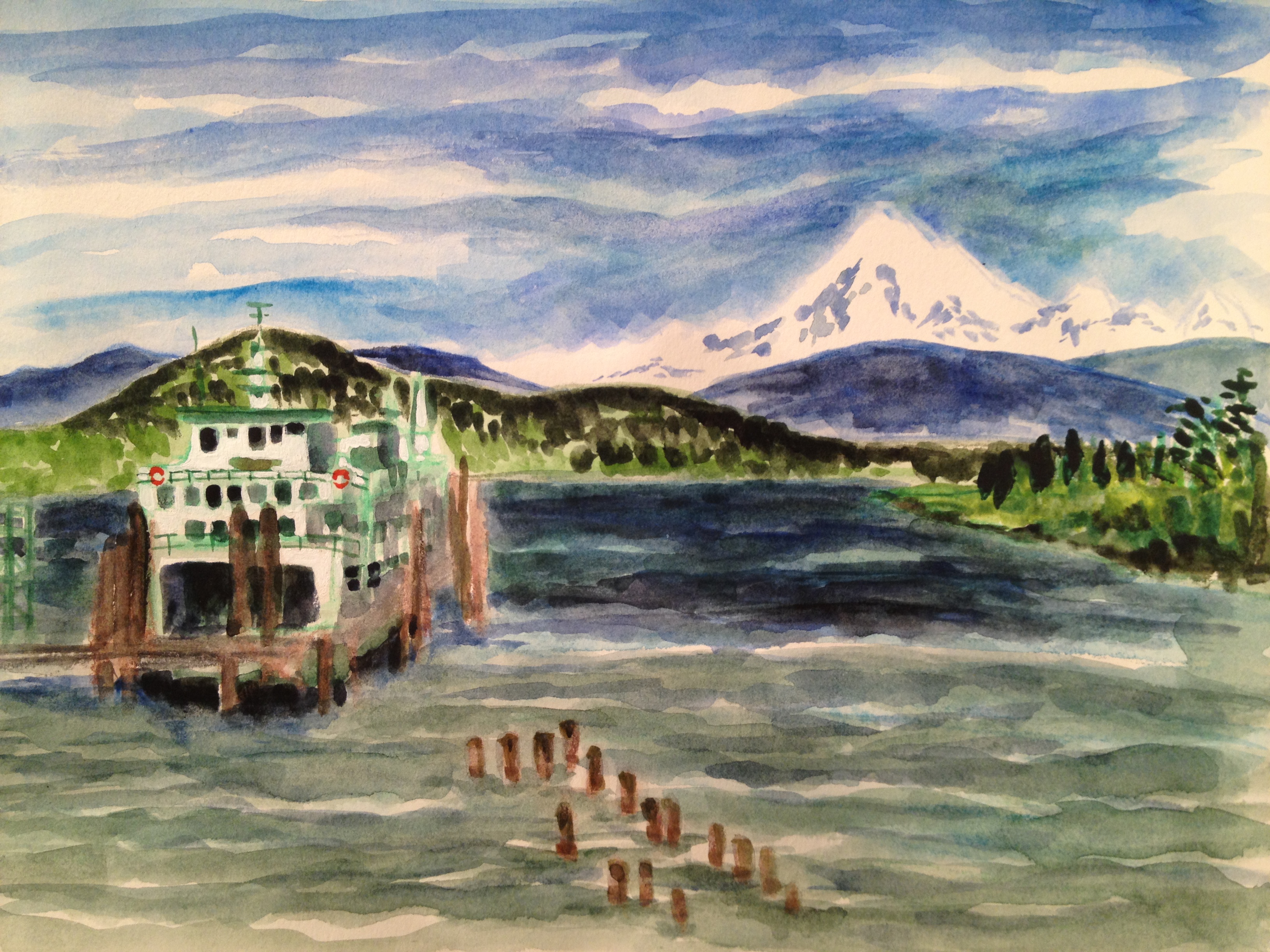
View of Mt. Baker from the Anacortes ferry landing. Copyright 2013 Robin L. Chandler
It’s spring on Orcas, in the San Juan Islands, and we are hiking from Cascade Falls via Mountain Lake to Mount Constitution; at the summit, the view of Mt. Baker across the sound is glorious. It is a day so hot and clear, that even Mt. Rainier, nearly 100 miles to the south, sheds the hazy cloak, granting a glimpse of inspiring wonder. The Pacific Northwest has a quality reminiscent yet distinct from the Grand Canyon. Looking across the vast expanse of Puget Sound, we are flotsam in time, humbled by the knowledge that our lives are defined by tides, wind and volcanism; at the Grand Canyon, we witness the passage of time humbled by the expanse of history portrayed by the simple act of water coursing the land. In these moments, when we glimpse our place in the scheme of things, we honor the greater forces at work on our planet.
On the trail, my feet seem to find every small cone shed by the Western Red Cedars populating this coastal forest;* the crunch seems deafening in the stillness. The air tastes salty, tinged by the scent of wood smoke, and the forest is quiet except for birdsong and the infrequent hiker or mountain biker. Rounding the turn, we discover a bald eagle perched on a partially submerged log near the shoreline, fishing. My friend whispers, “amazing to think that the removal of one chemical <DDT> from the environment made seeing this bald eagle possible.”
Today is Mother’s Day, a fitting day to honor women. According to Rebecca Solnit, in the early 1960s three women writers changed our thinking about the nature of authority and tradition in the world into which I was born: Jane Jacobs with The Death and Life of Great American Cities, Betty Friedan with The Feminine Mystique and Rachel Carson with Silent Spring. Jacobs assailed the postwar restructuring of cities resulting in suburbia; Friedan questioned the patriarchy of middle-class suburbia and the assigned gender roles of women; and Carson argued on behalf of ecosystems exposing fatal flaws in Big Science and industry’s broad stroke solutions. As Solnit describes in her essay Other Daughters, Other American Revolutions published in Storming the Gates of Paradise: Landscapes for Politics, Carson was “the first to describe the scope of the sinister consequences of a chemical society, the possibility that herbicides, pesticides and the like were poisoning not just pests – or pests, and some songbirds and farmworkers – but everyone and everything for a long time forward.”
Rachel Carson was able to communicate very technical information and inspire the general public to care about the environment. According to Solnit, Carson’s “book had a colossal impact from the beginning and is often credited with inspiring the DDT ban that went into effect nationwide in 1972. Though some now challenge the relationship between DDT and eggshell-thinning in species, wild birds from brown pelicans to bald eagles and peregrine falcons have rebounded from the brink of extinction since the ban.” Rachel Carson’s closing words say it best “the ‘control of nature’ is a phrase conceived in arrogance, born of the Neanderthal age of biology and philosophy, when it was supposed that nature exists for the convenience of man…it is our alarming misfortune that so primitive a science has armed itself with the most modern and terrible weapons, and that in turning them against the insects it has also turned them against the earth.” Thank you Rachel Carson; your “words are deeds.”** We honor your greater feminine force that gave us this bald eagle today.
* The San Juan Islands forest typically includes Western Red Cedars, Douglas Fir, Western Hemlock, Big Leaf Maples and Pacific Madrone.
** Lord Risley speaking to Maurice Hall from E.M. Forster’s novel Maurice.
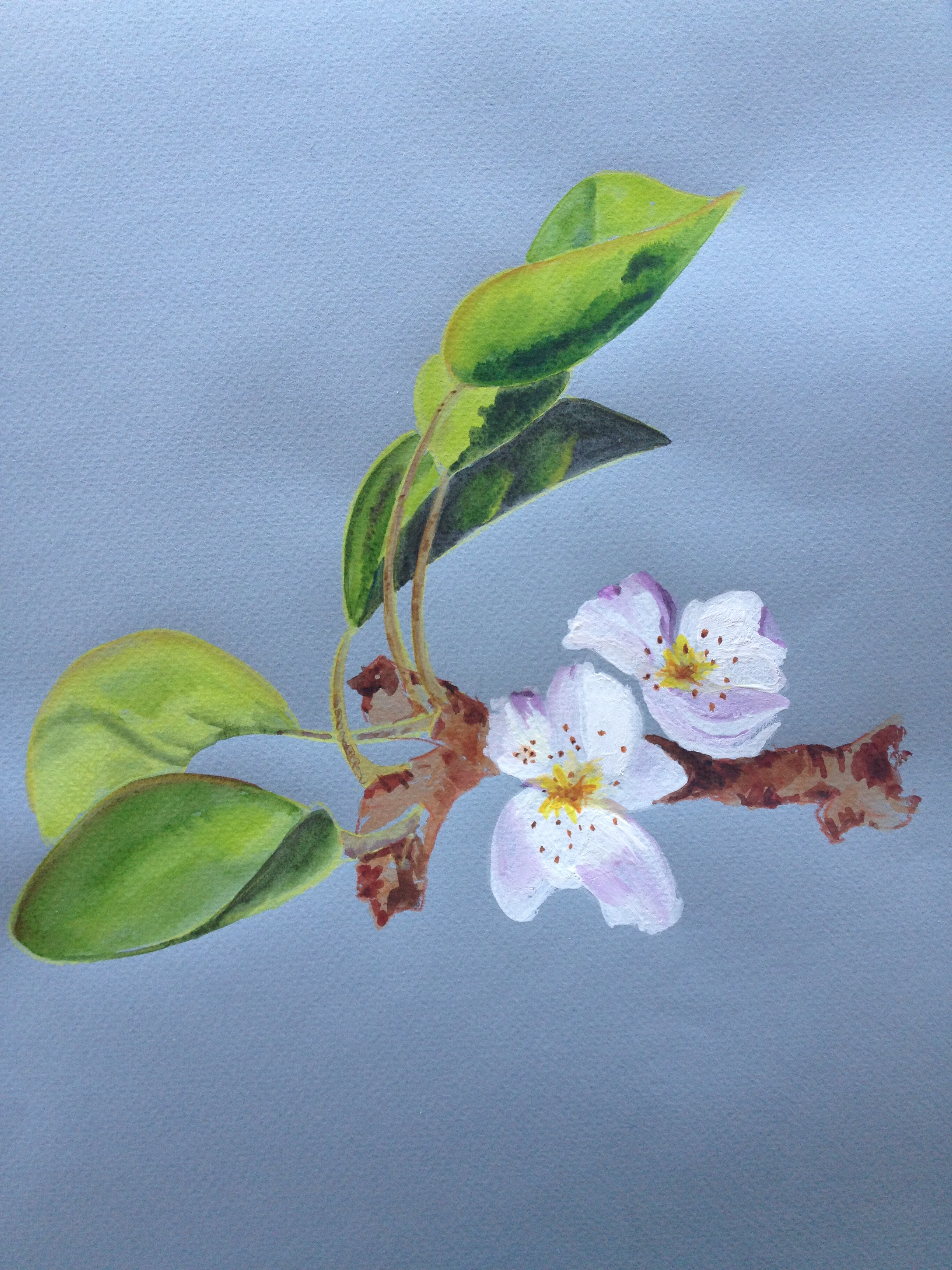
Asian pear blossom. Copyright 2013 Robin L. Chandler.
Winter Isa Lei,
Asian pear blossoms,
Ry and Bhatt by the River. *
*References the 1993 album A Meeting By The River, a collaboration by Ry Cooder and Vishwa Mohan Bhatt; the album contains the song “Isa Lei,” the Fijian song of farewell that Ry Cooder learned playing with the renowned Hawaiian slack-key guitarist Gabby Pahinui. I’ve been listening to Meeting By the River many mornings here in Santa Cruz while watching the beautiful asian pear tree in the garden outside my window greet the Spring.
Springtime. Cottonwoods and willow trees along Salado Creek, Texas. Copyright 2013 Robin L. Chandler
“The Rivers of Texas” is an old cowboy song that mentions fourteen rivers in the Lone Star state; Lyle Lovett recorded his version – The Texas River Song – on the album Step Inside This House. My good friend Bill tells me Townes Van Zandt also recorded this classic. This excerpt of lyrics comes courtesy of Verne Huser’s book Rivers of Texas:
“We crossed the broad Pecos and we crossed the Nueces, Swam the Guadalupe and followed the Brazos; Red River runs rusty; the Wichita clear. Down by the Brazos I courted my dear…The sweet Angelina runs glossy and glidey; The crooked Colorado flows weaving and winding. The slow San Antonio courses the plain. I will never walk by the Brazos again.”
Nomadic by circumstance, or maybe I just like driving, I am on the road again, speeding northward into the oncoming night from San Antonio towards Austin and Waco. I laugh out loud recalling an essay in High Country News by John Daniel; in A Word In Favor of Rootlessness he wrote “marriage to place is something we all need to realize in our culture, but not all of us are the marrying kind…it makes me very happy to drive the highways and back roads of the American West, exchanging talk with people who live where I don’t, pulling off somewhere to sleep in the truck and wake to a place I’ve never seen.” Out my side window, I search for the “Old Yellow Moon,” Emmylou Harris and Rodney Crowell croon about on my CD player. Running north – south, I-35 intersects a series of rivers crisscrossing Texas roughly north-west to south-east; I catalog them in my mind: San Antonio, Guadalupe, Colorado and as I get closer to my destination the tributaries to the Brazos including the Leon, San Gabriel and Little Rivers and of course Salado Creek.
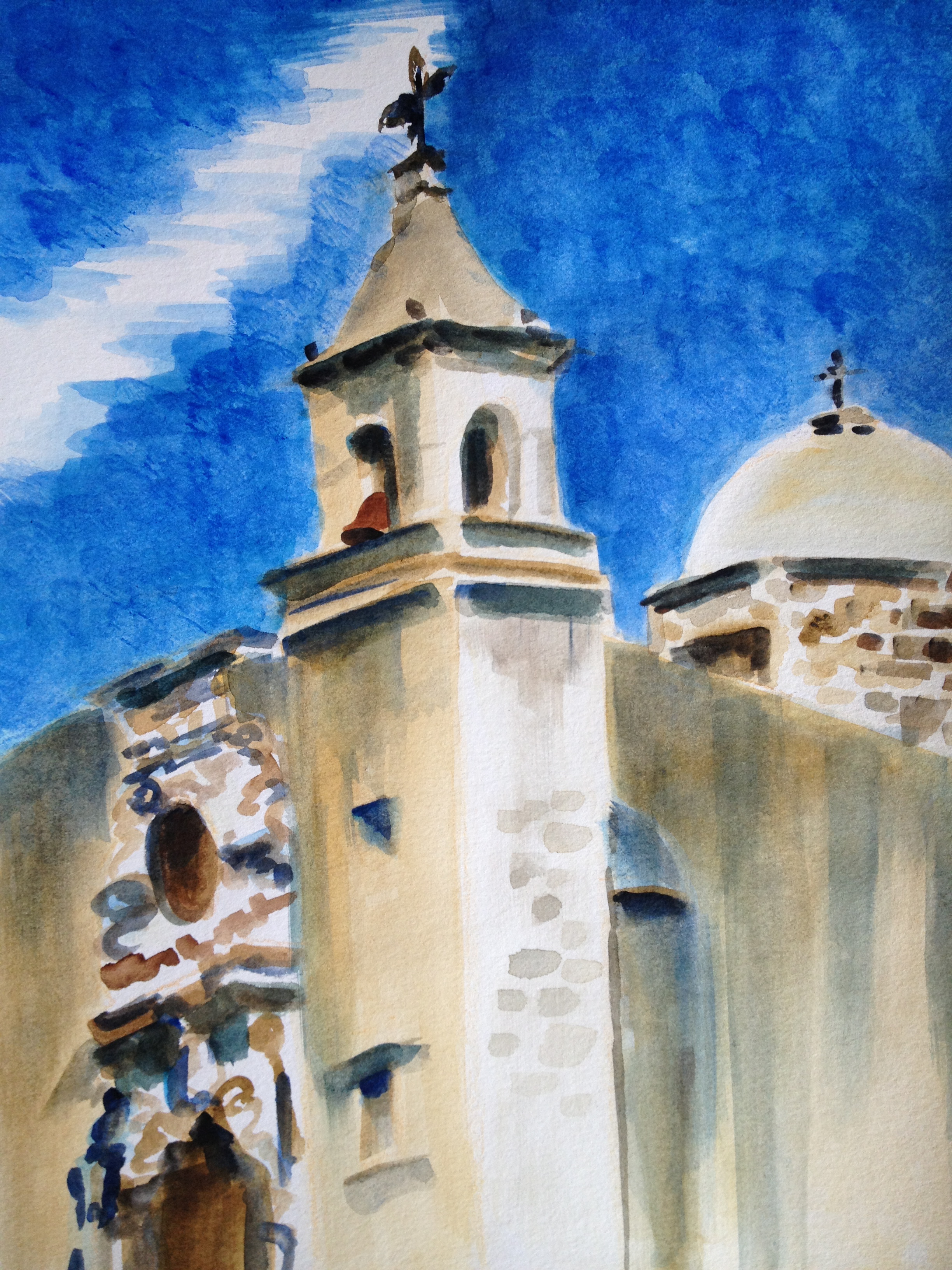
Mission San Jose, San Antonio, Texas. Copyright 2013, Robin L. Chandler.
This year, Texas like many places in the Western and Midwest United States is suffering from drought. Not enough rain is falling to soak into and heal the land, fill the reservoirs and aquifers and bless the riparian areas providing a respite to migratory birds and a home for wildlife along the streambeds. At the same time the demand for the life-giving water grows for agriculture, industry, and the expanding suburbs. In the thirty-some odd years I’ve been coming to Central Texas the population keeps increasing; more houses, more malls and with this expansion the burgeoning need for water. But this is not a new story. In San Antonio, I travelled parts of the San Antonio River Walk heading south to the Historic Missions National Park. Built in the early 18th century, close to rivers, the mission communities constructed dams and aqueducts to guide water for irrigating crops and powering flourmills. The Belton Lake Dam on the Leon River is a 20th century version of the mission acequias; Belton just provides a lot more water for a lot more people. The grandfather of Texas conservation, John Graves, wrote a book Goodbye to A River, published in 1959, now considered a classic about his late 1950s canoe trip down the Brazos River. The book is often cited as a major reason only a limited number of dams were built on the Brazos. The current drought places a strain on stored water supplies. But what can we do to make sure that there is enough water for all those who need it, including the native plants and animals? In the 13th Century, it is believed the Anazasi left the Colorado Plateau for the Rio Grande valley of New Mexico when extreme drought caused these peoples to abandon their homes. Where could we go?
Nomad that I appear to be, place and community do obsess me. Wherever I land, I want to understand the context of the place – the land and its people. I do not feel geographic detachment, but I realize this ability to move quickly from place to place comes at an expense. In Teaching About PlaceHal Crimmel published the article “Teaching About Place in an Era of Geographical Detachment.” Crimmel states “technology enables escape from any particular locale, accelerating the process of geographical detachment. In fact, living in place may have more to do with restraint than passion these days. Unprecedented access to distant energy sources, such as natural gas piped across the continent, and to mechanical or electrical technologies means people need not live within the ecological limits imposed by climate and topography.” I feel the contradiction deep in my bones; I hope my Prius buys me some credit when my judgement comes.
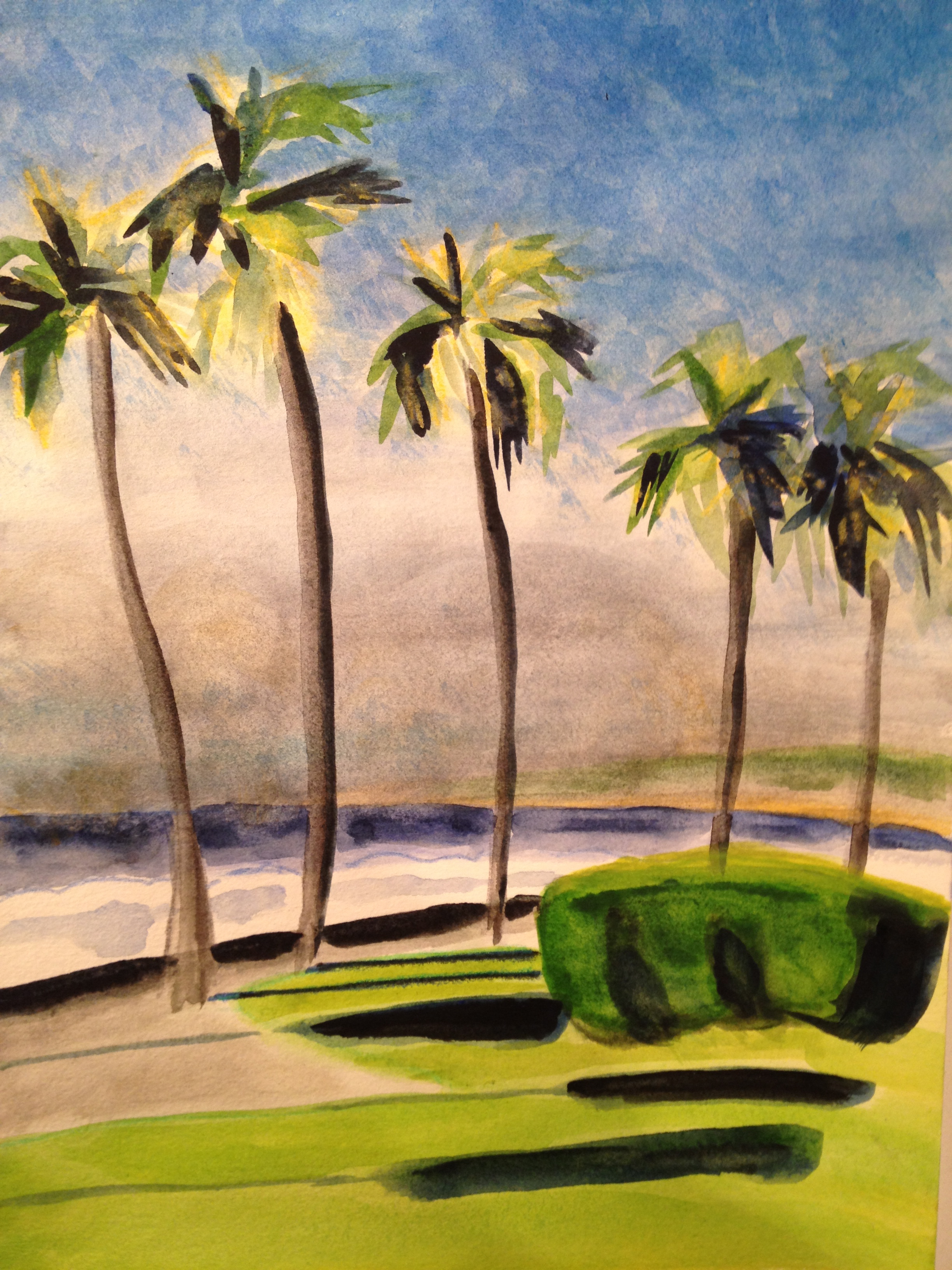
Ocean Park: La Jolla Shores. Copyright 2013 Robin L. Chandler
With our meeting finished, I took the opportunity to visit the beach near La Jolla Shores. Late in the afternoon on a beautiful spring day, I thought perhaps with luck I’d see the Green Flash, described in Wikipedia, as the optical phenomena that can occur after sunset for no more than a second or two. Emerging from the car, I was greeted by another kind of green flash. The angle of the sun this late in the afternoon brought dramatic lighting to the park by the beach. Rows of palms stretching towards the blue sky, cast dramatic deep shadows on the verdant green grass flashing before me. As I stood there, inhaling the sweet smell of the sea air touching the desert landscape, my eyes immediately focused on the dramatic colors and the strong verticals and horizontals. It was a beautiful moment – a quintessential moment when one feels blessed to be alive. Perhaps this kind of scene – my green flash – is what caught Richard Diebenkorn’s imagination inspiring him to create the paintings now known as the Ocean Park Series. Robert Henri’s words from The Art Spirit passed through my mind too: “the sketch hunter moves through life as he finds it, not passing negligently the things he loves, but stopping to know them, and to note them down in the shorthand of his sketchbook.” Would I be up to the task of sketching this scene? I decided it was worth the risk and that I would hold on to the basic elements that first intrigued me. Painting is like life, it is all to easy too get lost in the details. Try to find what is important – your magnetic north – and hold your course. As Henry David Thoreau wrote in Walden, “Our life is frittered away by detail…..simplicity, simplicity, simplicity! I say, let your affairs be as two or three, and not a hundred or a thousand.”
Hiking on the Bolinas Ridge Trail at the Geography of Hope. Copyright 2013 Robin L. Chandler
In his essay Thinking Like a Mountain, Aldo Leopold recorded the moment his ecological thinking evolved. “We reached the old wolf in time to watch a fierce green fire dying in her eyes. I realized then, and I have known ever since, that there was something new to me in those eyes – something known only to her and to the mountain. I was young then and full of trigger-itch; I thought that because wolves meant fewer deer, that no wolves would mean hunter’s paradise. But after seeing the green fire die, I sensed that neither the wolf nor the mountain agreed with me.”
Leopold spent a lifetime as a forester, a professor and an environmentalist developing his ideas and perspectives on the ethics of nature and wildlife preservation. Ultimately, his philosophy, evolving over years of observation and contemplation became known as his Land Ethic, which is at the core of his most beloved book A Sand County Almanac. Aldo Leopold joins Henry David Thoreau and John Muir as one of our three great American wilderness visionaries and writers.
This weekend March 15 – 17, 2013, Point Reyes Books (near Tomales Bay) is hosting its 4th Geography of Hope Conference entitled Igniting the Green Fire: Finding the Hope in Aldo Leopold’s Land Ethic. Typically held in March, these intellectual and spiritual gatherings are a gift to celebrate the coming of spring and rebirth encouraging us to think deeply about our relationships with the earth and our fellow living beings. At the conference’s center is the film Green Fire: Aldo Leopold and a Land Ethic for Our Time, a wonderful film directed by Steve Dunsky, edited by Ann Dunsky, written by Stephen Most and narrated by Curt Meine. It was announced at the conference that the film would be shown on PBS stations nationwide in April 2013.
Surrounding the film is a series of panel discussions with writers, thinkers and doers engaged the building of communities, the importance of stewardship and discussing our responsibilities to the land and to each other. One of the most compelling conversations has been with Michael Howard, Director of Eden Place Nature Center (part of the Fuller Park Community Development Corporation). Inspired by Leopold’s belief in the importance of community and the land, Michael Howard has built a park and a farm for the African-American community on Chicago’s South Side. “Eden” is in a place that was the former site of meat packing industry slaughterhouses, also polluted with lead poisoning which has impacted the ability of children to learn for generations. Howard deeply moved me with his work to try to persuade a people about the benefit of having a relationship with the land; a people whose daily concerns are about having money to pay bills and feed their children and who have spent years running away from a specter of linking the land to sharecropping and slavery. Michael Howard’s experience evoked for many conferee’s Paul Hawken’s Blessed Unrest about the emergence of non-profit and community organizations engaged in the environmental and social justice movement.
There is so much wisdom flowing from this conference, I will need days, weeks, perhaps a lifetime to really grasp and understand it all, and to see my thinking evolve as Aldo Leopold has demonstrated. But what rings clear and true is this: we need to understand that change is something that happens gradually, and it comes by engaging in deep listening, exchange with and respect for both humans and the land. We must learn to “think like a mountain.”