Snow storm at night along the Truckee River. Robin L. Chandler 2016.
Big flakes of snow melted on our faces as we cross-country skied, breaking trail on the ridge above Cold Stream Valley watershed. The soft quiet storm shattered by the sound of the train swiftly rolling up the mountain to Donner Pass. Joyous, we made our way through the meringue-like forest. Deep snow, grey sky, frozen blue pond and the charcoal scrawled tree scape now frosted, defined the sunless day.
Like thirsty pilgrims arriving at a well after a long journey, we gave thanks, knowing each snow filled hour meant sustained water for drought stricken cities and fields. Magnetized, we were drawn to the snow, both day and night, awestruck by this magical and rare occurrence. Never again taken for granted. A midnight stroll found us by the bank of the Truckee, laughing in joy, as the river, roared her song into the night, balance restored. In the heart of darkness, the snow-covered landscape reflected warmth, restoring our parched souls.
John Muir wrote in My First Summer in the Sierra “measureless mountain days…days in whose light everything seems to show us God…the blessings of one mountain day; whatever her fate, long life, short life, stormy or calm, she is rich forever.”
Winter softness shelters Yosemite Falls. Robin L. Chandler Copyright 2016.
We sat by the bedside of our departed loved one. Moments before dawn, quiet stillness all around, we listened for the spirit’s touch before it crossed the river.
Hours later in the granite cathedral of the spirit that is Yosemite, I sat before the falls along the Merced River and listened. The recent rains brought needed snow to the mountains, birthplace of the watershed, singing a welcome song of falling water to the Valley. In Siddhartha, Herman Hesse wrote “the river taught me how to listen…..the river knows everything; everything can be learned from it…..how to listen with a still heart, with an expectant, open soul, without passion, without desire, without judgment, without opinion.” Along the river, I heard the touch of farewell.
Eternity glimpsed from the Bay Bridge. Robin L. Chandler, Copyright 2016.
Cycling in the rain, while a bit hairy has great rewards. Riding the bike path on the Bay Bridge approach from Oakland to Yerba Buena Island suspends one in time and space. Rushing past, the wind filling my ears, I swear that was a glimpse of the great void in the corner of my eye. Perhaps, because of the recent deaths of cherished artists Alan Rickman and David Bowie, and the impending departure of a loved one, time and the measurement of our impact here on earth has been much on my mind. Western Civilization has bequeathed paradoxes to ponder and motivate us: reverence for eternity and a fascination with yesterday and yonder. Measuring, measuring, measuring, always measuring; how will we be judged by our peers or by heaven? Ungrounded measuring can mean endless suffering.
Lewis Mumford compared these paradoxes in The Golden Day. Describing the Middle Ages, Mumford wrote “medieval culture lived in the dreams of eternity: within that dream the visible world of cities and castles and caravans was little more than a forestage on which the prologue was spoken.” Characterizing the Renaissance, Mumford wrote “the first hint of change came in the Thirteenth Century, with the ringing of the bells…..as soon as the mariner could calculate his position in time and space, the whole ocean was open to him…..time and space took possession of the European’s mind. Why dream of heaven or eternity?…..outside the tight little world of Here and Eternity, they were interested in Yonder and Yesterday…..”
Reaching the end of the bike path, I dismounted and looked at the southwest vista. Thanks to Descartes‘ Cartesian coordinates, my position in time and space could be plotted, but where was I? Late afternoon, hundreds of cars rushed by, racing time, creating a thunderous enveloping sound. The grey twilight descended. Mortality, ageing and death are inescapable. All is impermanence, but acknowledgement is the first step on the Middle Way.
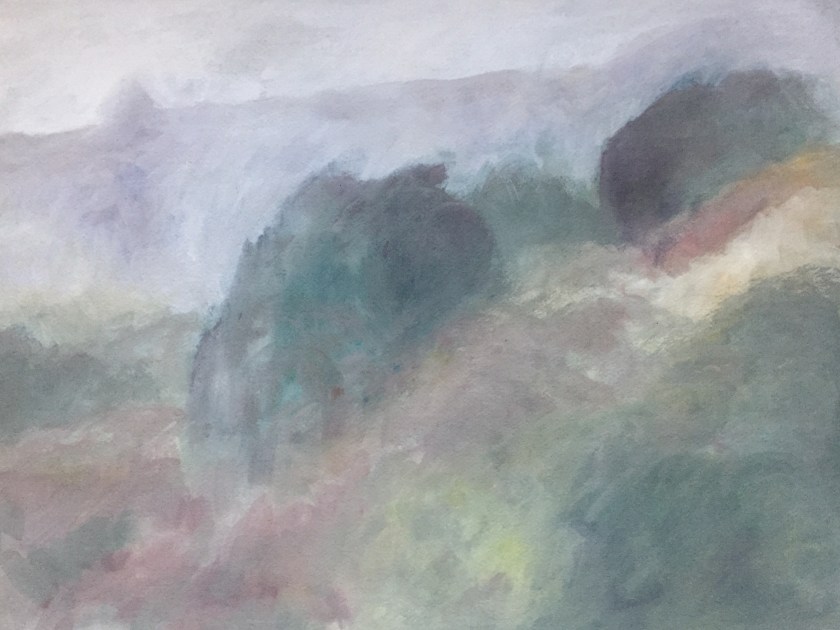
Laurel Canyon Trail, Winter rain. Robin L. Chandler Copyright 2016.
Rainy days are magical. Swaddled by the silvery mist, the grey-like sound of the hoot owl haunted the coastal live oak and eucalyptus forest of the East Bay hills near Oakland. Enchanted by the muted colors and subdued sounds we hiked the muddy Laurel Canyon trail. Twelve hundred feet above the sea promises a fair prospect. But reaching the hilltop, we found Wildcat Peak cloaked in a thick woolly rain cloud. Playfully, I imagined the peaks marking the compass points obscured by inclemency: Mount St. Helena (North), Mount Diablo (East), Mountain Hamilton (South), and Mount Tamalpais (West). Few hikers joined us on this cold, leaden day, but we found great warmth in our companionship and the grey solitude.
The artist and writer David Batchelor in The Luminous and the Grey surfaced the painter Vincent Van Gogh’s thoughts about the colour grey. Writing to his brother Theo in the 1880s, Van Gogh came to grey’s defence pointing to the “endless variations of greys, red-grey, yellow-grey, blue-grey, green-grey, orange grey, and purple grey…..it is impossible to say, for instance, how many green greys there are, it varies endlessly.” Continuing on this theme, Batchelor quotes the Bauhaus painter and color theorist Johannes Itten “[grey] is mute, but easily excited to thrilling resonances.” Batchelor opines “a small amount of any colour can and does transform grey…..into something subtle, complex and even thrilling.”
The Japanese poet Matsuo Basho describes this atmosphere – the solitude of grey – best with his haiku:
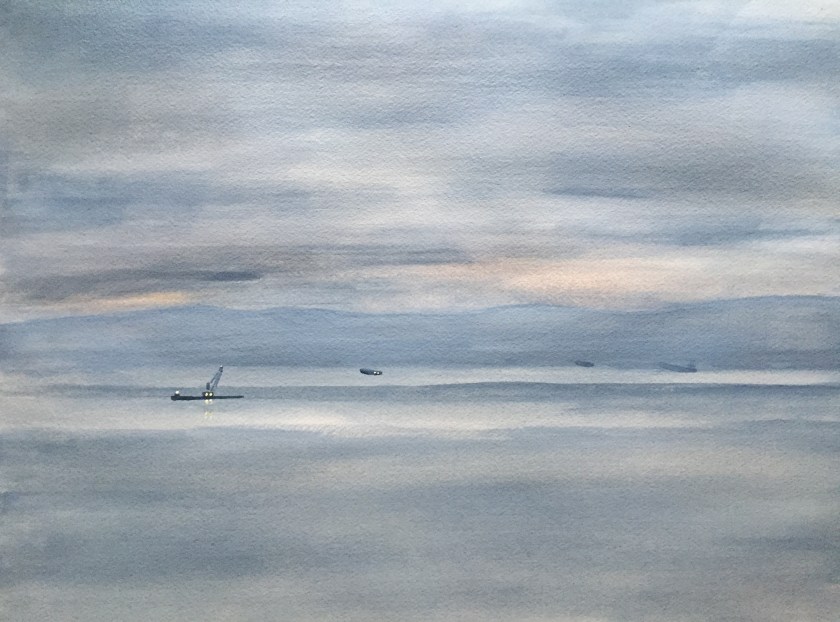
Cold December Dawn. Robin L. Chandler Copyright 2015.
The Society of Six, led by Selden Gile, part of the San Francisco Bay Area modernist art scene, painted plein air from 1917 to 1927. William Clapp, later Curator of the Oakland Museum and one of the Six, described their work as the intent “to produce joy through the use of the eyes.” After hiking short distances in the East Bay Hills or along the Oakland waterfront they painted small canvases that could be done quickly and “on the spot” creating a visual language defined by distinctive color and spatial relationships. Louis Siegriest, Maurice Logan, August Gay and Bernard von Eichman completed the close-knit group working from Gile’s cabin on Chabot Road, Oakland.
Led by the great artist Professor Anthony Dubovsky, our Visual Studies seminar Fall 2015, met weekly to discuss the Art History spectrum considering visual language, layers of meaning, and methods to organize expression. Mr. Dubovsky’s exhaustive knowledge of art and culture and the special insights provided by my fellow students, fueled our discussion to understand what is intentional and what is discovered in the artist’s creative act. Our goal was to grasp the diversity of visual language and nurture our own voice through individual art practice and group discussion. Tony introduced me to the work of Selden Gile suggesting the spontaneous plein air approach of the Society of Six might inform my art practice. The seminar experience was rich and priceless. Because of the seminar, I have renewed the exploration of visual language. What is my current painting vocabulary? It is time to let the painting speak for itself. Now, when I pick up my brush, dip into the paint, and connect with the canvas, I bring intent, and also the courage to let go. What will the painting be? What will I discover? I draw inspiration from the poet Paul Valery in Mauvaises Pensées et Autres: “the painter should not paint what he sees, but what will be seen.”
Winter rain has brought snow to our beloved Sierras and the sound of Yosemite Falls echoes like thunder through the valley! A welcome sound for our California beset by drought. Gradually hiking to Glacier Point from the valley, each switchback brought another gorgeous view of the waterfall. In his 1871 journal, John Muir wrote “as long as I live, I’ll hear waterfalls and birds and winds sing. I’ll interpret the rocks, learn the language of flood, storm, and the avalanche. I’ll acquaint myself with the glaciers and wild gardens, and get as near the heart of the world as I can.”
Captivated, I painted the waterfall the next day. Setting up my easel by the Swinging Bridge, I tried to capture the rainbow created by the sunshine striking the water falling earthward. The song of the waterfall, birds, and wind was all around, complemented by the sound of human language, as peoples from throughout the world came to visit and wonder at the beauty of this sacred National Park. Yosemite, the great sanctuary, the heart of the world, welcomes us all, makes brothers of us all, diminishing our fear, giving us peace in time of pain.
Dark, cold and grey comes the day as the sun protests for better working hours. The whiff of coffee wafting through the house persuades me to leave my blanket comfort. Jets flying 5,000 feet above, on landing approach, mean rain is coming. Finally.
Before leaving town, I drove over to my friend’s house to say goodbye and thank her again for the paddleboard adventure. My memories duly recorded of a beautiful November afternoon, the sun warm on my face as we glided on Elkhorn Slough off Monterey Bay. The wind picked up in the afternoon, bringing a slight chill. The breeze also brought waves rocking the board, challenging my core. Only my second time out on the board, I was still learning to balance…still learning to trust my ability to dance gracefully on a fluid surface, keeping time with water’s rhythms. Dancing the cha-cha, badly, with the wind and the waves. But when I relaxed, letting my mind and body live in the moment, I walked on the water.
Dogen meditates in his Mountain and Water Sutra “all waters appear at the foot of the eastern mountains. Above all waters are all mountains. Walking beyond and walking within are both done on water. All mountains walk with their toes on all waters and splash there.”
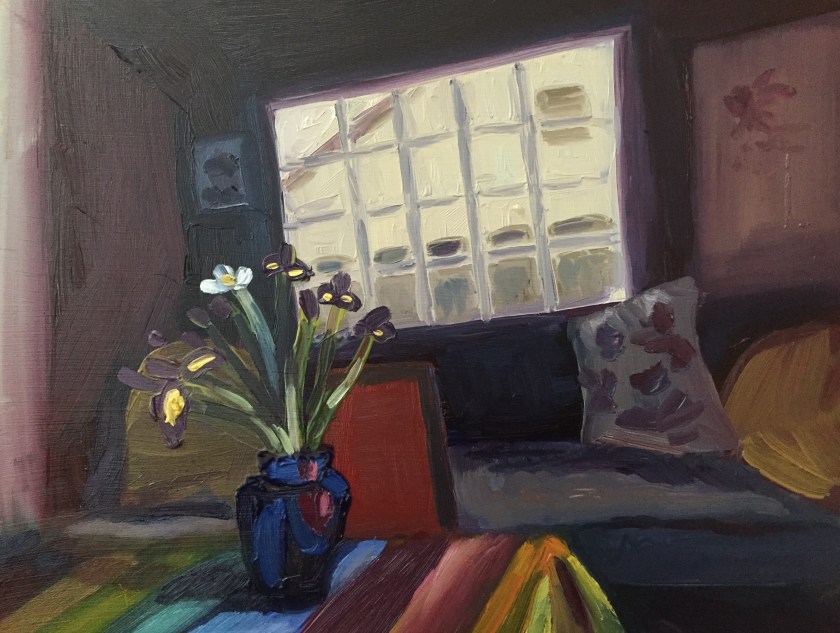
My friend was in the garden, cutting a single white flower, a dietes, a wild iris, from her garden, to place among the blue iris, waiting in the vase on her table. It was a beautiful juxtaposition: backlit, the iris emerged from the darkness, well situated on the tablecloth, a spectrum of colors. The image cried out to be painted in oil, but I am a watercolorist. With limited experience in oil paints, I have no trust in my abilities, in my mind and body to work together, no confidence that I could walk on water.
Gary Snyder writes in his essay Blue Mountains Constantly Walking published in The Practice of the Wild “there’s all sorts of walking – from heading out across the desert in a straight line to a sinuous weaving through the undergrowth. Descending rocky ridges and talus slopes is a specialty in itself. It is an irregular dancing – always shifting – step or walk on slabs and scree. The breath and eye are always following this uneven rhythm…the alert eye looking ahead, picking the footholds to come, while never missing the step of the moment. The body-mind is so at one with this rough world that it makes these moves effortlessly once it has had a bit of practice.”
So, I just said, just dive in, walking on water will come…with practice, and really, the journey is all that really matters. Diving into the deep end starts the learning. So, I painted with oil, the iris emerging from the darkness, well situated on the tablecloth, a spectrum of colors. So, I say, trust your mind and body, and never forget, the darker the night, the brighter the stars.
Search 1. Robin L. Chandler Copyright 2015.Search 2. Robin L. Chandler Copyright 2015.Search 3. Robin L. Chandler Copyright 2015.Search 4. Robin L. Chandler Copyright 2015.
They are often found by browsing. We find them in antique shops, or abandoned on that hard-to-reach shelf: forgotten. You can randomly encounter them preserved in an archival collection, displayed on a museum wall, or even in a digital library like Calisphere. The snapshot: a random glimpse of the world capturing someone you’ll never meet and a story you will never know. But yet, it draws us. We search for meaning. Vivian Maier’s street photographs come to mind. The composition, the lines, the color, or lack of, and the emphasis all conspire to spark the imagination and engage us.
Consciously or unconsciously made, art stands on its own authority; the artwork must exist successfully regardless of the creator’s context. The use of light, space, movement, rhythms, and textures must interact so compellingly that we gain insight on the human experience regardless of the work’s origin. The creator’s story can shape and enrich the work, but our engagement, that “snapshot” moment the work captures the viewer’s imagination, is the starting point. We want to understand the human experience. Can we solve the mystery?
The creation of and engagement with art is, among other things, a deep and personal search for knowledge, for certainty. It is a search for meaning. But this thirst for knowledge is a double-edged sword: overexposure can lead to wisdom or paralysis; underexposure to bliss or ignorance. Perhaps we must be both overexposed and underexposed to truly understand the meaning of being human. Understanding is not found in a single snapshot, but awareness is, and consciousness is a good place to start.
In Ten Windows: How Great Poems Transform the World Jane Hirshfield writes about the Heian era Japanese poet Izumi Shikibu stating [his] poem reminds its reader that the moon’s beauty, and also the Buddhist awakening…will come to a person, only if the full range of events and feelings are allowed in as well.