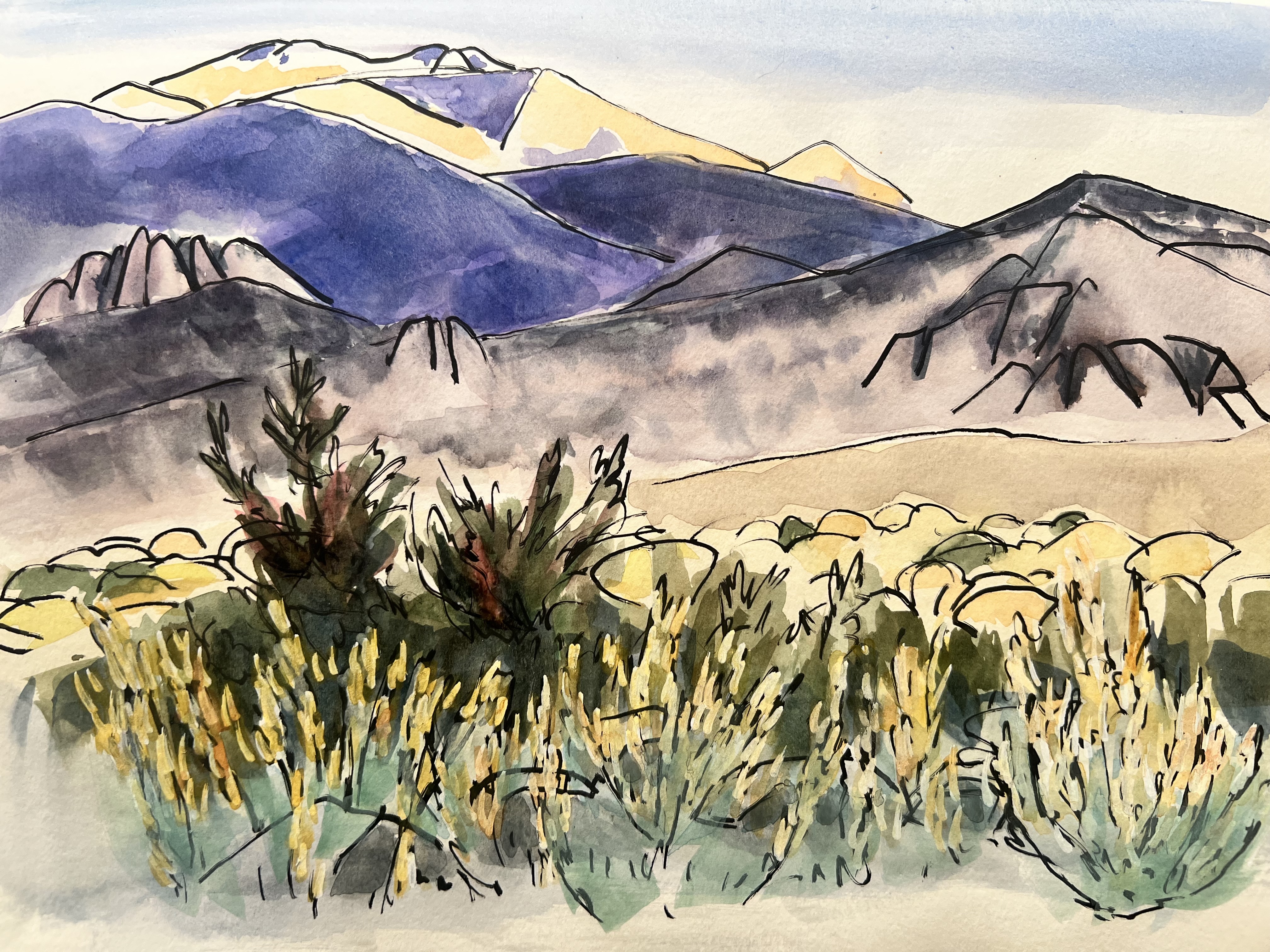
The Buttermilks Twilight. Robin L. Chandler, 2025
“Dürer was the first to take nature – a grassy meadow, for example, something completely mundane – and portray it. That kind of depiction hadn’t been done before. Until then, plants were always symbolic, like the lilies in a picture of the Virgin Mary. Earlier, each plant had a specific meaning. Dürer portrayed the meadow simply as a meadow – and that was completely revolutionary…..art doesn’t reside in nature as pure reality that you can depict directly. That doesn’t work anymore. Nature is no longer the innocent nature if once was…..
to make secretive is also to create a clearing in which something becomes visible, in which room for a new perception is created, but not in the scientific sense, in the mythological……
art brings all of the disparate kinds of knowledge into a new system. It brings this knowledge together and creates a unified view that must be constantly reinterpreted. It cannot be defined for all time…..
as a painter, one always hopes that under the surface, underneath what is visible, whether bricks or whatever, there’s something that will later mean more than what people see today. That is the veil…..that the painting already knows what will be in two centuries, what those looking at the painting will see in it in two hundred years. The veil of Isis can be a brick or a forest or whatever is painted and what is hidden beneath it is fed by the proceeding centuries but will also work in the centuries to come.”
Excerpt from Anselm Kiefer: In Conversation with Klaus Dermutz (New Delhi, India: Seagull Books, 2019) pps. 230 – 234

Twilight in a meadow in Bishop. Robin L. Chandler, 2025
 alive in the sea of information